
Hydrodynamic Backflow for Easing the Fermion Sign in Finite-Temperature Electron
Researchers have developed a hydrodynamic backflow method to ease the fermion sign problem, a major hurdle in quantum simulations of materials like graphene.
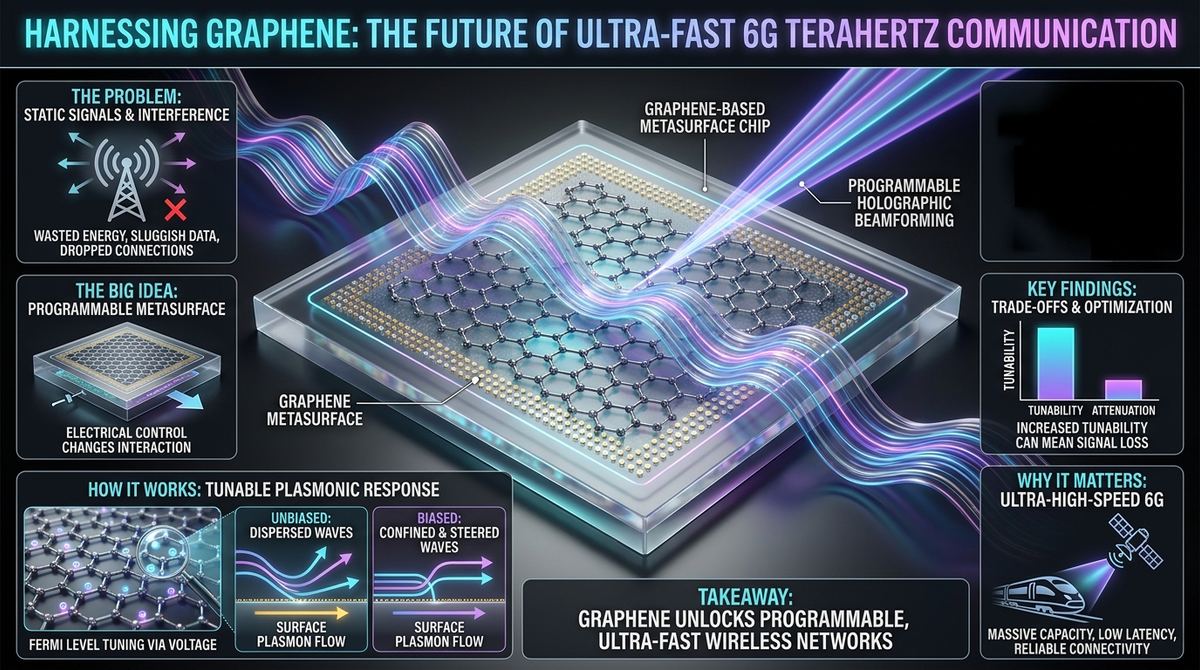
Imagine a world where your wireless connection never drops, even if you are traveling at hundreds of miles per hour in a high-speed train or flying through a storm in a drone. Currently, our mobile networks rely on radio waves that struggle to carry the massive amounts of data required by the next generation of technology. To solve this, scientists are moving toward the terahertz spectrum, a range of extremely high-frequency waves that can carry incredible amounts of information. However, these waves are notoriously difficult to control because they do not travel well through the air and are very hard to steer in a specific direction. This is where the magic of graphene comes in, acting as a programmable "smart skin" that can catch, shape, and direct these invisible waves with surgical precision.
As we move toward the era of 6G and 7G, the limitations of current wireless technology are becoming increasingly apparent. Traditional antennas are largely static, meaning they broadcast signals in a fixed direction, much like a standard light bulb that illuminates an entire room rather than focusing on a single point. This inefficiency leads to wasted energy and significant interference between different users. In a crowded urban environment or a high-speed satellite network, the inability to target a signal specifically toward a moving device results in dropped connections and sluggish data speeds.
Furthermore, the frequencies we need for ultra-high-speed communication fall into the terahertz gap. This is a challenging electromagnetic range where waves are easily absorbed by moisture in the atmosphere and require specialized materials to manipulate. Traditional materials used in antenna design are often too bulky or lack the agility needed to change their properties in real-time. As our reliance on autonomous drones, low-earth orbit satellites, and ultra-high-speed mobile networks grows, the industry faces a fundamental bottleneck: we need a way to steer high-frequency beams dynamically and efficiently without the need for heavy, moving mechanical parts.
The solution proposed by researchers Muhammad Mehmood Ul Haq, Fanuel Elias, and Sunday Ekpo involves using a revolutionary material called graphene to create something called a metasurface. Think of a metasurface as a highly advanced, ultra-thin sheet of material covered in microscopic, man-made structures called meta-atoms. Unlike a standard sheet of metal, this metasurface can be "programmed."
By applying a small electrical voltage to the graphene, we can change how the material interacts with electromagnetic waves. This allows us to control the phase, amplitude, and even the polarization of the signal. Instead of a light bulb that shines everywhere, a graphene-based metasurface acts like a high-tech laser pointer that can instantly shift its focus to follow a user, or split its signal into several different directions simultaneously. This process is called holographic beamforming, which uses the principles of holography to create complex, steerable patterns of light or radio waves.
To understand how this works, we must look at the unique physics of graphene. Graphene is a single layer of carbon atoms arranged in a hexagonal lattice. One of its most remarkable properties is its tunable plasmonic response. When terahertz waves hit the graphene, they trigger surface plasmons, which are collective oscillations of electrons moving along the surface of the material. These plasmons effectively "trap" the electromagnetic energy at the surface, allowing for extreme confinement of the signal.
The ability to control these plasmons is what makes the system so powerful. By changing the Fermi level of the graphene—which is essentially the energy level of its electrons—we can alter its electrical conductivity. This is achieved by applying a voltage through a gating mechanism. When the conductivity changes, the way the terahertz wave is delayed or shifted as it passes through or reflects off the graphene changes as well. This shift is known as the phase shift.
The researchers highlight several advanced methods for this manipulation. One is beam scanning, where the phase is changed across the surface to shift the direction of the reflected beam. Another is the Pancharatnam–Berry (PB) phase-controlled focusing. This is a geometric method where the shape and orientation of the meta-atoms on the metasurface are used to control the phase of circularly polarized light. By rotating these tiny structures, the signal can be focused into a tight, powerful beam without needing to change the material's conductivity itself. More advanced versions include dual holography and multi-spin holography, which allow a single metasurface to manage multiple different signals or polarizations at once, vastly increasing the amount of data that can be processed simultaneously.
This comprehensive review synthesizes a vast amount of data to provide an integrated, system-level view of how these devices function. The researchers analyzed how different materials and design choices impact the overall performance of the metasurface. They found that while graphene is incredibly versatile, its performance is dictated by a complex series of trade-offs. For instance, while increasing the tunability of the graphene allows for more precise beam steering, it often comes at the cost of increased signal attenuation, meaning the signal loses strength more quickly.
The review also investigated the use of hybrid materials, specifically combining graphene with Vanadium dioxide (VO2). VO2 is a material that can undergo a rapid phase transition from an insulator to a metal, and when paired with graphene, it can create even more efficient, ultra-thin metasurfaces. The researchers identified that the current state of the art is moving away from simply looking at a single component and is instead focusing on how to build a full, integrated system. They discovered that the ability to perform complex holographic beamforming is currently limited by how we control the electrical bias across the surface and the speed at which electrons can move through the material.
The implications of this research are profound for the future of global connectivity. If we can successfully implement graphene-based metasurfaces, the leap in network capacity will be massive. In a 6G environment, where billions of devices will need to be connected simultaneously with near-zero latency, the ability to steer beams with extreme precision is not just a luxury; it is a necessity.
For satellite networks, these metasurfaces could allow for much more efficient communication between ground stations and moving satellites. Instead of broadcasting a signal across a wide area and hoping it reaches the target, a satellite equipped with a graphene metasurface could "lock onto" a specific terminal on the ground, ensuring a stable and high-speed connection. For Unmanned Aerial Vehicles (UAVs), these surfaces enable high-speed, high-capacity links that can remain stable even during complex maneuvers. Essentially, this research provides the blueprint for the "intelligent transceivers" that will power the next generation of mobile, high-mobility, and high-capacity wireless technologies.
Despite the immense potential, the researchers are very clear that we are not yet at the stage of commercial deployment. Several significant technical hurdles remain. One major issue is non-uniform bias. To control a metasurface accurately, every single meta-atom needs its own precise electrical control. Currently, it is extremely difficult to apply a different, perfectly controlled voltage to millions of microscopic points across a surface. If the voltage is not uniform, the beam will be distorted.
Another critical limitation is carrier mobility. In graphene, electrons need to move through the material with as little resistance as possible to ensure high-speed operation. However, defects in the graphene lattice, impurities, or interactions with the substrate can cause electrons to scatter, slowing them down and generating heat. This reduces the switching speed of the device and limits its ability to handle the ultra-low latency required by 6G.
Additionally, there is the issue of attenuation and bandwidth. As we move to higher frequencies, the signals become increasingly fragile. The very process of manipulating the signal can sometimes absorb too much of it, leading to a weak output. Researchers are currently working on finding the "sweet spot" where the metasurface is highly tunable but does not significantly dampen the signal it is meant to steer.
The first major application will likely be seen in the infrastructure of 6G networks. Base stations equipped with graphene metasurfaces will be able to serve hundreds of users in a dense urban environment by creating individual, high-speed "data beams" for each user, significantly reducing interference.
The second application lies in the aerospace and satellite industry. As we move toward mega-constellations of small satellites, the ability to steer narrow, high-frequency beams from space to earth will be essential for providing high-speed internet to remote areas of the globe.
Thirdly, we will see these technologies integrated into high-speed transportation. Trains and autonomous vehicles will use these metasurfaces to maintain a continuous, high-bandwidth connection to the network, even while moving at high speeds, ensuring that autonomous navigation and real-time data processing remain uninterrupted.
If you remember only one thing from this research, let it be this: Graphene is transforming the way we control light and radio waves, turning flat surfaces into intelligent, programmable tools that can steer signals with incredible precision, paving the way for a future of instantaneous, high-capacity wireless communication.
What is a metasurface and how does it differ from a standard antenna?
A standard antenna is a physical object that radiates electromagnetic waves in a specific direction based on its shape and size. A metasurface is a flat, engineered surface composed of many tiny structures called meta-atoms. While a standard antenna is relatively fixed in its behavior, a metasurface can be dynamically tuned using electricity to change its properties, allowing it to steer, focus, or split beams on the fly.
Why is graphene specifically being used for this technology?
Graphene is a "wonder material" because it is incredibly thin—only one atom thick—and has unique electrical properties. Most importantly, its electrical conductivity can be precisely tuned by applying a voltage. This tunability allows us to control how electromagnetic waves interact with the surface, making it the ideal material for creating programmable metasurfaces.
What does "holographic beamforming" actually mean?
In this context, holographic beamforming refers to the ability to shape an electromagnetic wave into a complex pattern, much like how a hologram creates a 3D image from a 2D surface. By precisely controlling the phase and amplitude of waves across a metasurface, we can create highly directed and shaped beams that can follow a moving target or split into multiple beams to serve different users.
What are the biggest challenges preventing this from being used in your phone today?
There are several hurdles, including the difficulty of applying precise, individual voltages to millions of microscopic points on a surface, the loss of signal strength (attenuation) caused by the material itself, and the need to increase the speed at which electrons move through the graphene to ensure ultra-low latency. Currently, these technologies are moving from laboratory demonstrations to complex system-level designs.
How will this technology affect the internet of things and 6G?
As we transition to 6G, the number of connected devices will increase exponentially. Traditional wireless methods cannot handle the sheer volume of data and the need for constant, stable connections for mobile devices. Graphene-based metasurfaces will provide the high-speed, high-capacity, and highly efficient beam-steering necessary to support a world of billions of connected sensors, vehicles, and drones.
The transition toward terahertz-frequency communications is essential for the next evolution of digital connectivity. While the challenges of signal attenuation, carrier mobility, and complex biasing are significant, the potential of graphene-based metasurfaces is transformative. By moving toward integrated, scalable system architectures, researchers are laying the groundwork for intelligent, high-speed transceivers. This research marks a vital step in evolving from simple antennas to highly sophisticated, programmable holographic surfaces that will define the 6G and 7G era.
Serious about B2B integration? Test our premium Pulsed Electrical Resistive Carbon Heating turbostratic graphene in your lab. 100g sample packs available now.
Explore More
Researchers have developed a hydrodynamic backflow method to ease the fermion sign problem, a major hurdle in quantum simulations of materials like graphene.

Learn to build a prototype active graphene metasurface for mid-IR beam steering. This guide covers the materials, fabrication, and testing for LiDAR.

Researchers use the Generalized Beth-Uhlenbeck approach to model electron interactions in 2D materials, offering a new way to predict graphene's behavior.