
An Exact Solution for Electron Transport and Resistivity in the Hubbard Model
Researchers derived the first exact formula for resistivity in the 1D infinite-U Hubbard model, providing a crucial benchmark for understanding strongly...
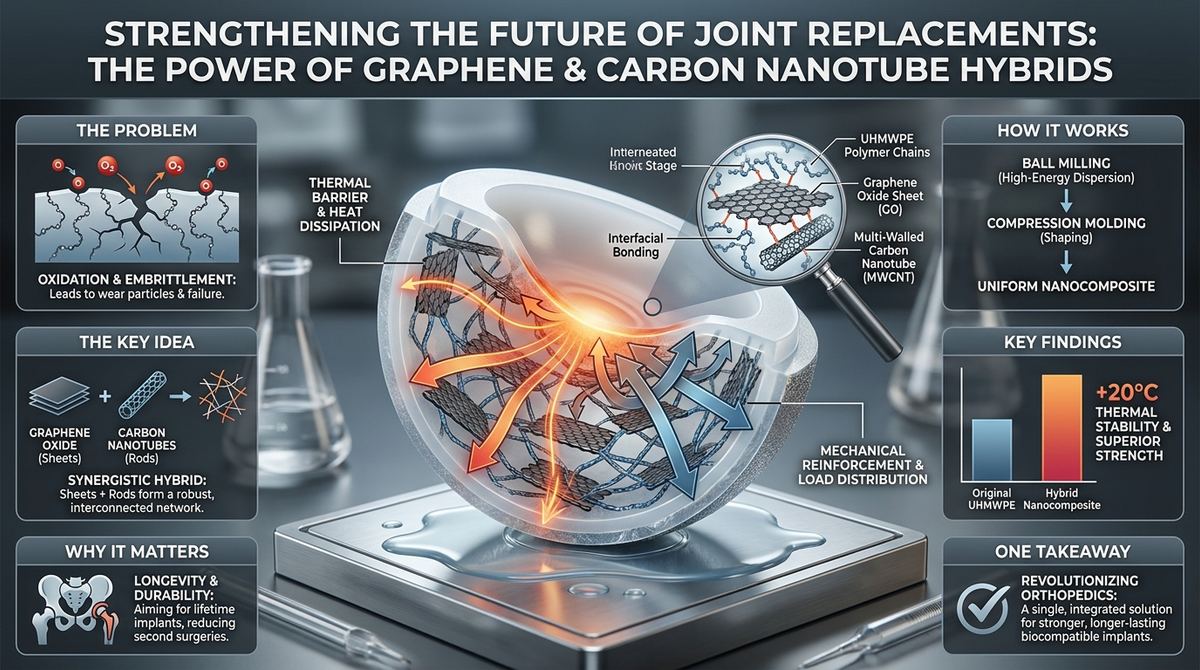
Imagine a hip replacement that lasts a lifetime without ever needing a second surgery. For millions of people undergoing joint reconstruction, the longevity of the implant is the single most important factor for success. Most modern implants rely on a specific type of plastic called ultra-high molecular weight polyethylene, or UHMWPE. While this material is incredibly tough, it has a hidden weakness: over many years inside the human body, it can oxidize, becoming brittle and eventually crumbling into tiny particles that cause painful inflammation. This research represents a potential leap forward in making these essential medical components nearly indestructible by reinforcing them with the wonders of nanotechnology.
The primary challenge in orthopedic surgery is the long-term durability of bearing surfaces, such as the sockets in hip or knee replacements. Ultra-high molecular weight polyethylene has been the gold standard for decades because of its high molecular weight, which translates to excellent wear resistance and the ability to withstand repetitive mechanical loading. However, even the highest quality UHMWPE is susceptible to oxidative degradation.
Oxidation occurs when oxygen molecules penetrate the polymer matrix, attacking the long chains of polyethylene. This chemical attack leads to chain scission, a process where the long, interlocking molecular chains are broken into much shorter segments. As these chains break, the material loses its structural integrity and becomes much more brittle. In a clinical setting, this degradation manifests as an increased wear rate. As the material fails, it sheds microscopic plastic debris into the surrounding tissue. The body’s immune system responds to this debris by triggering an inflammatory response, which can lead to bone loss around the implant, a condition known as osteolysis, and ultimately, the total failure of the prosthetic.
To solve this, scientists are looking for ways to reinforce the plastic at a molecular level, creating a barrier that prevents oxygen from entering and a structural network that prevents cracks from spreading.
To solve the problem of degradation and wear, researchers Mohsen Fakoori and Davood Bizari explored the use of two specific carbon-based nanomaterials: graphene oxide and multi-walled carbon nanotubes. Rather than simply adding one or the other, the researchers investigated a hybrid approach.
Think of the UHMWPE polymer as a large, open room filled with long, tangled pieces of string. If you want to make that room stronger, you could add some flat, rigid sheets of cardboard (the graphene oxide) or some long, thin rods (the nanotubes). However, if you add just the sheets, they might just stack on top of one another without actually reinforcing the strings. If you add just the rods, they might just clump together in one corner.
The key idea here is synergy. By using both 2D sheets of graphene oxide and 1D tubes of carbon nanotubes, the researchers aim to create a reinforced mesh. The nanotubes act as bridges that connect the graphene sheets, creating a complex, three-dimensional web throughout the plastic. This web serves two purposes: it physically blocks oxygen from traveling through the material, and it acts like a structural skeleton that absorbs and distributes mechanical stress, making the plastic much harder to break.
The success of this nanocomposite depends heavily on how well the nanofillers are dispersed within the polyethylene matrix. To achieve this, the researchers used a process called ball milling, which uses high-energy kinetic impact to break down the carbon materials and force them into the polymer chains. This was followed by compression molding to shape the final composite.
The chemistry of the fillers is particularly important. Graphene oxide (GO) contains various oxygen-containing functional groups on its surface, which makes it more "friendly" to chemical interaction than pure graphene. Similarly, the researchers used carboxyl-functionalized multi-walled carbon nanotubes (MWCNT-COOH). The addition of the carboxyl group (-COOH) to the nanotubes is a critical technical detail. These groups provide chemical handles that improve the interaction between the nanotubes and the polymer, preventing the nanotubes from sticking to each other and instead ensuring they bond effectively with the UHMWPE.
The mechanism of reinforcement is a beautiful example of structural synergy. In a standard plastic, when a crack begins to form, it travels relatively easily through the polymer chains. However, in this hybrid system, the crack quickly encounters a 2D graphene sheet, which acts as a massive roadblock. If the crack tries to go around the sheet, it encounters a carbon nanotube. Because the nanotubes are chemically bonded and physically bridge the gaps between the sheets, they redirect the energy of the crack or simply hold the material together, preventing the crack from growing. This is known as the bridging mechanism, and it is what fundamentally shifts the material properties from a simple plastic to a high-performance nanocomposite.
The results of the study demonstrated that the hybrid system was significantly superior to using the fillers individually or using pristine UHMWPE. The combination of 1 wt% graphene oxide and 1 wt% MWCNT-COOH produced the most impressive enhancements across all tested categories.
In terms of thermal stability, the hybrid composite showed a significant improvement. The thermal decomposition temperature, which is the point at which the material begins to break down due to heat, increased by approximately 20 degrees Celsius compared to the original polyethylene. This suggests that the carbon network acts as a thermal barrier, protecting the polymer chains from heat-induced degradation.
The mechanical properties saw even more dramatic improvements. The tensile strength, which measures how much pulling force the material can withstand before breaking, increased by about 24%, reaching a value of 33.5 MPa. Additionally, the Shore D hardness, which measures the material's resistance to indentation or surface deformation, increased by roughly 8% to a value of 67.8. This indicates that the material is not only harder to break but also more resistant to the surface wear that occurs during joint movement.
Interestingly, the researchers also found that the surface of the material became more hydrophilic. This was measured by a 12% reduction in the water contact angle. In the world of biomaterials, hydrophilicity is a vital trait because a surface that can interact more easily with water and biological fluids is often better at supporting cell attachment and integration. Finally, biological testing through MTT assays confirmed that these new materials are highly cytocompatible, with cell viability exceeding 95%, meaning the nanotubes and graphene did not poison the living cells in the study.
These findings are significant because they address the fundamental limitations of orthopedic materials through a single, integrated solution. For years, researchers have tried to improve UHMWPE by adding different types of additives, but they often had to trade one property for another. For example, adding something to increase hardness might make the material more brittle, or adding something to increase strength might make it harder to manufacture.
The hybrid GO-CNT system breaks this cycle. By achieving simultaneous improvements in thermal stability, mechanical strength, and surface chemistry, the researchers have provided a roadmap for a new generation of "smart" biomaterials. If these materials can be successfully integrated into manufacturing, the clinical implications are massive. A stronger, more oxidation-resistant joint means that the interval between revision surgeries—where a patient must undergo a second, more complex operation to replace a worn-out implant—could be extended from years to decades, or even a lifetime. This reduces the risk of surgical complications, lowers the long-term cost of healthcare, and significantly improves the quality of life for patients.
While these results are highly promising, it is important to note that this research is in the fundamental material development stage. The study proves that the material works in a controlled laboratory environment, but it is not yet ready for use in a human hip or knee.
One major area that requires further investigation is long-term tribological evaluation. Tribology is the study of friction, wear, and lubrication. While the researchers showed improved hardness and strength, the true test for an orthopedic implant is how it behaves under the constant, cyclic loading of a human walking, running, and moving for millions of cycles in a fluid-filled environment. The way the hybrid fillers behave under actual wear conditions—specifically whether they stay well-dispersed or if they contribute to the very debris they were meant to prevent—must be studied using specialized hip and knee simulators.
Furthermore, the long-term biological response to the nano-sized particles must be understood. While the initial cytocompatibility tests were excellent, researchers must ensure that if any microscopic particles do eventually wear off, they do not trigger a systemic inflammatory response over a period of twenty or thirty years.
The immediate application for this technology lies in the production of advanced orthopedic implants. This includes hip and knee replacement components, such as acetabular liners and femoral components. Beyond joints, these high-strength, oxidation-resistant nanocomposites could find use in other medical devices that require high durability and biocompatibility, such as spinal spacers or certain types of surgical tools.
As manufacturing techniques like 3D printing and advanced injection molding evolve, the ability to incorporate these specific ratios of graphene and nanotubes into complex, patient-specific shapes could revolutionize personalized medicine. We may eventually see implants that are custom-designed for an individual's specific anatomy and activity level, reinforced with these carbon-based networks to ensure they match the patient's unique physical demands.
If you take away only one concept from this research, let it be the power of synergy: by combining two-dimensional graphene sheets with one-dimensional carbon nanotubes, researchers have created a structural "bridge" that makes medical-grade plastic significantly stronger, more heat-resistant, and more biologically compatible than ever before.
What exactly is UHMWPE and why do we use it in hips?
Ultra-high molecular weight polyethylene is a specific type of plastic made of extremely long molecular chains. These long chains become highly entangled, which gives the material its unique combination of toughness and low friction. This makes it the ideal material for the bearing surfaces in joint replacements, where it must slide smoothly against metal or ceramic while supporting the weight of the entire body.
Why do we need both graphene and nanotubes instead of just one?
Using only graphene oxide might provide a barrier against oxidation, but the sheets could potentially slide against each other under pressure. Using only nanotubes might reinforce the material, but they could clump together and leave weak spots. When used together, the nanotubes act as bridges that tie the graphene sheets into a robust, three-dimensional network, creating a synergistic effect that is much more powerful than the sum of its parts.
Is the use of nanomaterials in the body safe?
The study used MTT assays to check for cell viability, which is a standard way to see if a material is toxic to cells. The results showed that cell viability remained above 95%, which is excellent. However, because these are nanomaterials, scientists still need to conduct much longer studies to ensure that any tiny particles that might wear off over many years do not cause any long-term health issues.
How does the addition of these materials prevent oxidation?
Oxidation happens when oxygen molecules seep into the plastic and break the chemical bonds of the polymer. By adding graphene oxide and nanotubes, we create a physical maze within the plastic. These carbon fillers act as a barrier, making it much harder and more difficult for oxygen molecules to travel through the material to reach the polyethylene chains.
What does the term "synergistic enhancement" mean in this context?
Synergistic enhancement refers to a situation where the combined effect of two substances is greater than the sum of their individual effects. In this research, the 1% of graphene oxide and 1% of carbon nanotubes worked together to improve the material's properties much more effectively than if you had used 2% of just one of those materials.
The integration of graphene oxide and carboxyl-functionalized carbon nanotubes into UHMWPE marks a significant milestone in the development of advanced biomaterials. By leveraging the unique structural properties of 2D and 1D carbon fillers, researchers have demonstrated a way to enhance the mechanical strength, thermal stability, and surface hydrophilicity of the industry's most important orthopedic plastic. While further long-term wear and biological studies are required before these materials can enter the operating room, the potential to create more durable, longer-lasting joint replacements is a profound achievement in the field of nanotechnology.
Serious about B2B integration? Test our premium Pulsed Electrical Resistive Carbon Heating turbostratic graphene in your lab. 100g sample packs available now.
Explore More
Researchers derived the first exact formula for resistivity in the 1D infinite-U Hubbard model, providing a crucial benchmark for understanding strongly...

Learn how to utilize bipartite-lattice symmetry to generate pure spin shift currents in graphene nanoribbons for advanced spintronic device prototyping.

Researchers propose a novel method to detect spin- and valley-polarized states in van der Waals materials, a key step for next-gen spintronics and...