
Detection of spin- and valley-polarized states in van der Waals materials via
Researchers propose a novel method to detect spin- and valley-polarized states in van der Waals materials, a key step for next-gen spintronics and...
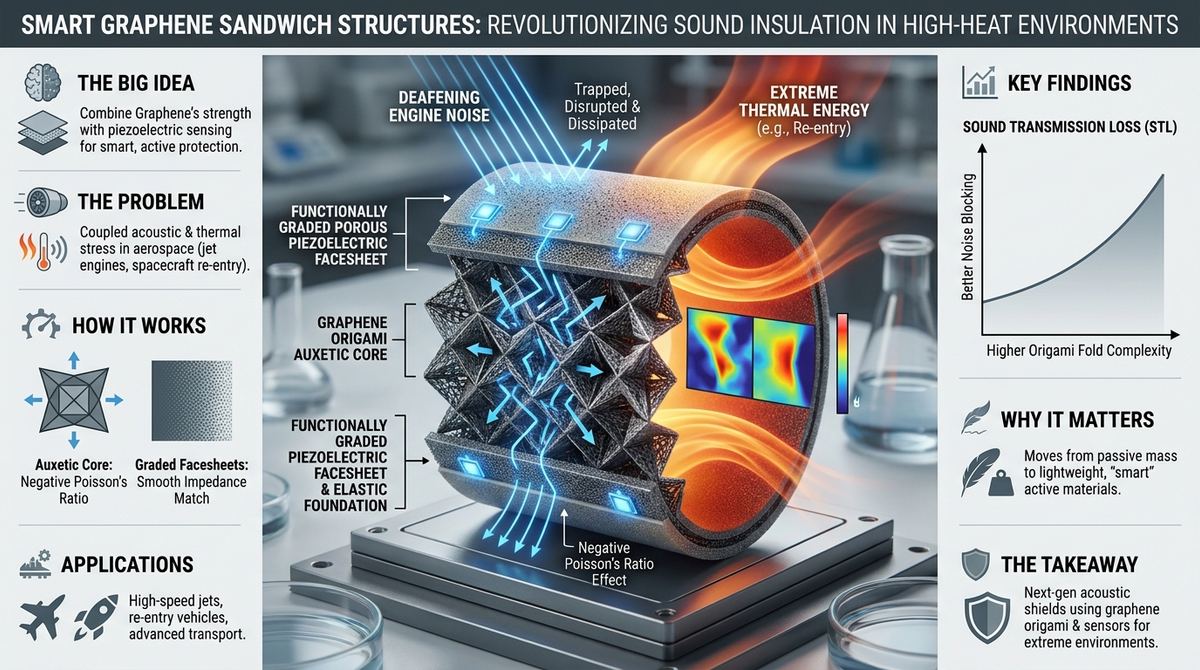
Imagine a high-speed passenger jet or a spacecraft re-entering the atmosphere. Inside these machines, engineers face a punishing dual-threat: the deafening roar of engines and extreme thermal energy that can melt or warp standard materials. To protect both the structural integrity of the craft and the comfort of the passengers, we need materials that are not just strong, but "smart." Recent breakthroughs in material science have moved us closer to this goal by combining the molecular strength of graphene with the active capabilities of piezoelectric sensors. This research, conducted by Rasoul Basheh Ahangar, Pezhman Taghipour Birgani, and Mehdi Shekarzadeh, explores how a new type of sandwich-structured cylinder can use advanced geometry and smart materials to silence noise and withstand intense heat simultaneously.
The fundamental challenge in modern aerospace and high-speed transport engineering is the coupling of acoustic and thermal stress. When a vehicle moves through air at high speeds, it generates significant acoustic energy in the form of pressure waves. Simultaneously, friction and atmospheric conditions subject the outer skin to intense thermal loading. Traditional materials struggle with this combination because sound and heat affect them in ways that often work against each other.
In standard composite materials, there is often a sharp boundary between different layers. When a sound wave hits a sharp boundary between two materials with different densities, most of the energy is reflected back, but the remaining energy is transmitted through, creating noise. Furthermore, temperature changes cause materials to expand. In a standard laminated structure, if one layer expands more than another, internal stresses build up rapidly, leading to delamination or structural failure. This creates a need for a material that can handle sound waves by absorbing them through its internal structure and handle thermal expansion through a gradual, controlled distribution of its properties.
The solution proposed by the researchers involves a "smart sandwich." Think of a sandwich where the bread is not just bread, but a specialized material that can sense and react to noise, and the filling is a highly engineered geometric lattice made of graphene. This filling is an "auxetic metamaterial."
Most materials behave predictably: if you stretch a rubber band, it gets thinner in the middle. This is called a positive Poisson's ratio. However, an auxetic material does the opposite. When you stretch it, it actually becomes thicker in the direction of the stretch. This strange behavior is achieved not by the chemistry of the material alone, but by the geometry of how it is folded, much like origami. By using graphene—the strongest, thinnest material known—and folding it into these origami patterns, we create a core that can absorb and scatter sound waves much more effectively than any traditional foam or honeycomb.
To understand why this system is so effective, we must look at the three distinct layers: the functionally graded porous piezoelectric facesheets, the graphene origami auxetic core, and the underlying elastic foundation.
The facesheets are "functionally graded," meaning their properties—like density and stiffness—change gradually from the outside to the inside rather than jumping abruptly. This is achieved through a power-law distribution, where the material composition is mathematically tuned through its thickness. This graduation is critical because it prevents the sudden impedance mismatch that causes sound to bounce off surfaces. By smoothing out the transition between the outer skin and the inner core, sound waves are allowed to penetrate more deeply into the structure, where they can be more effectively neutralized.
These facesheets also contain microscopic pores. As a sound wave enters these pores, the mechanical energy of the wave is converted into heat through friction as the air molecules rub against the pore walls. This is the principle of acoustic absorption. To add a layer of "intelligence," these facesheets are also piezoelectric. Piezoelectric materials have the unique ability to convert mechanical stress—such as the vibration from a loud engine—into an electric charge. By applying an external voltage to these facesheets, engineers can actively change the stiffness of the shell, essentially "tuning" the material to cancel out specific frequencies of noise.
The heart of the sandwich is the graphene origami (GOri) core. Graphene is an exceptional candidate for this because of its incredible thermal stability and high surface area. Because the graphene is folded into an origami-inspired lattice, it exhibits that "auxetic" or negative Poisson's ratio behavior. When an acoustic pressure wave hits the core, the auxetic structure densifies in the direction of the wave, creating a more formidable barrier that scatters the energy.
The mathematical modeling of this complex interaction requires advanced physics. The researchers used Hamilton’s Principle, which is a fundamental principle in mechanics used to derive equations of motion by analyzing the energy of a system. Because these sandwich structures are relatively thick, standard thin-shell theories are insufficient. Instead, they employed Third-Order Shear Deformation Theory (TSDT). This theory is more accurate because it accounts for the way different layers of the sandwich slide against each other (transverse shear deformation), providing a much more realistic simulation of how a real-world aircraft component would vibrate.
The research involved an extensive parametric analysis, which means the scientists tested how changing one specific variable affects the overall performance of the shell. They found that the Sound Transmission Loss (STL)—the metric used to measure how well a material blocks noise—is highly sensitive to several factors.
One major finding was the influence of the origami folding degree. The more complex the folds in the graphene core, the better the material's ability to disrupt sound waves. The geometry of the folds essentially creates a labyrinth for the sound, forcing it to travel a longer, more difficult path, which drains its energy.
The study also highlighted the impact of thermal loading. As temperatures rise, most materials lose stiffness, which usually makes them worse at blocking sound. However, by using functionally graded materials, the researchers showed that the shell could maintain its structural integrity and acoustic performance even under significant thermal stress. The grading helps distribute the heat-induced expansion more evenly, preventing the "stress concentrations" that typically lead to failure.
Furthermore, the application of piezoelectric voltage was found to be a powerful tool for active control. By adjusting the electrical input, the system can be optimized to block specific, troublesome frequencies. The researchers also discovered that the angle at which the sound wave hits the shell (the incidence angle) plays a significant role; the auxetic core is particularly adept at managing waves that hit at various angles, making it a versatile solution for complex environments.
This research is significant because it moves us away from "passive" materials toward "smart" materials. In the past, if you wanted more sound insulation, you simply added more mass, which made the aircraft heavier and less fuel-efficient. This new approach achieves better sound insulation through geometry and active electronic control, rather than just adding bulk.
The ability to manage both heat and sound in a single, lightweight component is a holy grail for aerospace engineering. By using graphene origami, we are essentially using the geometry of the material to do the heavy lifting of sound absorption. This leads to lighter vehicles, which directly translates to lower fuel consumption and reduced carbon emissions. For passengers, it means the difference between a loud, vibrating cabin and a silent, smooth flight.
While the results are highly promising, it is important to note that this study is primarily a computational and mathematical investigation. The researchers used advanced formulas and simulations to predict how these materials will behave.
Transitioning from a mathematical model to a physical prototype is a massive hurdle. Manufacturing graphene into complex, large-scale origami structures is currently extremely difficult and expensive. Scaling this technology from a small laboratory cylinder to a full-sized airplane fuselage involves significant challenges in material consistency and large-scale assembly. Additionally, while the model accounts for thermal loading, the real-world conditions of a jet engine or a re-entering spacecraft involve extreme chemical and oxidative environments that may degrade graphene over time. Future research will need to focus on the longevity and durability of these origami structures in real-world chemical environments.
The potential applications for this technology are vast and span several high-tech industries:
In the aerospace sector, these shells could be used for engine nacelles, cabin walls, and leading edges of wings to manage both acoustic noise and aerodynamic heating.
In the automotive industry, particularly with the rise of electric vehicles (EVs), there is a growing need for acoustic management. Since EVs lack the masking noise of a combustion engine, cabin noise from wind and road becomes much more noticeable. Smart graphene-based panels could provide a silent interior without adding significant weight.
For high-speed rail systems, these materials could be used in the car bodies of trains to protect passengers from the intense noise generated when traveling through tunnels or passing other trains at high velocities.
In deep-sea exploration, similar sandwich structures could be designed to withstand the extreme pressures of the ocean, using the auxetic properties of the core to resist crushing forces while protecting sensitive internal electronics from vibration.
If you take away only one concept from this research, let it be the power of synergy: by combining the unique geometry of graphene origami with the active responsiveness of piezoelectricity, we can create materials that solve two of engineering's hardest problems—noise and heat—simultaneously and more efficiently than ever before.
What exactly is an auxetic material?
Most materials get thinner when you stretch them, like a piece of gum. An auxetic material is unique because it gets thicker when you stretch it. This happens because of the way its internal structure is shaped, creating a "negative Poisson's ratio." This property makes it incredibly good at absorbing energy and resisting impacts.
How does graphene help with sound insulation?
Graphene is an incredibly strong and stable material at the atomic level. When used in an origami pattern, it creates a complex, lightweight lattice. This lattice acts as a geometric barrier that scatters and disrupts sound waves, turning their energy into heat and preventing them from passing through the material.
What does "functionally graded" mean in this context?
Instead of having a material that is the same all the way through, a functionally graded material has properties that change gradually from one side to the other. For example, the density might start low on the outside and increase toward the middle. This prevents sudden changes that would cause sound or heat to bounce off the layers.
Why do we need piezoelectric facesheets?
Piezoelectric materials are "smart" because they can turn mechanical vibrations into electricity and vice versa. By including them in the outer skin of a structure, we can apply a small voltage to "tune" the material, allowing us to actively cancel out specific noise frequencies, much like how noise-canceling headphones work.
Is this technology ready to be used in airplanes today?
Not quite. While the math and simulations show that it works exceptionally well, we are still in the stage of understanding how to manufacture these complex graphene structures at scale. It is currently a highly promising research direction that will require further development in manufacturing technology before it becomes a commercial reality.
The integration of graphene origami and functionally graded piezoelectric facesheets represents a significant leap forward in acoustic and thermal management. By moving beyond traditional, heavy, and passive materials, researchers like Ahangar, Birgani, and Shekarzadeh are paving the way for a new era of smart, lightweight, and highly efficient structural components. As our transport systems push toward higher speeds and more extreme environments, the ability to master the synergy between geometry and material science will be the key to the next generation of human exploration.
Serious about B2B integration? Test our premium Pulsed Electrical Resistive Carbon Heating turbostratic graphene in your lab. 100g sample packs available now.
Explore More
Researchers propose a novel method to detect spin- and valley-polarized states in van der Waals materials, a key step for next-gen spintronics and...

Researchers developed the CARBON-2D Topological Descriptor (C2DTD), an interpretable, physics-informed method to rapidly predict the properties of new 2D...

Learn how to create p-n junctions in graphene by selectively oxidizing the underlying germanium substrate. This guide covers a practical method for...