
Graphene-Silicon Modulator Unlocks High-Speed Data at New Wavelengths
Explore a breakthrough graphene-silicon slot-waveguide modulator. This high-speed device operates at both 1.5 μm and 2 μm, promising next-gen optical networks.
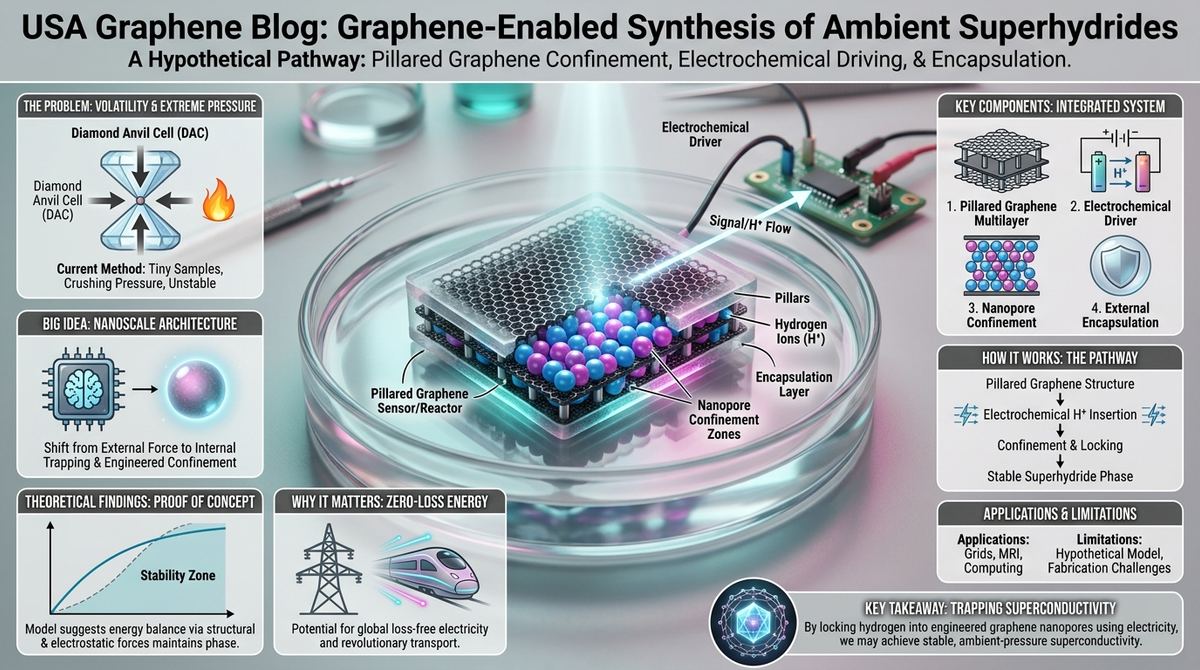
Imagine a world where electricity travels across continents without losing a single drop of energy to heat. This is the promise of superconductivity, a phenomenon where certain materials allow electrons to flow with zero resistance. Currently, the most promising candidates for this are superhydrides, materials packed with hydrogen atoms that require the crushing, unimaginable pressures found near the center of the Earth to function. Because these materials collapse the moment you release the pressure, they remain laboratory curiosities rather than practical tools. However, a new conceptual framework suggests we might be able to trick these materials into staying in their superconducting state by using graphene to build a microscopic "pressure cage."
The primary obstacle in modern condensed matter physics is the extreme volatility of superconducting hydrides. To reach the state where a material like lanthanum decahydride becomes a superconductor, scientists must use a Diamond Anvil Cell, or DAC. This device uses two brilliant-cut diamonds to squeeze a tiny sample between their tips. While this method is effective for discovery, it is deeply flawed for practical application. First, the sample volume is incredibly small, often smaller than a grain of sand, making it impossible to manufacture large-scale components. Second, and more critically, the superconducting state is entirely dependent on the external pressure. As soon as the diamonds are moved apart and the pressure is released, the hydrogen lattice relaxes, the internal structure collapses, and the superconductivity vanishes.
This creates a fundamental paradox for researchers. We are finding the "holy grail" of materials—substances that could revolutionize energy—but we are finding them in a state that is too fragile to ever leave the laboratory. The current approach is purely physical, relying on external force to maintain a structural configuration. There is no mechanism within a standard DAC to "lock" the atoms in their high-pressure positions once the external force is removed. To move from a laboratory curiosity to a functional technology, we need to move away from simply applying pressure and toward engineering a device that can maintain that state through structural and electrical means.
The solution proposed by Li-Kuang Yin and the theoretical framework suggests a shift in how we think about material synthesis. Instead of viewing superconductivity as something that happens to a material because of external weight, we should view it as a state that can be trapped inside a nanoscale architecture. The core idea is to use layers of graphene to create a series of tiny, ultra-strong rooms called nanopores. By using electricity to drive hydrogen ions into these rooms and then using the unique properties of graphene to "lock" the structure, we might create a material that is superconducting at normal room pressure.
This concept replaces the blunt force of a diamond anvil with the precise control of nanotechnology and electrochemistry. Rather than squeezing the whole sample, we are building a microscopic "nanodevice" that manages the internal pressure through a combination of structural confinement and electrical forces. This approach aims to create what is known as an ambient-pressure-stable superhydride, a material that retains its high-pressure properties even when the external environment is calm and normal.
To understand how this system works, we must look at the four integrated components that make up this hypothetical architecture. The first component is the pillared graphene multilayer. Graphene is a single layer of carbon atoms arranged in a hexagonal lattice. While a single layer is incredibly strong, many layers stacked together can be engineered to have tiny gaps or "pillars" between them. These pillars act as a physical scaffold, providing a nanoscale confinement zone. This confinement is essential because it limits the space available for the hydrogen atoms, essentially forcing them to stay in a high-density arrangement that mimics the effects of extreme pressure.
The second component is the synergy between pressure and electrochemistry. In a traditional setup, you simply squeeze the material. In this new model, an electric current is used to drive the reaction. By applying an electrochemical potential, we can force ions, such as lithium, into the graphene structure. This process does more than just add material; it provides an internal driving force. The movement of these ions through the material can create localized stresses and volumetric changes that assist the external pressure in stabilizing the target phase.
The third component is the use of lithium-ion conductors. These serve a dual purpose. They act as the source of the ions needed to form the hydride, but they also act as electromechanical transducers. As the ions move through the graphene layers in response to an electric field, their movement creates a subtle, localized pressure through ionic interaction. This "internal" pressure works in tandem with the external pressure, helping to stabilize the delicate hydrogen lattice from the inside out.
The fourth component is external edge encapsulation. One of the biggest problems with hydrogen-rich materials is that hydrogen is a very small, highly mobile atom that tends to leak out of any structure. The proposed design uses an encapsulation layer at the edges of the graphene stack to act as a pressure-seal. This layer ensures that the hydrogen stays trapped within the graphene cages and provides a way for researchers to interface the device electrically, allowing the control of the internal electrochemical environment.
The most innovative part of this mechanism is the "field-then-pillar" relay. This is designed specifically to solve the decompression problem. As the external pressure is gradually removed, the system uses a programmed electric field to maintain the structural integrity of the hydride. This electric field provides a "virtual pressure" that holds the atoms in their high-symmetry, superconducting positions. As the mechanical pressure drops, the structural rigidity of the pillared graphene takes over, acting as the "pillar" that physically locks the lattice in place. This relay mechanism ensures a smooth transition from a high-pressure state to a stable, ambient-pressure state.
Because this work is a theoretical and hypothetical proposal, the "findings" are not empirical measurements from a laboratory experiment, but rather the logical and mathematical proofs of concept provided by the model. The research demonstrates that it is theoretically possible to bypass the limitations of the diamond anvil cell through engineered confinement. The model suggests that the energy required to maintain the superconducting phase can be offset by the combined forces of graphene's structural confinement and the electrostatic forces generated by an electric field.
The theoretical framework provides a roadmap for how these components must be integrated. It shows that the success of the process depends on the precise tuning of the graphene layer spacing and the timing of the electric field during the decompression phase. The researchers propose that if the confinement energy provided by the graphene walls and the electrical field exceeds the thermal energy that would normally cause the lattice to expand, the high-pressure phase will remain stable. This represents a significant shift in the field, moving the goalpost from finding the "right" material to designing the "right" environment for the material to exist.
The implications of successfully implementing this theoretical model are almost impossible to overstate. If we can create stable, ambient-pressure superhydrides, we enter a new era of human technology. The most immediate impact would be in power transmission. Current electrical grids lose a significant percentage of electricity to resistance-driven heat loss during transport. Superconducting power lines would allow for nearly perfect efficiency, enabling renewable energy generated in remote areas, like offshore wind farms, to be transported thousands of miles without any loss.
Beyond power grids, superconductivity is the backbone of modern medical imaging. MRI machines rely on powerful superconducting magnets to function. Currently, these magnets often require expensive and bulky liquid helium cooling systems to maintain their temperature. A stable, ambient-pressure superconductor would simplify the design and drastically reduce the cost of MRI technology, making it accessible to smaller clinics and developing nations. Furthermore, the fields of quantum computing and high-speed transportation, such as Maglev trains, would see massive advancements as the need for extreme cooling and massive pressure-stabilization systems disappears.
It is vital to emphasize that this research is currently a speculative, hypothetical framework. No one has yet successfully synthesized a bulk superhydride using this method in a laboratory setting. The transition from a theoretical model to a physical device is a monumental task that involves many unknown variables. We do not yet know the exact electrochemical parameters required to drive the ions into the graphene structure without destroying the graphene itself.
There are also significant engineering challenges regarding the "field-then-pillar" relay. Maintaining a precisely controlled electric field at the nanoscale during a decompression cycle requires an unprecedented level of control over nano-electronics. Furthermore, the long-term stability of these encapsulated hydrides remains a major question. Even if we can "lock" the structure initially, we do not know if the hydrogen will eventually leak out or if the graphene structure will degrade over time due to the chemical reactivity of the hydrides. Extensive experimental testing is required to validate every step of this proposed pathway.
If this theoretical framework is validated through experimentation, the real-world applications would be transformative. In the field of electronics, we could see the development of ultra-fast, zero-heat computer processors. As electronic devices become more powerful, heat management becomes a primary limiting factor. Superconducting circuits would eliminate this heat entirely, allowing for much higher clock speeds and much smaller device footprints.
In the realm of transportation, superconductivity could enable a new generation of high-speed maglev trains that are much cheaper to operate and maintain. By removing the need for complex cryogenic systems, these trains could become a standard part of urban and intercity transit. Additionally, in the field of energy storage, superconducting magnetic energy storage (SMES) systems could be used to store electricity in the form of magnetic fields, providing a near-instantaneous response to changes in power demand, which is essential for stabilizing grids that rely on intermittent sources like solar and wind.
If you remember only one thing from this complex theoretical proposal, let it be this: the future of superconductivity may not depend on finding a magic material, but on building a tiny, engineered cage of graphene that can trap and hold a high-pressure state even when the world around it returns to normal.
What is a superhydride and why is it important?
A superhydride is a material containing a high concentration of hydrogen that can become a superconductor. Superconductors are special because they allow electricity to flow without any resistance, which means no energy is lost as heat. This is very important for making efficient electronics and power grids.
Why is graphene being used in this research?
Graphene is a single layer of carbon atoms that is incredibly strong and conductive. In this research, it is used to create a nanoscale "cage" or scaffold. This cage provides the physical structure needed to keep the hydrogen atoms compressed in a specific way, even when external pressure is removed.
What is the main problem with current superconducting materials?
Most known superconducting hydrides only work under extreme pressure, similar to what is found deep inside planets. This makes them very difficult to use in real-world technology because they lose their superconducting properties as soon as the pressure is released.
Is this technology ready for commercial use?
No, this is currently a theoretical and speculative concept. It is a proposed roadmap for future research. Scientists are still working through the mathematical and physical models to see if this "nanodevice" approach is actually possible in a real laboratory setting.
How does electricity help stabilize the material?
In this model, an electric field is used to provide a "virtual pressure." As the physical pressure is being removed, the electric field helps hold the atoms in their correct positions. This prevents the structure from expanding and losing its superconducting properties.
The quest for ambient-pressure superconductivity is one of the most important challenges in modern science. The hypothetical pathway presented by Li-Kuang Yin offers a radical departure from traditional methods by moving the focus from external pressure to internal, engineered confinement. By combining the strength of graphene, the precision of electrochemistry, and the stability of nanoscale encapsulation, this approach provides a compelling vision for how we might finally harness the power of superhydrides. While many experimental hurdles remain, the concept of an engineered nanodevice could be the key that unlocks a future of unprecedented energy efficiency and technological advancement.
END_OF_ARTICLE
Serious about B2B integration? Test our premium Pulsed Electrical Resistive Carbon Heating turbostratic graphene in your lab. 100g sample packs available now.
Explore More
Explore a breakthrough graphene-silicon slot-waveguide modulator. This high-speed device operates at both 1.5 μm and 2 μm, promising next-gen optical networks.

New research reveals that mechanical strain doesn't just reduce but fundamentally reshapes heat flow in graphene, a critical insight for flexible...

Learn to build a gate reflectometry sensor using bilayer graphene. This practical guide details a non-contact method for material characterization.