
Generalized Beth-Uhlenbeck Model for Graphene Electronics
Researchers use the Generalized Beth-Uhlenbeck approach to model electron interactions in 2D materials, offering a new way to predict graphene's behavior.
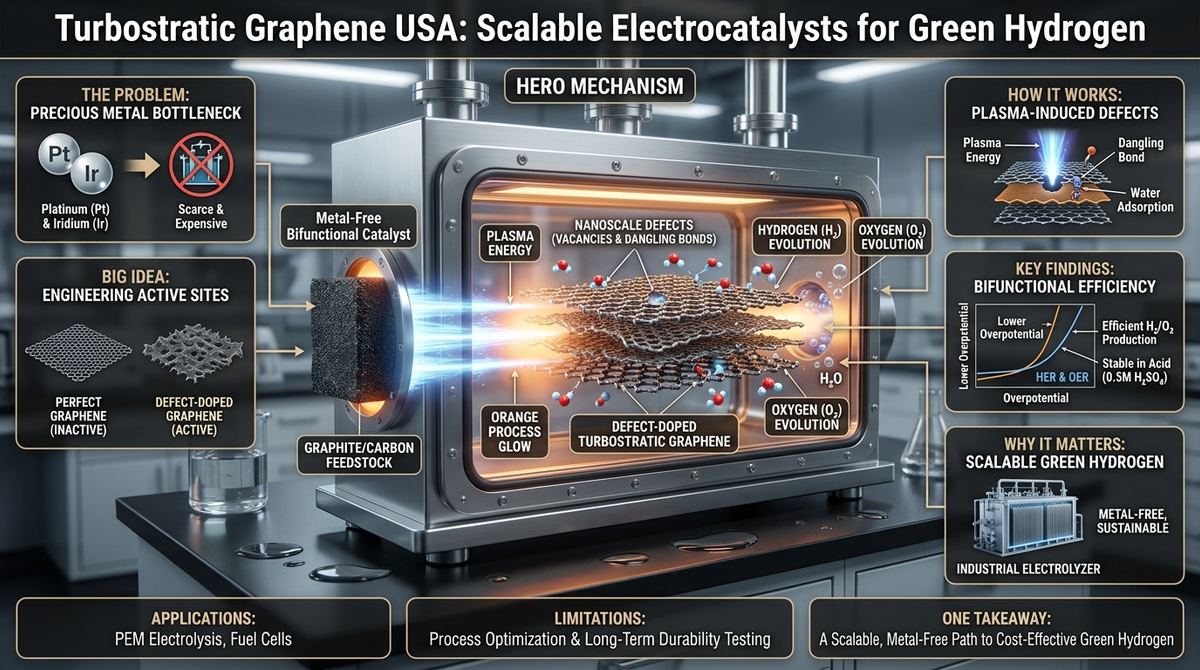
The global transition toward a sustainable energy economy relies heavily on our ability to store renewable energy in chemical forms, most notably through the production of green hydrogen. For hydrogen to truly be green, it must be produced via electrolysis, a process that uses electricity to split water into hydrogen and oxygen. However, the efficiency of this process is currently bottlenecked by the materials used to drive the reaction. Most modern electrolyzers rely on extremely expensive and rare precious metals like platinum and iridium to facilitate the reaction. While these metals work well, their scarcity and high cost make large-scale, global deployment of hydrogen infrastructure a massive economic challenge. This research presents a paradigm shift by moving away from precious metals and toward a highly engineered carbon-based material. This study on turbostratic graphene USA, conducted by Chandan Kumar Nayak, Niranjan Pandit, Saurav Keshri, and Anup Kumar Keshri, offers a roadmap for creating efficient, metal-free, and mass-producible catalysts that could finally make large-scale water splitting economically viable.
To understand why this research is a breakthrough, one must first understand the electrochemical hurdles of water splitting. Water splitting involves two distinct half-reactions: the Hydrogen Evolution Reaction (HER), where protons are reduced to hydrogen gas, and the Oxygen Evolution Reaction (OER), where water is oxidized to release oxygen gas. These two processes are fundamentally different in terms of the chemical mechanisms and the energy required to drive them. Because they are different, most catalysts are specialized for one or the other.
A bifunctional catalyst is a holy grail in electrochemistry because it can handle both reactions efficiently within a single device, such as a proton exchange membrane electrolyzer. Currently, the industry relies on precious metal oxides to drive the OER and noble metals to drive the HER. This creates two massive problems. First, the cost of these metals is prohibitive for the massive scale-up required by the green energy transition. Second, the scarcity of these materials means that we cannot simply mine enough iridium or platinum to power the world's future energy needs. There is an urgent need for a material that is abundant, inexpensive, and capable of performing both tasks with minimal energy loss.
The researchers realized that the problem might not be graphene itself, but rather the perfection of graphene. Standard graphene is often described as a perfect, flat sheet of carbon atoms arranged in a flawless hexagonal lattice. While this makes graphene a world-class conductor of electricity, it is actually quite poor as a catalyst. Because it is so perfect, it lacks the "active sites" where chemical reactions can actually take place. To a chemical reaction, a perfect sheet of graphene is like a smooth, frictionless glass surface; there is nothing for the molecules to grab onto.
The breakthrough idea was to intentionally "break" the graphene. By using a high-energy plasma spray technique, the researchers introduced controlled damage into the carbon structure. This creates two specific features: tiny holes and a disordered stacking arrangement. The holes create edges in the carbon sheets, and these edges have dangling bonds—unsatisfied chemical connections that are incredibly hungry to interact with water molecules. Furthermore, instead of the sheets being neatly stacked like a deck of cards, the plasma spray causes them to be misaligned and shifted, a state known as turbostratic. This disordered structure opens up the spaces between the layers, allowing ions to move through the material much faster.
The mechanism of this new catalyst is a masterclass in structural engineering at the nanoscale. When the plasma spray hits the graphene, it delivers intense energy that disrupts the periodic arrangement of carbon atoms. This disruption serves two purposes. First, it creates nanoscale defects, specifically vacancies where carbon atoms used to be. These vacancies are the birthplaces of active sites. At the edge of a hole, the carbon atoms are not fully bonded to other carbons; these are the dangling bonds mentioned earlier. These dangling bonds act as chemical docking stations where water molecules can attach, undergo electronic exchange, and then release hydrogen or oxygen gas.
Second, the plasma spray induces a turbostratic stacking arrangement. In standard graphite, the layers are stacked in a very specific, orderly fashion that makes it difficult for ions to move between the layers. In turbostratic graphene, the layers are rotated and shifted relative to one another. This structural disorder increases the interlayer spacing, effectively creating more "highways" for ions to travel through. This is critical because, in an electrochemical cell, the speed of the reaction is often limited by how fast ions can diffuse through the electrode material. By opening up the structure, the researchers have maximized the ion diffusion rates.
Furthermore, the synergy between the high electrical conductivity of the graphene backbone and the abundance of these new active sites is what drives the high performance. The graphene provides a superhighway for electrons to move toward the reaction sites, while the defects provide the chemical tools to perform the reaction. This combination ensures that the electrical energy is converted into chemical energy with minimal heat loss, which is the definition of high efficiency in electrochemistry.
The results of the study provide strong evidence that defect-doped turbostratic graphene is a formidable candidate for bifunctional electrocatalysis. The researchers tested the material in a 0.5 M sulfuric acid environment, which is a common electrolyte used in testing proton exchange membrane (PEM) electrolysis. They focused on two key metrics: overpotential and Tafel slope. The overpotential is the extra voltage required to drive a reaction at a specific current density beyond the theoretical thermodynamic requirement. A lower overpotential means a more efficient catalyst.
The findings were impressive. The plasma-sprayed graphene achieved an oxygen evolution reaction (OER) overpotential of 290 mV at a current density of 10 mA per square centimeter. For the hydrogen evolution reaction (HER), it achieved an overpotential of 370 mV at the same current density. While these numbers are higher than some precious metal standards, they are exceptionally competitive for a metal-free, carbon-based material.
Additionally, the researchers measured the Tafel slopes, which characterize the kinetics of the electrochemical reaction. The Tafel slope indicates how much additional voltage is needed to increase the reaction rate by a factor of ten. A smaller Tafel slope indicates faster reaction kinetics. The study reported Tafel slopes near 80 mV per decade for both reactions. This suggests that the reaction occurs relatively smoothly and efficiently on the engineered carbon surface, indicating that the defect-doped sites are highly active and capable of facilitating rapid charge transfer.
The implications of these findings are profound for the energy sector. First and foremost, this is a scalable solution. Many high-performance catalysts are created in small batches using complex chemical vapor deposition (CVD) methods that are difficult to scale up to industrial levels. Plasma spraying, however, is a well-established industrial technique used in everything from aerospace to automotive manufacturing. This means the process used to create this graphene can be integrated into existing industrial workflows, making the transition from lab to factory much easier.
Secondly, the metal-free nature of this catalyst solves the "scarcity problem." Carbon is one of the most abundant elements on Earth. By replacing rare-earth and precious metals with engineered carbon, we decouple the growth of the hydrogen economy from the volatile prices and geopolitical complexities of precious metal mining. If we can produce hydrogen using inexpensive, carbon-based materials, the cost of green hydrogen will plummet, making it competitive with fossil-fuel-derived hydrogen.
Lastly, the bifunctionality of the material simplifies the design of electrolyzers. In a typical water-splitting setup, you need an anode for OER and a cathode for HER. If a single material can perform both tasks, it opens up new possibilities for simplified, more robust, and cheaper electrolyzer architectures, potentially leading to more durable and efficient units for large-scale renewable energy storage.
While these results are groundbreaking, it is important to maintain scientific objectivity regarding the current stage of this technology. The study demonstrates excellent performance in a controlled laboratory setting using sulfuric acid as an electrolyte. However, industrial PEM electrolyzers often operate under more extreme conditions, including high pressures and varying temperatures, which could impact the long-term structural integrity of the defect-doped graphene.
The stability of the defects is another critical area for investigation. Because the active sites are created by "breaking" the graphene, there is a theoretical risk that the material could "self-heal" or, conversely, become overly degraded over thousands of hours of operation. For a catalyst to be commercially viable, it must demonstrate extreme durability, often requiring thousands of continuous hours of operation without a significant drop in efficiency.
Finally, while plasma spraying is scalable, the precise control of defect density and turbostratic stacking over large surface areas remains a challenge. Optimizing the plasma parameters to ensure a uniform distribution of holes and disordered layers across massive electrode surfaces will be essential for moving from a successful laboratory experiment to a commercial product.
The first major application for this technology will likely be in the production of green hydrogen for industrial use. Heavy industries such as steel manufacturing, ammonia production, and chemical refining require massive amounts of hydrogen to replace carbon-intensive processes. A scalable, inexpensive catalyst could make the electrification of these massive industrial plants economically feasible.
Another application lies in large-scale energy storage systems. As we add more solar and wind power to the grid, we face the challenge of storing that energy for when the sun isn't shining or the wind isn't blowing. Hydrogen serves as a long-duration energy storage medium. Using turbostratic graphene to produce hydrogen would allow for much larger, more cost-effective hydrogen storage facilities that could stabilize entire national power grids.
Finally, this research could find its way into smaller-scale, decentralized hydrogen production. Imagine modular hydrogen generators used in remote areas or for fueling stations in heavy-duty transport corridors. A robust, metal-free, and easy-to-manufacture catalyst would be ideal for these decentralized, high-reliability environments.
If you take away only one insight from this research, let it be this: the future of green energy might not lie in finding more precious metals, but in better engineering the abundant elements we already have. By intentionally introducing defects into the structure of graphene, researchers have turned a passive conductor into a highly active, bifunctional powerhouse that could unlock the full potential of the hydrogen economy.
What exactly is turbostratic graphene?
Turbostratic graphene is a form of carbon where the individual layers of graphene are not stacked in a neat, orderly, or parallel fashion. In standard graphite, the layers are very organized, but in turbostratic carbon, they are rotated and shifted relative to one another. This disorder is actually very useful because it creates more space between the layers, allowing ions to move through the material more easily.
Why are defects important in a catalyst?
In electrochemistry, a reaction needs a specific location to occur, known as an active site. A perfect, flawless sheet of graphene is actually quite inert because it has no "handles" for molecules to grab onto. By creating defects like nanoscale holes, we create "dangling bonds" at the edges of those holes. These dangling bonds act as the docking stations where chemical reactions take place.
What is the difference between OER and HER?
Water splitting is composed of two halves. The Hydrogen Evolution Reaction (HER) occurs at the cathode, where protons are turned into hydrogen gas. The Oxygen Evolution Reaction (OER) occurs at the anode, where water is turned into oxygen gas. These two processes require different chemical environments and different types of catalysts to work efficiently.
Why is "metal-free" such a big deal for the industry?
Most current catalysts for water splitting rely on precious metals like platinum and iridium. These metals are incredibly expensive and are only found in very small quantities in the Earth's crust. Using them for massive, global-scale hydrogen production is economically and environmentally challenging. Metal-free catalysts using abundant elements like carbon are much more sustainable and cost-effective.
How does plasma spray help make this scalable?
Plasma spraying is a high-energy industrial process used to deposit materials onto surfaces. It is already used widely in many manufacturing industries. Because the researchers used this specific method to create the defects in the graphene, it means the process can be scaled up from a small laboratory sample to large-scale industrial production much more easily than more complex chemical methods.
The work presented by the research team marks a significant milestone in the quest for sustainable energy. By moving away from the pursuit of perfect graphene and instead embracing the utility of disorder, they have unlocked a new class of bifunctional catalysts. The use of plasma spray to create turbostratic graphene USA provides a clear, scalable pathway to move away from expensive precious metals. As this technology matures and undergoes rigorous long-term stability testing, it stands to become a cornerstone of the green hydrogen economy, providing the efficient, low-cost foundation needed to power a carbon-neutral future.
Serious about B2B integration? Test our premium Pulsed Electrical Resistive Carbon Heating turbostratic graphene in your lab. 100g sample packs available now.
Explore More
Researchers use the Generalized Beth-Uhlenbeck approach to model electron interactions in 2D materials, offering a new way to predict graphene's behavior.

Researchers derived the first exact formula for resistivity in the 1D infinite-U Hubbard model, providing a crucial benchmark for understanding strongly...

Learn how to utilize bipartite-lattice symmetry to generate pure spin shift currents in graphene nanoribbons for advanced spintronic device prototyping.