
An Exact Solution for Electron Transport and Resistivity in the Hubbard Model
Researchers derived the first exact formula for resistivity in the 1D infinite-U Hubbard model, providing a crucial benchmark for understanding strongly...
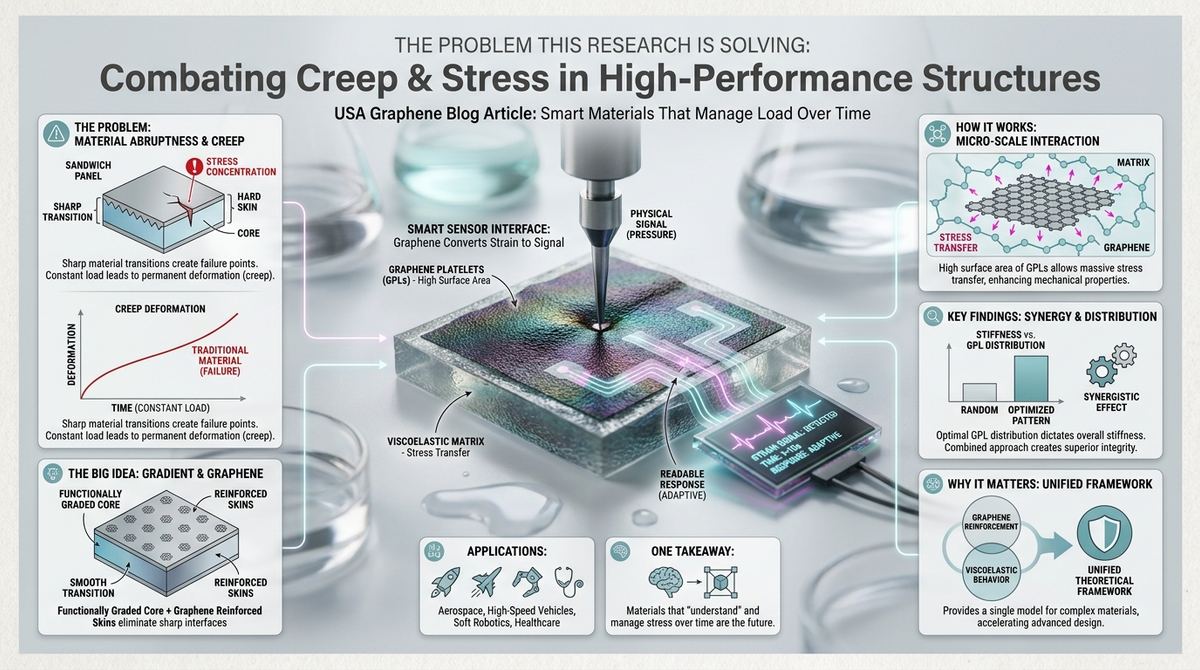
Imagine a structure that does not merely withstand pressure but understands how to manage it over time. In the world of aerospace and high-performance engineering, materials are constantly fighting a battle against time and force. Traditional materials often suffer from creep, a slow, permanent deformation that occurs when a constant load is applied for a long duration. As we demand lighter, stronger, and more reliable structures for spacecraft and high-speed vehicles, the old ways of building sandwich panels are no longer sufficient. The groundbreaking research conducted by Mahan Mahdavi and A. Alibeigloo offers a new way forward by combining the incredible strength of graphene with the smart, adaptive nature of functionally graded materials. Their work provides a mathematical roadmap for designing panels that can survive the relentless, time-dependent stresses of the modern world.
Most modern lightweight structures rely on a sandwich design: two strong outer skins protecting a lightweight core. While effective, these traditional designs face two massive hurdles. First, there is the issue of material abruptness. In a standard sandwich panel, there is a sharp transition between the stiff outer skin and the soft inner core. This sudden change in material properties creates stress concentrations at the interface, which are often the birthplaces of structural failure and delamination. When a material is pushed to its limit, these stress points become cracks that propagate through the structure.
Second, there is the challenge of viscoelasticity. Many high-performance cores are viscoelastic, meaning they exhibit properties of both a liquid and a solid. Unlike purely elastic materials that snap back to their original shape immediately after a load is removed, viscoelastic materials undergo time-dependent deformation. This means the material's response depends on how long the load has been applied. For engineers, predicting how a plane's fuselage or a satellite's component will behave after ten years of constant pressure is an incredibly complex mathematical nightmare. Current models often struggle to capture the interplay between the strength of the skin and the time-varying behavior of the core.
The solution proposed by Mahdavi and Alibeigloo is to stop thinking of materials as static and start thinking of them as gradients. Instead of having a sudden jump from a hard skin to a soft core, they propose a functionally graded core. This means the material properties change smoothly through the thickness of the panel, much like the density of the atmosphere changes as you climb a mountain. This smoothness eliminates the sharp stress points that lead to failure.
To make these panels even tougher, the researchers suggest reinforcing the outer skins with graphene platelets. Graphene is a single layer of carbon atoms that is incredibly strong and stiff. By embedding these platelets into the skin, the entire structure becomes much more resistant to deformation. By combining these two concepts—the smooth, time-dependent core and the ultra-strong graphene skins—the researchers have created a theoretical framework that can predict exactly how a complex, multi-layered structure will behave under pressure over any period of time.
To understand why this system works, we have to look at the micro-scale interaction between the graphene platelets and the host material. When graphene platelets (GPLs) are added to a composite face sheet, they do not just sit there; they fundamentally change the mechanics of the material. Because graphene has an enormous surface-area-to-volume ratio, it creates a massive amount of interfacial area within the composite. When a load is applied to the panel, the stress must travel through the polymer matrix to reach the graphene. The high interfacial shear strength between the graphene and the matrix allows for efficient load transfer. Essentially, the graphene platelets act as structural bridges, carrying the bulk of the stress and preventing the polymer matrix from deforming.
The functional grading in the core adds another layer of complexity and benefit. In a functionally graded viscoelastic (FGVE) core, the material properties are not uniform. Instead, they are mathematically distributed through the thickness of the panel. This distribution is often modeled using a power-law function, which allows engineers to "tune" the core. By making the core stiffer near the skin and more compliant in the center, the internal stress distribution becomes much more uniform.
The time-dependent nature of the core is handled through a concept called the Boltzmann superposition principle. This principle allows scientists to account for the material's "memory." Every time a load is applied or removed, the material "remembers" that event, and its current state is a summation of all previous loading events. To make this solvable, the researchers used a Prony-series representation, which breaks down complex, continuous time-dependent behavior into a series of simpler, discrete exponential functions. By moving the entire problem into the Laplace domain—a mathematical space used to simplify differential equations—they were able to transform difficult time-related calculus into much simpler algebraic equations.
The research yielded several critical insights into how these variables interact. One of the primary findings was the significant impact of the graphene platelet distribution. The study showed that it is not enough to simply add graphene; the pattern in which it is distributed within the face sheets dictates the overall stiffness and stability of the panel. The research demonstrated that the combination of graphene reinforcement and functional grading creates a synergistic effect, where the strength of the skin and the adaptive nature of the core work together to provide superior structural integrity compared to non-graded or non-graphene reinforced versions.
The study also explored how different boundary conditions—the ways the edges of the panel are supported—change the outcome. For example, a panel that is clamped tightly on all sides (clamped) behaves very differently under pressure than a panel that is merely resting on supports (simply supported). The researchers used the Differential Quadrature Method (DQM) to solve these complex equations for general boundary conditions, proving that their mathematical framework could accurately predict the behavior of even the most complex structural setups. They also found that the length-to-radius ratio, which describes the curvature of a structure, plays a vital role in how the panel handles static pressure, making this data essential for designing curved surfaces like aircraft fuselages.
This research is vital because it provides a "unified theoretical framework." Before this study, researchers had to look at graphene reinforcement and viscoelastic core behavior as two separate problems. This study was the first to combine them into one cohesive mathematical model. For engineers, this means they no longer have to guess how a graphene-reinforced skin will interact with a creeping, time-dependent core. They can now simulate the entire system with high precision.
The ability to predict time-dependent responses means that we can build structures that are lighter but also more predictable over their entire lifespan. In industries where failure is not an option, such as aerospace or deep-sea exploration, having a mathematical guarantee of how a material will behave after years of constant pressure is the difference between a successful mission and a catastrophic disaster. This research moves us closer to "smart" structures that are designed with their entire lifecycle in mind.
While the theoretical results are highly promising, it is important to recognize that this is a mathematical and computational study. The research provides a framework, not a finished commercial product. One major limitation is the assumption of perfect graphene dispersion. In a real-world manufacturing environment, graphene platelets have a tendency to clump together, a phenomenon known as agglomeration. If the graphene is not perfectly distributed, the benefits described in this study may be significantly diminished.
Furthermore, the study focuses on static pressure and time-dependent viscoelasticity, but real-world structures are often subjected to much more complex forces. Thermal fluctuations, moisture absorption, and cyclic fatigue (repeated loading and unloading) all play massive roles in how materials fail. Future research will need to integrate these environmental factors into the existing framework to create a truly comprehensive model for real-world deployment.
The implications of this research extend across several high-stakes industries. In the aerospace sector, these panels could be used for aircraft skins and fuselage components. A lighter, stronger, and more predictable skin allows for increased fuel efficiency and higher safety margins. Space exploration also stands to benefit, as satellite components must withstand constant vacuum and pressure stresses over many years without changing shape.
In the automotive industry, especially as we move toward electric vehicles that require extreme lightweighting to offset battery weight, these functionally graded sandwich panels could be used in chassis components or structural body panels. They offer a way to increase vehicle durability while reducing overall mass. Additionally, the vibration-dampening properties inherent in viscoelastic cores make these panels excellent candidates for noise-vibration-harshness (NVH) mitigation in high-performance machinery and luxury transportation.
If you take away only one thing from this research, let it be this: the future of high-performance materials lies in the transition from "static" materials to "graded" and "reinforced" systems. By smoothing out the transitions between different materials through functional grading and boosting strength with graphene, we can create structures that are not just stronger, but more resilient to the slow, creeping pressures of time.
What is a sandwich panel?
A sandwich panel is a structural component made of three layers: two thin, high-strength outer layers called face sheets, and a thicker, lightweight middle layer called the core. This design provides a much higher strength-to-weight ratio than a single solid sheet of the same weight, making it ideal for lightweight construction.
What does viscoelastic mean?
Viscoelasticity describes a material that has both viscous (liquid-like) and elastic (solid-like) properties. While a purely elastic material returns to its original shape instantly, a viscoelastic material undergoes slow, time-dependent deformation when a load is applied, a process often referred to as creep.
Why is graphene so important for these panels?
Graphene is a single layer of carbon atoms that is incredibly strong and stiff. When it is added to a composite, it creates a massive amount of surface area that allows for much better load transfer between the material's matrix and the reinforcement, significantly increasing the overall stiffness and strength of the structure.
What is functional grading?
Functional grading is the practice of gradually changing the composition or properties of a material through its thickness. Instead of having a sharp boundary between two different materials, the properties change smoothly, which helps to prevent stress concentrations and structural failure.
Why do researchers use mathematical models like the Laplace domain?
Many physical processes, such as the time-dependent deformation of a core, are described by very complex calculus equations that are difficult to solve directly. By using mathematical transformations like the Laplace domain, researchers can turn these difficult equations into simpler algebraic ones, allowing for much faster and more accurate computer simulations.
The research by Mahan Mahdavi and A. Alibeigloo represents a significant leap forward in computational mechanics. By successfully unifying the study of graphene-reinforced skins and functionally graded viscoelastic cores, they have provided a tool that can predict the complex, time-dependent behavior of next-generation structural materials. As we push the boundaries of aerospace and automotive engineering, the ability to design materials that are both incredibly strong and intelligently graded will be the key to building a safer, lighter, and more resilient future.
END_OF_ARTICLE
Serious about B2B integration? Test our premium Pulsed Electrical Resistive Carbon Heating turbostratic graphene in your lab. 100g sample packs available now.
Explore More
Researchers derived the first exact formula for resistivity in the 1D infinite-U Hubbard model, providing a crucial benchmark for understanding strongly...

Learn how to utilize bipartite-lattice symmetry to generate pure spin shift currents in graphene nanoribbons for advanced spintronic device prototyping.

Researchers propose a novel method to detect spin- and valley-polarized states in van der Waals materials, a key step for next-gen spintronics and...