
Detection of spin- and valley-polarized states in van der Waals materials via
Researchers propose a novel method to detect spin- and valley-polarized states in van der Waals materials, a key step for next-gen spintronics and...
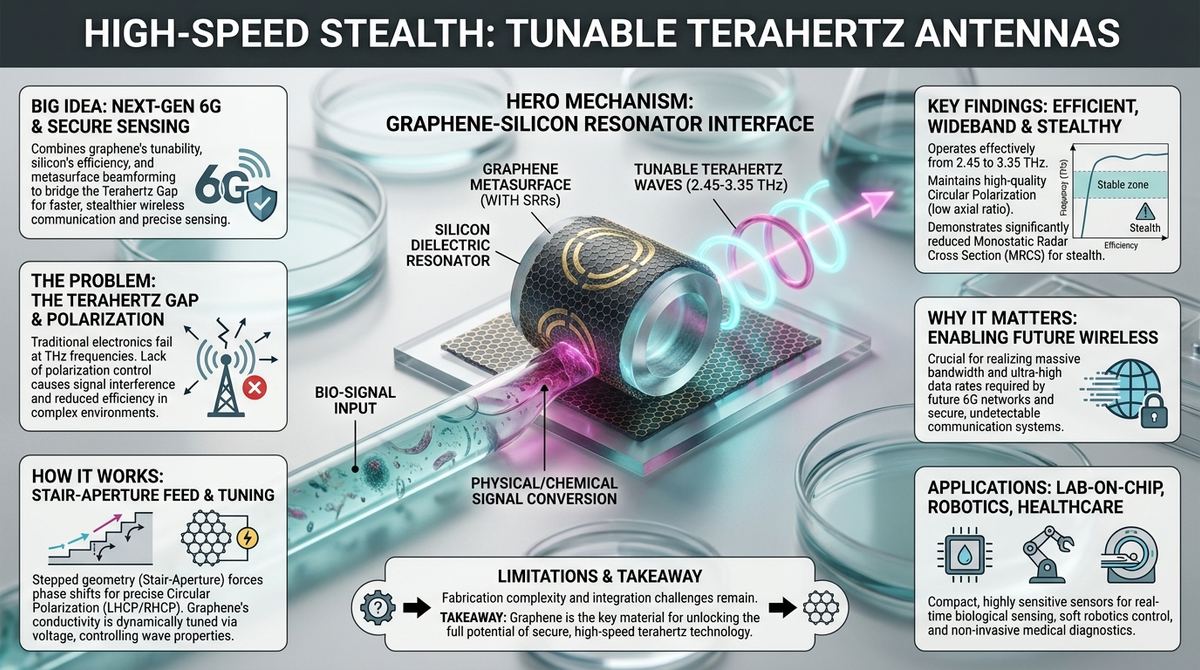
Imagine a world where wireless data moves at speeds that make our current fiber-optic networks look sluggish, and where communication is so secure that even the most advanced radar cannot detect the devices transmitting the signal. This is the promise of the terahertz (THz) regime, a frequency band that sits just below infrared light. As we transition toward 6G technology, we face a massive engineering hurdle: how do we control these incredibly high-frequency waves so they are both highly directional and virtually invisible to unintended observers? This is the fundamental challenge that the recent work of Dinesh Kumar Prabhakar, Krishna Kanth Varma Penmatsa, Khushboo Pachori, Ravikiran Huliyurdurga Nagesh, Shivesh Tripathi, Kuldip Singh, and Ashish Pandey aims to solve. By merging the unique properties of silicon with the tunable conductivity of graphene, these researchers have developed a multi-port antenna that can switch polarizations and hide from radar simultaneously.
As communication technology moves into the terahertz spectrum, engineers encounter a phenomenon often referred to as the Terahertz Gap. In this frequency range, traditional electronic components struggle to keep up, and the physical behavior of electromagnetic waves becomes much more sensitive to the materials they encounter. One of the most significant issues is the lack of precise control over wave polarization. Most standard antennas emit linear waves, but in complex environments where signals might bounce off walls or objects, linear waves can cause massive interference. To combat this, we need antennas that can emit circular polarization, specifically Left-Handed Circular Polarization (LHCP) and Right-Handed Circular Polarization (RHCP). This allows the signal to maintain its integrity even after multiple reflections.
Another critical problem is the Radar Cross Section (RCS). In security-sensitive applications, such as stealth communication or sensitive sensing, an antenna that reflects a significant amount of energy back to its source is a liability. If an antenna reflects too much energy, it becomes a beacon for radar systems, making the device easy to detect. Current antenna designs often suffer from high monostatic RCS, meaning they reflect energy directly back toward the transmitter. Furthermore, in multi-port antennas, which are necessary for advanced data multiplexing, there is a constant struggle with signal leakage, known as coupling. When the signal from one port leaks into another, it creates noise and reduces the overall efficiency of the system.
The researchers proposed a solution that combines three advanced concepts: a dielectric resonator, a metasurface, and graphene. Instead of using standard metal wires that might be too bulky or inefficient at terahertz frequencies, they used a cylindrical silicon resonator. Think of this as a specialized glass-like cylinder that can hold and shape electromagnetic energy. To control the waves, they added a metasurface—an artificial layer of engineered patterns called Split-Ring Resonators (SRRs). These patterns act like a microscopic obstacle course that can redirect or filter waves.
The "magic" ingredient here is graphene. Graphene is a single layer of carbon atoms that is incredibly conductive. Because its conductivity can be changed by applying an external electrical voltage, it allows the antenna to be tunable. This means the antenna can change its behavior on the fly. By combining the shape of the silicon cylinder with the programmable nature of the graphene-loaded metasurface, the researchers created a device that can switch between different polarizations while significantly reducing the amount of signal that bounces back to a radar.
To understand how this system works, we must look at the mechanics of the stair-aperture feed. Rather than sending a signal through a simple hole, the researchers used a stepped or "stair" geometry. As the electromagnetic wave travels through these steps, the physical structure forces a phase shift in the wave. In electromagnetic theory, circular polarization is achieved when two perpendicular waves are out of phase by exactly 90 degrees. The stair-aperture feed acts as a geometric transformer that creates this precise phase difference, allowing the antenna to produce both LHCP and RHCP signals.
Once the wave enters the cylindrical silicon dielectric resonator, the energy is concentrated. Silicon is an ideal material for this because it has low loss at high frequencies, meaning it does not absorb the signal energy and turn it into heat too quickly. This concentration allows for a very strong, directed radiation pattern. To prevent the two ports of the antenna from interfering with each other, the researchers implemented a mirror-oriented aperture arrangement. By mirroring the physical openings for the two terminals, the electromagnetic fields are spatially separated in a way that minimizes coupling. This geometric symmetry ensures that the signal in terminal-1 remains distinct from terminal-2, achieving an isolation of 30 dB.
The most advanced feature, however, is the metasurface composed of Split-Ring Resonators (SRRs). Each SRR is a tiny ring with a small gap in it. When an electromagnetic wave hits this gap, it induces a current that creates a secondary electromagnetic field. This secondary field can be used to cancel out or redirect the original wave. By loading these SRRs with graphene, the researchers can control the antenna's response. Because graphene's electron density can be manipulated, the capacitance and inductance of the SRRs change. This change in electrical properties shifts the resonant frequency of the metasurface, effectively allowing the user to tune how the antenna reacts to specific frequencies. This tuning is what allows the device to achieve such high performance across a wide bandwidth.
The experimental results of this design are highly promising for the future of high-frequency communications. The antenna operates effectively within a wide frequency range of 2.45 to 3.35 THz. Within this range, it maintains a high-quality circular polarization, characterized by a 3-dB axial ratio between 2.65 and 3.15 THz. A low axial ratio is a key indicator of how "pure" the circular polarization is, and these results suggest the antenna is highly reliable for complex signal transmission.
In terms of stealth and interference, the design met its objectives remarkably well. The monostatic Radar Cross Section (MRCS) was reduced by approximately 30 dBsm within the operational band. To put that in perspective, a 30 dB reduction means that the reflected signal is ten hundred times (one thousand times) weaker than it would be without the metasurface. Additionally, the isolation between the two ports was improved by 30 dB, ensuring that the multi-port functionality does not lead to signal degradation or noise. This combination of high isolation, high polarization purity, and low reflectivity makes this a highly versatile component for complex electromagnetic environments.
The implications of this research are vast, particularly as we move toward the realization of 6G networks. Future wireless standards will require massive bandwidth and extremely high data rates, necessitating the move into the terahertz spectrum. An antenna that can switch between LHCP and RHCP allows for more sophisticated "frequency reuse" and polarization division multiplexing, meaning more data can be packed into the same frequency space.
Furthermore, the reduction in RCS is a breakthrough for secure sensing. As we deploy more autonomous sensors in smart cities or industrial environments, we need devices that can sense their surroundings without creating electromagnetic pollution or becoming targets for interception. A low-RCS antenna allows for "stealthy" sensing, where the presence of the sensor itself does not interfere with the environment or reveal its location to unauthorized radar systems. This makes the technology invaluable for high-precision imaging, secure military communications, and even medical diagnostic tools that require high-frequency waves to penetrate biological tissues.
While the results presented are significant, it is important to recognize that this technology is still in the developmental and research phase. The primary challenge lies in the manufacturing and scalability of such complex structures. Fabricating split-ring resonators at the sub-millimeter scale and integrating them with a single layer of graphene requires extremely high-precision lithography. Scaling this up for mass production in consumer electronics would be a significant engineering feat and would likely be quite expensive in its current state.
Additionally, the material loss in silicon and the resistance within the graphene layer can become problematic at even higher frequencies. While this design works well up to 3.35 THz, moving higher into the spectrum may require even more advanced materials to prevent signal attenuation. Further testing is also required to see how this antenna performs in real-world, non-laboratory environments where temperature fluctuations or physical vibrations might affect the delicate graphene-silicon interface.
The potential real-world applications for this technology are diverse. In the realm of telecommunications, this antenna could serve as a cornerstone for 6G base stations, providing the high-speed, multi-polarized connections required for holographic communication and ultra-low latency applications. In the field of defense and aerospace, the low-RCS capability is essential for stealth communication modules in aircraft and drones, allowing them to transmit data without being detected by enemy radar.
Medical imaging is another frontier. Terahertz waves are non-ionizing, meaning they do not damage biological tissue like X-rays do. An antenna with these characteristics could be used in advanced skin cancer detection or dental imaging, where high precision and the ability to control polarization are required to distinguish between different types of biological structures. Finally, in industrial automation, these antennas could facilitate highly accurate, non-destructive testing of materials, allowing for real-time inspection of micro-circuitry in high-speed manufacturing lines.
If you take only one takeaway from this research, let it be that the combination of silicon and graphene enables a "programmable" antenna that can simultaneously be both a high-performance communicator and a stealthy, low-profile device, bridging the gap between current technology and the future of terahertz communications.
What exactly is a metasurface and why is it useful?
A metasurface is an artificial, engineered surface designed to manipulate electromagnetic waves in ways that natural materials cannot. By using tiny, specifically shaped structures like split-ring resonators, scientists can control the phase, amplitude, and polarization of a wave. This allows for the creation of "smart" surfaces that can direct signals or hide objects from radar.
Why is circular polarization important for high-frequency communication?
Linear polarization involves waves that oscillate in a single plane, which can lead to interference when waves bounce off surfaces. Circular polarization involves waves that rotate as they travel, which helps the signal maintain its integrity even after it has reflected off objects. This is crucial for ensuring reliable connections in complex environments like cities or industrial plants.
What is the significance of Radar Cross Section (RCS) reduction?
Radar Cross Section is a measure of how much electromagnetic energy an object reflects back to a radar source. A high RCS makes an object easy to detect. By reducing the RCS, as this research has done, we make a device "stealthy," meaning it can operate without being detected by radar-based sensing or surveillance systems.
How does graphene make the antenna "tunable"?
Graphene is a unique material because its electrical conductivity can be altered by changing the density of its electrons, often through an external electrical charge. Since the resonance of the metasurface depends on the conductivity of the material it is made of, adding graphene allows us to "tune" the antenna's behavior, effectively changing how it interacts with waves by simply adjusting an electrical input.
What is the Terahertz (THz) frequency range?
The Terahertz range refers to the part of the electromagnetic spectrum that lies between the microwave frequencies used by current Wi-Fi and the infrared frequencies used in thermal imaging. It is a high-energy, high-frequency band that offers massive bandwidth, making it the most likely candidate for the next generation of ultra-fast wireless communication known as 6G.
The research conducted by Dinesh Kumar Prabhakar and the team represents a significant step forward in the mastery of the terahertz spectrum. By moving away from traditional, static antenna designs and embracing the dynamic possibilities of graphene and silicon, they have demonstrated that it is possible to achieve high-speed, multi-port communication without sacrificing stealth or signal purity. As we move closer to an era of 6G and advanced sensing, the ability to control light-like waves with such precision will be the difference between a cluttered, noisy wireless world and a seamless, secure, and lightning-fast digital future.
Serious about B2B integration? Test our premium Pulsed Electrical Resistive Carbon Heating turbostratic graphene in your lab. 100g sample packs available now.
Explore More
Researchers propose a novel method to detect spin- and valley-polarized states in van der Waals materials, a key step for next-gen spintronics and...

Researchers developed the CARBON-2D Topological Descriptor (C2DTD), an interpretable, physics-informed method to rapidly predict the properties of new 2D...

Learn how to create p-n junctions in graphene by selectively oxidizing the underlying germanium substrate. This guide covers a practical method for...