
Detection of spin- and valley-polarized states in van der Waals materials via
Researchers propose a novel method to detect spin- and valley-polarized states in van der Waals materials, a key step for next-gen spintronics and...
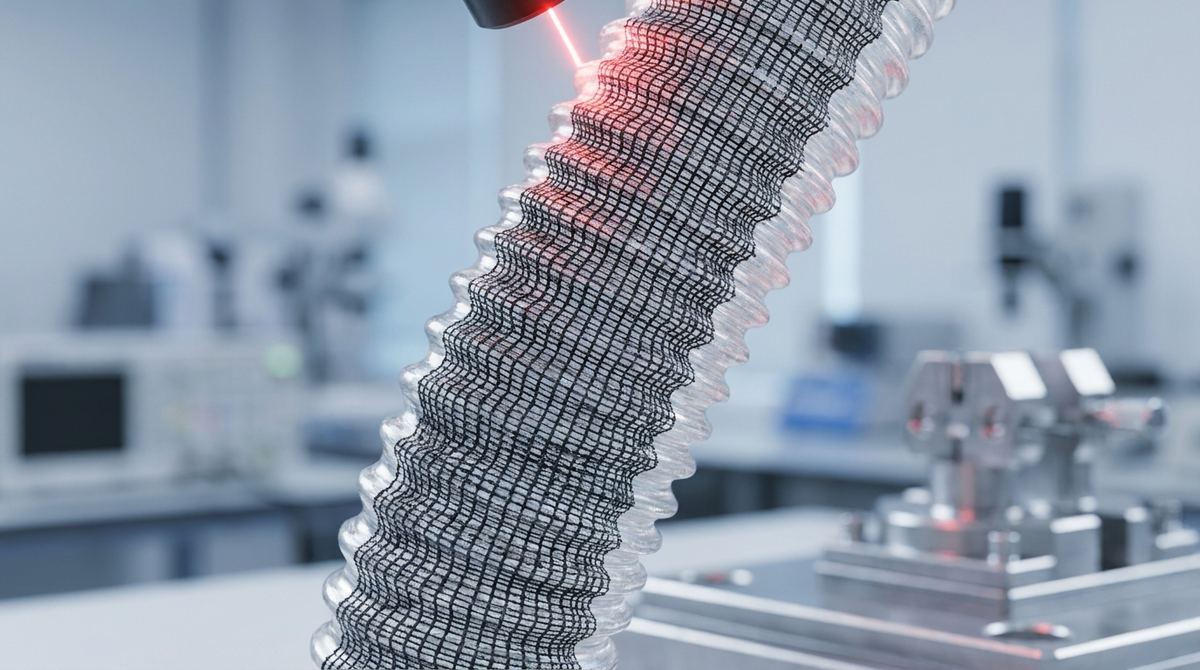
Continuum robots represent a significant shift from traditional rigid-link robotics. Instead of discrete joints and links, these robots consist of continuous, flexible structures that can bend and twist in multiple directions. This inherent compliance makes them ideal for minimally invasive surgery and navigating complex, tight spaces in industrial environments. However, this very flexibility introduces a massive engineering hurdle: shape sensing.
In a rigid robot, the position of the end-effector is easily calculated via forward kinematics because the joint angles are known. In a continuum robot, the structure can deform in ways that are difficult to track using external imaging alone. While optical or magnetic sensing are common, they often require bulky external hardware or complex sensor integration that can compromise the robot's flexibility.
The research by Rothe, Malhotra, and Desai offers a solution through Direct Laser Writing (DLW). The concept is to use a laser to induce carbonization within a polymer substrate, effectively turning the robot's own structural material into a conductive graphene-based strain sensor. This creates a monolithic structure where the sensor and the joint are a single, integrated component.
To replicate this approach in a lab or startup environment, you must move away from traditional component assembly and toward material-level modification. Because the exact polymer and laser settings are not specified in the source research, the following hardware stack is proposed based on standard soft robotics practices.
Substrate Materials:
The substrate must be a polymer capable of undergoing controlled carbonization without complete structural failure. Polydimethylsiloxane (PDMS) is the industry standard for soft robotics, but it is notoriously difficult to carbonize via laser. A more accessible starting point for prototyping is Thermoplastic Polyurethane (TPU). TPU is easier to process with common lasers and provides a more robust carbonization response.
Laser System:
The research utilizes Direct Laser Writing (DLW). For high-precision applications, a UV laser is preferred due to its short wavelength and ability to induce localized photothermal conversion. However, for a maker or small lab, a CO2 laser can be used, provided the scan speed is high enough to prevent excessive thermal damage to the surrounding polymer.
Signal Conditioning and Data Acquisition:
The change in resistance in a graphene-based strain sensor is often minute. To achieve the precision mentioned in the research (error below 2 degrees), you cannot rely on a standard Arduino analog pin. You will need a high-resolution Analog-to-Digital Converter (ADC), such as the ADS1115 (16-bit), to capture the subtle voltage shifts.
The goal is to create a conductive pattern within the polymer that changes resistance as the polymer bends.
Step 1: Geometric Design
The sensor pattern should be designed as a serpentine or meander geometry. A straight line is highly susceptible to fracture. A serpentine pattern allows the conductive graphene path to undergo significant strain by uncoiling slightly as the joint bends, which increases the sensitivity and the functional range of the sensor.
Step 2: Laser Parameter Calibration
This is the most critical and difficult step. You must find the sweet spot where the laser provides enough energy to carbonize the polymer into graphene but not enough to vaporize the material entirely.
Since exact values are not provided in the source, use the following cautious starting range for a CO2 laser on TPU:
- Power: 5% to 15% of maximum output.
- Scan Speed: 500 mm/s to 2000 mm/s.
- Frequency: 10 kHz to 50 kHz.
You must perform a series of test passes on small coupons of your material. After each pass, check the conductivity with a multimeter. If the resistance is infinite, increase the power slightly. If the material is visibly burnt or a hole is formed, increase the scan speed.
Step 3: Patterning the Sensor
Once the parameters are calibrated, use the laser to trace your serpentine pattern directly onto or into the surface of the polymer joint. The result should be a black, conductive trace that is chemically and physically continuous with the substrate.
Step 4: Electrical Interfacing
Connecting a flexible, carbonized trace to traditional wires is a common failure point. To avoid mechanical stress at the connection point, use conductive silver epoxy to create a bridge between the graphene pattern and your copper lead wires.
Once the monolithic sensor is fabricated, you must validate its performance through two distinct phases: static characterization and dynamic tracking.
Static Characterization:
Mount the joint in a jig that allows for controlled bending. As the joint bends through a known angle (measured via an external high-precision optical tracker), record the change in resistance.
The research notes that both linear and nonlinear models are required. For very small deformations, a linear relationship (Resistance vs. Angle) may suffice. However, as the bend angle increases, the relationship typically becomes nonlinear. You should use a polynomial regression to create a mathematical model that maps resistance to angle. This model is what your microcontroller will use to interpret the sensor data.
Dynamic Tracking and Closed-Loop Control:
To implement the closed-loop control mentioned in the research, the sensor must be integrated into a feedback loop. The sensor provides the real-time angle, which is compared to the target angle in a PID (Proportional-Integral-Derivative) controller. The research demonstrates that this method can achieve a tracking error of under 3 degrees, making it highly viable for precision robotic tasks.
When implementing this technology, be aware of the following risks:
Thermal Damage and Structural Integrity:
The laser energy required to create graphene is very close to the energy that causes polymer degradation. If the laser parameters are too high, you will create micro-cracks in the polymer structure, leading to premature fatigue failure of the robotic joint.
Hysteresis and Creep:
Polymers are viscoelastic. This means the sensor may not return to its original resistance immediately after the bend is released. This hysteresis can lead to significant errors in shape sensing. You may need to implement a compensation algorithm in your software to account for this time-dependent behavior.
Signal Noise and Impedance:
The resistance of the graphene pattern will change with temperature and mechanical loading. Because the signal is small, electromagnetic interference (EMI) from nearby motors can introduce significant noise. Using shielded cables and high-resolution ADCs is essential for achieving the < 1.76-degree error reported in the source.
This guide is based on the research findings presented in:
Shape Sensing of Continuum Robots using Direct Laser Writing
Authors: Amber K. Rothe, Nidhi Malhotra, Jaydev P. Desai
Published: June 2026
Key findings utilized: Monolithic sensor fabrication via DLW, error rates for static and closed-loop sensing, and the necessity of linear/nonlinear modeling.
Serious about B2B integration? Test our premium Pulsed Electrical Resistive Carbon Heating turbostratic graphene in your lab. 100g sample packs available now.
Explore More
Researchers propose a novel method to detect spin- and valley-polarized states in van der Waals materials, a key step for next-gen spintronics and...

Researchers developed the CARBON-2D Topological Descriptor (C2DTD), an interpretable, physics-informed method to rapidly predict the properties of new 2D...

Learn how to create p-n junctions in graphene by selectively oxidizing the underlying germanium substrate. This guide covers a practical method for...