
Generalized Beth-Uhlenbeck Model for Graphene Electronics
Researchers use the Generalized Beth-Uhlenbeck approach to model electron interactions in 2D materials, offering a new way to predict graphene's behavior.
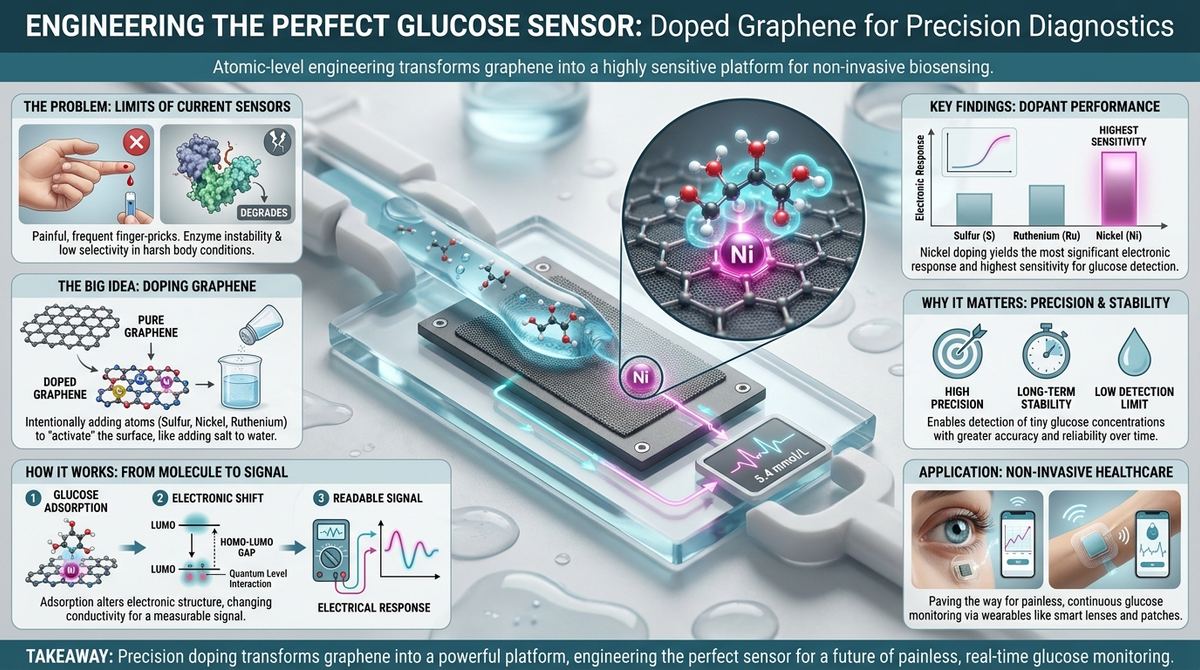
Imagine a world where managing diabetes no longer requires the sharp sting of a needle or the inconvenience of frequent finger-prick tests. Instead, a tiny, painless sensor integrated into a contact lens or a wearable patch provides real-time, continuous glucose readings directly to your smartphone. This future of non-invasive healthcare relies heavily on our ability to detect tiny concentrations of glucose with extreme precision. In a recent groundbreaking investigation, Saja Hameem Kareem, Hasan Ali Dhahi, and Valeria Suárez explored how we can engineer materials at the atomic level to make this level of sensitivity possible. Their study focuses on graphene, a material often called the wonder material of the 21st century, and specifically how we can "tune" it to become a master glucose detector.
For millions of people living with diabetes, monitoring blood glucose levels is a constant, repetitive necessity. Current standard methods often rely on electrochemical sensors that use enzymes to react with glucose. While effective, these enzyme-based sensors face significant hurdles. Enzymes are biological molecules that are inherently unstable; they can degrade over time due to temperature fluctuations, changes in pH, or the harsh chemical environment within the human body. Furthermore, many current sensors struggle with selectivity, meaning they might accidentally react to other sugars or substances in the blood, leading to inaccurate readings.
There is a pressing need for a sensor that is more robust, more stable, and significantly more sensitive. We need a platform that does not rely on fragile biological proteins but instead uses solid-state materials that can provide a clear, measurable electrical signal the moment a glucose molecule touches the surface. This is where graphene enters the conversation. While graphene is incredibly conductive and has a massive surface area, pure graphene is somewhat chemically "lazy." It does not naturally react strongly with glucose, making it difficult to detect the sugar's presence through simple electrical changes. To make graphene a world-class sensor, we have to find a way to make it more "reactive" without losing its incredible electrical properties.
The researchers approached this problem by using a technique called doping. In the world of materials science, doping is the process of intentionally adding a tiny amount of "impurities" into a pure substance to change its properties. Think of it like adding a pinch of salt to water; the water is still mostly water, but its properties have changed. By injecting specific atoms—in this case, sulfur, nickel, or ruthenium—into the hexagonal lattice of graphene, the researchers were able to "activate" the surface.
These dopants act as specialized landing pads for glucose molecules. When a glucose molecule approaches a doped graphene sheet, the dopant atom creates a localized area of intense electronic activity. This interaction causes a shift in how electricity flows through the graphene. Because graphene is so sensitive to its environment, this tiny shift in electron flow can be measured as a change in electrical resistance. By measuring that change, we can accurately determine exactly how much glucose is present. The goal was to find which dopant creates the strongest, most stable, and most readable signal.
To understand how these sensors work, we have to look at the intersection of quantum chemistry and electrical conductivity. The researchers utilized two primary advanced computational methods: Density Functional Theory (DFT) and Molecular Dynamics (MD). DFT allows us to look at the "quantum" level, calculating the behavior of electrons and how they shift when molecules interact. Molecular Dynamics allows us to look at the "movement" level, simulating how atoms vibrate and behave over time to ensure the system remains stable.
When a glucose molecule approaches the doped graphene, a process called adsorption occurs. This is not just a physical sticking; it is a chemical interaction where the electron clouds of the glucose molecule and the dopant atom begin to overlap. This overlap causes a charge transfer, where electrons move from the glucose to the graphene or vice versa. This movement of charge is the "signal."
In pure graphene, this charge transfer is minimal because the carbon atoms are satisfied in their stable configuration. However, when we introduce a transition metal like nickel or ruthenium, we disrupt that perfect stability. These metal atoms have "d-orbitals" containing electrons that are much more willing to interact with the glucose molecule. This interaction alters the electronic structure of the entire graphene sheet, shifting its Fermi level—the energy level up to which electronic states are filled. A shift in the Fermi level directly translates to a change in the material's electrical conductivity, providing the measurable signal required for sensing.
The study yielded fascinating insights into how different dopants change the graphene's personality. The researchers found that doping significantly influences the electronic response, but not all dopants are created equal. The study looked at the energy gap, specifically the gap between the Highest Occupied Molecular Orbital (HOMO) and the Lowest Unoccupied Molecular Orbital (LUMO). This gap is a critical indicator of a material's reactivity.
The results showed that the introduction of sulfur, nickel, and ruthenium atoms successfully altered the electronic landscape of the graphene. While sulfur provided some changes, the transition metals—nickel and ruthenium—offered much more dramatic electronic responses. Specifically, the nickel-doped graphene emerged as a standout performer. The researchers observed that nickel-doped graphene exhibited a remarkable electronic response following glucose adsorption. This means that the electrical signal produced when glucose touches nickel-doped graphene was strong and distinct.
Furthermore, the researchers were looking for a "balanced" adsorption-de-adsorption behavior. In sensor design, you do not want the glucose to stick so tightly that the sensor becomes permanently saturated (which would make it useless after one use), nor do you want it to be so loose that it flies off before a measurement can be taken. The nickel-doped system provided a highly favorable balance, showing that the interaction was strong enough to be detected but maintained a structural stability that the molecular dynamics simulations confirmed would hold up under thermal stress.
The implications of finding a "perfect" dopant like nickel are profound for the field of biosensing. When a material shows a high electronic response to a specific molecule, it means the sensor can operate at much lower concentrations of that molecule. This is the difference between detecting high blood sugar and detecting the subtle, early-onset shifts in glucose that could prevent a medical emergency.
Because the nickel-doped graphene showed such high stability in the molecular dynamics simulations, it suggests that these sensors could be more durable. A sensor that is stable across different temperatures and doesn't degrade quickly is much more useful for real-world, long-term monitoring. By understanding the exact electronic mechanisms—how the density of states shifts and how the Fermi level moves—engineers can move away from trial-and-error testing and toward "design-by-intent," where we build sensors atom-by-atom to meet specific medical needs.
While these results are incredibly promising, it is important to recognize that this was a computational study. The researchers used high-level mathematical models to simulate how these atoms interact. While these models are incredibly accurate, they are still simulations. We have not yet seen a nickel-doped graphene sensor being used in a clinical setting or even a physical laboratory test involving real human blood.
There are several hurdles to overcome before this reaches a pharmacy shelf. First, real-world biological fluids are "messy." Blood, sweat, and tears contain hundreds of different proteins, ions, and other sugars like galactose or fructose. A major next step is testing how these doped graphene systems perform in a complex mixture to ensure they are truly selective for glucose and won't give a "false positive" due to other substances. Second, the manufacturing process for integrating individual atoms of nickel or ruthenium into a graphene lattice with perfect precision is an immense engineering challenge that must be scaled up for mass production.
The potential applications for nickel-doped graphene sensors are vast and span several industries. In the medical field, the most immediate application is the development of next-generation Continuous Glucose Monitors (CGMs). These could move from being wearable patches to being integrated into smart contact lenses, allowing diabetics to monitor their levels through their eyes without any invasive procedures.
Beyond diabetes, this technology could be applied to general wellness and athletic performance tracking. Imagine a smart patch that monitors glucose, lactic acid, and cortisol levels simultaneously to give athletes a real-time map of their metabolic health. In the broader diagnostic field, this level of sensitivity could be used to detect other biomarkers for diseases like cancer or inflammatory conditions, where detecting a tiny amount of a specific molecule early can save lives.
If you take away only one piece of information from this research, let it be this: by adding specific metal atoms like nickel to graphene, we can transform a passive carbon sheet into a highly sensitive, electrically responsive "trap" for glucose, paving the way for non-invasive, real-time health monitoring.
Question: What exactly is graphene and why is it special?
Answer: Graphene is a single layer of carbon atoms arranged in a hexagonal, honeycomb lattice. It is incredibly strong, highly conductive, and has a massive surface area relative to its size, which makes it an ideal platform for sensing various molecules.
Question: Why can't we just use pure graphene for glucose detection?
Answer: Pure graphene is chemically very stable and relatively unreactive. Because it doesn't interact strongly with glucose molecules, the electrical signal produced when glucose touches it is too weak to be easily measured. Doping "breaks" this stability just enough to create a signal.
Question: What is the purpose of "doping" in this context?
Answer: Doping is the intentional introduction of foreign atoms, like nickel or sulfur, into the graphene structure. These dopants act as active sites that change the electronic properties of the graphene, making it much more sensitive to the presence of glucose.
Question: Why was nickel highlighted as a particularly good dopant?
Answer: The research showed that nickel-doped graphene produces a significant electronic response when it encounters glucose. It also demonstrated a balanced interaction, meaning the glucose stays attached long enough to be measured but doesn't permanently clog the sensor surface.
Question: How do these simulations help real-world scientists?
Answer: Simulations like DFT and Molecular Dynamics allow scientists to test how materials behave at a quantum level before they ever enter a lab. This saves immense amounts of time and money by identifying the most promising materials—like nickel-doped graphene—before expensive physical manufacturing begins.
The research conducted by Saja Hameem Kareem, Hasan Ali Dhahi, and Valeria Suárez represents a vital step toward the next generation of medical diagnostics. By combining advanced computational physics with material science, they have demonstrated that the electronic "personality" of graphene can be fine-tuned through doping to achieve remarkable sensitivity. While the transition from a computer simulation to a commercial medical device requires much more testing in complex biological environments, the foundation laid here provides a clear roadmap for the future of non-invasive, real-time health monitoring.
Serious about B2B integration? Test our premium Pulsed Electrical Resistive Carbon Heating turbostratic graphene in your lab. 100g sample packs available now.
Explore More
Researchers use the Generalized Beth-Uhlenbeck approach to model electron interactions in 2D materials, offering a new way to predict graphene's behavior.

Researchers derived the first exact formula for resistivity in the 1D infinite-U Hubbard model, providing a crucial benchmark for understanding strongly...

Learn how to utilize bipartite-lattice symmetry to generate pure spin shift currents in graphene nanoribbons for advanced spintronic device prototyping.