
An Exact Solution for Electron Transport and Resistivity in the Hubbard Model
Researchers derived the first exact formula for resistivity in the 1D infinite-U Hubbard model, providing a crucial benchmark for understanding strongly...
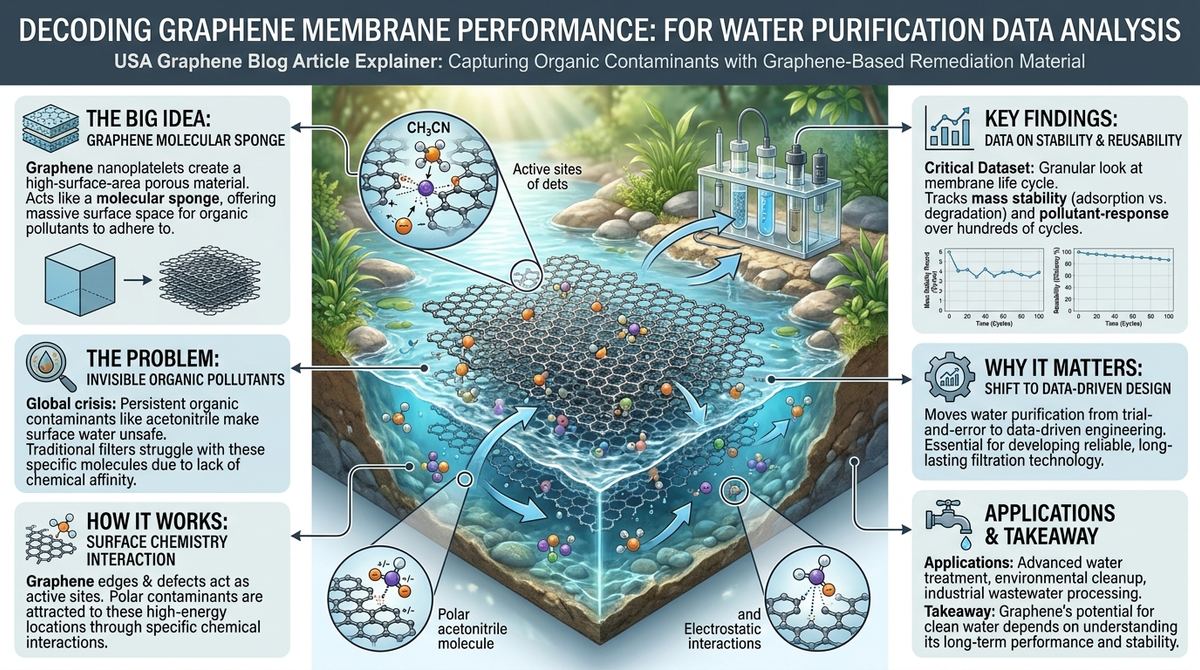
Imagine a world where our most precious resource, fresh water, is protected by a microscopic net so precise it can catch individual molecules of toxic chemicals before they ever reach our taps. This is the promise of nanotechnology, and it is a promise that depends heavily on the data we collect in the lab. To move from a scientific breakthrough to a household reality, engineers need more than just a successful experiment; they need a comprehensive map of how a material behaves over hundreds of cycles of use. This is exactly what the recent work provided by Stefano Bellucci and his team aims to achieve, offering a deep, machine-readable dataset that tracks how graphene-based membranes hold up when faced with organic pollutants. By providing a clear record of how these materials absorb contaminants and how they resist degradation, this research provides the essential roadmap required to turn advanced carbon science into practical, large-scale water treatment solutions.
The global crisis of water contamination is not merely about visible dirt or debris; it is about the invisible, persistent presence of organic pollutants in our surface waters. These pollutants include substances like acetonitrile, which can be byproduct of industrial processes, making water unsafe for drinking, agriculture, or ecosystem stability. Traditional filtration methods, such as sand filters or basic polymer membranes, often struggle with these specific organic molecules because they lack the necessary chemical affinity or the surface area required to capture them effectively.
Even when advanced materials are used, a major hurdle remains: durability and efficiency over time. A filter that works perfectly for one hour but falls apart after ten hours of use is not a viable solution for a city's water treatment plant. Furthermore, the cost of these advanced materials means that they must be reusable. If a membrane becomes saturated with pollutants and cannot be cleaned or regenerated without losing its structural integrity, the economic and environmental cost of replacement becomes prohibitive. We currently lack standardized, high-quality datasets that allow scientists to predict exactly how these new materials will behave under repetitive stress, making it difficult to move from laboratory curiosity to industrial implementation.
At its core, this research focuses on using graphene nanoplatelets to create a highly efficient molecular sponge. Graphene is a single layer of carbon atoms arranged in a hexagonal lattice, but in these filters, it is used in the form of nanoplatelets—tiny, thin flakes that can be layered to create a porous structure. This structure is special because it offers a massive amount of surface area relative to its volume. Think of it like a room filled with thin, overlapping sheets of paper; there is an enormous amount of surface space for something to stick to, even if the total volume of the paper is small.
The key idea is to use these sheets to intercept organic molecules as water flows through them. Instead of just acting as a physical sieve that blocks particles based on size, the graphene surfaces interact with the pollutants on a chemical level. Through a process called adsorption, the molecules of the pollutant cling to the surfaces and edges of the graphene flakes. This research provides the data to prove whether this process is stable, how much the filter can hold, and whether the filter can be "washed" to remove the pollutants so the graphene can be used again and again.
To understand how these filters work, we must look at the relationship between the surface chemistry of graphene and the molecular structure of the contaminant. In this study, acetonitrile serves as the model contaminant. Acetonitrile is a polar organic molecule, meaning it has regions of positive and negative charge. Graphene, while often considered chemically inert, possesses various active sites including defects in the lattice and the edges of the nanoplatelets. These edges are particularly important because they provide high-energy locations where chemical interactions can occur more readily than on the flat, basal planes of the graphene sheets.
When water passes through a membrane made of graphene nanoplatelets, the organic molecules are drawn toward the carbon surfaces. This occurs because the interaction between the organic molecules and the graphene lattice is energetically favorable. As the molecules adhere to the sheets, they essentially "coat" the internal architecture of the membrane. This process is not just about physical trapping; it involves the interplay of van der Waals forces and potentially more complex electronic interactions between the pollutant's molecular orbitals and the graphene's electron cloud.
One of the most sophisticated aspects of this system is the ability to monitor these interactions through impedance. Electrical impedance is a measure of how much a material resists the flow of an electric current. Because graphene is an exceptional conductor, any change in its environment—such as the attachment of organic molecules to its surface—will alter its electrical properties. By measuring these impedance-derived response metrics, researchers can "see" the adsorption process happening in real-time without having to destroy the membrane. This allows for a precise understanding of how the presence of pollutants changes the electrochemical landscape of the filter, providing a direct link between molecular-level adsorption and macro-level electrical signals.
The dataset produced by this research is a granular look at the life cycle of a graphene membrane. Rather than just stating that the membrane works, the data provides a detailed account of mass stability and pollutant-response behavior. One of the most critical findings documented is the mass-stability record. As the membrane is used, it may gain mass as it adsorbs pollutants, but it may also lose mass if the graphene flakes themselves are being washed away by the flow of water. The data allows scientists to distinguish between successful adsorption and structural degradation.
The research also quantifies the reusability of the membranes. By tracking the performance across multiple cycles, the dataset shows how much of the original adsorption capacity remains after the filter has been cleaned. This is a vital metric for determining the economic viability of graphene technology. If the capacity drops significantly after one cleaning cycle, the material is not suitable for long-term use. The data also highlights the correlation between the electrical impedance and the amount of contaminant present, proving that impedance can serve as a reliable proxy for monitoring the saturation level of the filter. This means that in a real-world setting, a sensor could potentially tell an operator exactly when it is time to clean the filter based solely on its electrical signal.
This research matters because it shifts the development of water purification technology from a period of trial-and-error experimentation into an era of data-driven design. In the past, a researcher might create a new membrane and find that it works well in a single lab test, but they might lack the comprehensive data to know how it will behave after six months of continuous operation in a river. This dataset provides that missing piece of the puzzle.
By providing machine-readable data, this work enables the use of computational modeling and machine learning to predict the performance of future graphene-based materials. Engineers can use this information to simulate how different thicknesses of nanoplatelets or different types of defects in the graphene lattice might affect filtration efficiency. This accelerates the innovation cycle, allowing for the rapid development of membranes that are specifically tuned to target the most dangerous organic pollutants while maintaining maximum stability and reusability.
While this research provides a monumental step forward, it is important to recognize the boundaries of the current findings. The study uses acetonitrile as a model contaminant, which is a useful proxy for many organic pollutants, but it does not represent the full complexity of real-world water. In a natural environment, water contains a "matrix" of other substances, including salts, minerals, bacteria, and various other organic matter. These substances can compete with the target pollutants for space on the graphene surface, a phenomenon known as competitive adsorption, which could change the performance metrics seen in a controlled lab setting.
Furthermore, the study focuses on the performance and stability of the nanoplatelets themselves in a highly controlled environment. Real-world water treatment involves significant changes in pressure, temperature, and flow rates over long periods. It remains to be seen how these graphene-based membranes will respond to the mechanical stresses of industrial-scale pumping systems or the chemical stresses of various cleaning agents used to regenerate the filters. The transition from a laboratory-scale nanoplatelet membrane to a robust, industrial-scale filtration unit is a significant engineering challenge that requires further testing in complex, non-idealized environments.
The potential applications for these graphene-based membranes are vast and touch many sectors of the modern economy. In municipal water treatment, these membranes could be integrated into existing systems to provide a final, high-precision barrier against emerging organic contaminants that traditional methods miss. This would ensure a higher standard of safety for drinking water as new industrial chemicals enter the water cycle.
In the industrial sector, factories producing chemicals or pharmaceuticals could use these membranes to treat their effluent before it is discharged into the environment. This would not only ensure compliance with increasingly strict environmental regulations but also allow for the recovery of valuable organic components from waste streams. Additionally, the ability to monitor the membrane's state via electrical impedance could lead to "smart" filtration systems that automatically signal when maintenance is required, reducing operational costs and preventing accidental pollutant breakthroughs.
If you remember only one thing from this research, let it be that the path to advanced water purification lies in the data. The ability to precisely measure, record, and model how graphene interacts with contaminants is what will ultimately turn a laboratory marvel into a reliable, mass-produced tool for protecting the world's water supply.
How does graphene actually catch pollutants in water? Graphene works through a combination of its massive surface area and its unique chemical properties. The tiny flakes, or nanoplatelets, create a complex, layered structure that acts like a high-tech sponge. As water flows through, organic molecules stick to the surfaces and the edges of these flakes through a process called adsorption, where the molecules are attracted to the carbon structure.
Why is acetonitrile used in the study if it is not the only pollutant? Acetonitrile is used as a model contaminant because it is a common organic molecule that is relatively easy to study in a lab. By understanding how a membrane reacts to a known, predictable molecule like acetonitrile, scientists can create a baseline for how the membrane might behave with more complex and dangerous pollutants found in nature.
What is the significance of the electrical impedance measurements? Electrical impedance measures how a material resists an electrical current. Since graphene is highly conductive, the presence of organic molecules sticking to its surface changes its electrical resistance. By tracking these changes, researchers can monitor how much of a pollutant is being captured in real-time without having to physically examine the membrane.
Can these graphene filters be used more than once? One of the main goals of this research is to ensure reusability. The data helps scientists understand if the membrane can be cleaned of pollutants and then reused without losing its structure or its ability to catch more molecules. If a membrane can be regenerated many times, it becomes a much more sustainable and cost-effective solution for water treatment.
Does this research mean we can use graphene in water filters today? Not quite yet. This research provides the essential data and proof-of-concept needed for development. Before these filters can be used in your city's water plant, they must be tested in much more complex environments that mimic real-world water, including the presence of salts, bacteria, and varying pressures, to ensure they are both durable and effective at a large scale.
The transition from laboratory science to real-world application is one of the most difficult phases in material science. Stefano Bellucci and the research team have addressed this challenge by providing a comprehensive dataset that moves the conversation from "can graphene work" to "how can we optimize graphene." By detailing the adsorption performance, stability, and reusability of graphene-based membranes, this work provides the quantitative foundation necessary for the next generation of water purification technologies. As we continue to map the molecular interactions between carbon and contaminants, the dream of highly efficient, smart, and sustainable water filtration becomes closer to reality.
Serious about B2B integration? Test our premium Pulsed Electrical Resistive Carbon Heating turbostratic graphene in your lab. 100g sample packs available now.
Explore More
Researchers derived the first exact formula for resistivity in the 1D infinite-U Hubbard model, providing a crucial benchmark for understanding strongly...

Learn how to utilize bipartite-lattice symmetry to generate pure spin shift currents in graphene nanoribbons for advanced spintronic device prototyping.

Researchers propose a novel method to detect spin- and valley-polarized states in van der Waals materials, a key step for next-gen spintronics and...