
A New Era of Graphene Engineering: Pre-Designing Twist Angles on Demand
Researchers have developed a breakthrough method for growing twisted bilayer graphene with pre-designed angles, a key step toward manufacturable quantum...
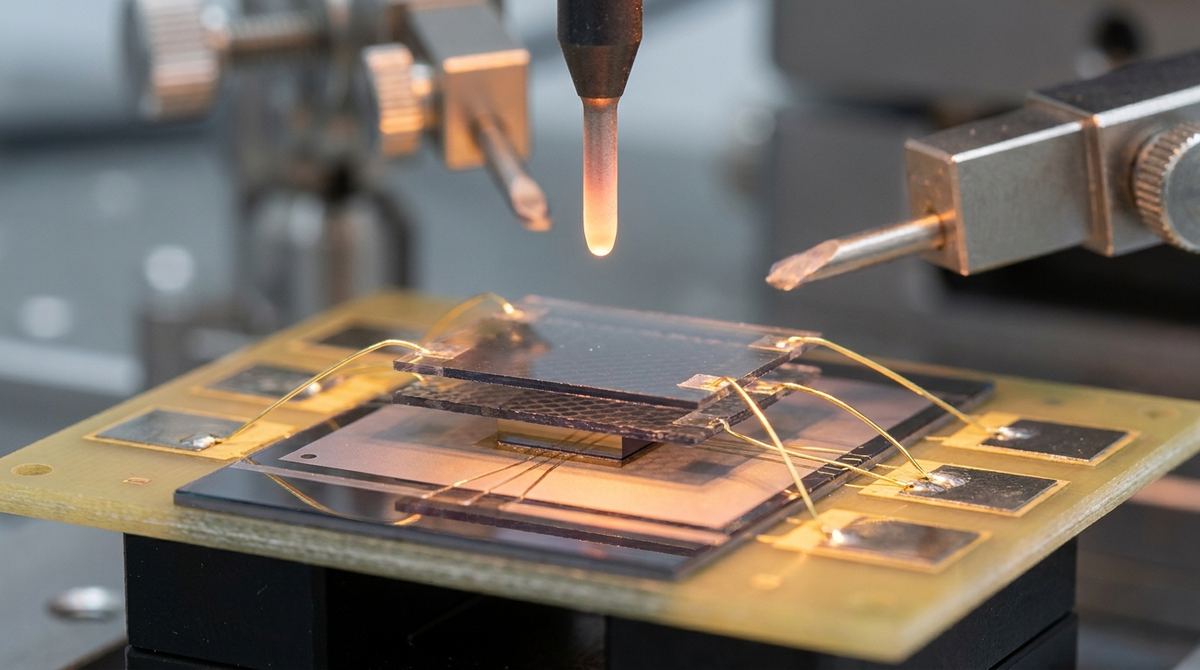
Thermal energy scavenging is a growing field in micro-electronics, aimed at powering small sensors by capturing ambient temperature fluctuations. While traditional pyroelectric materials are often bulky or require high-temperature gradients, two-dimensional (2D) van der Waals materials offer a way to build ultra-thin, mechanically compliant harvesters.
The goal of this guide is to prototype a nanoscale pyroelectric nanogenerator. This device uses a ferroelectric semiconductor, CuInP2S6 (CIPS), sandwiched between two layers of few-layer graphene. When the temperature of the CIPS layer changes, it undergoes a change in spontaneous polarization, which induces an electrical current through the graphene electrodes. By using graphene, we ensure an atomically smooth interface, which is critical for maximizing the efficiency of the charge transfer in these nanoscale devices.
This guide focuses on the assembly and characterization of such a device, moving beyond simple bulk measurements to identify local performance-limiting defects.
Because this project involves 2D materials and nanoscale characterization, it is best suited for a micro-fabrication lab or a highly equipped startup environment.
Materials:
1. CuInP2S6 (CIPS) crystals: These serve as the active pyroelectric layer.
2. Few-layer graphene (FLG): This can be obtained via chemical vapor deposition (CVD) on copper or via mechanical exfoliation.
3. Substrate: A standard Silicon/Silicon Dioxide (Si/SiO2) wafer (300nm SiO2 layer) is recommended for stability.
4. Contact metal: Gold or Silver for the macroscopic contact pads.
5. Cleaning agents: Acetone, Isopropanol, and Deionized (DI) water for surface cleaning.
Equipment:
1. Micro-manipulator or high-resolution optical microscope: For flake identification.
2. Mechanical exfoliation tools: High-quality adhesive tape for the Scotch-tape method.
3. Electrical Characterization: A high-sensitivity electrometer or a Lock-in amplifier (essential for harmonic detection).
4. Thermal Stimulus: A Scanning Thermal Microscopy (SThM) probe or a localized micro-heater.
5. Environment: A nitrogen-filled glovebox is highly recommended to prevent the oxidation of CIPS during the assembly process.
The assembly follows a van der Waals heterostructure approach, where layers are stacked without the need for traditional evaporation-based deposition that might damage the crystal lattice.
Step 1: Substrate Preparation
Clean the Si/SiO2 substrate using a standard solvent clean (Acetone, then Isopropanol, then DI water) and dry with Nitrogen. Ensure the surface is free of any organic contaminants to allow for optimal adhesion of the 2D layers.
Step 2: CIPS Deposition
Using the mechanical exfoliation method, peel a thin flake of CIPS and transfer it onto the substrate. For a functional nanogenerator, the CIPS layer should ideally be between 50nm and 200nm thick. If using CVD, ensure the growth parameters are optimized for high crystallinity.
Step 3: Graphene Encapsulation
This is the most critical step. You must deposit a layer of few-layer graphene directly onto the CIPS flake. This can be done via dry transfer of CVD graphene. The graphene acts as the top and bottom electrode. The goal is to create a sandwich structure: Substrate / CIPS / Graphene. The graphene must be in direct atomic contact with the CIPS to minimize contact resistance.
Step 4: Contact Pad Integration
Using a shadow mask or electron-beam evaporation, deposit gold contact pads onto the edges of the graphene layers. These pads will connect your microscopic device to your macroscopic measurement equipment.
Engineering Assumption: Since the exact thickness of the graphene required for optimal charge collection is not specified in the source research, we recommend starting with 3 to 5 layers of graphene to balance conductivity with mechanical flexibility.
Measuring a pyroelectric signal at the nanoscale is difficult because the signal is often buried under electromechanical noise (piezoelectric effects).
Step 1: Thermal Modulation
Apply a localized heat source to the device. In a research setting, an SThM probe is used to provide a precise, localized thermal pulse. For a practical prototype, a micro-heater or a modulated laser can be used to create a temperature oscillation (dT/dt).
Assumption: We assume a thermal modulation frequency between 100 Hz and 1 kHz. This frequency is high enough to generate a measurable current but low enough to avoid excessive thermal diffusion.
Step 2: Harmonic Detection
The electrical response must be measured using a Lock-in amplifier. The pyroelectric effect produces a current that is proportional to the rate of temperature change. By using harmonic detection, you can isolate the signal that corresponds to the thermal modulation frequency, effectively filtering out the first-harmonic electromechanical contributions that can lead to false readings.
Step 3: Spatial Mapping
To optimize the device, perform a spatial scan across the CIPS flake. The research indicates that conventional measurements often provide a spatially averaged value that hides defects. By scanning the thermal probe across the device, you can map the local pyroelectric coefficient.
Step 4: Data Analysis and Modeling
Compare the measured electrical response against a finite-element thermal model. This allows you to determine the local pyroelectric coefficient of your CIPS/Graphene heterostructure.
1. Interface Contamination: The primary risk is the presence of air or moisture between the CIPS and the graphene. This creates a high contact resistance and significantly reduces the harvested power.
Mitigation: Perform all assembly steps inside a nitrogen-filled glovebox and use dry-transfer methods for the graphene.
2. Signal-to-Noise Ratio: The currents generated by nanoscale pyroelectric devices are extremely small (pico-amperes to nano-amperes).
Mitigation: Use high-impedance electrometers and ensure the device is shielded from electromagnetic interference (EMI) using a Faraday cage.
3. Material Degradation: CIPS can be sensitive to prolonged exposure to ambient conditions.
Mitigation: Encapsulate the final device with a thin layer of hexagonal Boron Nitride (hBN) or a polymer like PMMA if long-term stability is required for testing.
4. Electromechanical Interference: The thermal expansion of the substrate can create piezoelectric signals that mimic the pyroelectric signal.
Mitigation: Use the harmonic detection method mentioned in the source to isolate the specific pyroelectric response.
This guide is based on the research findings presented in:
Fonck, V., et al. (2026). Direct Nanoscale Pyroelectric Characterization of a CuInP2S6 van der Waals Nanogenerator. arXiv:2606.16410v1.
The core methodology—specifically the use of SThM for localized characterization and harmonic detection for signal isolation—is derived directly from this study. The practical assembly steps and material assumptions are engineering interpretations intended to translate the research into a repeatable laboratory protocol.
Serious about B2B integration? Test our premium Pulsed Electrical Resistive Carbon Heating turbostratic graphene in your lab. 100g sample packs available now.
Explore More
Researchers have developed a breakthrough method for growing twisted bilayer graphene with pre-designed angles, a key step toward manufacturable quantum...

Learn how deep learning is revolutionizing the structural characterization of twisted bilayer materials, accelerating the development of next-generation...

Learn to build a prototype graphene FET biosensor for sensitive DNA detection. This guide covers materials, fabrication, and testing for point-of-care...