
Graphene Systems Show Apparent Ideal Diamagnetism at Room Temperature
Researchers revisit a graphene, n-heptane, and permalloy system, observing apparent ideal diamagnetism at ambient conditions, a key property of superconductors.
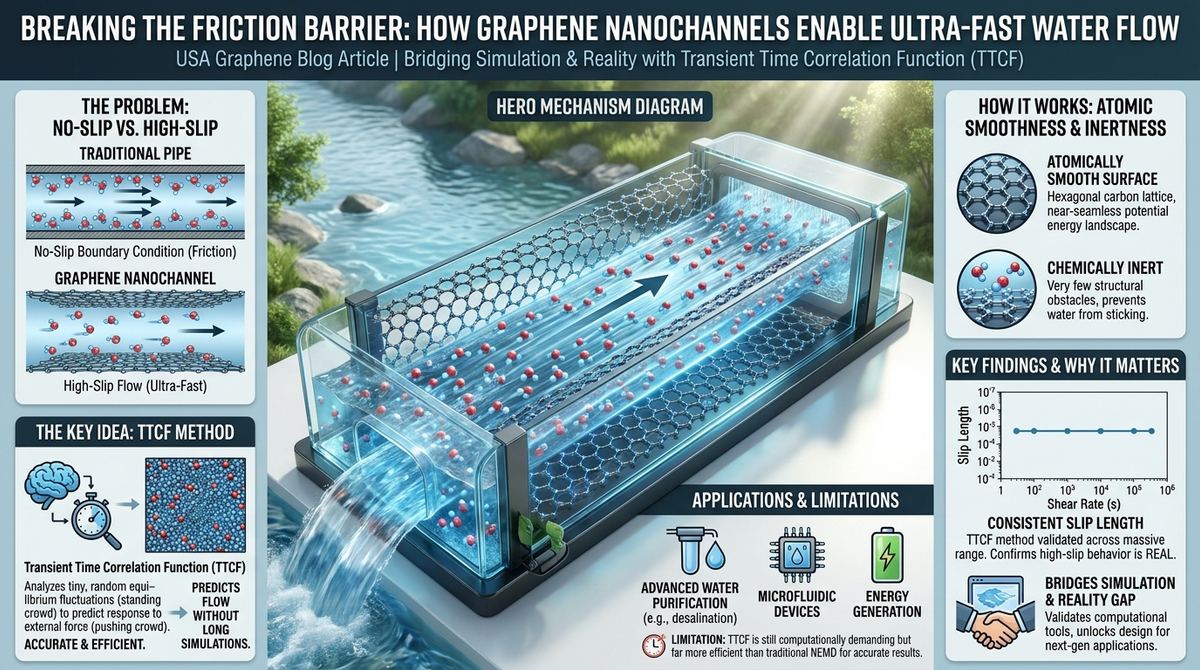
Imagine a world where water moves through an industrial pipe not as a sluggish stream, but as a high-speed projectile, sliding with almost zero resistance. In the macroscopic world of plumbing and city water mains, this is impossible because fluid molecules stick to the walls of the container, creating a boundary layer that slows down the entire flow. However, at the scale of a billionth of a meter, the rules of physics shift. When water is confined between sheets of graphene, it exhibits a phenomenon known as high slip flow, where the liquid essentially glides over the surface rather than clinging to it. Understanding exactly how this happens is the key to unlocking a new generation of water filtration, energy harvesting, and biological sensing technologies.
For decades, scientists have been fascinated by the extreme fluidity of water in graphene nanochannels. In traditional fluid dynamics, we assume a no-slip boundary condition, meaning the velocity of the fluid at the wall is zero. In graphene systems, this assumption fails completely. Water slips, and the amount of slip is measured by a value called the slip length. However, calculating this accurately has proven to be a computational nightmare.
The challenge lies in the discrepancy between simulation and reality. Researchers typically use Nonequilibrium Molecular Dynamics, or NEMD, to simulate flow. In NEMD, you apply a force to the fluid to make it move. To get a signal that is strong enough to be distinguished from random thermal noise, simulations often require incredibly high shear rates—essentially pushing the water at speeds that would be impossible or destructive in a real laboratory setting. This creates a gap where the simulation results might not reflect what actually happens at experimentally accessible shear rates, which are many orders of magnitude lower.
To solve this, Carmelo Riccardo Civello, Luca Maffioli, Edward R. Smith, James P. Ewen, Peter J. Daivis, Daniele Dini, and B. D. Todd sought a way to predict low-shear behavior without needing the immense computational power required to simulate slow, steady flow over long periods. They needed a bridge between the chaotic energy of high-speed simulations and the gentle flow of real-world experiments.
The researchers utilized a sophisticated mathematical approach called the Transient Time Correlation Function, or TTCF. To understand TTCF, imagine you want to know how a crowd of people will move through a corridor if you gently push them from behind. Instead of actually pushing them and timing the result—which might take hours to get an accurate average—you instead observe the crowd while they are just standing around, naturally shifting and shuffling. By analyzing these tiny, random equilibrium fluctuations, you can use a specific set of mathematical formulas to predict exactly how the crowd would react if you applied a gentle, steady push.
In the context of this research, TTCF allows scientists to look at water molecules in an equilibrium state—where no external force is applied—and calculate the Navier friction coefficient. This coefficient tells us how much resistance the water feels against the graphene wall. Once this is known, the researchers can accurately project the slip length and flow behavior across a vast range of shear rates, including those that are actually used in laboratories, without ever having to run a computationally expensive NEMD simulation at those slow speeds.
The extraordinary flow properties of this system are rooted in the atomic structure and chemistry of graphene. Graphene is a single layer of carbon atoms arranged in a hexagonal honeycomb lattice. This structure provides two critical advantages: atomic smoothness and chemical inertness.
First, the surface of graphene is exceptionally flat. Unlike a typical metal or plastic pipe, which has microscopic ridges and valleys that trap fluid molecules, graphene provides a nearly seamless potential energy landscape. When water molecules move over the carbon atoms, they encounter very few structural obstacles that would cause them to stop or slow down.
Second, the interaction between water and graphene is governed by weak van der Waals forces rather than strong chemical bonds. Water is a polar molecule, meaning it has distinct positive and negative ends that like to stick to other polar surfaces. Graphene, however, is non-polar and hydrophobic. Because the water molecules are more attracted to each other via hydrogen bonding than they are to the graphene surface, they tend to organize themselves into a structured layer that slides across the carbon sheet. This lack of strong adhesion prevents the fluid from anchoring to the wall, which drastically reduces the friction and allows the water to slip.
By applying the TTCF method, the research team was able to explore shear rates spanning six orders of magnitude. This is a massive range that covers everything from the extreme speeds used in traditional simulations to the subtle speeds found in actual experimental setups.
The most significant finding was that the slip length remains remarkably consistent across these different scales. The researchers found that the results obtained via TTCF were in excellent agreement with previous equilibrium molecular dynamics simulations and actual experimental data. This confirms that the high-slip behavior of water in graphene is not an artifact of high-speed simulations, but a fundamental physical property that persists even at very low shear rates.
Furthermore, the study proved that the Navier friction coefficient—the measure of how much the wall resists the fluid—is stable. This means that as you gradually increase the force pushing the water, the relationship between the force and the resulting velocity remains linear for a long period. Essentially, the graphene does not suddenly become a high-friction surface just because the water is moving faster or slower; it maintains its super-lubricating properties across a wide operational window.
This research is a major win for the field of nanofluidics because it validates a powerful computational tool. For years, there has been a lingering doubt about whether the high-speed results of NEMD simulations actually mapped onto real-world physics. By proving that TTCF can accurately predict flow at experimentally accessible rates, the researchers have provided a reliable way to design nano-scale fluidic devices without needing to rely on guesswork or prohibitively expensive simulations.
Beyond the math, this result reinforces the potential of graphene as a material for high-efficiency transport. If we can reliably predict and maintain high slip flow, we can design channels that move water with a fraction of the energy required by conventional systems. This has profound implications for any technology that relies on moving liquids through tiny spaces, as it suggests that the energy cost of transport can be lowered simply by optimizing the interface between the fluid and the wall.
While these results are promising, it is important to note that the simulations were performed using pristine graphene models. In a laboratory or industrial setting, graphene is rarely perfect. Real-world graphene often contains defects, such as vacancies where carbon atoms are missing, or grain boundaries where different crystal orientations meet. These imperfections can act as atomic-scale speed bumps, creating sites where water molecules can anchor and increasing the overall friction.
Additionally, the study focused on pure water. In practical applications, fluids are often contaminated with ions, salts, or organic molecules. These solutes can interact with both the graphene surface and the water molecules, potentially altering the slip length. Future research will need to explore how the presence of electrolytes or surfactants affects the TTCF predictions and whether the high-slip behavior holds up in chemically complex environments.
The ability to transport water with near-zero friction opens several doors in engineering. One of the most immediate applications is in desalination and water purification. Current membranes require significant pressure to force water through tiny pores, which consumes vast amounts of energy. If graphene nanochannels can be integrated into membranes to facilitate high slip flow, the pressure required to move water through the filter would drop significantly, making clean water cheaper and more accessible.
Another application is in the field of biological sensing and drug delivery. By creating nano-channels that can move fluids with extreme precision and minimal resistance, researchers could develop sensors capable of detecting single molecules of a biomarker in a blood sample. Similarly, targeted drug delivery systems could use graphene-coated channels to transport therapeutic agents through a medium more efficiently than traditional porous materials.
Finally, this research has implications for thermal management in electronics. As microchips become smaller and more powerful, cooling them becomes a critical challenge. Using graphene-based nanofluidic channels to transport coolant would allow for much higher flow rates and better heat dissipation than current silicon-based cooling architectures.
If you take away one key point from this study, it is that water does not just flow through graphene nanochannels—it glides. By using a clever mathematical shortcut called the Transient Time Correlation Function, researchers have proven that this high-speed, low-friction sliding occurs even at the slow speeds found in real-world experiments, confirming that graphene's atomic smoothness makes it an ideal material for ultra-efficient fluid transport.
What exactly is slip length in the context of nanotechnology?
Slip length is a theoretical distance into the wall where the fluid velocity would extrapolate to zero. In a normal pipe, this length is zero because the water sticks to the wall. In graphene, the slip length is large, meaning the fluid continues to move at a significant speed even right at the interface, which results in much faster overall flow.
Why is graphene better than other materials for moving water?
Graphene consists of a perfectly smooth, one-atom-thick layer of carbon. Because it is non-polar and chemically inert, water molecules do not form strong bonds with the surface. This creates a low-friction environment where the fluid glides over the surface rather than being dragged by it.
What is a shear rate, and why does it matter?
Shear rate refers to the gradient of velocity between the wall and the center of the flow. In simple terms, it is a measure of how fast the fluid is being pushed. It matters because some materials change their friction properties depending on how fast the fluid is moving, so researchers must ensure their simulations match real-world speeds.
How does the TTCF method differ from traditional NEMD simulations?
Nonequilibrium Molecular Dynamics, or NEMD, applies an actual force to the fluid to simulate flow, which often requires unrealistic speeds to get clear data. The Transient Time Correlation Function, or TTCF, looks at the natural, random movements of molecules at rest and uses that data to calculate how they would behave under a gentle push.
Is this technology ready to be used in commercial water pipes today?
No, this research is conducted at the molecular scale using nanochannels. While it proves the physics of high slip flow, scaling this up to industrial-sized pipes is a massive engineering challenge. The current work is more applicable to microscopic devices, such as medical sensors or high-tech filtration membranes.
The work performed by Civello and his colleagues provides a critical missing link in our understanding of nanofluidics. By bridging the gap between theoretical simulations and experimental reality, they have demonstrated that the extraordinary properties of graphene are not just mathematical curiosities but reliable physical phenomena. As we continue to shrink our technology, the ability to move fluids with minimal energy loss will become a cornerstone of modern engineering. While challenges remain in perfecting the material and handling complex fluids, the path toward ultra-efficient water transport is now more clearly defined. Through the power of TTCF, we can finally see exactly how water dances across the surface of graphene, paving the way for innovations that could reshape how we filter water and cool our computers.
Serious about B2B integration? Test our premium Pulsed Electrical Resistive Carbon Heating turbostratic graphene in your lab. 100g sample packs available now.
Explore More
Researchers revisit a graphene, n-heptane, and permalloy system, observing apparent ideal diamagnetism at ambient conditions, a key property of superconductors.

Researchers are using artificial intelligence to autonomously discover optimal recipes for growing graphene, a breakthrough in AI-driven graphene synthesis...

Explore how environment-dependent tight-binding models, derived from ab initio principles, are revolutionizing materials simulation for graphene applications.