
Practical Guide: Building a Graphene Support for High-Flux Water Filtration Membranes
Learn how a graphene support layer can mechanically reinforce ultra-thin polymer membranes, boosting water flux without compromising filtration efficiency.
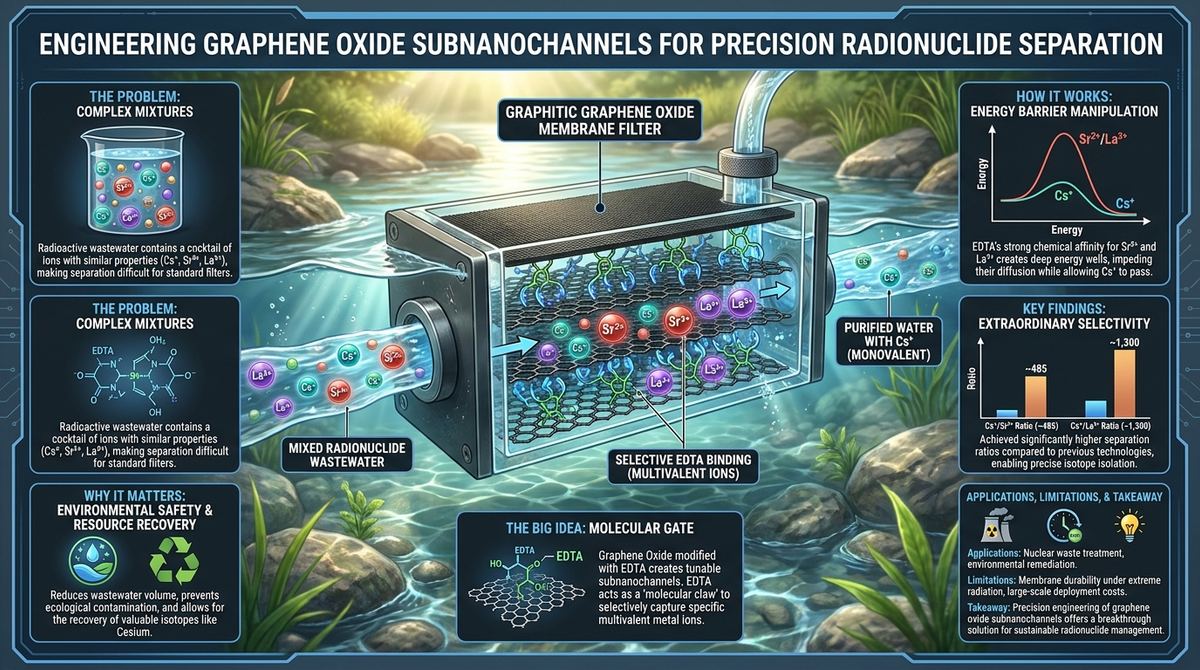
Nuclear energy stands as a cornerstone of the transition toward a low-carbon future, providing immense power with minimal atmospheric emissions. However, this benefit comes with a significant environmental cost in the form of radioactive wastewater. This wastewater contains a complex cocktail of radionuclide ions that must be meticulously separated and managed to prevent ecological contamination. The challenge lies in the fact that these ions often share similar chemical properties, making it incredibly difficult for standard filters to tell them apart. Imagine trying to separate different types of salt from a mixture where every grain looks almost identical; this is the precision required for nuclear waste management.
The primary obstacle in treating nuclear wastewater is the selective separation of monovalent and multivalent radionuclides, such as cesium (Cs+), strontium (Sr2+), and lanthanum (La3+). Because these ions exist in aqueous environments with varying charges and sizes, traditional membranes often struggle to achieve high purity. Most current separation technologies rely on size exclusion or simple electrostatic repulsion, but these methods lack the surgical precision needed to isolate specific isotopes for resource recovery.
Furthermore, the environment inside a nuclear waste facility is hostile. Most synthetic membranes degrade rapidly when exposed to ionizing radiation, losing their structural integrity and selectivity. This means that even if a membrane works in a laboratory setting, it may fail almost immediately upon contact with actual radioactive effluent. The scientific community has therefore needed a material that is not only chemically precise in its separation capabilities but also physically robust enough to withstand constant radiation. This is where the work of Ziwen Dai, Pengrui Jin, Yi-Xiang Wang, Hao Tan, Genyuan Zhang, Hui Li, Dandan Su, Sha Liang, Jie Yang, Mihail Barboiu, Bart Van der Bruggen, and Shushan Yuan becomes so pivotal.
The researchers decided to build a molecular gate using graphene oxide, which is essentially a single-atom-thick sheet of carbon decorated with oxygen groups. When these sheets are stacked, they create tiny, two-dimensional gaps called subnanochannels. To make these channels selective, the team modified them with a molecule called ethylenediaminetetraacetic acid, or EDTA.
EDTA is well-known in chemistry as a chelating agent, meaning it acts like a molecular claw that can grab onto specific metal ions. By integrating EDTA into the graphene oxide channels, the researchers created a system where the membrane does not just block ions based on their size, but rather interacts with them chemically. This interaction creates a diffusion energy barrier. If an ion has a strong attraction to the EDTA, it faces a higher energy hurdle to move through the channel. By tuning this barrier, the researchers could effectively slow down or stop certain ions while allowing others to pass through freely.
To understand the mechanics of this system, one must look at the interface between the graphene oxide and the modified EDTA groups. Graphene oxide provides a stable, high-surface-area scaffold. When modified with EDTA, the channels become lined with functional carboxylate groups. These groups are negatively charged and possess a high affinity for multivalent cations, which are ions with a charge of plus-two or plus-three.
When wastewater passes through the membrane, ions like strontium (Sr2+) and lanthanum (La3+) interact strongly with these carboxylate groups. This strong chemical affinity creates a deep energy well, essentially trapping the multivalent ions or significantly increasing the energy required for them to migrate from one side of the membrane to the other. This is the essence of the diffusion energy barrier. Because these ions are so tightly bound to the EDTA sites, their transport is hindered.
In contrast, monovalent ions like cesium (Cs+) have a much weaker interaction with the EDTA functional groups. Because they are not held as tightly by the carboxylate claws, the energy barrier for cesium is much lower. This allows Cs+ ions to glide through the nanochannels with far less resistance. The result is a membrane that acts as a chemical sieve, selectively permitting the passage of monovalent ions while effectively blocking multivalent ones.
The research team utilized a quartz crystal microbalance to break down the total energy barrier into two distinct parts: partitioning at the pore entry and intrapore diffusion. Partitioning refers to the energy cost an ion pays just to enter the channel from the bulk liquid, while intrapore diffusion is the energy cost of moving through the channel once inside. By analyzing these components, the researchers proved that they could modulate the overall selectivity by adjusting how the ions interact with the channel walls.
The performance of the GO-EDTA membrane was significantly higher than previous iterations of graphene-based filters. The researchers observed extraordinary selectivity ratios, achieving a ratio of 485 for cesium over strontium and a staggering 1,300 for cesium over lanthanum. These numbers indicate that the membrane is vastly more efficient at distinguishing between these specific radionuclides than prior technologies.
Beyond simple separation, the team demonstrated a practical application for resource recovery. By using an electrodialysis discharge method—where an electric field is used to drive ions through the membrane—they were able to recover cesium chloride (CsCl) with a purity of 99.5 percent. This transforms a hazardous waste product into a high-purity chemical resource, which is a critical step toward a circular economy in the nuclear sector.
One of the most impressive findings was the membrane's stability. Under conditions of intense irradiation, the GO-EDTA structure remained intact. The robust carbon-based framework of the graphene oxide, combined with the stable chemical bonding of the EDTA modification, ensured that the separation performance did not degrade. This radiation resistance is a primary advantage over polymer-based membranes, which often become brittle or lose their functional groups when exposed to gamma rays or alpha particles.
The ability to separate radionuclides with such high precision has profound implications for environmental safety. By removing strontium and lanthanum from wastewater while recovering cesium, the overall volume of high-level radioactive waste that requires long-term geological storage is reduced. This lowers the cost and risk associated with nuclear waste disposal.
Furthermore, the discovery that the diffusion energy barrier can be precisely manipulated opens a new door in membrane science. Rather than relying on the accidental properties of a material, scientists can now intentionally engineer the energy landscape inside a nanochannel. If the chemical groups in the channel can be swapped or modified, this same approach could potentially be used to separate other precious or toxic metals from industrial waste streams, far beyond the realm of nuclear energy.
While the results are promising, this research was conducted in a controlled laboratory environment. Real-world nuclear wastewater is far more complex than the solutions used in these experiments. It often contains a wide array of competing ions, organic contaminants, and varying pH levels, all of which could interfere with the EDTA binding sites. The potential for membrane fouling—where particles or organic matter clog the subnanochannels—remains a significant concern that must be addressed before industrial scaling.
Additionally, while the selectivity is ultra-high, the researchers must continue to optimize the flux of the membrane. There is often a trade-off in membrane science where increasing selectivity leads to a decrease in the speed at which liquid passes through the filter. For this technology to be viable for treating millions of gallons of wastewater, the throughput must be high enough to be economically feasible. Long-term durability tests over several years of continuous operation are also necessary to ensure the EDTA modification does not leach out over time.
The most immediate application is in the decommissioning of old nuclear reactors, where vast amounts of contaminated water must be processed before the site can be returned to a safe state. The GO-EDTA membrane could serve as a final polishing stage to remove trace radionuclides that other filters miss.
In active nuclear power plants, this technology could be integrated into wastewater treatment loops to continuously recover valuable isotopes. Beyond energy, the medical field relies on specific radioisotopes for cancer treatment and imaging; this membrane's ability to provide 99.5 percent purity makes it a candidate for the purification of medical-grade radionuclides.
The most important takeaway is that by modifying graphene oxide with EDTA, researchers created a molecular filter that uses a tunable energy barrier to distinguish between radioactive ions. This allows for the nearly perfect separation of cesium from other radionuclides, offering a radiation-resistant pathway to cleaner nuclear energy and resource recovery.
What exactly is graphene oxide in this study? Graphene oxide is a derivative of graphene consisting of a single layer of carbon atoms arranged in a honeycomb lattice, but with oxygen-containing groups attached to the surface. In this research, it acts as the structural foundation that creates the tiny channels through which ions must travel.
Why was EDTA used to modify the membrane? EDTA is a chelating agent, which means it can form multiple bonds with a single metal ion. By adding EDTA to the graphene oxide, the researchers created chemical traps that specifically attract multivalent ions like strontium and lanthanum, slowing them down while letting monovalent ions like cesium pass.
How does the energy barrier actually work? Think of the energy barrier as a series of hills that an ion must climb to move through the membrane. Because the multivalent ions are so strongly attracted to the EDTA, they essentially fall into a deep valley and require much more energy to climb back out and move forward, whereas cesium ions experience a much smaller hill.
Is this technology already being used in power plants? No, the research is currently at the laboratory stage. While it has demonstrated incredible precision and radiation resistance, it must still be tested against complex real-world wastewater and scaled up for industrial volumes before it can be deployed in power plants.
Can this membrane separate other things besides radioactive waste? Yes, the principle of manipulating diffusion energy barriers is universal. By changing the functional groups used to modify the graphene oxide, this system could theoretically be tuned to separate various other metal ions or organic molecules in water purification and industrial chemical processing.
The integration of EDTA into graphene oxide subnanochannels represents a significant leap forward in the quest for sustainable nuclear waste management. By shifting the focus from simple size-based filtration to the precise manipulation of diffusion energy barriers, Ziwen Dai and their colleagues have demonstrated that high-purity radionuclide separation is possible even in the harshest radiation environments. While challenges regarding industrial scale and complex wastewater matrices remain, this research provides a blueprint for the next generation of selective membranes. The ability to recover high-purity cesium chloride not only mitigates environmental risk but also proves that what we once considered waste can be reclaimed as a valuable resource.
Serious about B2B integration? Test our premium Pulsed Electrical Resistive Carbon Heating turbostratic graphene in your lab. 100g sample packs available now.
Explore More
Learn how a graphene support layer can mechanically reinforce ultra-thin polymer membranes, boosting water flux without compromising filtration efficiency.

Researchers have developed a breakthrough method for growing twisted bilayer graphene with pre-designed angles, a key step toward manufacturable quantum...

Learn how deep learning is revolutionizing the structural characterization of twisted bilayer materials, accelerating the development of next-generation...