
Practical Guide: Building a Graphene Support for High-Flux Water Filtration Membranes
Learn how a graphene support layer can mechanically reinforce ultra-thin polymer membranes, boosting water flux without compromising filtration efficiency.
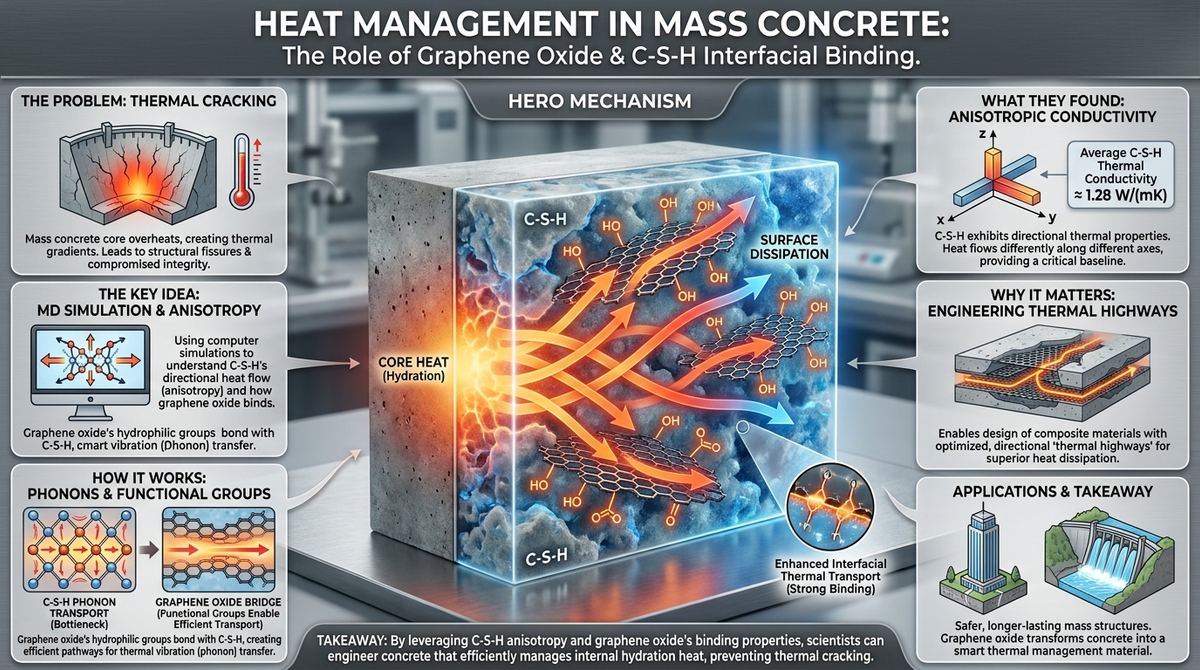
Imagine constructing a massive hydroelectric dam or the foundation of a skyscraper. These projects require thousands of cubic meters of concrete poured into single, enormous blocks. As the cement hydrates and hardens, it releases a significant amount of chemical heat. In these massive structures, the heat generated at the core cannot escape as quickly as it does from the surface. This temperature gradient creates internal stress, which often leads to thermal cracking, compromising the structural integrity of the entire project. To solve this, scientists are looking toward graphene-based additives to turn concrete into a material that can move heat more efficiently.
The primary binder formed during the hydration of cement is calcium silicate hydrate, commonly known as C-S-H. This material is the glue that gives concrete its strength, but it is also the primary bottleneck for thermal transport. For decades, engineers have struggled with heat dissipation in mass concrete because C-S-H has relatively low thermal conductivity. If the heat remains trapped, the resulting expansion and contraction can cause deep structural fissures.
To optimize how we add conductive materials like graphene to concrete, we first need to understand the intrinsic thermal behavior of C-S-H at an atomic level. Specifically, researchers need to know if heat moves the same way in all directions and how strongly graphene or graphene oxide binds to the C-S-H matrix. Without this fundamental knowledge, adding graphene is essentially a guessing game of trial and error. To address these gaps, Tong Chen, Dan Chen, Cheng Gong, Yongzhe Zhao, Yongliang Han, and Yijie Wang utilized molecular dynamics simulations to map the thermal landscape of C-S-H and its interaction with graphene oxide.
The core idea of this research is to use a computer-simulated environment to observe how heat vibrates through the atomic structure of C-S-H and how different types of carbon sheets stick to it. The researchers wanted to see if C-S-H behaves like a uniform sponge or more like a piece of wood, where heat might travel faster in one direction than another. This is known as anisotropy.
Furthermore, they compared pure graphene, which is a perfect sheet of carbon, with graphene oxide, which is a graphene sheet decorated with oxygen-containing groups like hydroxyl and carboxyl groups. By measuring the binding energy, they could determine which material forms a more stable and cohesive interface with the cement binder. A stronger bond is essential because if there is a gap or a weak connection between the graphene and the C-S-H, heat cannot jump across that interface efficiently, rendering the conductive additive useless.
To understand how this system works, we must look at the chemical nature of both C-S-H and graphene oxide. C-S-H is composed of calcium ions and silicate chains that form a complex, layered network. In this environment, thermal transport occurs via phonons, which are quantized collective vibrations of the atoms in the lattice. The efficiency of this transport depends on how tightly the atoms are packed and how well they are connected through chemical bonds.
Graphene is naturally an incredible thermal conductor, but it is hydrophobic and chemically inert, meaning it does not like to bond with the hydrophilic, polar environment of hydrating cement. This leads to poor dispersion and weak interfacial binding. Graphene oxide solves this problem by introducing oxygen-containing functional groups onto the carbon plane. These oxygen groups act as chemical anchors. They can form hydrogen bonds and electrostatic interactions with the calcium and silicate ions in the C-S-H structure.
When these anchors engage, they create a bridge that allows phonons to transfer more easily from the cement matrix into the high-conductivity graphene sheet. Essentially, the oxidation of the graphene transforms it from a smooth, slippery slide into a textured surface that can grip the C-S-H matrix, creating a continuous path for heat to flow.
The simulation results revealed that C-S-H is indeed anisotropic. This means that the thermal conductivity varies depending on the axis being measured. The researchers calculated the thermal conductivities along the x, y, and z axes separately, finding that heat does not flow uniformly. Despite this directional difference, the average volumetric thermal conductivity of C-S-H was determined to be 1.28 W/(mK). This value provides a critical baseline for any engineer attempting to design a composite material to exceed this performance.
Regarding the interface, the researchers discovered a direct correlation between the oxidation level of the graphene and its binding energy. As more oxygen groups were added to the graphene sheet, the binding energy increased significantly. This confirms that the chemical modifications on the graphene surface are what drive the stability of the composite.
Additionally, they found that the orientation of the C-S-H mattered. The xy-plane of the C-S-H structure exhibited the strongest affinity for both graphene and graphene oxide. This suggests that if the carbon sheets can be aligned to interface with this specific plane, the resulting bond will be at its strongest, providing the most stable architecture for thermal transport.
These findings change how we approach the design of cement-based composites. Because C-S-H is anisotropic, it implies that we can potentially engineer "thermal highways" within concrete. If we know that the xy-plane is the strongest binding site and that heat moves differently across various axes, researchers can develop methods to align graphene oxide sheets in specific directions during the pouring and setting process. This would allow engineers to direct heat away from the core of a structure and toward the surface more effectively.
Moreover, the discovery regarding oxidation levels provides a precise chemical target. Instead of simply adding any form of graphene, developers can now optimize the degree of oxidation to balance conductivity and binding strength. While too much oxidation can disrupt the carbon lattice and lower the intrinsic conductivity of the graphene itself, too little oxidation leads to a weak interface. This research helps identify the "sweet spot" where the graphene is conductive enough to move heat but oxidized enough to stay firmly locked into the C-S-H matrix.
While these molecular dynamics simulations provide invaluable data, they are not without limitations. The study was conducted at the atomic scale, meaning it looked at a very small, idealized section of C-S-H and graphene oxide. Real-world concrete is far more chaotic. It contains large aggregates like sand and crushed stone, air voids, and various chemical impurities that can disrupt the thermal paths identified in a simulation.
Furthermore, the study focuses on the static binding energy and intrinsic conductivity. It does not account for the dynamic process of cement hydration over weeks or months, nor does it simulate the macroscopic stresses and strains that occur in a full-scale dam. Future research must move from these molecular models to physical laboratory prototypes. Testing is required to see if the predicted anisotropic advantages can actually be realized in a large-scale pour, and whether the graphene oxide remains stable over decades of environmental exposure.
The most immediate application for this research is in the construction of mass concrete structures. By integrating optimized graphene oxide, engineers could reduce the need for expensive cooling systems, such as circulating cold water through pipes embedded in the concrete, which is currently a common but costly practice for large dams.
Beyond construction, this research has implications for the energy sector. The ability to create cement-based materials with tailored thermal conductivity could lead to more efficient geothermal energy storage systems, where heat is stored in the ground within specialized concrete shells. It could also be applied to industrial foundations for heavy machinery or nuclear power plant containment structures, where managing the thermal gradient is a matter of critical safety. Even in urban architecture, thermally conductive concrete could be used to create passive cooling systems that draw heat out of buildings during the summer.
If you take away one key point from this research, it is that the effectiveness of graphene in concrete depends entirely on the interface. The addition of oxygen to graphene creates a chemical bridge that allows it to bind strongly to the C-S-H binder, especially along the xy-plane, turning a structural material into an efficient thermal conductor.
What is C-S-H and why does it matter for heat?
C-S-H stands for calcium silicate hydrate, which is the main product formed when cement reacts with water. It acts as the glue that holds concrete together. Because it is the dominant phase in hardened cement paste, its ability to conduct or resist heat determines how quickly a large concrete structure can cool down after being poured.
What does it mean when the researchers say C-S-H is anisotropic?
Anisotropy means that a material's properties are different depending on the direction in which they are measured. In this case, heat does not move through C-S-H at the same speed in the x, y, and z directions. This is important because it means heat flow can be manipulated or directed if the material structure is aligned.
Why use graphene oxide instead of regular graphene?
Pure graphene is like a smooth sheet of glass; it does not stick well to the polar, water-based environment of cement. Graphene oxide has oxygen groups on its surface that act like chemical hooks, allowing it to bond strongly to the calcium and silicate ions in C-S-H. This strong bond is necessary for heat to pass from the cement into the graphene.
How did the researchers find these results without building a real concrete block?
They used molecular dynamics simulations. This is a powerful computational method that simulates the movements and interactions of individual atoms over time based on the laws of physics. It allows scientists to test hypotheses and measure forces at a scale that is impossible to see with a traditional microscope.
Is this technology ready to be used in construction today?
No, this research is at the fundamental molecular level. While it provides a roadmap for how to optimize graphene-concrete composites, further testing is needed at the macroscopic scale to see how these atomic interactions translate to real-world building materials and long-term durability.
The work by Tong Chen and colleagues provides a critical missing piece of the puzzle in cement chemistry. By uncovering the anisotropic nature of C-S-H thermal transport and the vital role of graphene oxide oxidation in interfacial binding, they have moved the field closer to a new generation of thermally managed concrete. While transition from simulation to the construction site will take time and rigorous testing, the ability to chemically tune the interface between carbon nanomaterials and cement binders opens a door to safer, more efficient, and more durable infrastructure.
Serious about B2B integration? Test our premium Pulsed Electrical Resistive Carbon Heating turbostratic graphene in your lab. 100g sample packs available now.
Explore More
Learn how a graphene support layer can mechanically reinforce ultra-thin polymer membranes, boosting water flux without compromising filtration efficiency.

Researchers have developed a breakthrough method for growing twisted bilayer graphene with pre-designed angles, a key step toward manufacturable quantum...

Learn how deep learning is revolutionizing the structural characterization of twisted bilayer materials, accelerating the development of next-generation...