
Practical Guide: Building a Graphene Support for High-Flux Water Filtration Membranes
Learn how a graphene support layer can mechanically reinforce ultra-thin polymer membranes, boosting water flux without compromising filtration efficiency.
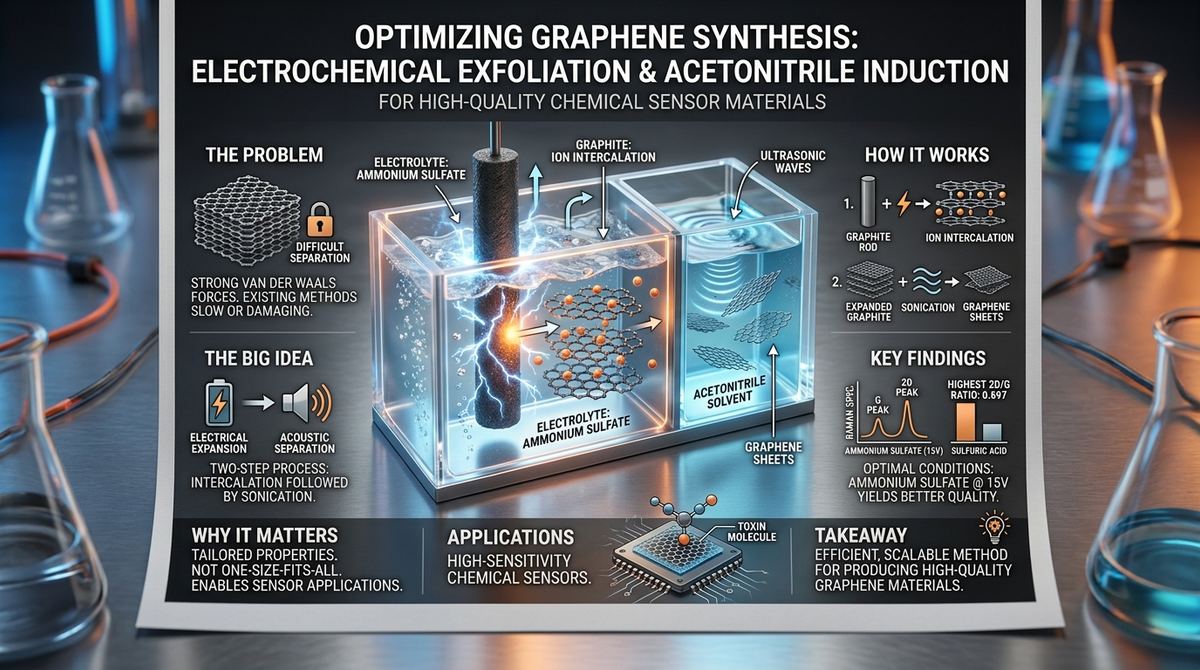
Imagine a material so thin that it is only one atom thick, yet so strong and conductive that it could revolutionize everything from the battery in your phone to the sensors used to detect toxins in our water. This material is graphene, a single layer of carbon atoms arranged in a hexagonal honeycomb lattice. While the theoretical potential of graphene is immense, the practical challenge has always been synthesis. For years, scientists have struggled to find a method that produces high-quality graphene efficiently without using prohibitively expensive equipment or harsh chemicals that destroy the material's intrinsic properties.
The quest for a scalable, high-quality production method is what drove the recent research conducted by Thorikul Huda, Riyanto Riyanto, Taufik Abdillah Natsir, and Mudasir Mudasir. By combining electrochemical exfoliation with a precise induction process using acetonitrile, these researchers have explored a way to peel apart the layers of bulk graphite to create graphene that is specifically tuned for high-performance applications like chemical sensing.
To understand the contribution of this work, one must first understand the nature of graphite. Graphite is essentially a stack of graphene sheets held together by weak van der Waals forces. To make graphene, you must overcome these forces and separate the sheets without introducing too many defects into the carbon lattice. Common methods like Chemical Vapor Deposition produce high-quality films but are slow and expensive, making them unsuitable for mass production of powders or inks. On the other hand, chemical exfoliation methods, such as the Hummer's method, use extremely aggressive oxidants to force the sheets apart, which fundamentally alters the chemistry of the carbon and leaves behind a material called graphene oxide. Graphene oxide is not as conductive as pure graphene because the oxygen groups break the conjugated pi-electron system.
The researchers focused on electrochemical exfoliation, which uses electricity to drive ions into the graphite structure. However, simply exfoliating the graphite is not enough. Once the layers are loosened, they tend to clump back together, a process known as agglomeration. Finding a way to keep these sheets separated and stable in a liquid medium—without using chemicals that degrade the graphene—has been a significant hurdle in the synthesis pipeline.
The core strategy employed in this study is a two-step process: electrical expansion followed by acoustic separation. First, the researchers used a graphite rod as an electrode in an electrolyte solution. By applying a specific voltage, they forced ions from the liquid into the spaces between the graphite layers. This creates internal pressure that pushes the layers apart, effectively swelling the graphite.
Once the graphite was expanded and dried, it was placed in acetonitrile, a specialized organic solvent. The researchers then applied sonication, which uses high-frequency sound waves to create tiny vacuum bubbles in the liquid. When these bubbles collapse, they release intense localized energy that knocks the already-loosened graphene sheets away from one another. The acetonitrile acts as a stabilizing agent, ensuring the graphene remains dispersed and does not collapse back into graphite. By varying the type of electrolyte and the voltage applied, the team could essentially tune the structural properties and the electrical performance of the resulting graphene.
The technical execution begins with the selection of the electrolyte, as the chemical nature of the ions determines how they interact with the carbon lattice. The researchers tested two primary options: sulfuric acid and ammonium sulfate. In the electrochemical cell, when a voltage is applied to the graphite rod, ions from these electrolytes migrate into the graphite galleries. This process, known as intercalation, expands the interlayer spacing. The higher the voltage, the more ions are forced into the structure, which generally increases the ease of subsequent exfoliation but can also introduce more structural defects.
Following this electrical treatment, the material undergoes a critical stabilization phase. The expanded graphite is filtered and dried before being introduced to acetonitrile. Acetonitrile is chosen because it is relatively inert, meaning it does not react chemically with the graphene surface. This is vital because any unwanted chemical bonding during the induction phase would alter the electronic properties of the material.
When sonication is applied, the sound waves create a phenomenon called acoustic cavitation. The rapid formation and implosion of bubbles create shear forces that act like microscopic hammers, peeling the graphene layers apart. Because the acetonitrile provides a compatible surface energy environment, the graphene sheets remain suspended in the liquid rather than sticking together. The final step is a controlled drying process at 60 degrees Celsius for 24 hours, which removes the solvent while preserving the morphology of the exfoliated sheets.
The study revealed that the choice of electrolyte and voltage has a profound impact on the final product's characteristics. Using Raman spectroscopy, which is the gold standard for identifying graphene, the team analyzed the G peak (representing the graphitic carbon) and the 2D peak (representing the number of layers). They found that using an ammonium sulfate electrolyte at a voltage of 15 volts produced the highest 2D to G intensity ratio, reaching 0.697. A higher ratio typically suggests a better quality of exfoliation and thinner sheets.
Interestingly, this same configuration—ammonium sulfate at 15 volts—also resulted in the highest D to G intensity ratio of 0.12. In Raman spectroscopy, the D peak is associated with defects or disorders in the carbon lattice. While a low D peak is generally desired for pure conductivity, a small amount of controlled defects can actually be beneficial for certain applications, as these sites often serve as active points for chemical interactions.
When switching to a sulfuric acid electrolyte at 15 volts, the outcomes shifted toward electrical performance. The electrochemical characterization showed that this specific combination yielded the highest specific capacitance of 11.57 farads per gram. Specific capacitance is a measure of how much electrical charge a material can store per unit of mass. The increase in capacitance with sulfuric acid is likely due to the introduction of oxygen-containing functional groups on the graphene surface, which facilitate pseudocapacitance—a process where fast redox reactions occur at the interface between the material and the electrolyte.
Morphological analysis via Scanning Electron Microscopy confirmed that regardless of the electrolyte, the resulting graphene exhibited a flat and smooth surface structure, indicating that the sonication process in acetonitrile was effective at producing clean sheets without causing excessive tearing or fragmentation.
These findings are significant because they demonstrate that graphene synthesis is not a one-size-fits-all process. By simply changing the electrolyte from ammonium sulfate to sulfuric acid, the researchers could pivot between a material optimized for structural purity and one optimized for energy storage or sensing.
The ability to tune the specific capacitance is particularly important for the development of chemical sensors. In a sensor, the material must be able to interact with target molecules in the environment. A higher specific capacitance often correlates with a more active surface area and better electronic interfaces, which allow the sensor to detect minute changes in chemical concentration with higher sensitivity. Furthermore, the use of acetonitrile as an inert dispersant ensures that the graphene maintains its stability over time, which is a prerequisite for creating reliable, long-term sensing devices.
While the results are promising, it is important to note that this research is a foundational study and not yet a commercial-scale production protocol. One primary limitation is the scale of synthesis; the process described uses graphite rods and laboratory-scale sonication, which may not translate directly to industrial tonnage without further optimization of the energy inputs.
Additionally, while the Raman spectroscopy confirms the presence of graphene, more extensive testing is needed to determine the exact average number of layers across the entire sample. The study focuses on the efficacy of the acetonitrile induction, but it remains to be seen how different concentrations of this solvent or alternative organic dispersants might further improve the yield. Finally, long-term stability tests are required to ensure that the graphene produced via this method does not degrade or re-aggregate when integrated into a final device over several months of use.
The most immediate application for this specific synthesis method is in the realm of chemical sensors. Because the researchers could optimize the material for high capacitance, this graphene could be used to create electrodes that detect glucose levels in medical diagnostics or pollutants like nitrates and heavy metals in environmental monitoring. The high surface-to-volume ratio of the exfoliated sheets ensures that almost every carbon atom is exposed to the environment, maximizing the signal-to-noise ratio of the sensor.
Beyond sensing, the material's properties make it a candidate for supercapacitors. Since supercapacitors bridge the gap between traditional capacitors (which charge quickly but store little energy) and batteries (which store a lot of energy but charge slowly), the optimized capacitance found in the sulfuric acid samples could lead to faster-charging energy storage devices for small electronics. There is also potential for this graphene to be used as a conductive additive in polymer composites, enhancing the mechanical strength and electrical conductivity of lightweight plastics used in aerospace or automotive components.
The key takeaway from this research is that the combination of electrochemical exfoliation and sonication in acetonitrile provides a controllable, low-damage pathway to produce graphene. By adjusting the electrolyte and voltage, scientists can tailor the material's defects and capacitance, making it possible to engineer graphene specifically for high-sensitivity chemical sensors.
What is the difference between graphite and graphene?
Graphite is a bulk material consisting of millions of layers of carbon stacked on top of each other, similar to a deck of cards. Graphene is a single, individual layer from that stack. While graphite is used in pencils, graphene possesses extraordinary electrical and mechanical properties because of its single-layer structure.
Why is acetonitrile used in this process?
Acetonitrile acts as a solvent that prevents the graphene sheets from sticking back together after they have been separated. Because it is inert, it does not react with the carbon, ensuring that the graphene's natural electronic properties are preserved while keeping the material evenly dispersed in a liquid form.
What does the Raman spectroscopy tell us about the graphene?
Raman spectroscopy measures how light interacts with the carbon bonds. The G peak tells us about the graphitic structure, the D peak indicates the presence of defects, and the 2D peak helps determine how many layers are present. By comparing these peaks, researchers can judge the quality and thickness of the synthesized graphene.
How does voltage affect the synthesis?
Voltage serves as the driving force that pushes ions into the graphite. Higher voltages generally lead to more aggressive exfoliation, which can make it easier to separate the layers but may also introduce more defects into the carbon lattice. Finding the optimal voltage, such as 15 volts in this study, is key to balancing quality and efficiency.
Can this graphene be used in batteries today?
While the research shows high specific capacitance, which is a great sign for energy storage, this work is currently at the laboratory stage. Further testing on cycle life—how many times it can be charged and discharged—and large-scale manufacturing stability is needed before it can be used in commercial batteries.
The work by Huda, Riyanto, Natsir, and Mudasir provides a valuable roadmap for the precision synthesis of graphene. By leveraging the synergy between electrochemical intercalation and acoustic cavitation in an inert solvent, they have demonstrated a method to produce graphene with tunable properties. Whether the goal is structural integrity or high electrochemical activity, the ability to control the synthesis environment allows for the creation of materials tailored to specific technological needs. As this process is refined and scaled, it may pave the way for a new generation of highly sensitive chemical sensors and efficient energy storage systems.
Serious about B2B integration? Test our premium Pulsed Electrical Resistive Carbon Heating turbostratic graphene in your lab. 100g sample packs available now.
Explore More
Learn how a graphene support layer can mechanically reinforce ultra-thin polymer membranes, boosting water flux without compromising filtration efficiency.

Researchers have developed a breakthrough method for growing twisted bilayer graphene with pre-designed angles, a key step toward manufacturable quantum...

Learn how deep learning is revolutionizing the structural characterization of twisted bilayer materials, accelerating the development of next-generation...