
Graphene Sensors and a New Method for Dark Matter Detection
Researchers propose a new method for dark matter detection using angular scanning, a technique that may rely on graphene's unique electronic sensitivity.
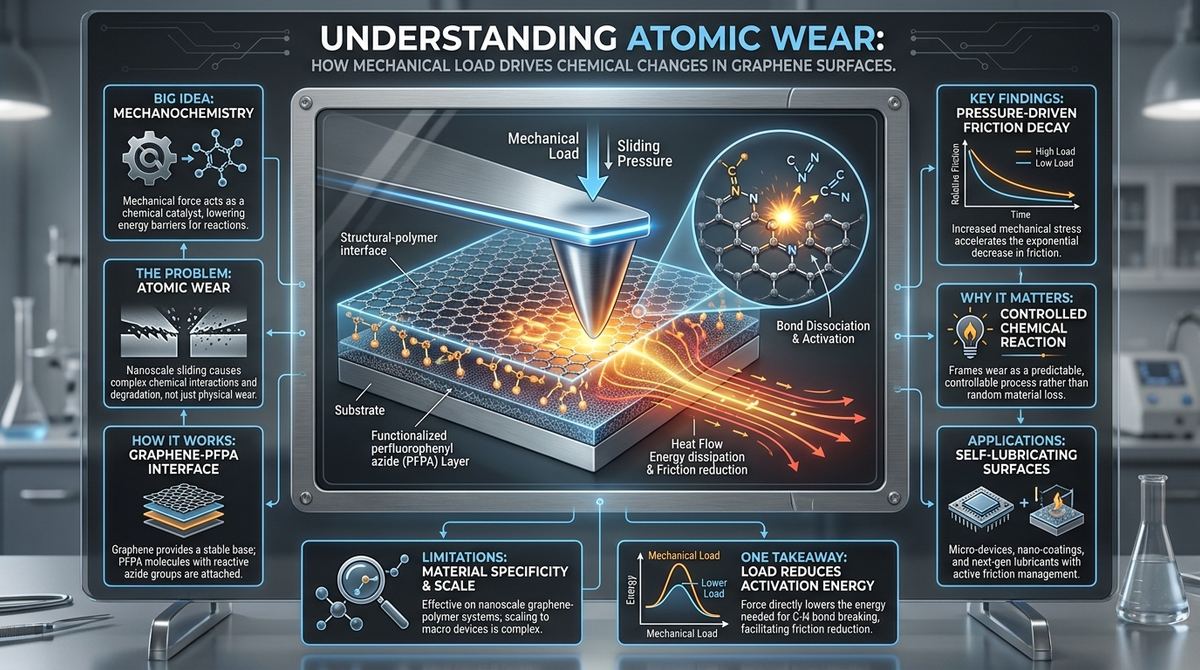
Imagine a world where the surfaces of our machines are so smooth that friction is almost non-existent. At the macroscopic level, we use oils and greases to achieve this, but at the atomic level, friction is a complex dance of chemical bonds breaking and reforming. If we could program a material to change its own chemistry in response to the pressure applied to it, we could create surfaces that effectively lubricate themselves through a chemical reaction triggered by movement. This is the frontier of nanotribology, where the goal is not just to reduce wear, but to understand and control the precise atomic events that cause a material to degrade or evolve under stress.
In the quest to build smaller and more efficient devices, such as micro-electro-mechanical systems or advanced nano-coatings, engineers face a persistent challenge: atomic wear. When two surfaces slide against each other at the nanoscale, they do not just rub together like sandpaper; instead, they engage in a series of complex chemical interactions. For materials like functionalized graphene, which are often used for their incredible strength and conductivity, understanding how these surfaces wear down is critical. If a coating degrades too quickly or unpredictably, the entire device fails.
The core problem is that we often treat friction as a constant value, but in reality, it is dynamic. Specifically, the interaction between a graphene surface and a polymer coating can change over time as the material is subjected to mechanical load. Until recently, it has been difficult to quantify exactly how much pressure is required to trigger a chemical change in these coatings and how that change subsequently affects the friction. Scientists needed a way to map the relationship between the physical force applied by a contact probe and the chemical kinetics of bond dissociation on the surface.
The research conducted by Perawat Boonpuek, Watcharee Waratchareeyakul, and Kanchala Sudtachat focuses on a phenomenon called mechanochemistry. This is the idea that mechanical force, such as the pressure from a sliding tip, can act like a chemical catalyst. In this specific study, the researchers used a material called perfluorophenyl azide (PFPA) attached to a single layer of graphene. They discovered that when an atomic force microscopy (AFM) tip slides across this surface, the pressure it exerts actually lowers the energy barrier required to break certain chemical bonds.
Essentially, the mechanical load does some of the work that heat or a chemical reagent would normally do. As the tip pushes down and slides, it forces the carbon-nitrogen (C-N) bonds in the PFPA layer to break. This breakage is not just damage; it is a transformation. The breaking of these bonds leads to a reorganization of the surface chemistry, which results in a measurable decay in friction. The harder the tip presses, the faster these bonds break, and the more quickly the surface becomes slippery.
To understand this process, we must look at the architecture of the interface. Graphene acts as the structural foundation, providing a flat, stable, and highly conductive hexagonal lattice of carbon atoms. On top of this graphene layer, the researchers attached perfluorophenyl azide (PFPA). PFPA is a specialized molecule designed to bond with the surface, and it contains azide groups which are highly reactive. The resulting interface is a hybrid of inorganic carbon (graphene) and organic polymer (PFPA).
The researchers utilized an Atomic Force Microscopy (AFM) setup, which uses a microscopic tip as a probe to interact with the surface. By controlling the normal load—the amount of force pressing the tip vertically into the material—they could simulate different levels of stress. As the tip slides horizontally, it creates a contact zone where intense local pressure is concentrated. This pressure targets the C-N bonds that tether the PFPA molecules to the graphene or hold the internal structure of the polymer together.
The reason this system is so effective for study is that graphene provides a predictable, single-atom-thick baseline. Any change in friction measured by the AFM tip can be directly attributed to the chemical state of the PFPA layer rather than irregularities in the substrate. The interaction is governed by the activation energy, which is the minimum amount of energy required for a chemical reaction to occur. In a static environment, these bonds might be stable, but the introduction of mechanical sliding force alters the energy landscape.
The most striking discovery was the relationship between the contact load and friction decay. The researchers observed that as the AFM tip slid across the surface, the relative friction did not stay constant; instead, it decreased exponentially over time. This is known as friction decay. Crucially, they found that this decay happened much faster when the normal load was increased.
By applying a reaction-rate analysis model, the team determined that the mechanical stress was directly lowering the activation barrier for the dissociation of C-N bonds. In simpler terms, the force from the tip made it easier for the bonds to snap. Once a C-N bond is cleaved, it triggers a subsequent reaction where the azide groups rearrange or substitute. This chemical transformation changes the nature of the interface, effectively turning a higher-friction surface into a lower-friction one.
The researchers proposed a unified mechanism to explain this: the sliding contact induces C-N bond cleavage, which then enables the substitution of the azide groups. This process progressively modifies the interfacial chemistry. Because the rate of this chemical change is tied to the amount of mechanical work being done, the normal load acts as a regulator. Higher loads accelerate the kinetics of the reaction, meaning the surface reaches its low-friction state much faster than it would under a light load.
This research is significant because it moves us away from viewing wear as a random or purely physical process of material loss. Instead, it frames wear as a controlled chemical reaction driven by mechanical force. By quantifying the kinetics of this process, scientists can now predict how long a graphene-polymer coating will last under specific load conditions.
The ability to link mechanical load to chemical bond dissociation allows for the design of smart surfaces. If we know exactly how much pressure is needed to trigger a friction-reducing reaction, we can engineer materials that remain stable under light loads but become ultra-slippery when high pressure is applied. This creates a load-responsive interface that can protect components from sudden spikes in friction or wear, potentially extending the lifespan of nanoscopic machines and sensors.
Furthermore, this work deepens our understanding of the C-N bond in the context of graphene functionalization. Knowing that these bonds are the primary point of failure—and the primary driver of friction decay—allows chemists to modify the PFPA molecule or choose different functional groups to either strengthen the bond for durability or weaken it for faster friction reduction.
While the findings are groundbreaking, it is important to note that this research was conducted in a highly controlled laboratory environment using single-layer graphene. In real-world industrial applications, graphene is rarely a perfect single layer and is often integrated into complex composites or applied to rougher surfaces. The presence of defects, wrinkles, or contaminants in a commercial setting could significantly alter the reaction kinetics and the resulting friction decay.
Additionally, the study focused on a specific polymer, PFPA. While this provides a clear model for mechanochemical reactions, other polymers may react differently or require much higher loads to trigger bond dissociation. Future research needs to explore a wider variety of functional groups to see if this unified mechanism of bond cleavage and substitution is universal across all graphene-polymer interfaces.
There is also the question of reversibility. The study describes a process where the surface is modified, but it does not clarify if these changes are permanent or if the surface can be restored to its original state. Testing the long-term stability of these modified surfaces after repeated cycles of loading and unloading will be essential before this can be applied to commercial products.
The practical applications of this research span several high-tech industries. In the field of MEMS (Micro-Electro-Mechanical Systems), where tiny moving parts are prone to sticking or wearing out, using load-responsive graphene coatings could reduce energy loss and prevent device failure. By engineering the C-N bond strength, manufacturers could create components that self-lubricate exactly when and where the most pressure is applied.
In the aerospace and automotive sectors, this knowledge could lead to the development of advanced nano-lubricants. Instead of relying on liquid oils that can leak or evaporate, a solid-state graphene-polymer coating could provide a durable, low-friction interface for high-precision bearings or actuators. The ability to tune the friction decay based on expected operating loads would allow for unprecedented precision in mechanical design.
Moreover, this research has implications for the semiconductor industry. As chips become smaller and the need for thermal management increases, graphene is often used for its heat-dissipating properties. Understanding how the surface chemistry of graphene interacts with protective polymer layers under stress can help in creating more robust packaging and interconnects that do not degrade during the thermal expansion and contraction cycles of a working processor.
The most important takeaway from this research is that friction at the nanoscale is not just a physical struggle between two surfaces, but a chemical reaction. By applying mechanical load to a graphene-PFPA interface, the researchers proved that pressure can break chemical bonds and transform the surface into a more slippery state, meaning we can use mechanical force to control the chemistry of a material in real-time.
What is mechanochemistry in the context of this study?
Mechanochemistry is the process where mechanical force, such as pushing or sliding, triggers a chemical reaction. In this research, the pressure from an AFM tip provided the energy needed to break carbon-nitrogen bonds in a polymer coating on graphene, changing the material's chemical structure and reducing its friction.
Why was graphene used as the base material?
Graphene was used because it is a single-atom-thick sheet of carbon that provides an extremely flat and stable surface. This allows researchers to isolate the chemical reactions occurring in the polymer layer without interference from the roughness or irregularities found in bulkier materials.
What exactly is friction decay?
Friction decay refers to the observation that the resistance to sliding decreases over time as a surface is rubbed. In this study, the decay happened because the sliding action was physically breaking bonds and rearranging the surface chemistry, making the interface smoother and more slippery as the process continued.
Does a higher load always mean more wear?
In this specific system, a higher load accelerated the chemical reaction that reduced friction. While we typically think of more pressure as causing more damage, here it actually speeded up the transition to a lower-friction state. However, whether this is beneficial or detrimental depends on whether the goal is surface stability or maximum slipperiness.
Can these findings be used to make a permanent lubricant?
The research suggests that we can engineer surfaces with specific friction properties, but it does not yet provide a permanent solution. The study focused on the process of decay and reaction kinetics; further testing is needed to determine how long these modified surfaces remain slippery before they degrade completely.
The work of Boonpuek, Waratchareeyakul, and Sudtachat provides a sophisticated map of the atomic-scale interactions that govern wear in graphene-polymer systems. By demonstrating that normal load directly regulates the kinetics of C-N bond dissociation, they have revealed how mechanical energy can be harnessed to modify interfacial chemistry. This shifts our understanding of nanoscopic wear from a process of simple erosion to one of dynamic chemical transformation. As we move toward an era of precision nanotechnology, the ability to tune these mechanochemical reactions will be instrumental in creating the next generation of durable, high-efficiency surfaces.
Serious about B2B integration? Test our premium Pulsed Electrical Resistive Carbon Heating turbostratic graphene in your lab. 100g sample packs available now.
Explore More
Researchers propose a new method for dark matter detection using angular scanning, a technique that may rely on graphene's unique electronic sensitivity.

Build a flexible graphene battery sensor for real-time temperature and strain monitoring, a crucial step toward preventing thermal runaway in Li-ion cells.

Research on 30° quasi-periodic twisted bilayer graphene reveals a unique, fractal-like energy structure under magnetic fields, paving the way for novel...