
Rippled Graphene Pores for Neuromorphic Fluidic Memristive Devices
Discover how rippled graphene pores act as fluidic memristors, enabling advanced synaptic functionalities for the next generation of neuromorphic computing.
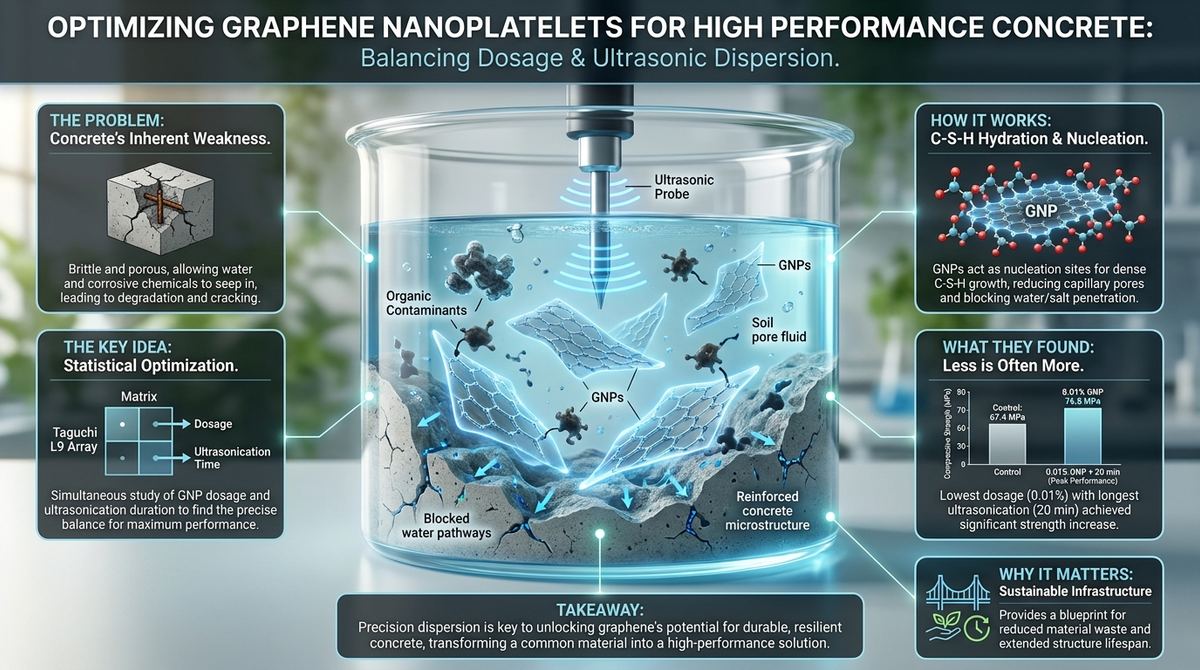
Concrete is the most widely used construction material on Earth, yet it possesses an inherent weakness that has plagued engineers for centuries. While it is incredibly strong under compression, it is naturally brittle and porous, allowing water and corrosive chemicals to seep into its microstructure over time. This permeability leads to the degradation of internal steel reinforcements and the eventual cracking of the structure. To solve this, researchers are turning to carbon nanomaterials, specifically graphene nanoplatelets, which act as microscopic reinforcements. However, adding these materials is not as simple as stirring in a powder. Because of their chemical nature, graphene particles tend to clump together, creating weak points rather than strengthening the matrix. Finding the exact threshold where these materials stop helping and start hindering is the central challenge of modern nano-reinforced concrete.
The primary obstacle in improving cementitious composites is the trade-off between material addition and dispersion quality. Graphene nanoplatelets, or GNPs, are composed of multiple layers of graphene stacked together. Due to strong van der Waals forces, these platelets naturally attract one another, forming agglomerates or clumps. When these clumps are embedded in cement, they act as structural defects rather than reinforcements. Instead of bridging nanocracks and blocking the flow of water, they create heterogeneous regions where the cement cannot bond properly to the matrix.
Furthermore, the industry lacks a precise roadmap for how much graphene is actually necessary. Many early attempts at reinforcement assumed that more material would lead to better results, but in the world of nanotechnology, excess often leads to failure. If the dosage is too high, the material becomes impossible to disperse evenly, leading to a decrease in compressive strength. The research conducted by Maria Liovas, Reagan Farough, and Adeyemi Adesina sought to move beyond trial-and-error by utilizing rigorous statistical methods to determine the optimal combination of GNP concentration and the energy required to disperse them.
The core concept of this research is based on the idea of optimization through statistical design. Rather than testing every possible combination of variables, which would be time-consuming and expensive, the researchers used a method called the Taguchi L9 orthogonal array. This allows them to study two critical factors simultaneously: the amount of graphene nanoplatelets added to the cement and the duration of ultrasonication, which is a process using high-frequency sound waves to shake the particles apart and spread them evenly throughout the mixture.
By analyzing how these two variables interact, the team aimed to find a sweet spot where the graphene is present in enough quantity to reinforce the structure but not so much that it clumps together. They treated the cement mixture like a chemical recipe, adjusting the dosage and the mixing energy to see which combination produced the strongest and least permeable material. The goal was to prove that the quality of the dispersion is just as important, if not more so, than the quantity of the graphene itself.
To understand why graphene nanoplatelets improve cement, one must look at the chemistry of hydration. When water is added to cement, a chemical reaction occurs that creates calcium silicate hydrate, or C-S-H, which is the glue that holds concrete together. In a standard mixture, this C-S-H grows in a somewhat random fashion, leaving behind tiny capillary pores and voids. These voids are the highways that water and salts use to penetrate the concrete, leading to internal decay.
Graphene nanoplatelets change this process by acting as nucleation sites. Because GNPs have an incredibly high surface area and a unique atomic structure, they provide a foundation upon which the C-S-H crystals can begin to grow. Instead of growing in isolated pockets, the hydration products form more uniformly around the dispersed graphene. This results in a denser, more interconnected microstructure with fewer large pores.
Additionally, GNPs function as mechanical bridges. On a microscopic scale, cement is prone to developing tiny cracks under stress. When graphene nanoplatelets are well-dispersed, they span these nanocracks, effectively stitching the matrix together. This prevents micro-cracks from coalescing into larger, structural cracks. The effectiveness of this bridging mechanism depends entirely on the interface between the graphene and the cement; if the graphene is clumped, there is no interface to bridge, and the reinforcement effect vanishes.
The results of the study revealed a surprising but critical truth: less is often more. The researchers tested GNP dosages of 0.01 percent, 0.05 percent, and 0.10 percent by mass of cement, with ultrasonication times of 5, 10, and 20 minutes. The most striking finding was that the lowest dosage of 0.01 percent, when paired with the longest ultrasonication time of 20 minutes, produced the best overall performance. This specific mixture achieved a 28-day compressive strength of 76.8 MPa, a significant increase over the control mixture's 67.4 MPa.
The team also found that this same combination was the most effective at blocking water. The 28-day water absorption for the optimized mixture was only 7.47 percent, compared to 8.35 percent for the control. This confirms that a small amount of perfectly dispersed graphene can seal the internal pore network more effectively than a larger amount of poorly dispersed material.
Interestingly, the data showed that strength and pore-network refinement do not always peak at the same point. While 0.01 percent GNP provided the highest strength, a dosage of 0.05 percent with only 5 minutes of ultrasonication produced the lowest permeable void content. This suggests that different mechanisms are at play regarding how graphene fills voids versus how it reinforces the mechanical bonds of the cement. However, when looking at the overall structural integrity, the low-dosage, high-dispersion approach was the clear winner. Scanning electron microscopy confirmed these results, showing a dense, uniform hydration matrix in the optimized samples and visible clumps of material in the higher-dosage samples.
This research is pivotal because it provides a blueprint for reducing material waste and increasing the lifespan of infrastructure. By proving that 0.01 percent GNP is sufficient for significant strength gains, the study suggests that expensive nanomaterials can be used sparingly without sacrificing performance. This makes the prospect of graphene-reinforced concrete more economically viable for large-scale projects.
Beyond the cost, the reduction in water absorption is a critical victory for durability. In environments where concrete is exposed to saltwater or freeze-thaw cycles, the ability to block water ingress is the primary factor in preventing structural failure. By refining the pore network through optimized GNP incorporation, engineers can create structures that are far more resistant to corrosion and environmental weathering. This shift from simply making concrete stronger to making it more durable represents a fundamental change in how we approach sustainable construction.
Despite the promising results, this research is a foundational step rather than a final commercial solution. One primary limitation is the scale of the production. Ultrasonication is highly effective in a laboratory setting for small batches, but applying this level of energy to thousands of cubic meters of concrete on a construction site is a massive logistical challenge. The industry will need to find scalable ways to replicate this dispersion quality without requiring every batch of concrete to be treated in a sonic bath.
Furthermore, while 28-day strength is the industry standard for testing, it does not tell us how these materials will behave over 20 or 50 years. The long-term stability of the graphene-cement interface under constant load or extreme temperature fluctuations remains to be seen. There is also a need to test these optimized mixtures with different types of cement, such as fly-ash or slag-based blends, to see if the 0.01 percent threshold remains consistent across different chemical compositions of concrete.
The optimized graphene-cement composite has immediate potential in high-performance infrastructure. Marine structures, such as piers, seawalls, and bridge supports, would benefit immensely from the reduced water absorption and increased density, as these environments are notoriously aggressive toward concrete. Similarly, in seismic zones, the ability of GNPs to bridge nanocracks could lead to buildings that are more resilient during earthquakes, absorbing energy and resisting catastrophic failure.
Another application lies in the development of thin-shell concrete structures. Because the optimized mixture provides higher compressive strength at a lower material volume, architects could design thinner, more elegant structural elements that maintain the same load-bearing capacity as thicker, traditional concrete. This would not only reduce the amount of material needed for construction but also lower the overall carbon footprint associated with cement production.
The most important takeaway from this research is that the secret to graphene-reinforced concrete is not the amount of graphene added, but the quality of its dispersion. A tiny amount of graphene, precisely spread using sufficient energy, outperforms a larger amount of material that is poorly mixed.
Does adding more graphene always make concrete stronger? No, the research shows that increasing the dosage can lead to agglomeration, where graphene particles clump together and create weak spots in the cement matrix, actually reducing strength.
What is ultrasonication and why is it used here? Ultrasonication uses high-frequency sound waves to create bubbles that collapse and release energy, which physically pushes the graphene nanoplatelets apart. This ensures they are evenly distributed so they can act as nucleation sites for the cement's growth.
How does graphene actually stop water from entering concrete? Graphene nanoplatelets act as physical barriers that block the tiny capillary pores in the cement. By filling these voids and promoting a denser hydration matrix, they make it much harder for water to penetrate the material.
Is this technology ready to be used in every house today? Not quite. While the lab results are excellent, the process of ultrasonication is difficult to scale up to the massive volumes required for typical residential construction.
What was the most effective combination found in the study? The best performance in terms of strength and water resistance was achieved using a very low dosage of 0.01 percent graphene nanoplatelets combined with 20 minutes of ultrasonication.
The integration of graphene nanoplatelets into cementitious composites marks a significant leap forward in material science, but as this study demonstrates, precision is paramount. By utilizing statistical tools like the Taguchi method and response surface modeling, Maria Liovas, Reagan Farough, and Adeyemi Adesina have shown that the synergy between dosage and dispersion energy is what truly unlocks the potential of carbon nanomaterials. When graphene is used sparingly but dispersed thoroughly, it transforms concrete from a porous, brittle stone into a dense, high-performance composite. While challenges in industrial scaling remain, the path toward more durable and sustainable infrastructure is now clearer, proving that in the world of nanotechnology, a small, well-placed addition can lead to a massive structural impact.
Serious about B2B integration? Test our premium Pulsed Electrical Resistive Carbon Heating turbostratic graphene in your lab. 100g sample packs available now.
Explore More
Discover how rippled graphene pores act as fluidic memristors, enabling advanced synaptic functionalities for the next generation of neuromorphic computing.

Learn how to use electromechanical responses in gapped graphene to measure electronic temperature and band gaps using traveling flexural waves.

Explore how researchers have discovered viscous electron fluid behavior in cadmium, a breakthrough that could revolutionize the future of nanoelectronics.