
Rippled Graphene Pores for Neuromorphic Fluidic Memristive Devices
Discover how rippled graphene pores act as fluidic memristors, enabling advanced synaptic functionalities for the next generation of neuromorphic computing.
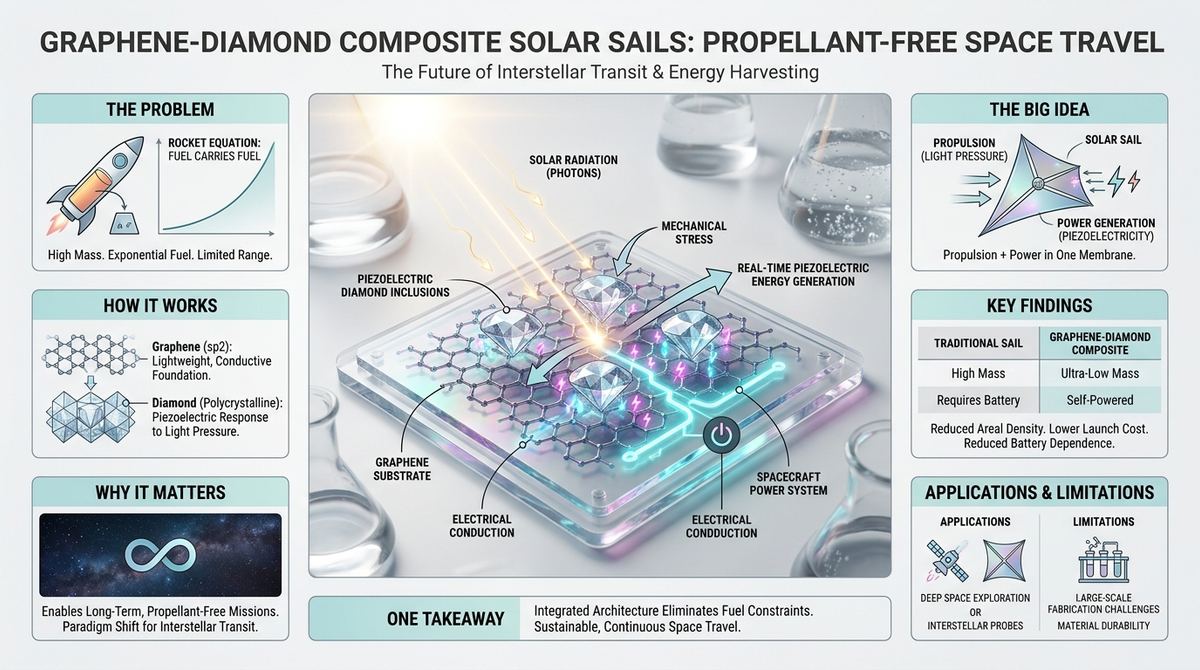
Imagine a spacecraft that requires no fuel tanks, carries no heavy chemical propellants, and never needs to stop for a recharge. For decades, the dream of sailing through the cosmos using nothing but the pressure of sunlight has captivated scientists, yet the practical reality has been hindered by the weight of the materials and the need for separate, heavy power systems to keep the ship's electronics running. The prospect of a vessel that is simultaneously its own engine and its own power plant represents a paradigm shift in how we perceive interstellar transit.
Space exploration is currently held hostage by the tyranny of the rocket equation. To move a payload, a rocket must carry propellant; however, to move that propellant, more propellant is required, leading to an exponential increase in the initial mass of the vehicle. While solar sails offer a solution by utilizing the momentum of photons from the sun to provide continuous, low-thrust acceleration, they face two primary bottlenecks. First, traditional sail materials are often too heavy or lack the structural durability to survive the stresses of long-term deployment. Second, solar sails are typically just propulsion systems. To power the onboard computers, communication arrays, and navigation sensors, these ships must still carry heavy electrochemical batteries or large, rigid solar panels that add significant mass and complexity to the architecture.
The effort to integrate propulsion and power into a single, ultra-lightweight membrane is where the current limitations lie. Most sail designs treat the mirror and the battery as separate entities. This separation increases the total areal density of the spacecraft, which directly reduces its acceleration. If a sail is too heavy, the force exerted by solar radiation pressure becomes insufficient to move the craft efficiently through cislunar or interplanetary space.
Toma Alexandru proposes a radical architectural integration that turns the sail itself into a power generator. Instead of using a simple reflective sheet, this design employs a composite membrane made of graphene and polycrystalline diamond. This material does more than just reflect sunlight to push the ship forward; it uses the physical pressure of that light to generate electricity.
The core innovation is the use of a phenomenon called piezoelectricity within the diamond layers of the sail. Piezoelectric materials generate an electric charge when they are mechanically stressed or deformed. Because solar radiation pressure constantly pushes against the sail, it creates a persistent mechanical strain on the material. By engineering the diamond components of the membrane to be piezoelectric, the sail converts this physical pressure directly into electrical energy. This creates a self-sustaining system where the same light source that propels the ship also powers its internal systems, potentially eliminating the need for heavy onboard batteries.
The effectiveness of this architecture depends entirely on the synergistic relationship between graphene and diamond. Graphene, a single layer of carbon atoms arranged in a hexagonal lattice, provides the necessary structural foundation. Due to its sp2-hybridized bonding, graphene possesses one of the highest known strengths-to-weight ratios and exceptional electrical conductivity. In this system, graphene acts as the ultra-low-mass substrate that holds the membrane together and provides a conductive pathway to transport the harvested electricity to the spacecraft's systems.
Integrated into this graphene framework is polycrystalline diamond. While single-crystal diamond is a well-known thermal conductor, the polycrystalline form allows for the creation of specific grain boundaries and lattice asymmetries. When these diamond structures are integrated into the membrane, they exhibit piezoelectric properties. As photons from the sun strike the sail, they transfer momentum, creating a mechanical force known as radiation pressure. This pressure causes minute deformations in the diamond lattice. Because the diamond is polycrystalline and structured to be piezoelectric, these mechanical shifts displace the centers of positive and negative charges within the crystal, creating an electric potential.
The cause-and-effect chain is precise: solar photons hit the sail, creating mechanical stress; this stress deforms the piezoelectric diamond lattice, generating a voltage; and the highly conductive graphene layer collects these charges and moves them toward the ship's energy bus. By combining these two carbon allotropes, the researchers create a material that is light enough to be accelerated by sunlight but robust enough to serve as a primary energy harvester.
The research establishes a theoretical framework for an integrated architecture that could drastically reduce the mass of spacecraft. By leveraging the combined properties of graphene and diamond, the design achieves an ultra-low areal density. This is critical because the acceleration of a solar sail is inversely proportional to its mass per unit area. The findings suggest that by integrating power generation directly into the sail membrane, the requirement for heavy electrochemical energy storage systems can be substantially reduced or even eliminated across various mission profiles.
The research outlines four specific embodiments of this technology. For cislunar transport, the architecture can support cycler missions that move between Earth and the Moon with minimal energy expenditure. For inner solar system transit, the high radiation pressure allows for rapid maneuvering. In the case of outer planet trajectories, the design suggests a perihelion-boost maneuver, where the craft dives close to the sun to maximize radiation pressure and energy harvesting before being slung toward the outer reaches of the solar system. Finally, the researchers propose an adaptation for interstellar travel, where a powerful ground-based or orbital laser array replaces the sun as the primary photon source, pushing the graphene-diamond sail to a significant fraction of the speed of light.
This research is a fundamental step toward making propellant-free space travel a reality. By removing the need for traditional fuel and reducing the reliance on heavy batteries, the total launch mass of a spacecraft is lowered significantly. This reduces the cost of leaving Earth's gravity well and allows for much larger payloads or more ambitious mission durations.
Furthermore, the ability to generate power from radiation pressure solves a long-standing problem in deep-space exploration: the decay of energy sources. Traditional solar panels lose efficiency as a spacecraft moves away from the sun, and radioisotope thermoelectric generators are limited by their fuel supply. A piezoelectric sail that harvests energy from the very force pushing it forward ensures that as long as there is a light source—whether it be the sun or a directed laser—the ship remains powered. This opens the door to truly autonomous, long-term probes that can explore the interstellar medium without fearing a complete power failure.
While the theoretical framework is robust, this architecture is not yet commercially ready or flight-proven. One of the primary challenges is the large-scale fabrication of graphene-diamond composite membranes. Creating a material that is uniform, defect-free, and maintains its piezoelectric properties over thousands of square meters is a significant manufacturing hurdle. Any inconsistencies in the diamond grain structure could lead to inefficient energy harvesting or structural weak points that might cause the sail to tear under pressure.
Thermal management also remains a critical area for testing. While diamond is an excellent thermal conductor, the interaction between the graphene and diamond layers under extreme temperature fluctuations—from the searing heat of a perihelion pass to the absolute cold of interstellar space—must be thoroughly analyzed. The researchers must ensure that the interface between these materials does not degrade due to thermal expansion mismatch, which could lead to delamination. Additionally, the long-term effects of cosmic radiation and micrometeoroid impacts on the piezoelectric efficiency of the polycrystalline diamond have yet to be empirically measured in a space environment.
The most immediate application for this technology would likely be in cislunar space. A fleet of graphene-diamond sail cyclers could provide a sustainable, fuel-free transport link between Earth and lunar colonies, moving cargo and personnel using optimized trajectories that require no propellant.
Beyond the Moon, this architecture could enable a new class of interplanetary probes designed for the inner solar system. These craft could navigate between Venus, Earth, and Mars with unprecedented agility, using the sun's radiation to constantly adjust their orbits. For missions to the outer planets, such as Jupiter or Saturn, the perihelion-boost strategy would allow a spacecraft to gain immense velocity by dipping close to the sun, effectively using the solar sail as a gravitational and radiation-based slingshot. In the longest term, this architecture provides a blueprint for interstellar precursors—tiny, lightweight probes pushed by massive laser arrays toward Proxima Centauri and other nearby star systems.
The most important takeaway from this research is the integration of function: the solar sail is no longer just a mirror used for propulsion, but a sophisticated carbon-based composite that simultaneously pushes the spacecraft forward and generates electricity through the piezoelectric effect of polycrystalline diamond.
What exactly is a solar sail? A solar sail is a spacecraft propulsion system that uses the pressure of sunlight to move. Unlike rockets, which expel mass to create thrust, a solar sail captures the momentum of photons hitting its surface, providing a constant, gentle push that accelerates the craft over time.
Why is graphene used in this design? Graphene is used because it is incredibly light and strong, providing the structural integrity needed for a massive sail without adding significant weight. Its high electrical conductivity also allows it to act as the wiring that collects electricity from the diamond components.
How does the sail generate electricity? The sail uses polycrystalline diamond, which has piezoelectric properties. When solar radiation pressure pushes against the sail, it creates mechanical stress in the diamond lattice. This stress shifts electrical charges within the material, creating a voltage that can be harvested as power.
Can this system really reach other stars? Theoretically, yes. While sunlight is too weak for rapid interstellar travel, the research suggests that a powerful laser array could be used to push a graphene-diamond sail. Because the material is so light, a laser could accelerate it to speeds high enough to reach nearby star systems within a human lifetime.
Is this technology already being used in space? No, this is currently a theoretical architectural proposal. While graphene and diamond are well-studied materials, integrating them into a massive, power-generating solar sail requires further advancements in manufacturing and materials science before it can be launched.
The graphene-diamond composite architecture proposed by Toma Alexandru represents a bold vision for the future of space exploration. By merging the structural brilliance of graphene with the energy-harvesting capabilities of polycrystalline diamond, this design offers a path toward propellant-free transport that is both efficient and sustainable. While significant engineering challenges remain in the realm of large-scale fabrication and thermal stability, the theoretical foundations are clear. The transition from heavy, fuel-dependent rockets to lightweight, light-harvesting sails could be the key that finally unlocks the vast distances of our solar system and the mysteries of the interstellar void.
Serious about B2B integration? Test our premium Pulsed Electrical Resistive Carbon Heating turbostratic graphene in your lab. 100g sample packs available now.
Explore More
Discover how rippled graphene pores act as fluidic memristors, enabling advanced synaptic functionalities for the next generation of neuromorphic computing.

Learn how to use electromechanical responses in gapped graphene to measure electronic temperature and band gaps using traveling flexural waves.

Explore how researchers have discovered viscous electron fluid behavior in cadmium, a breakthrough that could revolutionize the future of nanoelectronics.