
Rippled Graphene Pores for Neuromorphic Fluidic Memristive Devices
Discover how rippled graphene pores act as fluidic memristors, enabling advanced synaptic functionalities for the next generation of neuromorphic computing.
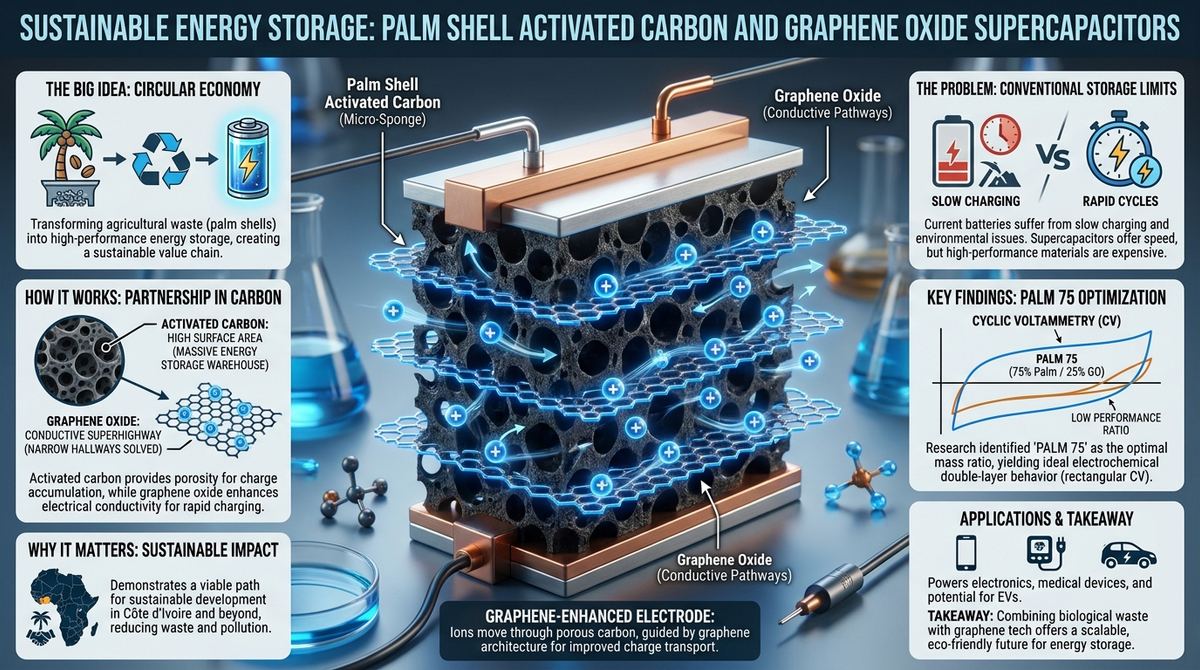
Imagine a world where the waste from our food systems does not pollute the environment but instead powers our smartphones and medical devices. In Côte d'Ivoire, the palm oil industry provides a massive economic boost, yet it leaves behind mountains of palm nut shells that often go to waste. The challenge is transforming this biological debris into something technologically valuable. By combining these organic remnants with the futuristic properties of graphene, scientists are creating energy storage devices that charge almost instantly and last for years.
The modern world is facing a dual crisis of electronic waste and an urgent need for sustainable energy storage. While lithium-ion batteries are the current standard, they suffer from slow charging times and a reliance on expensive, environmentally damaging mining processes. Supercapacitors offer an alternative by providing rapid charge and discharge cycles and incredible longevity, but their efficiency depends entirely on the materials used for the electrodes.
High-performance electrodes typically require expensive synthetic carbons or rare metals to achieve a high surface area and high electrical conductivity. This creates a financial and ecological barrier to scaling supercapacitor technology. In regions like Côte d'Ivoire, the abundance of palm nut shells presents a golden opportunity to source carbon naturally. However, raw activated carbon derived from these shells often lacks the necessary electrical conductivity to move charges quickly, which limits its ability to store and release energy efficiently. Djako Oscar Eric Koutouan and Donourou Diabaté sought to bridge this gap by integrating agricultural waste with graphene oxide, creating a hybrid material that leverages the strengths of both components.
The core strategy is to create a partnership between two different types of carbon. The activated carbon derived from palm shells acts like a giant, microscopic sponge. It is filled with tiny pores and crevices that provide a massive amount of surface area where electrical charges can gather. However, this biological sponge is not very good at conducting electricity on its own; it is like having a huge warehouse for energy but very narrow hallways to get the electricity in and out.
To fix this, the researchers introduced graphene oxide. Graphene is a single layer of carbon atoms arranged in a honeycomb lattice, known for being one of the most conductive materials on Earth. By mixing graphene oxide into the palm shell carbon, they essentially built a high-speed electrical highway system throughout the sponge. This allows electrons to move rapidly across the entire electrode, ensuring that every single pore of the activated carbon can be utilized for energy storage. The result is a composite material that is both cheap to produce and highly efficient at storing electricity.
To understand why this composite works, we must look at the interface between the activated carbon and the graphene oxide. In a standard supercapacitor, energy is stored through the formation of an electrical double layer. This happens when ions from an electrolyte migrate to the surface of the electrode, creating a layer of charge that can be released almost instantly. The efficiency of this process depends on two main factors: the available surface area and the conductivity of the material.
The activated carbon from palm shells provides the necessary porosity. When these shells are chemically treated and heated, they develop a complex network of micropores. These pores increase the effective surface area exponentially, providing more sites for ions to cling to. However, if the carbon particles are not well-connected, the internal resistance increases, which slows down the charging process and reduces the total capacity.
This is where the graphene oxide comes into play. Graphene oxide sheets wrap around and interconnect with the activated carbon particles. Because graphene has exceptional electron mobility, it reduces the equivalent series resistance of the electrode. Furthermore, the presence of graphene oxide helps prevent the activated carbon particles from clumping together, which would otherwise block access to the pores. By optimizing the ratio of these two materials, the researchers created a synergistic effect where the graphene oxide handles the transport of electrons while the activated carbon handles the storage of ions.
The research focused on testing different ratios of palm shell carbon to graphene oxide to find the sweet spot for performance. The most successful iteration was labeled PALM 75, which consisted of a mass ratio of 75 percent palm shell activated carbon and 25 percent graphene oxide.
When the team analyzed this material using cyclic voltammetry, they observed quasi-rectangular voltammograms. In the world of electrochemistry, a rectangular shape is the gold standard for supercapacitors because it indicates an ideal electrochemical double-layer behavior. It means that the energy is being stored and released in a linear, predictable fashion without significant energy loss through side reactions.
The PALM 75 composite achieved a maximum specific capacity of 143 Farads per gram at a current density of 0.25 Amperes per gram. Beyond just capacity, the material showed impressive energy and power metrics. It reached a maximum energy density of 19.8 Watt-hours per kilogram and a power density of 2500 Watts per kilogram. Perhaps most impressively, the researchers found that the material maintained 100 percent of its cyclic stability after 10,000 charge and discharge cycles. This suggests that the structural bond between the palm carbon and the graphene oxide is incredibly robust, resisting the mechanical stress that usually degrades electrodes over time.
The implications of this research extend beyond the laboratory. By utilizing palm nut shells, the study demonstrates a viable path toward a circular economy in West Africa. Instead of treating agricultural leftovers as waste that contributes to pollution, these materials are repurposed into high-value technological components. This reduces the reliance on imported synthetic carbons and lowers the overall carbon footprint of supercapacitor production.
From a technical standpoint, the ability to achieve 100 percent stability over 10,000 cycles is a major milestone. Most energy storage devices degrade as they are used, losing capacity over time. A material that can withstand thousands of cycles without losing performance is essential for creating sustainable electronics that do not need to be replaced every few years. This research proves that biological precursors can be engineered into professional-grade electronic materials when paired with the right nanostructures.
While the results are promising, it is important to note that this research is currently at the material characterization stage and is not yet a commercially ready product. The study focused on the electrochemical properties of the composite in a controlled environment, but several hurdles remain before this could be used in a consumer device.
One primary limitation is the scalability of graphene oxide production. While palm shells are abundant and cheap, graphene oxide requires specific chemical processing that can be costly and environmentally taxing if not managed correctly. Future research must investigate ways to produce the graphene oxide component using green chemistry to ensure the entire process remains sustainable.
Additionally, the study tested the material's stability over 10,000 cycles, which is impressive, but industrial standards for supercapacitors often require stability over hundreds of thousands or even millions of cycles. Long-term stress tests under varying temperatures and humidity levels are also necessary to determine how the PALM 75 composite would behave in real-world climates, such as the extreme heat and moisture of tropical regions.
Because of its high power density and rapid charging capability, the palm-graphene composite is ideal for applications that require quick bursts of energy. One potential use is in the development of low-cost, sustainable power backups for agricultural sensors. In smart farming, sensors that monitor soil moisture or crop health need efficient energy storage to operate in remote fields without constant battery replacements.
The material could also be utilized in wearable electronics or small-scale energy harvesting systems. For instance, a supercapacitor made from this composite could store energy captured from a small solar panel or a kinetic energy harvester, providing steady power to a wearable health monitor. Because the material is derived from organic waste, it aligns perfectly with the growing demand for biodegradable or eco-friendly electronics.
The most critical takeaway from this research is that agricultural waste, such as palm nut shells, can be transformed into high-performance energy storage materials when combined with graphene oxide. This synergy creates a conductive, porous electrode that is stable over thousands of cycles and provides a sustainable alternative to expensive synthetic carbons.
What exactly is a supercapacitor? A supercapacitor is a device that stores electrical energy, acting as a hybrid between a traditional capacitor and a rechargeable battery. It can charge and discharge much faster than a battery but typically stores less total energy.
Why was graphene oxide used instead of just using the palm shells? While palm shells provide a lot of surface area for storing ions, they are not very conductive. Graphene oxide acts as a conductive bridge, allowing electricity to flow quickly through the material, which significantly boosts the overall performance.
What does 100 percent cyclic stability mean? This means that after charging and discharging the device 10,000 times, the electrode was still able to store exactly as much energy as it did on the first cycle. There was no degradation of the material's capacity.
Is this technology ready to replace lithium batteries in my phone? No, it is not yet a direct replacement for high-capacity batteries. Supercapacitors are better at providing quick bursts of power and fast charging, whereas batteries are better for long-term energy storage. However, they often work together in hybrid systems.
How does this help the environment? By using palm nut shells, the process turns a waste product from the agricultural industry into a useful tool. This prevents the waste from polluting the land and reduces the need to mine or synthesize carbon from petroleum-based sources.
The integration of palm shell activated carbon and graphene oxide represents a significant step forward in the pursuit of sustainable electronics. By leveraging the natural porosity of agricultural waste and the exceptional conductivity of graphene, Djako Oscar Eric Koutouan and Donourou Diabaté have demonstrated that high-performance energy storage does not have to come at a high environmental cost. While further testing is required to move this from the lab to the factory, the PALM 75 composite provides a blueprint for how we can rethink waste and build a greener, more energy-efficient future.
Serious about B2B integration? Test our premium Pulsed Electrical Resistive Carbon Heating turbostratic graphene in your lab. 100g sample packs available now.
Explore More
Discover how rippled graphene pores act as fluidic memristors, enabling advanced synaptic functionalities for the next generation of neuromorphic computing.

Learn how to use electromechanical responses in gapped graphene to measure electronic temperature and band gaps using traveling flexural waves.

Explore how researchers have discovered viscous electron fluid behavior in cadmium, a breakthrough that could revolutionize the future of nanoelectronics.