
Rippled Graphene Pores for Neuromorphic Fluidic Memristive Devices
Discover how rippled graphene pores act as fluidic memristors, enabling advanced synaptic functionalities for the next generation of neuromorphic computing.
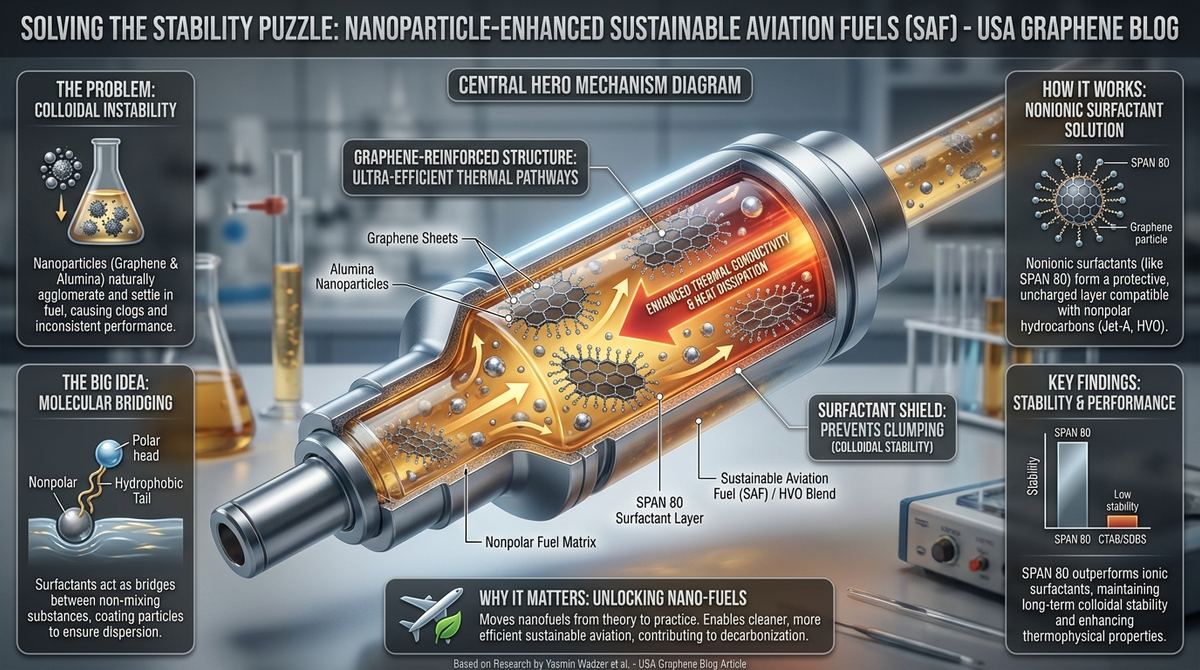
Imagine a world where airplanes fly further and cleaner, not just by changing the fuel they burn, but by fundamentally altering how that fuel behaves inside the engine. Sustainable aviation fuel, often derived from hydrotreated vegetable oils, is already helping the industry move toward decarbonization. However, there is a way to make these fuels even more efficient by adding nanoparticles like graphene and aluminum oxide. These additives can improve how heat moves through the fuel and how efficiently it burns, but there is a catch. Nanoparticles are naturally inclined to clump together and sink to the bottom of the tank, which could clog fuel lines or cause uneven combustion. To make this technology viable, scientists must find a way to keep these particles floating and evenly dispersed in a nonpolar liquid that naturally rejects them.
The transition to sustainable aviation fuel, or SAF, is a cornerstone of the aerospace industry's goal to reduce carbon emissions. While hydrotreated vegetable oil blends are a promising alternative to traditional Jet-A fuel, the quest for higher thermophysical performance has led researchers toward nanofuels. By introducing nanoparticles such as graphene and aluminum oxide, engineers can potentially increase the thermal conductivity and combustion efficiency of the fuel. However, a massive technical hurdle stands in the way: colloidal instability.
In the research conducted by Yasmin Wadzer, Hussin Mamat, Syed Afdhal Sayed Ghazali, and Nurul Musfirah Mazlan, the team addressed the inherent incompatibility between nanoparticle surfaces and nonpolar fuel systems. Nanoparticles possess an extremely high surface-area-to-volume ratio, which gives them immense surface energy. In a nonpolar environment like Jet-A or HVO, these particles experience strong attractive forces, such as van der Waals interactions, which pull them together into large aggregates. Once these particles clump, they lose their unique nano-scale properties and sediment out of the liquid, rendering the fuel unstable and potentially dangerous for aircraft engines. The challenge was to identify a chemical stabilizer that could sit at the interface between the nanoparticle and the fuel, effectively acting as a shield to keep the particles separated.
The solution lies in using surfactants, which are molecules that act as a bridge between two substances that normally do not mix. A surfactant molecule has two distinct ends: a hydrophilic head that likes water or polar surfaces and a hydrophobic tail that prefers oil or nonpolar environments. By carefully selecting the right surfactant, researchers can coat the surface of graphene or aluminum oxide nanoparticles. The polar head attaches to the nanoparticle, while the nonpolar tail extends outward into the fuel.
This creates a protective layer around every single particle. Instead of two nanoparticles bumping into each other and sticking together, they now bump into these surfactant tails. This creates a physical or electrical barrier that pushes the particles away from one another, a phenomenon known as steric or electrostatic stabilization. The goal of this specific study was to determine which type of surfactant—nonionic, cationic, or anionic—would provide the most stable and long-lasting suspension for graphene and alumina in a sustainable aviation fuel blend.
Graphene is often referred to as a wonder material because of its incredible thermal and electrical conductivity. In the context of aviation fuel, graphene acts as a heat-transfer enhancer. Because graphene consists of a single layer of carbon atoms arranged in a hexagonal lattice, it has an extraordinary ability to move heat across its surface. When dispersed correctly in fuel, graphene creates a network of highly conductive pathways that allow heat to dissipate more efficiently during the combustion process.
However, graphene is notoriously difficult to disperse. Due to strong pi-pi stacking interactions, graphene sheets tend to overlap and collapse back into graphite-like structures. To prevent this, the researchers utilized a two-step dispersion process. First, magnetic stirring provided a coarse mix, followed by ultrasonic homogenization. Sonication uses high-frequency sound waves to create microscopic bubbles that collapse violently, producing shockwaves that tear the graphene aggregates apart. Once separated, the surfactants immediately snap onto the exposed surfaces of the graphene. By tailoring the surfactant-to-nanoparticle ratio, the researchers ensured that there was enough chemical coverage to prevent the sheets from re-stacking, thereby maintaining the high surface area necessary for improved thermal performance.
The study compared three different surfactants: Cetyltrimethylammonium bromide (CTAB), which is cationic; sodium dodecylbenzenesulfonate (SDBS), which is anionic; and sorbitan monooleate (SPAN 80), which is nonionic. The results revealed a clear winner for fuel stability. SPAN 80 provided significantly better interfacial compatibility with both graphene and aluminum oxide nanoparticles than the ionic alternatives.
The reason for this success lies in the chemistry of the fuel itself. Jet-A and HVO are nonpolar hydrocarbons. Cationic and anionic surfactants like CTAB and SDBS carry a strong electrical charge, which makes them more suitable for water-based systems than for oily fuels. In contrast, SPAN 80 is nonionic, meaning it does not carry a net charge. This allows the surfactant to integrate more seamlessly with the nonpolar fuel molecules, creating a more robust steric barrier.
The researchers used zeta-potential analysis to quantify this stability. Zeta-potential measures the electrical charge at the boundary of the nanoparticle. A higher absolute zeta-potential value indicates a stronger repulsive force between particles, which translates to better stability. The study found that optimal stabilization occurred at a surfactant-to-nanoparticle ratio of 1:1 for graphene and 1:2 for aluminum oxide. At these specific ratios, the nanoparticles remained suspended without visible sedimentation and exhibited the best thermophysical behavior, confirming that the balance of surfactant coverage is critical to preventing agglomeration.
These findings are pivotal because they move nanofuels from a theoretical curiosity to a practical possibility. By proving that SPAN 80 can maintain the colloidal stability of graphene and alumina in SAF blends, the research provides a blueprint for creating fuels that are more thermally efficient. Improved thermal conductivity means that heat can be managed more effectively within the combustion chamber, potentially leading to more complete fuel burn and a reduction in the emission of unburnt hydrocarbons and particulate matter.
Furthermore, the ability to stabilize different types of nanoparticles—both carbon-based like graphene and metal-oxide based like alumina—suggests that "hybrid" nanofuels could be developed. Different nanoparticles offer different advantages; for instance, alumina provides excellent structural stability and specific thermal properties, while graphene offers unmatched conductivity. Being able to stabilize both in a single fuel blend opens the door to optimizing engine performance through precise material engineering.
While the results are promising, it is important to note that this research was conducted in a controlled laboratory setting. The stability of the fuel was assessed through visual observation, zeta-potential, and thermal measurements, but it has not yet been tested in a functioning jet engine over thousands of hours of operation. In a real-world aviation environment, fuel is subjected to extreme temperature swings, high pressures, and constant vibration, all of which could impact the long-term stability of the surfactant-nanoparticle bond.
Additionally, the potential for nanoparticle deposition on engine components, such as fuel injectors and turbine blades, remains an open question. While the surfactants prevent clumping in the tank, the behavior of these particles during the high-heat environment of combustion must be thoroughly mapped to ensure that they do not leave carbon or alumina deposits that could degrade engine performance over time. Further research into the toxicity and environmental impact of these specific surfactants during combustion is also necessary before commercial adoption.
The most immediate application of this work is in the development of next-generation sustainable aviation fuels. By integrating stabilized graphene or alumina, aerospace companies could develop fuels that allow engines to run at higher efficiencies with lower cooling requirements. This could lead to a reduction in overall fuel consumption per flight, directly lowering the operating costs for airlines and reducing the carbon footprint of global travel.
Beyond aviation, this stabilization technique could be applied to other nonpolar lubricant and fuel systems. High-performance automotive racing fuels or industrial heating oils could benefit from the same surfactant-aided nanoparticle dispersions to improve heat dissipation and lubricity. Any system that relies on the dispersion of polar nanoparticles in a nonpolar hydrocarbon fluid could utilize the insights gained from the success of SPAN 80 in this study.
The most critical takeaway from this research is that the stability of nanoparticle-enhanced fuels depends entirely on the chemistry of the interface. By using a nonionic surfactant like SPAN 80, researchers can effectively "mask" the nanoparticles, preventing them from clumping in nonpolar sustainable aviation fuels and ensuring that the fuel remains a consistent, high-performance mixture.
What exactly is sustainable aviation fuel?
Sustainable aviation fuel, or SAF, is a fuel produced from renewable resources such as vegetable oils, waste fats, or agricultural residues. It is designed to be a drop-in replacement for traditional petroleum-based jet fuel, meaning it can be used in existing aircraft engines without requiring major modifications, while significantly reducing lifecycle carbon emissions.
Why do nanoparticles clump together in fuel?
Nanoparticles have very high surface energy, which makes them unstable. In nonpolar liquids like jet fuel, the particles experience attractive forces that pull them together to minimize this energy. This process, called agglomeration, causes the particles to form large clumps that eventually sink to the bottom of the container.
How does a surfactant stop nanoparticles from clumping?
A surfactant acts as a molecular bridge with one end that sticks to the nanoparticle and another end that blends into the fuel. This creates a protective layer around each particle. When two coated particles approach each other, these layers push them apart, maintaining a stable dispersion through a process called steric stabilization.
What is zeta-potential and why does it matter?
Zeta-potential is a measure of the electrical charge on the surface of a particle in a liquid. In this research, it was used as a proxy for stability. A high absolute zeta-potential suggests that the particles have strong repulsive forces between them, which prevents them from sticking together and settling over time.
Is this technology ready to be used in commercial airplanes today?
No, this research is currently at the laboratory stage. While it successfully demonstrates how to stabilize nanoparticles in fuel, extensive testing is required to ensure the fuel is safe for long-term engine use, does not cause clogging in fuel systems, and meets all stringent aviation safety regulations.
The integration of nanotechnology into sustainable aviation fuel represents a bold step toward more efficient and eco-friendly flight. By solving the fundamental problem of colloidal instability, Yasmin Wadzer and her team have demonstrated that the right chemical interface can unlock the potential of graphene and alumina. The success of nonionic surfactants like SPAN 80 proves that careful molecular engineering can overcome the natural repulsion between polar nanoparticles and nonpolar fuels. As this research moves from the lab toward real-world engine testing, it paves the way for a future where nanofuels enhance the performance of aircraft while supporting the global push toward a carbon-neutral sky.
Serious about B2B integration? Test our premium Pulsed Electrical Resistive Carbon Heating turbostratic graphene in your lab. 100g sample packs available now.
Explore More
Discover how rippled graphene pores act as fluidic memristors, enabling advanced synaptic functionalities for the next generation of neuromorphic computing.

Learn how to use electromechanical responses in gapped graphene to measure electronic temperature and band gaps using traveling flexural waves.

Explore how researchers have discovered viscous electron fluid behavior in cadmium, a breakthrough that could revolutionize the future of nanoelectronics.