
Nature's Nanotech: Graphene and Blue Emission Found in Bee Hives
Researchers discover naturally formed graphene sheets and carbon ovals in stingless bee hives, creating a novel emergent material with powerful blue light...
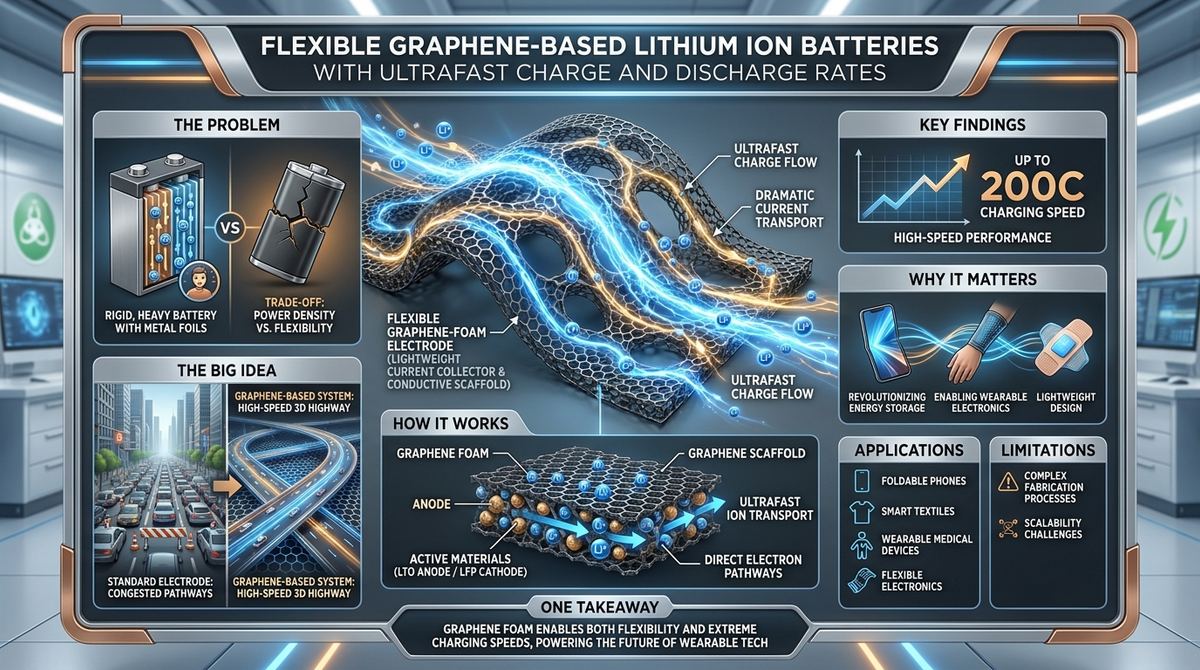
Imagine charging a battery on a timescale closer to a traffic light than an overnight routine. That is the promise behind this graphene battery paper. As electronics become thinner, lighter, and more flexible, the battery is turning into the limiting component. Designers want faster charging, lower weight, and the ability to bend power sources for wearables, foldable devices, and soft medical hardware. Traditional lithium-ion batteries can do some of those jobs well, but rarely all at once. This study is interesting because it does not rely on a brand-new battery chemistry. Instead, it rethinks the physical architecture around familiar electrode materials by using a three-dimensional graphene foam as the conductive backbone.
Most lithium-ion batteries carry extra structural weight that does not store much energy. Copper and aluminum foils are typically used as current collectors, polymer binders are needed to hold powders together, and conductive additives are mixed in so electrons can move through the electrode. All of these components are useful, but they make the battery heavier and can also interfere with fast transport.
That transport issue is the real bottleneck. A high-speed battery needs electrons to move quickly through the conductive network while lithium ions travel efficiently through pores and into active particles. In ordinary electrodes, those pathways are often long and crowded. The active material may be good in principle, but it is trapped inside an inefficient structure. Resistance rises, heat is generated, and charging or discharging slows down.
The challenge becomes even harder when flexibility is required. Rigid metal-backed electrodes do not enjoy repeated bending, and their layered structure can lose integrity under mechanical stress. Researchers Na Li, Zongping Chen, Wencai Ren, Feng Li, and Hui-Ming Cheng tackled this design conflict directly. Their question was simple but important: can graphene replace several conventional battery components at once and make the whole cell both faster and more flexible?
The core idea is to replace a flat, heavy, cluttered battery support system with a light, open, highly conductive graphene scaffold. Graphene is a one-atom-thick carbon sheet famous for combining low weight, high strength, and excellent electrical conductivity. In this paper, however, graphene is not used as a flat film. It is built into a foam, meaning it becomes a three-dimensional porous network.
A good way to picture this is to compare a standard electrode to a crowded street map and the graphene foam to a modern multi-level transit hub. In the ordinary layout, ions and electrons have fewer routes, more bottlenecks, and more dead ends. In the graphene foam layout, there are far more interconnected pathways. That gives charge carriers more room to move and reduces the delays that normally appear when a battery is pushed to very high rates.
The graphene foam is then loaded with known electrode materials. The anode uses Li4Ti5O12 and the cathode uses LiFePO4. These are not exotic chemistries, which is exactly why the result is useful. The paper shows that major performance gains can come from changing the architecture around familiar materials rather than only hunting for new ones.
A lithium-ion battery stores and releases energy by moving lithium ions between two electrodes while electrons travel through the external circuit. Speed depends on how easily both carriers can move. In a standard electrode, electrons often depend on a combination of metal foil and conductive additives, while ions diffuse through dense packed material. That arrangement works, but it is not ideal when engineers want very high-rate performance.
The graphene foam improves several things at the same time. First, it is conductive, so it can act as a lightweight current collector instead of relying on a thick metal foil. Second, its three-dimensional structure provides a continuous electron pathway throughout the electrode, reducing electrical resistance. Third, because the foam is porous, electrolyte can penetrate the structure more effectively, giving lithium ions shorter and more accessible routes into the active material.
The study also removes binders and extra conductive additives. That matters because those ingredients do not just add weight. They can occupy space that ions would otherwise use and create extra interfaces that slow transport. In the graphene-foam design, more of the structure is active and less of it is just supporting overhead.
This architecture also helps with mechanical flexibility. A rigid metal-backed electrode tends to behave like a laminated stack. A graphene foam network behaves more like an interconnected carbon skeleton that can tolerate bending without immediately breaking electrical continuity. That feature makes the concept especially relevant for flexible electronics.
The most striking result is the rate capability. The Li4Ti5O12/graphene foam electrode reached rates up to 200C, which the paper describes as equivalent to a full discharge in 18 seconds. That is the number that makes this study stand out. It suggests that the graphene scaffold is not providing a small incremental benefit but is fundamentally changing how quickly charge can move through the electrode.
The paper attributes this to the excellent conductivity and pore structure of the hybrid electrode. Electrons can move rapidly through the interconnected graphene network, while ions gain faster access to active surfaces because of the open three-dimensional geometry. Instead of one narrow pathway, the system offers many parallel routes for transport.
The researchers did not stop at a half-cell demonstration. They also built a full lithium-ion battery using graphene foam with Li4Ti5O12 on the anode side and LiFePO4 on the cathode side. That matters because full-cell performance is much more relevant than an isolated materials result. The study further reports that the battery maintained high-rate performance while remaining flexible enough to be repeatedly bent to a small radius without structural failure or major performance loss.
This work matters because it attacks two important industry goals at once. One is ultrafast charging and discharging, which is crucial for high-power devices and systems that need rapid energy transfer. The other is flexibility, which is increasingly important for wearable electronics, smart textiles, foldable consumer devices, and lightweight medical hardware.
There is also a broader lesson here about battery innovation. Not every major gain comes from inventing a new active material. Sometimes the real leap comes from removing architectural inefficiencies around materials we already understand. Li4Ti5O12 and LiFePO4 have known strengths, but their full performance is often hidden by slow transport and heavy supporting structures. The graphene foam changes that environment.
For graphene itself, this is the type of role that makes the material commercially meaningful. Graphene is not being treated as a marketing additive or a thin coating with vague benefits. It is serving as a structural, electrical, and mechanical platform all at once. When one material can replace metal collectors, reduce inactive mass, support bending, and improve high-rate transport, it becomes much easier to justify from an engineering perspective.
The paper is exciting, but there are still serious questions between lab success and real commercial deployment. The first is manufacturing scale. Producing graphene foam with consistent pore structure, conductivity, and mechanical performance at industrial volumes is not trivial. Batteries are unforgiving products, and small structural variations can become large performance problems.
Cost is another major issue. Replacing metal collectors sounds attractive, but only if graphene foam can be made economically and integrated into production lines without destroying yield. Existing lithium-ion manufacturing is already highly optimized, so new architectures must beat or at least justify themselves against a mature supply chain.
There are also system-level questions. Demonstrating very high-rate discharge in a research setting is one thing; building complete commercial cells that repeatedly fast-charge under real thermal and safety constraints is another. Engineers still need more data on long-term cycling, thermal behavior, packaging, mechanical fatigue, and environmental durability.
If this architecture can be scaled, wearable electronics are an obvious target. Flexible health monitors, smart patches, soft robotics, and heated garments all benefit from lighter and more bendable batteries. In those products, the battery is often the least cooperative component, so a flexible power source changes the whole design conversation.
Rapid-charge portable electronics are another clear application area. A phone or tablet that charges dramatically faster depends on more than just one paper, but improving electrode transport is central to that goal. High-power drones, sensors, compact mobility devices, and specialty industrial electronics could also benefit, especially where weight reduction and rapid power delivery matter as much as total stored energy.
The concept may also be useful in military, aerospace, and field systems where lightweight high-rate power sources can offer operational advantages. Any platform that values quick recharge, mechanical resilience, and lower mass has a reason to pay attention.
The key takeaway is that this paper is less about a miracle new chemistry and more about a smarter battery framework. By turning graphene into a three-dimensional foam that serves as a conductive and flexible scaffold, the researchers showed how a lithium-ion battery can become lighter, faster, and bendable at the same time, with reported rates up to 200C or full discharge in 18 seconds.
What does 200C mean in simple language?
A C-rate describes how fast a battery charges or discharges relative to its full capacity. A 1C rate means about one hour. A 200C rate means the same process is taking place hundreds of times faster, which the paper describes as full discharge in roughly 18 seconds.
Why use graphene foam instead of ordinary graphite or flat graphene sheets?
A foam creates a real three-dimensional conductive network with open pores. That geometry gives electrons and ions more efficient pathways than a flatter or denser structure, which is especially important for fast charging and discharging.
Does this mean graphene batteries are ready to replace regular phone batteries now?
No. The study is promising, but commercial readiness still depends on manufacturability, cost, long-term cycling, safety validation, and pack-level engineering. It shows a powerful direction, not an immediate mass-market replacement.
Why are Li4Ti5O12 and LiFePO4 important in this paper?
They are stable and well-known lithium-ion materials. Using them helps show that the performance gain comes from the graphene architecture itself, not only from a novel chemistry with unknown tradeoffs.
What is the most practical lesson from this work?
The most practical lesson is that battery performance can improve dramatically when the supporting architecture becomes part of the solution. A lightweight graphene scaffold can reduce inactive mass, improve charge transport, and support flexibility all at once.
This paper shows why graphene continues to attract attention in advanced energy storage. The researchers used a three-dimensional graphene foam to create a conductive, lightweight, and flexible battery framework around established lithium-ion materials. That design improved transport efficiency so dramatically that the system reached rates up to 200C, equivalent to a full discharge in 18 seconds, while also tolerating repeated bending.
There is still substantial work ahead in scaling, cost control, long-term durability, and product integration. But the scientific message is already valuable. When graphene is engineered into the right structure, it can help break the usual compromise between speed, weight, and flexibility. That is why this study deserves a real place in the battery conversation.
Serious about B2B integration? Test our premium Pulsed Electrical Resistive Carbon Heating turbostratic graphene in your lab. 100g sample packs available now.
Explore More
Researchers discover naturally formed graphene sheets and carbon ovals in stingless bee hives, creating a novel emergent material with powerful blue light...

Discover how rippled graphene pores act as fluidic memristors, enabling advanced synaptic functionalities for the next generation of neuromorphic computing.

Learn how to use electromechanical responses in gapped graphene to measure electronic temperature and band gaps using traveling flexural waves.