
Rippled Graphene Pores for Neuromorphic Fluidic Memristive Devices
Discover how rippled graphene pores act as fluidic memristors, enabling advanced synaptic functionalities for the next generation of neuromorphic computing.
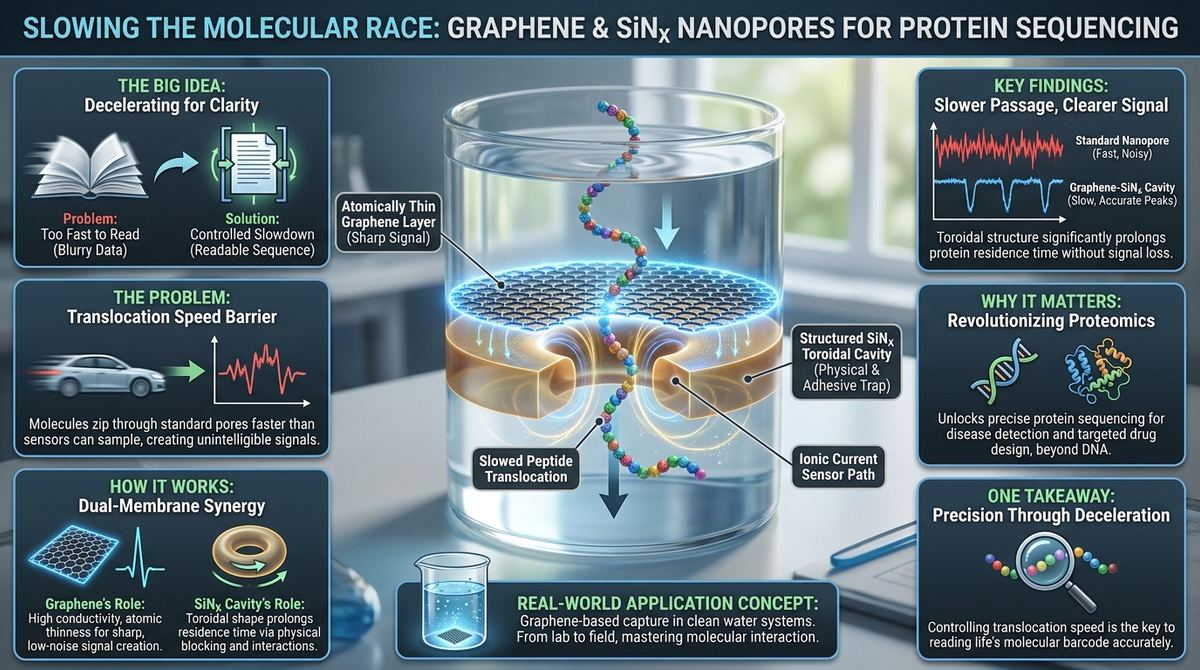
Imagine if you were trying to read a book, but the pages were being flipped by a high-speed industrial fan. No matter how fast your eyes could move, the information would blur into an unintelligible smudge. This is precisely the challenge scientists face when trying to sequence proteins using nanopores. Proteins are the workhorses of life, carrying a vast amount of biological information in their sequence of amino acids. Being able to read these sequences rapidly and accurately would revolutionize medicine, allowing us to detect diseases or design drugs with unprecedented precision. However, when a protein is pulled through a nanopore by an electric field, it often moves far too quickly for current electronic sensors to capture the distinct signature of every single amino acid.
The fundamental hurdle in nanopore-based protein sequencing is the translocation rate. In a standard nanopore setup, an electric potential is applied across a membrane, driving a charged molecule through a tiny hole. The sensor detects the protein by measuring the change in ionic current as the molecule blocks the pore. Ideally, each amino acid would create a unique dip in the current, allowing researchers to read the protein's sequence like a barcode. In practice, however, these molecules zip through the pore at speeds that exceed the sampling capabilities of most high-bandwidth amplifiers.
When a protein moves too quickly, the sensor cannot gather enough data points for each amino acid to distinguish it from its neighbor. This leads to low sensing accuracy and a high rate of error. To solve this, researchers need a way to slow the protein down without stopping it entirely or destroying its structure. While chemical modifiers have been tried, they often lack the precision needed for high-throughput sequencing. There is an urgent need for a structural or physical mechanism that can act as a molecular brake, extending the residence time of the protein in the sensing zone to allow for high-resolution data collection.
To address this speed problem, Yubin Cao, Junzhou He, and Wei Si developed a sophisticated dual-membrane system that acts like a specialized vestibule for proteins. Instead of a simple, straight hole through a single sheet of material, they combined a layer of graphene with a structured silicon nitride cavity. The key innovation is the creation of a toroidal cavity—a donut-shaped chamber—within the silicon nitride layer.
The idea is to move away from a seamless slide and instead create a space where the protein is physically hindered. By designing this cavity, the researchers created an environment where the protein does not just fall through; it interacts with the walls of the chamber. This interaction, combined with carefully managed electrical charges, slows the protein's progress. By increasing the time the protein spends in the sensing region, the electronic sensors have a much larger window to record the current fluctuations, effectively turning a blur of information into a clear, readable sequence.
The efficiency of this system relies on the synergy between two very different materials: graphene and silicon nitride. Graphene is used because of its extraordinary electronic properties and its atomic thinness. Because graphene is only one atom thick, it creates a sensing region that is incredibly localized. This means that when a protein passes through the graphene layer, the resulting change in ionic current is sharp and distinct, minimizing the background noise that typically plagues thicker membranes. Furthermore, graphene's high conductivity ensure that the electrical signals are transmitted with minimal loss, which is critical for detecting the subtle differences between amino acids.
The silicon nitride layer serves as the structural backbone and the primary site for deceleration. The researchers engineered a toroidal cavity within this layer, which introduces two critical physical effects: steric hindrance and van der Waals adsorption. Steric hindrance occurs when the physical dimensions of the cavity are tailored to be just large enough for the peptide to enter, but narrow enough that the molecule's movement is restricted. It is similar to a person trying to move through a crowded room; the physical presence of the walls forces them to slow down and navigate carefully.
Simultaneously, the chemical nature of the silicon nitride surface promotes van der Waals adsorption. Van der Waals forces are weak, short-range attractive forces that occur between all atoms and molecules. By optimizing the interface between the protein and the cavity walls, these forces create a slight stickiness. As the protein moves through the toroidal structure, it momentarily clings to the walls of the cavity. This constant, subtle attraction acts as a molecular friction, significantly reducing the velocity of the protein as it translocates.
Beyond the physical structure, the researchers employed charge regulation to fine-tune the movement. By adjusting the surface charges of the membrane and the ionic strength of the surrounding solution, they could modulate the electrostatic repulsion or attraction between the nanopore and the peptide. This allows for a level of control that ensures the protein is slowed down enough for sensing but not so much that it becomes permanently stuck, which would clog the pore and end the experiment.
The results of this dual-membrane approach were significant. The researchers observed that the toroidal cavity structure successfully prolonged the residence time of peptides within the sensing region. When compared to standard nanopores, the proteins moving through the graphene/silicon nitride cavity exhibited a much slower translocation rate. This deceleration is the direct result of the combined effects of physical blocking and the adhesive nature of the van der Waals interactions.
Crucially, this increase in residence time did not come at the expense of signal quality. In many sensing systems, slowing down a particle can lead to increased noise or blurred signals due to prolonged interactions with the walls. However, the graphene/silicon nitride system maintained excellent signal resolution. The atomic thinness of the graphene ensured that the current dips remained sharp, while the silicon nitride cavity provided the necessary deceleration.
The data showed that by reducing the speed of the protein, the system lowered the bandwidth requirements for the recording electronics. Instead of needing impossibly fast sampling rates to catch a fleeting signal, the researchers could obtain high-resolution data using more standard equipment. This proves that structural engineering at the nanoscale can effectively compensate for the limitations of electronic sampling speeds, providing a viable path toward accurate single-molecule protein sequencing.
This research represents a major step forward for the field of proteomics, which is the large-scale study of proteins. While DNA sequencing has been well-understood for decades, protein sequencing is far more complex because proteins are not just linear strings of information; they fold into intricate three-dimensional shapes and lack the complementary base-pairing that makes DNA so easy to replicate and read.
By providing a method to decelerate proteins during sensing, this work moves the scientific community closer to real-time, high-throughput protein sequencing. If we can accurately read protein sequences in a portable, low-cost nanopore device, we could identify biomarkers for diseases like cancer or Alzheimer's much earlier than current methods allow. It would also accelerate the development of synthetic proteins, allowing biologists to engineer new enzymes for industrial use or create targeted therapeutics that interact with specific protein sequences in the body.
Furthermore, the integration of graphene into these systems highlights a broader trend in nanotechnology: using 2D materials to create interfaces that are physically minimal but electronically powerful. This approach can be adapted for other types of sensing, such as detecting viral RNA or monitoring the movement of ions in a cell membrane, expanding the utility of nanopore technology far beyond protein sequencing.
While the results are promising, it is important to note that this system is currently a proof-of-concept and is not yet ready for commercial application. One of the primary limitations is the complexity of fabricating the dual-membrane cavity with absolute precision across thousands of pores. Creating a perfectly uniform toroidal structure in silicon nitride and layering it precisely with graphene requires sophisticated nanofabrication techniques that are difficult to scale for mass production.
Additionally, the study focused largely on peptides, which are shorter chains of amino acids. Full-sized proteins are much larger and more complex, often folding into globular shapes that might interact with the toroidal cavity differently. There is a risk that larger proteins could clog the cavity entirely or experience such strong van der Waals attractions that they fail to translocate. Future research must test a wider variety of protein sizes and folding patterns to ensure the deceleration mechanism remains consistent.
Finally, the long-term stability of the graphene/silicon nitride interface needs further investigation. The repeated passage of proteins and the exposure to varying ionic concentrations could potentially degrade the membrane over time, affecting the accuracy of the readings. Establishing the lifespan and durability of these dual-membrane sensors is a necessary step before they can be used in clinical settings.
The potential applications for this technology are vast. In the realm of personalized medicine, a graphene-based nanopore sensor could be used to analyze a patient's protein profile from a small blood sample. This would allow doctors to see exactly which proteins are being overproduced or malformed, leading to highly tailored treatment plans.
In the field of drug discovery, this technology could be used to study how potential drug molecules interact with specific proteins. By observing the translocation dynamics in real-time, researchers could determine if a drug is binding to its target protein with the correct affinity and orientation.
Moreover, this system could be integrated into portable diagnostic devices for use in remote areas. Because nanopore sequencing is inherently low-cost and requires relatively simple electronic readouts, it could provide a way to diagnose infectious diseases in the field without the need for a full-scale laboratory, potentially saving millions of lives through early detection in underserved regions.
If you take away one key point from this research, it is that the speed of protein movement is the biggest obstacle to accurate sequencing, and the researchers solved this by building a molecular brake. By combining an atomically thin graphene sensor with a silicon nitride toroidal cavity, they used physical hindrance and weak molecular attractions to slow proteins down, allowing sensors to capture high-resolution data that was previously lost in a blur.
What is a nanopore and how does it work?
A nanopore is a hole so small that only one molecule can pass through it at a time. When a charged molecule, like a protein, moves through this hole, it blocks the flow of ions in the surrounding liquid. This creates a measurable change in the electrical current, which scientists use to identify the molecule based on its size and shape.
Why is graphene used in this system instead of just using silicon nitride?
Graphene is only one atom thick and highly conductive, which makes it an ideal sensing element. Because it is so thin, the region where the protein interacts with the sensor is extremely small and precise. This minimizes background noise and ensures that the current changes are sharp, which is essential for distinguishing between different amino acids in a protein.
What does translocation rate mean in this context?
Translocation rate refers to the speed at which a protein or peptide moves through the nanopore. If the translocation rate is too high, the protein zips through the pore faster than the electronic equipment can record the data. Slowing down this rate is necessary to capture enough information to sequence the protein accurately.
What are van der Waals forces and how do they help?
Van der Waals forces are weak attractive forces that exist between all molecules. In this research, the researchers designed the silicon nitride cavity so that these forces would create a slight stickiness between the protein and the walls of the pore. This attraction acts as a form of friction, slowing the protein as it moves through the system.
Is this technology already being used to sequence proteins in hospitals?
No, this research is a critical scientific step toward that goal, but it is not yet commercially available. The researchers have demonstrated that the dual-membrane cavity can slow down proteins and improve sensing, but further work is needed to scale the manufacturing process and test the system with a wider variety of complex proteins.
The quest to sequence proteins with the same ease as DNA is one of the most challenging frontiers in biotechnology. The work by Yubin Cao, Junzhou He, and Wei Si provides a sophisticated answer to the problem of molecular speed. By integrating the electronic precision of graphene with the structural utility of a silicon nitride toroidal cavity, they have created a system that successfully decelerates proteins without sacrificing signal clarity. This approach proves that the physical architecture of a nanopore is just as important as the materials used to build it. While challenges in scalability and protein complexity remain, this dual-membrane system lays a strong foundation for the next generation of proteomic tools, bringing us closer to a future where the molecular machinery of life can be read in real-time.
Serious about B2B integration? Test our premium Pulsed Electrical Resistive Carbon Heating turbostratic graphene in your lab. 100g sample packs available now.
Explore More
Discover how rippled graphene pores act as fluidic memristors, enabling advanced synaptic functionalities for the next generation of neuromorphic computing.

Learn how to use electromechanical responses in gapped graphene to measure electronic temperature and band gaps using traveling flexural waves.

Explore how researchers have discovered viscous electron fluid behavior in cadmium, a breakthrough that could revolutionize the future of nanoelectronics.