
Rippled Graphene Pores for Neuromorphic Fluidic Memristive Devices
Discover how rippled graphene pores act as fluidic memristors, enabling advanced synaptic functionalities for the next generation of neuromorphic computing.
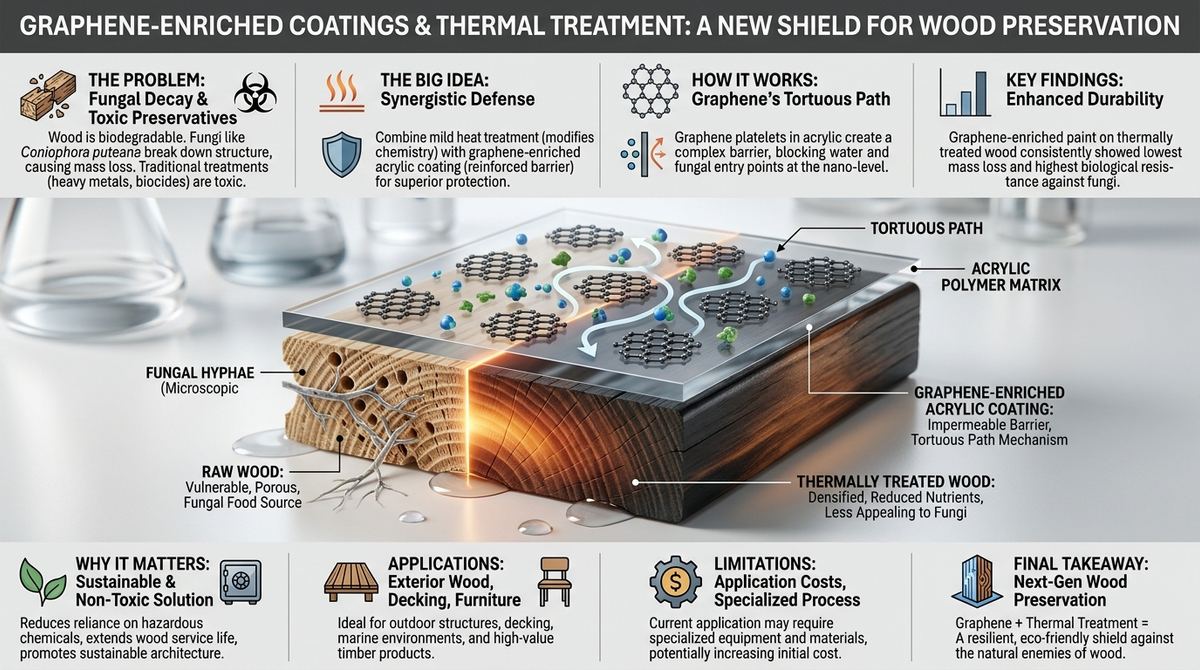
Wood is one of the most versatile and sustainable building materials available to humanity, yet it possesses a fundamental flaw: it is organic and biodegradable. For centuries, we have fought a losing battle against fungi and bacteria that view our homes, bridges, and furniture as a primary food source. While chemical preservatives have long been the standard solution, many of these substances are toxic to humans and the environment. The quest for a non-toxic, durable, and effective way to stop wood rot is not just an academic exercise; it is a necessity for sustainable architecture. Recent advancements in nanotechnology, specifically the use of graphene, are now offering a way to turn ordinary paint into an impenetrable shield.
The primary challenge addressed in this study is the vulnerability of commercial wood species to fungal attack, specifically by the fungus Coniophora puteana. This particular organism is a notorious agent of decay that breaks down the structural components of wood, leading to mass loss and a catastrophic drop in mechanical integrity. To combat this, the industry has traditionally relied on heavy-metal treatments or synthetic biocides, which often leach into the soil and water.
Hamid R. Taghiyari, Elham Nadali, A. Pizzi, Roya Majidi, Jakub Kawalerczyk, Ioanna A. Papadopoulou, Olaf Schmidt, and Antonios N. Papadopoulos sought a more sustainable alternative. They focused on three common commercial species: beech and poplar, which represent hardwoods, and spruce, which represents softwoods. The goal was to determine if a combination of physical barriers—specifically acrylic paint reinforced with graphene—and thermal modification could provide a comprehensive defense system that reduces the need for toxic chemicals while maintaining or even improving the wood's physical strength.
The researchers proposed a two-pronged defense strategy. First, they used heat treatment to change the internal chemistry of the wood, making it less appealing and harder to digest for fungi. Second, they applied a specialized coating of acrylic paint infused with graphene.
If you imagine wood as a sponge, the heat treatment essentially shrinks the pores and removes the sugars that fungi love to eat. The graphene-enriched paint then acts like a high-tech waterproof seal. While regular paint provides a basic layer of protection, the addition of graphene transforms that layer into a reinforced composite. The result is a material that is not only more resistant to rot but also physically stronger and more durable than untreated wood.
To understand why graphene improves acrylic paint, we have to look at the molecular architecture of the coating. Graphene consists of a single layer of carbon atoms arranged in a hexagonal lattice. This structure is incredibly dense and impermeable, meaning that almost no gas or liquid can pass directly through a perfect sheet of graphene. When these nano-platelets are dispersed within an acrylic polymer matrix, they create what materials scientists call a tortuous path.
In plain acrylic paint, there are microscopic gaps and defects in the polymer chain that water molecules and fungal enzymes can penetrate over time. However, when graphene is added, these impermeable platelets act as physical roadblocks. Any moisture or fungal spore attempting to penetrate the coating cannot move in a straight line; instead, it must navigate around every single graphene platelet. This vastly increases the distance the contaminant must travel to reach the wood surface, effectively slowing down or entirely blocking the penetration process.
Furthermore, graphene enhances the interface between the paint and the wood. Due to its massive surface area, graphene increases the internal cohesion of the acrylic film, making the coating less prone to cracking or peeling under mechanical stress. This structural reinforcement is why the researchers observed a slight increase in compression strength even in specimens that were simply coated.
The heat treatment adds another layer of cause-and-effect complexity. By heating the wood to 185 degrees Celsius for four hours, the researchers triggered a process known as hornification. This involves the thermal degradation of hemicelluloses, which are the most chemically unstable and biodegradable polymers in the wood cell wall. As these polymers break down, the cell walls collapse slightly and reorganize, creating a denser structure with fewer available binding sites for water. Because fungi require moisture to survive and specific sugars to feed on, the heat-treated wood becomes a biological desert, offering very little nutritional value to Coniophora puteana.
The study employed a rigorous comparison between uncoated wood, wood coated with plain acrylic paint, and wood coated with graphene-enriched paint. These groups were tested across both unheated and heat-treated specimens. The results provided a clear hierarchy of protection.
In the unheated samples, the plain acrylic paint provided significant protection compared to the control group, proving that a basic physical barrier is effective. However, the graphene-enriched paint outperformed the plain paint across all three wood species. The mass loss—the amount of wood consumed by the fungus—was consistently lower in the graphene-coated samples. This confirms that the tortuous path created by the carbon nanoparticles is superior to a simple polymer film.
The most dramatic results appeared when the heat treatment was combined with the coatings. Heat-treated wood showed a massive decrease in mass loss regardless of the coating, proving that internal chemical modification is a powerful deterrent. When graphene-enriched paint was applied to heat-treated wood, the level of protection reached its peak.
Beyond biological resistance, the researchers measured the mechanical impact of these treatments. They found that heat treatment increased the compression strength of the wood. This is a direct result of the thermal alterations to the cell-wall polymers and the aforementioned hornification, which makes the wood structure more rigid. When combined with the reinforcing effect of graphene in the coating, the resulting material was significantly more robust than the original raw wood.
This research is significant because it moves us closer to a future where we can preserve wood without relying on hazardous chemicals. By leveraging the physical properties of graphene and the chemical changes induced by heat, we can create a biological shield that is integrated into the material itself.
The ability to protect both hardwoods like beech and poplar and softwoods like spruce means this technology is broadly applicable. If we can extend the lifespan of wood structures in damp or fungus-prone environments, we reduce the frequency of replacement, which lowers the demand for timber and reduces the overall carbon footprint of construction. Moreover, the fact that these treatments can increase compression strength means that the preservation process does not come with a mechanical penalty; rather, it provides a performance upgrade.
While the results are promising, it is important to note that this research was conducted in a controlled laboratory environment. The fungus tested, Coniophora puteana, is a primary cause of decay, but in the real world, wood is attacked by a cocktail of different fungal species and bacteria simultaneously. Further testing is required to see if the graphene-acrylic shield is equally effective against a broader spectrum of biological threats.
Additionally, the long-term durability of the graphene-enriched coating under extreme weather conditions remains an open question. UV radiation from the sun, freeze-thaw cycles, and constant abrasion can degrade acrylic polymers over several years. To determine if this is a commercially viable replacement for industrial preservatives, researchers need to conduct accelerated weathering tests to see how long the graphene platelets remain effectively dispersed and bonded within the acrylic matrix.
The potential applications for graphene-enriched protective coatings are vast. In the construction industry, this technology could be used for outdoor decking, window frames, and structural beams that are exposed to moisture. Because the process is relatively simple—applying a modified paint to heat-treated wood—it could be integrated into existing manufacturing pipelines without requiring massive infrastructure changes.
In the furniture industry, this approach could allow for the use of more sustainable, fast-growing wood species that are normally too susceptible to rot for outdoor use. By treating them with heat and graphene-acrylic coatings, low-cost softwoods could be transformed into high-durability materials. Even in heritage restoration, where maintaining the aesthetic of wood is crucial, a clear graphene-enriched acrylic could provide invisible but powerful protection.
The most important takeaway from this research is the synergy between internal and external protection. While heat treatment removes the food source for fungi and strengthens the wood's cell walls, graphene-enriched paint creates a microscopic, impermeable labyrinth that blocks fungal entry. Together, they create a highly effective, non-toxic defense system that protects wood while simultaneously increasing its mechanical strength.
Does adding graphene to paint make it toxic?
No, graphene is a form of carbon, and in the context of these coatings, it is used to create a physical barrier rather than a chemical poison. The goal of this research was specifically to find an alternative to toxic biocides by using the structural properties of carbon nanoparticles.
Can any type of paint be used with graphene?
The study focused on acrylic paint because of its bonding properties and durability. While other polymers might work, the key is ensuring that the graphene can be evenly dispersed within the liquid without clumping, as the protective effect depends on the creation of a consistent tortuous path.
Is heat treatment damaging to the wood?
When done at mild temperatures like 185 degrees Celsius, heat treatment is not damaging; instead, it is a modification process. It changes the chemistry of the hemicelluloses and causes hornification, which actually makes the wood more stable and resistant to moisture and decay.
Why was spruce included if it is a softwood?
Researchers included spruce, beech, and poplar to ensure the solution worked across different wood categories. Softwoods and hardwoods have different cell structures and chemical compositions, so proving that graphene-enriched paint works for both is essential for widespread industrial adoption.
Will this coating stop all types of wood rot?
The study specifically targeted Coniophora puteana, and while the results were highly successful, it cannot be claimed that all possible types of rot are stopped. However, the combination of removing nutrients via heat and blocking entry via graphene is a strategy likely to be effective against many common decay fungi.
The integration of nanotechnology into traditional wood preservation marks a significant step forward in sustainable material science. By combining the impermeable nature of graphene with the biological resistance induced by thermal modification, researchers have developed a method to shield wood from decay without resorting to harmful chemicals. While further testing in uncontrolled outdoor environments is necessary, the current findings suggest that graphene-enriched acrylic paint is a powerful tool for increasing the longevity and strength of both hard and softwoods. This approach transforms wood from a vulnerable organic resource into a high-performance composite, paving the way for more durable and eco-friendly construction.
Serious about B2B integration? Test our premium Pulsed Electrical Resistive Carbon Heating turbostratic graphene in your lab. 100g sample packs available now.
Explore More
Discover how rippled graphene pores act as fluidic memristors, enabling advanced synaptic functionalities for the next generation of neuromorphic computing.

Learn how to use electromechanical responses in gapped graphene to measure electronic temperature and band gaps using traveling flexural waves.

Explore how researchers have discovered viscous electron fluid behavior in cadmium, a breakthrough that could revolutionize the future of nanoelectronics.