
Nature's Nanotech: Graphene and Blue Emission Found in Bee Hives
Researchers discover naturally formed graphene sheets and carbon ovals in stingless bee hives, creating a novel emergent material with powerful blue light...
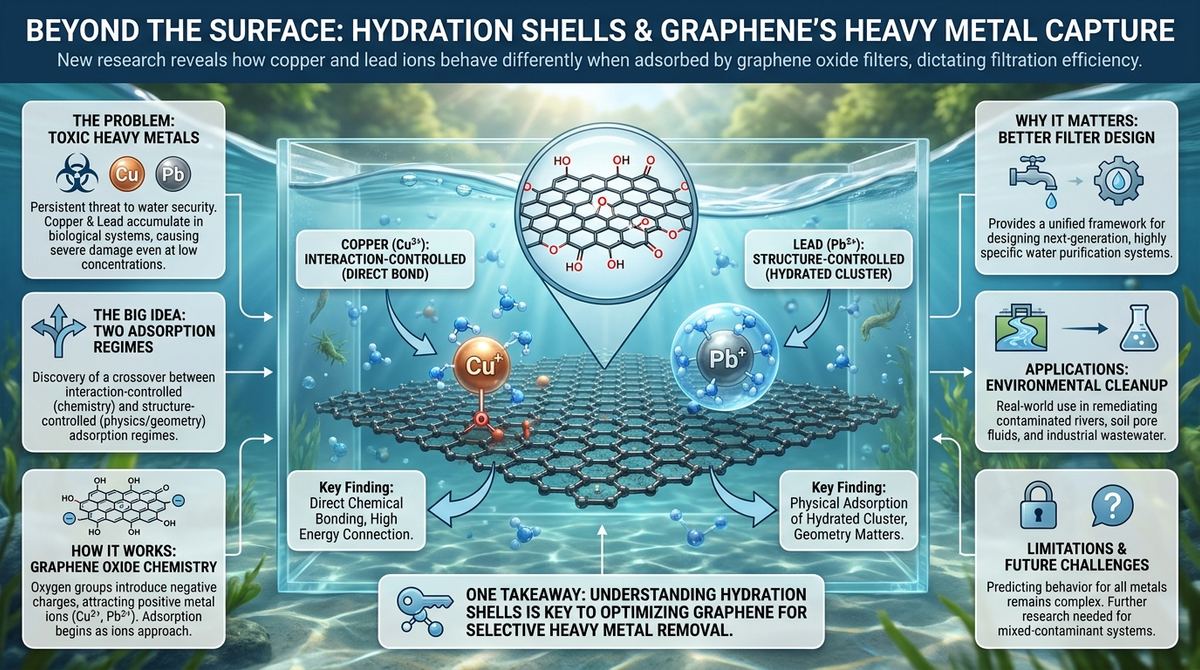
Imagine trying to catch a baseball with a glove, but the ball is encased in a thick, slippery layer of gelatin. To actually grip the ball, you would either need to squeeze through the gelatin or find a way to make the gelatin stick to the glove. This is essentially the challenge scientists face when trying to remove heavy metals like lead and copper from contaminated water using advanced materials. In the world of nanotechnology, graphene oxide is often hailed as a miracle filter because of its massive surface area and chemical versatility. However, the effectiveness of these filters is not just about the material itself; it is about the invisible dance between the metal ions, the water molecules surrounding them, and the surface of the graphene.
Heavy metal contamination remains one of the most persistent threats to global water security. Metals such as copper and lead are toxic even at low concentrations, accumulating in biological systems and causing severe neurological and organ damage. While graphene oxide and its reduced forms have shown immense promise as adsorbents, scientists have struggled to predict exactly how different metals will behave on these surfaces. The primary difficulty lies in the fact that ions do not travel through water as naked particles; they are surrounded by a hydration shell of water molecules that act as a protective shield.
To unlock the full potential of these materials, researchers need to understand why some metals are captured more efficiently than others. This requires moving beyond simple observations of "how much" was removed and diving into the molecular physics of "how" it happens. In a comprehensive study, Patrick Ruam Bredow Côrtes, Bianca Lino Gondim Leite, Carolina Ferreira de Matos, Mateus H. Köhler, and José Rafael Bordin sought to decode these mechanisms. By combining high-precision molecular dynamics simulations with experimental tests on three-dimensional reduced graphene oxide, the team aimed to determine whether the adsorption process is driven by the chemical attraction of the surface or the physical structure of the material.
The core discovery of this research is that there are two entirely different ways metal ions attach to graphene oxide, depending on the specific metal. The researchers describe this as a crossover between an interaction-controlled regime and a structure-controlled regime. For some metals, like copper, the process is all about chemistry: the ion strips away its water shield to bond directly with the oxygen groups on the graphene surface. This is a direct, high-energy connection.
For other metals, like lead, the process is more about physics and geometry. Lead ions tend to hold onto their water shields much more tightly. Instead of bonding directly to the surface, they interact with the graphene through a layer of water, which creates a more diffuse and less direct connection. This means that while copper is sensitive to the chemical "hooks" on the surface, lead is more influenced by the overall structural arrangement of the graphene sheets. Understanding this distinction allows scientists to stop guessing and start designing filters tailored to the specific toxin they want to remove.
To understand these results, one must first understand the chemistry of graphene oxide. Pure graphene is a single layer of carbon atoms arranged in a honeycomb lattice, which is incredibly stable but chemically inert. Graphene oxide, however, is modified with oxygen-containing functional groups such as hydroxyls, epoxies, and carboxyls. These groups are crucial because they introduce negative charges to the surface, which naturally attract positively charged metal ions like Cu2+ and Pb2+.
When these materials are used as filters, the process of adsorption begins. As a metal ion approaches the graphene oxide surface, it must compete with the water molecules already binding to it. If the attraction between the metal ion and the graphene surface is strong enough, the ion will shed some or all of its hydration shell to create a direct chemical bond. This is where the degree of oxidation becomes vital. Higher oxidation means more oxygen groups, which generally provides more sites for ions to attach.
The researchers also looked at reduced graphene oxide, or rGO. Reduction is the process of removing those oxygen groups to restore some of the carbon lattice's conductivity and stability. This creates a tension in adsorbent design: more oxidation increases chemical attraction, but too much oxidation can disrupt the structural integrity of the material. In three-dimensional rGO structures, these sheets are stacked and cross-linked, creating a porous network that can trap ions not just on the surface, but within the interior voids of the material.
Using molecular dynamics simulations, the team observed that copper and lead behave in fundamentally different ways at the molecular level. Copper ions were found to have a more compact hydration shell that is relatively easy to displace. This allowed the copper ions to interact directly with the graphene oxide membrane, leading to a strong, localized bond. Because this process depends so heavily on the presence of oxygen groups, the researchers found that adsorption increased linearly with the degree of surface oxidation. This confirms that copper operates in an interaction-controlled regime where chemistry is king.
Lead ions, conversely, presented a different challenge. The simulations showed that lead maintains a much stronger grip on its hydration shell. Instead of shedding water to bond directly, the lead ion remains hydrated and interacts with the surface more diffusely. This suggests that lead is less concerned with the specific chemical hooks of oxygen and more influenced by the overall environment.
The most surprising results emerged from the experimental tests using 3D-rGO materials. While the simulations suggested that higher oxidation always leads to more adsorption, the real-world 3D materials showed a nonmonotonic dependence. This means that as the researchers changed the level of reduction, the adsorption did not simply go up or down in a straight line. Furthermore, the 3D materials showed a strong selectivity toward lead over copper. This indicated that in a complex, three-dimensional architecture, the physical structure—such as pore size and sheet spacing—plays a more dominant role than surface chemistry alone. This is the essence of the structure-controlled regime.
This research provides a unified framework for designing next-generation water purification systems. For decades, the goal has been to simply increase the number of functional groups on a surface to improve adsorption. However, these findings prove that such a strategy is only effective for metals like copper. If the goal is to remove lead, simply adding more oxygen groups may not be the most efficient path. Instead, engineers should focus on the structural architecture of the 3D material to optimize how hydrated ions move through the filter.
By recognizing the crossover between interaction-controlled and structure-controlled regimes, researchers can now implement a targeted design approach. For toxins that bond directly, the focus should be on surface chemistry and oxidation levels. For toxins that remain hydrated, the focus should be on the geometry of the pores and the spatial arrangement of the graphene sheets. This shift in perspective allows for the creation of highly selective filters that can target specific pollutants while ignoring harmless minerals in the water.
While these findings are a significant step forward, there are clear boundaries to the current study. The molecular dynamics simulations provide an idealized view of ion behavior, often simplifying the complex environment of real-world wastewater. In a natural setting, water is not just a mixture of one metal and graphene; it contains competing ions like calcium or magnesium, as well as organic matter that can block adsorption sites. The interaction between these competing species and the hydration shells of lead and copper remains a critical area for further exploration.
Additionally, while the 3D-rGO materials showed promising selectivity, the research does not yet provide a roadmap for mass industrial production. The process of precisely controlling the degree of reduction and the resulting 3D architecture is complex and expensive. Further testing is needed to determine how these materials hold up under high-pressure flow conditions or in environments with fluctuating pH levels, which could alter the charge of both the graphene surface and the metal ions.
The immediate application of this research is in the development of specialized industrial filters. Mining operations, which often release high concentrations of copper and lead into local waterways, could employ a dual-stage filtration system. The first stage could utilize highly oxidized graphene oxide to aggressively capture interaction-controlled metals like copper, while the second stage could use a structurally optimized 3D-rGO filter to trap structure-controlled metals like lead.
Beyond industrial wastewater, this knowledge could be applied to the creation of wearable sensors or medical implants that need to sequester specific heavy metals from biological fluids. By tuning the hydration-shell interaction, scientists could create membranes that are permeable to essential nutrients but act as impenetrable barriers to toxic heavy metals.
The most critical takeaway is that metal ions do not all "stick" to graphene in the same way. Copper acts through a direct chemical bond by shedding its water shield, making it interaction-controlled. Lead stays wrapped in water and is influenced more by the physical layout of the material, making it structure-controlled. Effective filter design must therefore balance surface chemistry with physical architecture.
What exactly is graphene oxide in the context of water filtration?
Graphene oxide is a modified version of graphene that contains oxygen-based groups on its surface. These groups make the material hydrophilic, meaning it likes water, and give it a negative charge that allows it to attract and hold onto positively charged metal pollutants.
Why does the water shell around a metal ion matter so much?
The hydration shell is like a protective bubble of water molecules. For an ion to bond directly to a filter, it must break some of these water bonds, which requires energy. If the ion refuses to shed this bubble, it can only interact with the filter indirectly, which changes how efficiently it is captured.
Is there a big difference between how lead and copper are removed?
Yes. Copper is more likely to strip away its water shell and bond directly to the oxygen sites on graphene, making it very sensitive to surface chemistry. Lead tends to keep its water shell, meaning its capture is more dependent on the physical structure and spacing of the filter material.
What does it mean for a material to be reduced graphene oxide?
Reduction is the process of removing oxygen groups from graphene oxide. This changes the material's properties, often making it more stable and conductive, but reducing the number of chemical "hooks" available to grab onto metal ions.
Can this technology be used in a standard home water filter?
While the science is promising, these materials are currently used in research and specialized industrial settings. Converting this into a consumer product requires scaling up the manufacturing of 3D-rGO and ensuring it is cost-effective compared to traditional activated carbon filters.
The study conducted by Côrtes, Leite, Matos, Köhler, and Bordin marks a pivotal shift in how we approach the remediation of heavy metal pollution. By identifying the crossover between interaction-controlled and structure-controlled adsorption, the research moves the field beyond a one-size-fits-all approach to graphene oxide. We now know that the "secret" to efficient adsorption lies not just in the material's surface, but in the subtle physics of hydration shells and the three-dimensional architecture of the adsorbent. As we refine the ability to manipulate these factors, graphene-based materials will likely become the gold standard for creating precise, selective, and highly efficient water purification systems.
Serious about B2B integration? Test our premium Pulsed Electrical Resistive Carbon Heating turbostratic graphene in your lab. 100g sample packs available now.
Explore More
Researchers discover naturally formed graphene sheets and carbon ovals in stingless bee hives, creating a novel emergent material with powerful blue light...

Discover how rippled graphene pores act as fluidic memristors, enabling advanced synaptic functionalities for the next generation of neuromorphic computing.

Learn how to use electromechanical responses in gapped graphene to measure electronic temperature and band gaps using traveling flexural waves.