
Nature's Nanotech: Graphene and Blue Emission Found in Bee Hives
Researchers discover naturally formed graphene sheets and carbon ovals in stingless bee hives, creating a novel emergent material with powerful blue light...
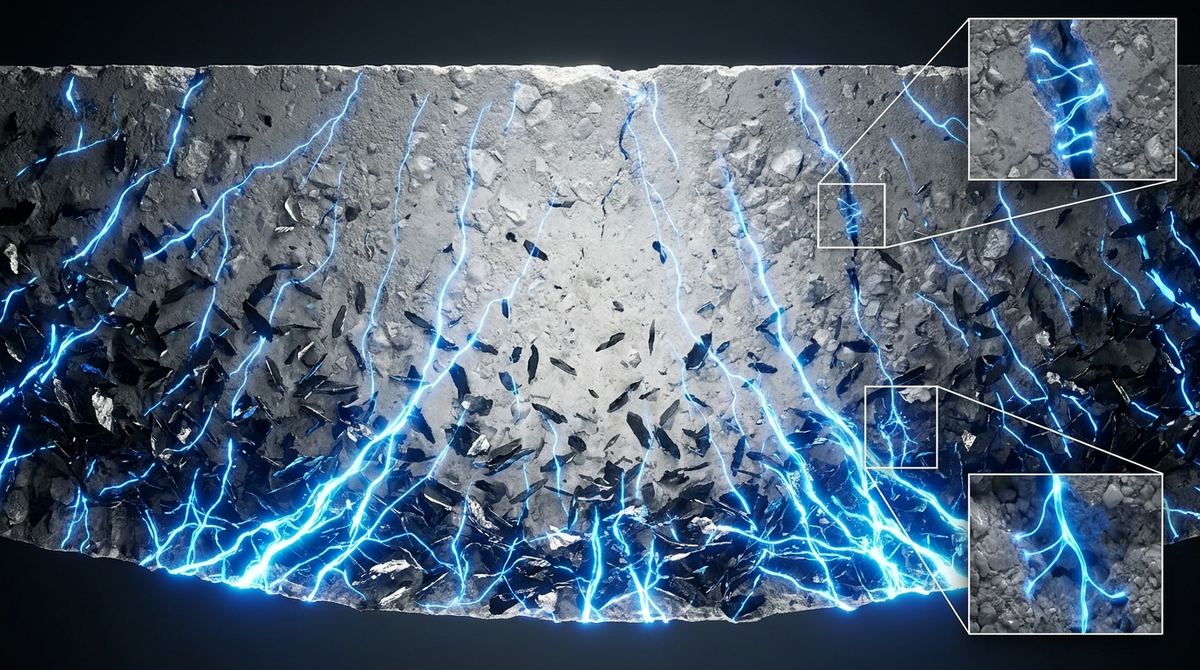
Imagine building a skyscraper or a bridge where the concrete does not just sit there as a heavy, brittle mass, but instead behaves more like a biological organism, with reinforced fibers concentrated exactly where the stress is highest. For decades, the construction industry has relied on adding steel rebar to handle the tension that concrete cannot manage on its own. However, as we move toward a future of smarter, lighter, and more durable infrastructure, the focus has shifted to the nano-scale. By integrating graphene nanoplatelets into the cement matrix, scientists are creating a new class of composites that can resist cracking far more effectively than traditional materials.
The challenge has always been how to distribute these nano-reinforcements. Most researchers simply mix the graphene uniformly throughout the concrete, but this is an inefficient use of material. In a real-world structure, stress is not distributed evenly; some areas bear nearly all the load while others do almost nothing. This inefficiency is what Zhenglong Zhou, Chuang Feng, Jinzhu Zhang, Ziyan Hang, and Duo Liu sought to address in their recent research. By utilizing a combination of finite element modeling and physical experiments, they have demonstrated that the spatial arrangement of graphene is just as important as the amount used.
Cement composites are legendary for their compressive strength, meaning they can support immense weight pressing down on them. However, they are notoriously poor in flexural performance, which refers to their ability to resist bending. When a cement beam bends, the bottom side experiences tension, pulling the material apart. Because concrete is brittle, tiny nano-cracks form almost immediately. Once these cracks start, they propagate rapidly through the matrix, leading to sudden and catastrophic failure.
To stop this, engineers often add nano-fillers like graphene nanoplatelets. While these additives help, the industry has struggled with a diminishing returns problem. Adding too much graphene can lead to agglomeration, where the nanoplatelets clump together due to strong van der Waals forces. These clumps actually create weak points in the concrete, acting as defects rather than reinforcements. Conversely, adding too little graphene provides insufficient support. The core problem is the lack of a precise strategy for where to put the graphene to maximize strength without compromising the structural integrity of the cement matrix.
The researchers proposed a shift from uniform distribution to functionally graded distribution. In simple terms, a functionally graded material is one where the composition changes gradually across its volume. Instead of scattering graphene nanoplatelets evenly like salt in a soup, the researchers strategically placed higher concentrations of graphene in the areas that experience the most stress during bending—typically the outer edges of a beam.
Think of it like a high-performance athletic shoe. The sole is not made of the same density of foam everywhere; it is denser in the heel for impact and softer in the arch for flexibility. By applying this same logic to cement, the researchers created a material that is reinforced exactly where it needs to be. This allows them to achieve massive gains in strength while using a very small total volume of graphene, reducing costs and preventing the clumping issues associated with high concentrations.
Graphene nanoplatelets are essentially stacks of graphene sheets, creating a two-dimensional reinforcement. Their effectiveness comes from their incredible surface area and high elastic modulus. When these nanoplatelets are embedded in the cement, they create a mechanical interlocking effect with the calcium silicate hydrate (C-S-H) gel, which is the glue that holds concrete together.
The reinforcement works through a mechanism called crack bridging. As a nano-crack begins to open in the cement matrix, it encounters a graphene nanoplatelet. Because the graphene is so strong and well-bonded to the surrounding cement, it acts as a bridge across the crack, exerting a closing force that prevents the crack from widening. This forces the crack to either stop entirely or take a long, winding path around the nanoplatelet, which consumes more energy and slows down the failure process.
Two critical factors influence this bridging efficiency: the diameter-to-thickness ratio (denoted as lambda) and the orientation of the nanoplatelets. A higher lambda means the platelet is wider and thinner, providing more surface area for the cement to grip. If a platelet is too thick, it behaves more like a particle and less like a sheet, reducing its ability to bridge cracks. Furthermore, the angle at which the graphene sits relative to the stress determines how much load it can carry. If a platelet is perfectly parallel or perpendicular to the crack, it may not be as effective as one oriented at an angle that can better distribute the shear forces.
The results of the study were striking. Using a Finite Element Modeling (FEM) framework incorporating concrete damage plasticity and cohesive contact models, the team was able to simulate exactly how these composites would fail. When they validated these models with physical experiments, the data confirmed that even a tiny addition of graphene—just 0.1 percent by volume—resulted in a 45.56 percent increase in flexural strength compared to pure cement.
However, the real breakthrough came from the functionally graded distribution. The researchers found that by strategically placing the graphene nanoplatelets, they could increase the peak load capacity of the composite by up to 137.5 percent compared to a version with the same amount of graphene distributed uniformly. This proves that the arrangement of the reinforcement is actually more impactful than the sheer quantity of the material added.
The parametric analysis also revealed an optimal geometry for the reinforcement. The researchers discovered that a diameter-to-thickness ratio of 500 and an orientation of 45 degrees provided the best reinforcing efficiency. At this specific angle, the nanoplatelets were most capable of resisting the complex stress vectors that occur during bending, maximizing the load transfer between the cement matrix and the graphene.
This research is a game-changer for sustainable construction. Graphene production, while becoming more efficient, is still more expensive than traditional concrete additives. By proving that functionally graded distributions can more than double the performance of uniform distributions, this study shows a path toward using significantly less nano-material to achieve the same or better structural results.
Beyond cost, this approach solves a major chemical and physical hurdle in nano-concrete: the dispersion problem. Achieving a perfectly uniform mix of nanoplatelets in a massive volume of wet cement is nearly impossible in the field. However, if we only need high concentrations in specific zones, the manufacturing process becomes more manageable. This allows for the creation of high-performance structural elements that are lighter, thinner, and more resilient, potentially reducing the total amount of concrete needed for global infrastructure.
While the results are impressive, it is important to note that this research was conducted using finite element modeling and controlled laboratory experiments. Translating these findings to a construction site involves significant challenges. For instance, precisely controlling the orientation of nanoplatelets at a 45-degree angle across a massive concrete pour is far more difficult than doing so in a small lab sample.
Additionally, the study focuses primarily on flexural strength and peak load. Other critical factors for construction materials, such as long-term creep, resistance to freeze-thaw cycles, and the chemical stability of the graphene-cement interface over several decades, still require extensive testing. The researchers have provided a roadmap for optimization, but the industry must now determine how to implement these graded distributions at scale using current casting and 3D printing technologies.
The most immediate application for functionally graded graphene cement would be in precast concrete elements. Since these are made in a factory setting, engineers can use layered casting or additive manufacturing to precisely place graphene-rich layers where they are needed most. This would be ideal for bridge girders, railway sleepers, and high-rise floor slabs that must withstand significant bending forces.
Another promising application is in seismic retrofitting. By applying a functionally graded graphene-reinforced layer to the exterior of existing columns and beams, engineers could significantly increase the ductility and strength of older buildings, making them more resistant to earthquakes without adding excessive weight or bulk.
If you take away one key point from this research, it is that the placement of reinforcement is just as critical as the material itself. By using a functionally graded distribution of graphene nanoplatelets, researchers achieved a staggering 137.5 percent increase in peak load over uniform distributions, proving that strategic geometry can unlock far more strength than simple addition.
What exactly are graphene nanoplatelets?
Graphene nanoplatelets are small, disc-like stacks of graphene sheets. Unlike a single layer of graphene, which is one atom thick, nanoplatelets consist of several layers, making them easier to produce and integrate into materials like cement while still maintaining the extraordinary strength and surface area of graphene.
What does functionally graded mean in this context?
Functionally graded means that the material properties change intentionally across the structure. In this study, it refers to varying the concentration and orientation of graphene nanoplatelets throughout the cement composite so that the most reinforced areas align with the highest stress zones.
Why is a 45-degree orientation better than other angles?
When cement bends, the internal stresses are not just simple pushes or pulls; they include complex shear forces. A 45-degree orientation allows the nanoplatelets to better bridge these specific stress paths, providing more efficient resistance against the opening of micro-cracks.
Can this be used in all types of concrete?
While the study focused on cement composites, the principle of functionally graded reinforcement can be applied to various types of concrete. However, the specific optimal ratio and orientation would likely change depending on the aggregate size and the specific loading conditions of the structure.
Is this technology ready for use in houses today?
This research is currently in the advanced modeling and experimental validation stage. While it provides a blueprint for high-performance cement, it is not yet a commercial off-the-shelf product. It will likely enter the market first through specialized precast industrial components before reaching residential construction.
The work of Zhou and colleagues represents a significant leap forward in the field of nano-reinforced materials. By moving beyond the simplistic approach of uniform mixing and embracing the complexity of functionally graded distributions, they have unlocked a way to drastically enhance the flexural performance of cement composites. The synergy between finite element modeling and experimental validation has allowed them to pinpoint the exact geometry and orientation needed to maximize graphene's potential. As we continue to refine these distributions, the prospect of ultra-strong, material-efficient infrastructure becomes a tangible reality.
Serious about B2B integration? Test our premium Pulsed Electrical Resistive Carbon Heating turbostratic graphene in your lab. 100g sample packs available now.
Explore More
Researchers discover naturally formed graphene sheets and carbon ovals in stingless bee hives, creating a novel emergent material with powerful blue light...

Discover how rippled graphene pores act as fluidic memristors, enabling advanced synaptic functionalities for the next generation of neuromorphic computing.

Learn how to use electromechanical responses in gapped graphene to measure electronic temperature and band gaps using traveling flexural waves.