
Nature's Nanotech: Graphene and Blue Emission Found in Bee Hives
Researchers discover naturally formed graphene sheets and carbon ovals in stingless bee hives, creating a novel emergent material with powerful blue light...
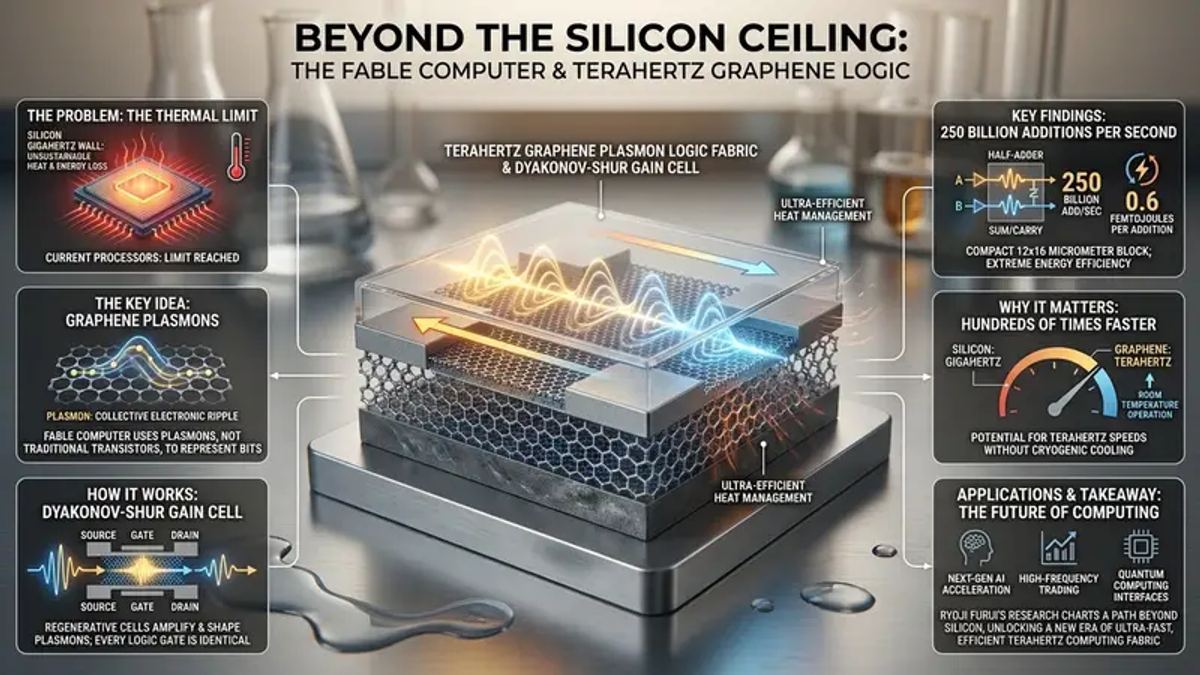
Imagine a computer that operates not by pushing electrons through tiny switches, but by guiding waves of electronic energy across a microscopic sea of carbon. For decades, the world has relied on silicon transistors that turn on and off like light switches. However, as these switches get smaller, they leak energy and generate immense heat, creating a physical ceiling that limits how fast our devices can possibly become. To break this barrier, scientists are looking toward the terahertz gap, a frequency range where signals move far faster than current microwave electronics but are easier to manage than light waves. The challenge has always been that the materials capable of these speeds usually require freezing temperatures to function, making them impractical for anything other than a laboratory.
Modern computing is hitting a wall known as the thermal limit. When electrons move through silicon, they collide with atoms in the crystal lattice, creating heat. As we push clock speeds higher into the gigahertz range, this heat becomes unsustainable, leading to thermal throttling or hardware failure. To achieve terahertz speeds—which are three orders of magnitude faster than current commercial processors—traditional electronics simply cannot keep up because the energy required to switch a transistor at that speed would vaporize the chip.
Furthermore, while optical computing uses photons to move data at incredible speeds, creating logic gates that can actually process information using light is notoriously difficult and energy-intensive. There has been a desperate need for a medium that combines the speed of light with the controllability of electricity. This is where graphene comes into play. However, even with graphene, maintaining stable signals at room temperature has been an elusive goal. Most high-speed plasmonic devices fail because the electronic oscillations, known as plasmons, decay almost instantly due to scattering and resistance. The research led by Ryoji Furui addresses this specific bottleneck, seeking a way to create a stable, self-sustaining logic fabric that operates at room temperature without overheating.
The Fable Computer is not a physical machine sitting on a desk yet, but rather a groundbreaking architectural model for a new kind of processor. Instead of using traditional transistors to represent bits as high or low voltages, it uses graphene plasmons. A plasmon is essentially a collective ripple of electrons moving across the surface of the graphene. In this system, a bit is defined by the presence or absence of one of these ripples, which are carefully timed and shaped.
The brilliance of the Fable design is that it treats every single logic gate as the exact same physical object. In a traditional computer, an AND gate and an OR gate are built differently. In the Fable Computer, every component is a resonant gain cell. The function of the gate—whether it adds, subtracts, or inverts a signal—is determined not by its construction, but by how it is biased with an external voltage. This creates a programmable logic fabric where the signals are wave-pipelined, meaning multiple calculations can follow one another in a continuous stream, much like water flowing through a pipe, rather than waiting for a switch to flip open and closed.
To understand how this system functions, one must first look at the unique properties of graphene. Graphene is a single layer of carbon atoms arranged in a hexagonal lattice. Because of its structure, electrons move through it with incredibly high mobility and very little resistance. When these electrons are confined in a gated channel, they can form collective oscillations called acoustic graphene plasmons. These plasmons are the carriers of information in the Fable Computer.
The core component is the Dyakonov-Shur gain cell. In a standard conductor, a wave of electrons would simply flatten out and disappear as it travels. However, the Dyakonov-Shur effect allows a graphene channel to act as an amplifier. By applying a specific drift bias—essentially pushing the electrons in one direction at a constant speed—the cell can take a weak incoming plasmon wave and amplify it. The researchers designed these cells to operate just below their self-oscillation threshold. This means the cell does not create its own noise, but it is primed and ready to amplify any signal that enters it.
This amplification process solves the problem of signal decay. In traditional electronics, signals lose strength as they move through a circuit, requiring periodic boosting. In the Fable Computer, the regenerative gain is built into every gate. When a plasmon wave enters a cell, it is restored to its full strength through saturating gain. This ensures that the logic levels remains crisp and clear, even after passing through multiple stages of a complex calculation.
The system is timed by a microcomb-photomixing chain. This acts as the master clock, sending out ultra-stable pulses of light that are converted into electronic triggers at the edge of the graphene fabric. These pulses ensure that every plasmon wave is synchronized, allowing the computer to perform additions in precise 4-picosecond slots. Because the system is wave-pipelined, it does not need to wait for one operation to finish before starting the next; it simply feeds a continuous stream of data through the fabric, resulting in an incredible processing density.
Ryoji Furui and the team focused their model on a half adder, a fundamental building block of all computers that adds two binary digits to produce a sum and a carry. The result was a compact block of logic measuring roughly 12 by 16 micrometers. Within this tiny area, five regenerative cells were able to perform the addition process at a rate of 250 billion additions per second.
The energy efficiency was equally striking. The model indicates that each addition consumes approximately 0.6 femtojoules on the fabric side. To put this in perspective, a femtojoule is one quadrillionth of a joule. This extreme efficiency is possible because the system does not rely on moving large amounts of charge in and out of a capacitor, which is how traditional transistors work. Instead, it modulates existing waves of energy.
The researchers also proved that the system could remain stable at room temperature. By tuning the carrier density to 10 to the power of 12 per square centimeter and setting the cell length to approximately 575 nanometers, they achieved a perfect resonance at 1 terahertz. Their analysis showed that the chip would maintain a temperature below 80 degrees Celsius during standard use, avoiding the meltdown risks associated with high-frequency electronics. Furthermore, they found a cell yield of 98 to 100 percent, meaning the system is highly resistant to the minor structural defects typically found in manufactured graphene.
This research is significant because it provides a theoretical roadmap for computing that is fundamentally different from everything currently in a consumer device. If realized, this technology would allow for the creation of processors that are orders of magnitude faster than today's best CPUs while consuming a fraction of the power.
The ability to operate at terahertz frequencies without cryogenic cooling removes the biggest barrier to deploying plasmonic logic in the real world. Most previous attempts at this speed required liquid helium or nitrogen to stop the electrons from scattering, which limited the technology to specialized physics labs. By proving that regenerative gain can stabilize signals at room temperature, this work opens the door to a new era of hardware that could handle the massive data loads required by next-generation artificial intelligence and real-time planetary scale simulations without requiring a power plant for cooling.
While the Fable Computer is a triumph of modeling, it is important to note that it remains a theoretical framework. The researchers have used highly transparent, reduced-order models to prove feasibility, but a physical bench experiment has not yet been conducted. The paper explicitly states that the model is a fable—a conceptual proof that the physics allow for such a machine.
There are two primary hurdles remaining. First, the researchers need to perform a full Boltzmann-Maxwell solve. This is a complex mathematical process that would account for the exact electromagnetic coupling between the graphene and its environment, ensuring that the radiative losses do not undermine the gain. Second, the system needs physical verification. The researchers have proposed a five-gate pass/fail protocol to test if a real-world device can actually replicate the gain and restoration predicted by the model. Until a physical chip is fabricated and tested, the Fable Computer remains a prediction of what is possible rather than a finished product.
The implications for the real world are vast, particularly in fields where latency is the primary enemy. In 6G and 7G telecommunications, the ability to process terahertz signals in real-time would allow for data transfer speeds that make current fiber optics look slow, enabling instantaneous holographic communication and seamless augmented reality.
In the realm of artificial intelligence, the energy cost of training large language models is becoming an environmental concern. A logic fabric that operates at femtojoule energy levels could reduce the power consumption of AI data centers by several orders of magnitude. Additionally, this technology would be ideal for edge computing in autonomous vehicles or drones, where the system must process massive amounts of sensor data in microseconds to make life-saving decisions, all while operating on a limited battery budget.
If you take away one key point, it is that the Fable Computer proposes a shift from switching electrons to guiding plasma waves. By using graphene's unique properties, Ryoji Furui has modeled a way to perform calculations at terahertz speeds and room temperature, effectively bypassing the heat and speed limits that currently constrain silicon chips.
What exactly is a graphene plasmon?
A graphene plasmon is a collective oscillation of electrons on the surface of a graphene sheet. Instead of thinking of electrons as individual particles moving through a wire, imagine them as a coordinated wave, similar to a ripple moving across the surface of a pond. These waves can carry information much faster than individual electrons drifting through a traditional semiconductor.
Does this mean my next laptop will be made of graphene?
Not immediately. The Fable Computer is currently a theoretical model and a proof of concept. While it shows that the physics are sound, translating this into a mass-produced consumer chip requires overcoming significant manufacturing challenges and conducting physical bench tests to verify the model.
Why is room temperature so important for this research?
Most materials that can handle terahertz frequencies are only stable at extremely low temperatures, often near absolute zero. If a computer requires liquid nitrogen to function, it cannot be used in a phone or a laptop. Proving that graphene can maintain these speeds at room temperature is the key to making this technology commercially viable.
How does a half adder relate to a whole computer?
A half adder is one of the simplest logic circuits, capable of adding two single bits. While it seems basic, every complex operation a computer performs—from rendering a video to running an app—is essentially just billions of these simple additions and logic gates happening in rapid succession. If you can make a half adder work at terahertz speeds, you have the blueprint for a full processor.
Will this technology replace silicon entirely?
It is more likely that we will see hybrid systems first. Silicon is incredibly efficient for memory and low-speed control, while graphene plasmonic logic would be used for the high-speed processing cores. Eventually, as the technology matures, graphene could replace silicon in the most demanding high-performance computing environments.
The Fable Computer represents a bold leap in our understanding of how information can be processed. By moving away from the binary switch and embracing the nature of electronic waves, Ryoji Furui has mapped out a path toward computing speeds that were previously thought to be the domain of science fiction. While the transition from a theoretical model to a physical chip is a daunting task, the potential rewards—near-instantaneous processing and negligible power consumption—make it one of the most exciting frontiers in materials science. As we move closer to the physical limits of silicon, the wave-based logic of graphene may be exactly what we need to propel the digital age into its next era.
Serious about B2B integration? Test our premium Pulsed Electrical Resistive Carbon Heating turbostratic graphene in your lab. 100g sample packs available now.
Explore More
Researchers discover naturally formed graphene sheets and carbon ovals in stingless bee hives, creating a novel emergent material with powerful blue light...

Discover how rippled graphene pores act as fluidic memristors, enabling advanced synaptic functionalities for the next generation of neuromorphic computing.

Learn how to use electromechanical responses in gapped graphene to measure electronic temperature and band gaps using traveling flexural waves.