
Rippled Graphene Pores for Neuromorphic Fluidic Memristive Devices
Discover how rippled graphene pores act as fluidic memristors, enabling advanced synaptic functionalities for the next generation of neuromorphic computing.
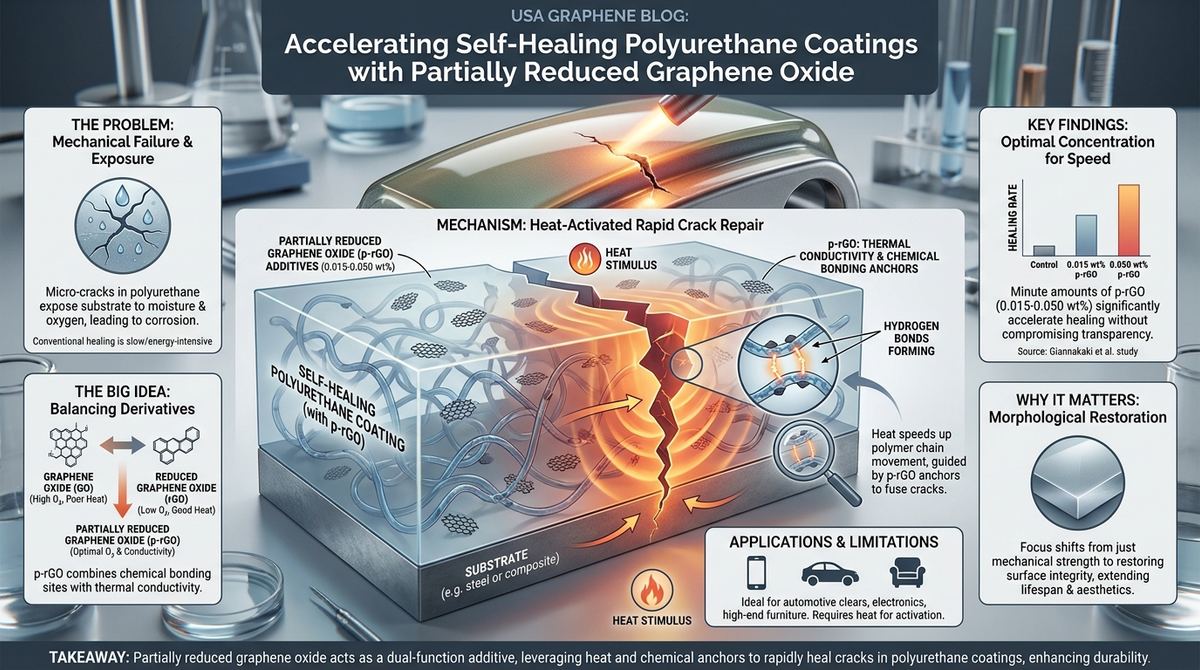
Imagine a world where the scratches on your smartphone screen, the chips in your car's paint, or the cracks in your hardwood furniture could simply vanish. This is the promise of self-healing materials, a class of polymers designed to autonomously repair damage and extend the lifespan of everyday products. While the concept sounds like science fiction, it is becoming a reality through the clever manipulation of chemistry at the molecular level. However, one of the biggest hurdles in developing these materials is efficiency; many self-healing polymers require immense amounts of energy or long periods of time to fully recover their original state. Recent breakthroughs in nanotechnology are now offering a way to supercharge this process, making the repair mechanism faster and more complete than ever before.
Polyurethane is one of the most versatile polymers used in modern coatings due to its durability, flexibility, and aesthetic appeal. Despite these strengths, polyurethane is still susceptible to mechanical failure in the form of micro-cracks and scratches. When a coating cracks, it does more than just look unsightly; it exposes the underlying material to moisture, oxygen, and pollutants, which can lead to corrosion or degradation of the entire structure. To combat this, scientists have developed self-healing polyurethanes that can reform their internal bonds after being damaged.
The challenge is that these intrinsic healing mechanisms are often sluggish. For a polymer to heal, its molecular chains must be mobile enough to move across the gap of a crack and re-establish chemical bonds with the opposing side. In many cases, this process is too slow or incomplete to be practical for consumer applications. Neat polyurethane, meaning the polymer without any additives, often reaches a plateau in its healing capacity, leaving behind visible scars or structural weaknesses even after being subjected to heat. There is a pressing need for an additive that can act as a catalyst, increasing the speed and efficiency of this molecular reassembly without compromising the coating's original properties.
The solution proposed in this research involves the use of a specialized derivative of graphene called partially reduced graphene oxide, or p-rGO. To understand this, one must first understand the two extremes of graphene derivatives. Graphene oxide is a form of graphene saturated with oxygen-containing groups, which makes it excellent at bonding with other chemicals but poor at conducting heat. On the opposite end is reduced graphene oxide, where most of those oxygen groups have been removed to restore the material's incredible electrical and thermal conductivity, but at the cost of its chemical bonding ability.
The researchers decided to create a middle ground. By reducing graphene oxide under mild conditions, they produced p-rGO, which retains some of the oxygen groups while regaining a significant portion of its conductivity. The key idea was to create a synergistic effect where the p-rGO serves two purposes simultaneously. First, it acts as a chemical bridge that helps pull the polymer chains back together through hydrogen bonding. Second, it acts as a thermal highway, distributing heat evenly throughout the coating to give the polymer chains the energy they need to move and heal. By embedding this material into a waterborne polycarbonate polyol-based polyurethane, the team aimed to create a coating that could repair itself more effectively than any pure polymer could on its own.
The effectiveness of p-rGO in a polyurethane matrix is rooted in the interplay between surface chemistry and physical transport. When graphene oxide is partially reduced, it retains specific functional groups on its surface, such as hydroxyl and carboxyl groups. These oxygen-rich sites are highly polar, meaning they can form strong non-covalent interactions known as hydrogen bonds with the functional groups present in the polyurethane chains. In a damaged state, these p-rGO flakes act as anchor points. As the material is heated, the hydrogen bonds between the p-rGO and the polymer help guide the chains back toward one another, effectively promoting the reassembling of reversible bonds across the crack interface.
Simultaneously, the structural properties of graphene come into play through thermal conductivity. Polyurethane is naturally a thermal insulator, meaning heat moves through it slowly and unevenly. When you apply heat to a neat polymer to trigger healing, the area closest to the heat source warms up quickly while other areas remain cool, leading to inconsistent healing. p-rGO flakes, however, possess a high intrinsic thermal conductivity due to their carbon lattice structure. Once dispersed within the polyurethane matrix, these flakes create a percolating network that allows heat to diffuse rapidly and uniformly throughout the entire volume of the coating.
This uniform heating is critical because it increases the chain mobility of the polymer. In a cold state, polymer chains are locked in place; as they heat up, they gain kinetic energy and begin to slide and flow. Because the p-rGO ensures that the heat is distributed efficiently, the polymer chains across the entire damaged area can reach the necessary mobility threshold to migrate and fuse. The combination of chemical attraction provided by the oxygen groups and physical energy provided by the thermal conductivity creates a dual-action mechanism that accelerates the restoration of the material's morphology.
The study, led by Evangelia Giannakaki, Vasileios Tzatzadakis, Minas Μ. Stylianakis, Kiriaki Chrissopoulou, and Spiros H. Anastasiadis, focused on the precise calibration of p-rGO concentrations to find the optimal balance for healing. They tested various low concentrations, ranging from 0.015 wt% to 0.050 wt%. It is important to note that these are incredibly small amounts of additive, ensuring that the overall transparency and nature of the polyurethane coating remained largely intact.
The results were striking. The researchers used a method called grey value analysis, which involves using digital imaging to quantify the amount of light reflected from a damaged area compared to a healed area. This allowed them to objectively measure how much of the crack had physically closed. They found that neat polyurethane, when heated at 90 degrees Celsius for 22 hours, achieved a self-healing efficiency of approximately 55 percent. However, when p-rGO was added, the self-healing capacity jumped significantly, reaching as high as 83 percent.
This increase demonstrates that the p-rGO does not just marginally improve the process but fundamentally changes the efficiency of the repair. The data indicated that even at very low loading levels, the synergy between the residual oxygen functionalities and the restored thermal conductivity was sufficient to push the polymer past its natural healing limit. The researchers confirmed that the p-rGO effectively lowered the barrier for molecular reassembly, allowing the coating to return to a state that closely resembled its original, undamaged morphology.
This research is significant because it shifts the focus from mechanical strength to morphological restoration. In many industrial applications, particularly decorative coatings for furniture or automotive interiors, the primary goal of self-healing is aesthetic. If a surface has a visible scratch, it is perceived as damaged or old, regardless of whether the structural integrity of the part is still sound. By increasing the healing efficiency from 55 percent to 83 percent, this graphene-enhanced system provides a way to make scratches virtually disappear, maintaining the visual appeal of a product for much longer.
Furthermore, the fact that such a dramatic improvement was achieved with such low concentrations of p-rGO is a major win for material science. High loadings of nanofillers often lead to problems such as aggregation, where the particles clump together and create weak spots in the material, or changes in color and transparency that make the coating unattractive. By proving that concentrations as low as 0.015 wt% can have a substantial impact, the researchers have shown that graphene derivatives can be used as powerful enhancers without disrupting the bulk properties of the host polymer.
While the results are promising, there are important limitations to consider. The primary focus of this study was morphological restoration—essentially, how well the crack closes visually. The researchers did not focus on mechanical recovery, which is the ability of the healed area to withstand the same amount of stress as the original material. It is one thing for a crack to disappear from view; it is another for that area to regain its full tensile strength. Future studies will need to determine if the p-rGO also helps restore the mechanical properties of the polyurethane or if the healing is primarily an aesthetic improvement.
Additionally, the conditions required for healing—90 degrees Celsius for 22 hours—are relatively intense. While this is feasible in a controlled industrial setting or with specialized heating equipment, it is not an instantaneous process. For the technology to be truly transformative for consumers, research must investigate whether the healing temperature can be lowered or the time reduced without sacrificing efficiency. Testing the long-term stability of these coatings under various environmental stressors, such as UV exposure or extreme humidity, will also be necessary before this can move toward commercial adoption.
The potential applications for p-rGO enhanced polyurethane are vast, particularly in sectors where appearance is paramount. In the automotive industry, this could lead to clear-coat finishes that repair swirl marks and light scratches with a simple heat treatment, reducing the need for expensive repainting. In the interior design and furniture industry, high-end lacquer finishes on tables or cabinets could be made self-healing, allowing homeowners to remove the signs of wear and tear with a heat gun or integrated heating elements.
Beyond aesthetics, this technology could be applied to protective coatings for electronics and medical devices. Any surface that requires a sterile, smooth interface could benefit from the ability to close micro-cracks that might otherwise harbor bacteria or allow moisture to seep into sensitive circuitry. As we move toward more sustainable manufacturing, the ability to extend the life of a product by repairing its surface rather than replacing it aligns perfectly with the goals of a circular economy.
If you take away one key point from this research, it is that the secret to better self-healing lies in balance. By using partially reduced graphene oxide, researchers combined the chemical bonding power of graphene oxide with the thermal conductivity of reduced graphene, creating a synergistic effect that boosts the healing efficiency of polyurethane coatings from 55 percent to 83 percent.
What exactly is partially reduced graphene oxide?
It is a material created by taking graphene oxide, which is full of oxygen atoms, and removing some of those atoms through a mild reduction process. This results in a material that can both conduct heat efficiently and form chemical bonds with polymers, making it more versatile than either fully oxidized or fully reduced graphene.
Does the coating heal automatically at room temperature?
No, in this specific study, the healing process was triggered by heat. The material was heated to 90 degrees Celsius for 22 hours to give the polymer chains enough energy and mobility to move across the crack and reform their bonds.
How do researchers measure if a crack has actually healed?
They use a technique called grey value analysis. By taking high-resolution images of the damaged and then the restored area, they can analyze the pixel intensity (the grey values) to determine how much of the crack has physically closed and disappeared.
Will adding graphene make the coating opaque or black?
Graphene is naturally dark, but because the researchers used extremely low concentrations—less than one tenth of one percent by weight—the impact on the overall appearance of the polyurethane was minimized, allowing it to remain functional as a coating.
Can this technology be used for structural repairs like fixing a broken bridge?
This specific research focused on decorative coatings and morphological restoration, meaning it is designed to fix surface scratches rather than deep structural failures. While the principles of self-healing are being explored for construction, this particular system is aimed at high-performance surface finishes.
The integration of partially reduced graphene oxide into polyurethane coatings represents a sophisticated leap in the development of smart materials. By leveraging the dual nature of p-rGO, Evangelia Giannakaki and her colleagues have demonstrated that nanofillers do not have to be used merely for structural reinforcement; they can instead be used to catalyze the intrinsic biological-like repair processes of a polymer. The synergy between enhanced thermal diffusion and hydrogen bonding provides a blueprint for the next generation of durable, self-maintaining surfaces. While further work is needed to optimize healing times and verify mechanical strength recovery, this study highlights the immense potential of graphene derivatives to transform how we maintain and preserve the objects in our daily lives.
Serious about B2B integration? Test our premium Pulsed Electrical Resistive Carbon Heating turbostratic graphene in your lab. 100g sample packs available now.
Explore More
Discover how rippled graphene pores act as fluidic memristors, enabling advanced synaptic functionalities for the next generation of neuromorphic computing.

Learn how to use electromechanical responses in gapped graphene to measure electronic temperature and band gaps using traveling flexural waves.

Explore how researchers have discovered viscous electron fluid behavior in cadmium, a breakthrough that could revolutionize the future of nanoelectronics.