
Unlocking Quasicrystal Physics in 30-Degree Twisted Bilayer Graphene
Research on 30° quasi-periodic twisted bilayer graphene reveals a unique, fractal-like energy structure under magnetic fields, paving the way for novel...
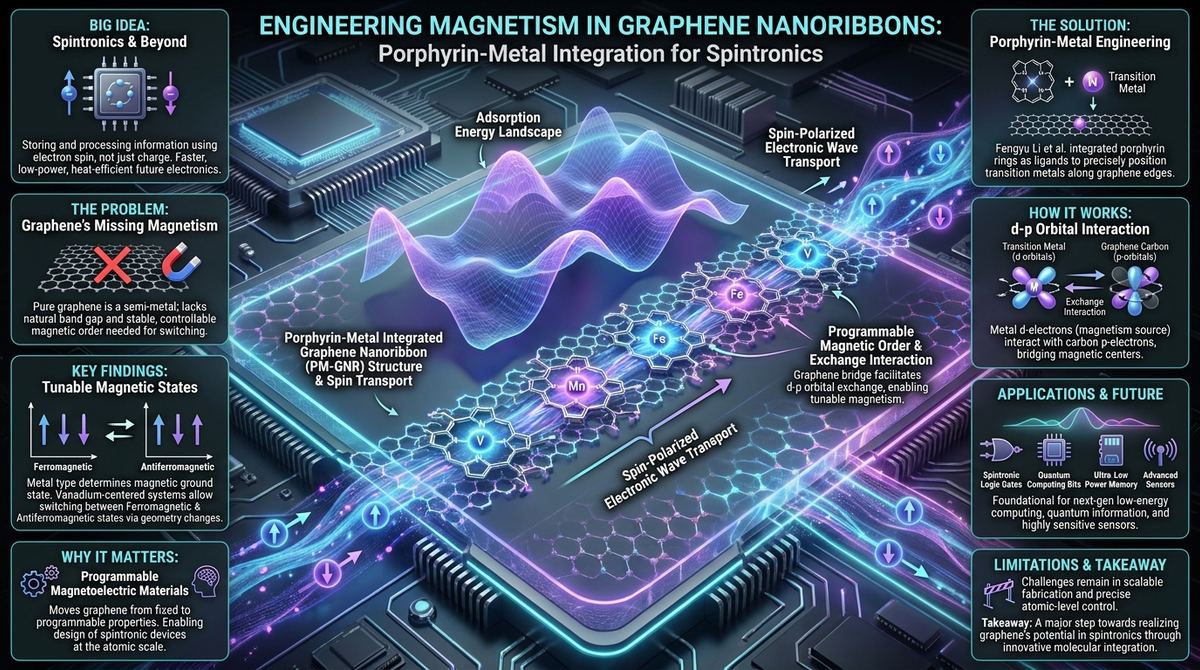
Imagine a computer chip where information is not just moved by the flow of electricity, but is stored and processed using the intrinsic spin of electrons. This concept, known as spintronics, promises devices that are faster, consume far less power, and generate significantly less heat than today's silicon-based electronics. However, the biggest hurdle is finding a material that can maintain stable magnetism while remaining highly conductive and easy to manipulate at the atomic scale. Graphene, a single layer of carbon atoms arranged in a honeycomb lattice, is an ideal candidate due to its extraordinary electronic properties, but it lacks natural magnetism. To solve this, scientists are looking for ways to chemically modify graphene to give it the magnetic properties of a metal without losing its carbon-based advantages.
The primary challenge in developing graphene-based spintronic devices is the lack of a natural band gap and stable, controllable magnetic order. While pure graphene is an excellent conductor, it behaves as a semi-metal, meaning it cannot be easily switched off like a transistor. Researchers discovered that when graphene is cut into narrow strips called nanoribbons, particularly those with zigzag edges, the electronic structure changes. These zigzag graphene nanoribbons, or ZGNRs, possess edge states that can exhibit magnetism. However, these magnetic properties are often fragile and difficult to tune.
The ability to precisely control whether a material is ferromagnetic, meaning its magnetic moments align in the same direction, or antiferromagnetic, where they align in opposite directions, is critical for creating memory and logic gates. Relying solely on the carbon edges of a nanoribbon is insufficient for the programmable control required in advanced computing. There is a desperate need for a method to introduce magnetic centers into the graphene structure that can be adjusted based on the specific needs of the electronic device.
To address these limitations, Fengyu Li, Jingnan Su, Haining Wang, and Yinghe Zhao proposed a sophisticated structural modification. Instead of using simple zigzag edges, they integrated porphyrin rings into the edges of the graphene nanoribbon. Porphyrins are organic molecules that can act as ligands, meaning they can wrap around and hold a single metal atom at their center. By embedding these porphyrins into the graphene lattice, the researchers created a hybrid system where transition metal atoms are precisely positioned along the ribbon.
The core idea is that by changing which transition metal is placed in the porphyrin ring, and by adjusting the physical dimensions of the nanoribbon itself, the researchers could effectively program the magnetic and electronic behavior of the material. This transforms the graphene nanoribbon from a passive conductor into an active, tunable magnetoelectric system. It is essentially like adding customizable magnetic switches along the edge of a highway for electrons.
The system functions through a complex interaction between the d-orbitals of the transition metal atoms and the p-orbitals of the carbon atoms in the graphene lattice. Transition metals, such as vanadium, manganese, iron, and cobalt, have partially filled d-shells. These electrons are the source of the material's magnetism. When these metals are placed inside a porphyrin ring and integrated into a zigzag graphene nanoribbon, the metal centers do not exist in isolation. Instead, they interact with each other through a process called exchange interaction.
The graphene nanoribbon acts as a bridge, or an exchange pathway, that allows the magnetic moments of the metal atoms to communicate. The electronic structure is determined by how these d-electrons hybridize with the pi-electron network of the graphene. Depending on the metal chosen, the interaction can lead to different magnetic ground states. For example, if the electrons in the metal centers align their spins in the same direction across the ribbon, the system becomes ferromagnetic. If they alternate directions, it becomes antiferromagnetic.
Furthermore, the dimensionality of the ribbon plays a crucial role. The width and length of the nanoribbon affect the distance between metal centers and the overall symmetry of the electronic states. By altering these dimensions, the researchers can shift the energy levels of the electrons near the Fermi level, which is the highest occupied energy state at absolute zero. This shift allows them to open or close a band gap, effectively controlling whether the material acts as a metal or a semiconductor.
Through rigorous first-principles calculations, the research team systematically tested transition metals from scandium to zinc. They discovered that the d-electron configuration of the metal center is the primary driver of the magnetic ground state. The most striking result occurred with vanadium-centered systems. They found that they could switch the material between ferromagnetic and antiferromagnetic states simply by modifying the electronic structure of the exchange pathway bridging the vanadium centers. This means that small changes in the ribbon's geometry can completely flip the magnetic orientation of the system.
The study also revealed that manganese, iron, and cobalt centered nanoribbons respond differently to structural changes compared to vanadium. For these metals, the magnetic properties are more robust but can still be tuned through dimensional engineering. The researchers observed that by changing the ribbon width, they could manipulate the band dispersion near the Fermi level. This allows for a high degree of precision in designing materials that have specific conductivity levels and magnetic orders.
Crucially, the researchers found a direct correlation between the symmetry of the porphyrin-serrated edges and the resulting electronic band gap. By carefully selecting the metal atom and combining it with a specific ribbon width, they could create a material that is not only magnetic but also possesses a tailored band gap. This provides a blueprint for designing materials that can switch between conducting and insulating states while maintaining specific magnetic properties.
This research is significant because it moves graphene from a material with fixed properties to one with programmable properties. In traditional semiconductor manufacturing, materials are chosen based on their inherent traits. Here, the material is engineered from the bottom up to behave exactly as needed for a specific application. The ability to control the exchange pathway means that we can now envision logic gates where the input is a change in ribbon dimension or metal center, and the output is a flip in magnetic state.
Moreover, the integration of porphyrins provides a stable chemical environment for the transition metals. Without the porphyrin ring, metal atoms would likely cluster together or migrate across the graphene surface, destroying the uniformity of the material. The porphyrin acts as a molecular anchor, ensuring that the magnetic centers are spaced evenly and interact predictably. This stability is essential for any future attempt to manufacture these ribbons at scale.
While the results are promising, it is important to note that this study was conducted using first-principles calculations and theoretical modeling. This means the findings describe what is physically possible according to quantum mechanical laws, but they have not yet been demonstrated in a physical laboratory. The synthesis of porphyrin-serrated graphene nanoribbons with atomic precision is a formidable challenge. Current chemical vapor deposition and lithography techniques may struggle to place metal atoms in porphyrin rings with the exact regularity required by the model.
Additionally, the study focuses on a perfect crystal structure. In real-world scenarios, defects such as vacancies in the carbon lattice or impurities in the transition metals could disrupt the exchange pathways and alter the magnetic ground state. Future research will need to investigate how these materials behave at room temperature, as many of the predicted magnetic states may only be stable at cryogenic temperatures. Testing the long-term stability of these metal-porphyrin bonds under operational electrical stress is also a necessary step before any commercial application can be considered.
If the theoretical predictions of this research can be realized experimentally, the applications would be transformative. The most immediate use would be in high-density non-volatile memory. Because the magnetic state can be programmed and switched, these nanoribbons could serve as the basis for memory cells that are much smaller and more energy-efficient than current MRAM technology.
Beyond memory, these systems could lead to the creation of spin-filters and spin-valves. These are devices that only allow electrons with a certain spin direction to pass through, which is the fundamental requirement for spintronic logic circuits. Such circuits would operate with a fraction of the energy used by current transistors, potentially extending the battery life of mobile devices and reducing the cooling requirements for massive data centers.
There is also potential in the field of quantum sensing. Because the magnetic state of these nanoribbons is so sensitive to their electronic environment and dimensionality, they could be used to create sensors capable of detecting incredibly small magnetic fields or single-molecule interactions, making them valuable for medical diagnostics and materials science.
The most important takeaway from this research is that by combining transition metals with porphyrin-modified graphene nanoribbons, scientists can create a programmable material where magnetism and conductivity are controlled by both the choice of metal and the physical dimensions of the ribbon.
What is a graphene nanoribbon?
A graphene nanoribbon is essentially a very thin strip of graphene, which itself is a single layer of carbon atoms. When graphene is shaped into these narrow ribbons, its electronic properties change, allowing it to exhibit behaviors that a large sheet of graphene does not have, such as the development of a band gap.
What is a porphyrin ring in this context?
A porphyrin is a large, organic, ring-shaped molecule that can hold a metal atom at its center. In this research, porphyrins are used as a way to embed transition metals into the edges of the graphene nanoribbon, acting like a molecular cage that keeps the metal atoms in place.
What is the difference between ferromagnetic and antiferromagnetic states?
In a ferromagnetic state, the magnetic moments of the atoms align in the same direction, creating a strong overall magnetic field. In an antiferromagnetic state, the moments align in opposite directions, effectively canceling each other out, though they still possess local magnetic order.
Why are transition metals used?
Transition metals like vanadium, iron, and cobalt have partially filled d-electron shells. These electrons are responsible for the magnetic properties of the material. By choosing different metals, researchers can change how many electrons are available to interact with the graphene, thus tuning the magnetism.
Is this technology already in my computer?
No, this research is currently theoretical and based on computational modeling. While it provides a roadmap for creating new types of electronics, the materials must first be synthesized and tested in a laboratory before they can be integrated into commercial hardware.
The work by Fengyu Li and colleagues represents a significant leap in our understanding of how to manipulate the quantum properties of carbon-based materials. By treating the graphene nanoribbon as a programmable canvas and using porphyrin-metal complexes as the ink, they have demonstrated that magnetoelectric properties can be tuned with extreme precision. While the road from theoretical calculation to a commercial spintronic chip is long, this research provides the necessary chemical and physical framework to make such a future possible. The synergy between dimensional engineering and chemical modification opens a new frontier in materials science, where the properties of a device are determined not just by what it is made of, but by how its atoms are precisely arranged.
Serious about B2B integration? Test our premium Pulsed Electrical Resistive Carbon Heating turbostratic graphene in your lab. 100g sample packs available now.
Explore More
Research on 30° quasi-periodic twisted bilayer graphene reveals a unique, fractal-like energy structure under magnetic fields, paving the way for novel...

Researchers discover naturally formed graphene sheets and carbon ovals in stingless bee hives, creating a novel emergent material with powerful blue light...

Discover how rippled graphene pores act as fluidic memristors, enabling advanced synaptic functionalities for the next generation of neuromorphic computing.