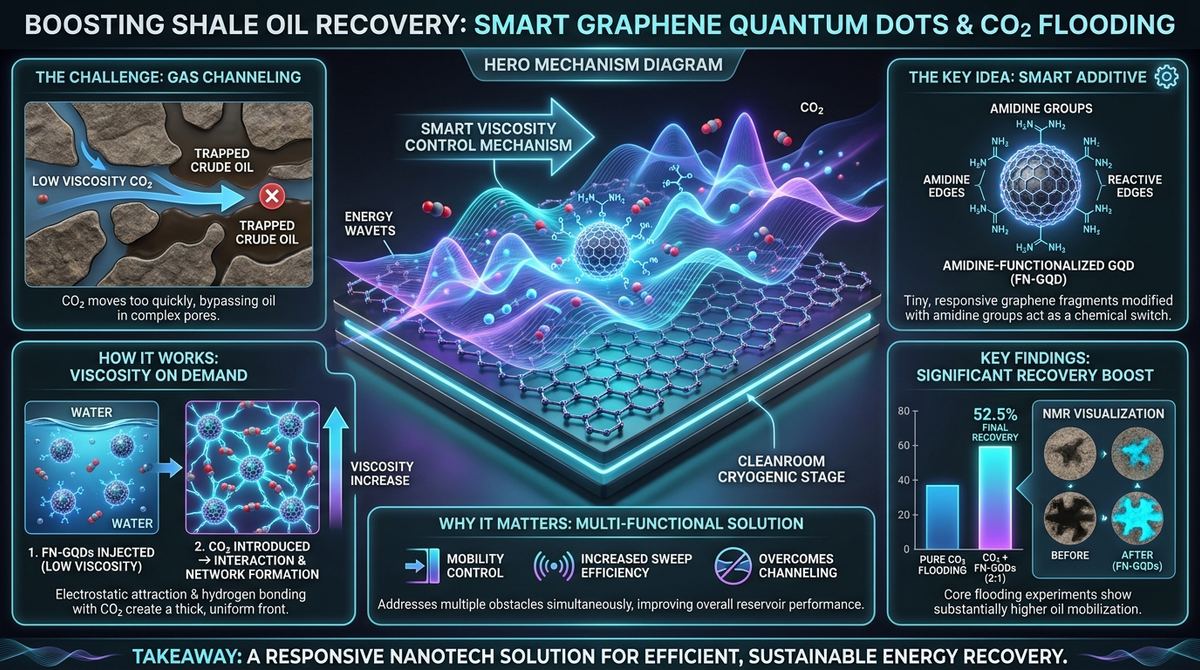
Imagine trying to push a thick layer of honey through a dense sponge using only a blast of air. Because the air is so much thinner and more mobile than the honey, it will not push the honey evenly. Instead, the air will find the easiest, most open paths through the sponge and shoot straight through them, leaving the vast majority of the honey untouched. This is essentially the challenge engineers face when using carbon dioxide to push oil out of shale rock reservoirs deep underground. The gas moves too quickly and unevenly, a phenomenon known as gas channeling, which leaves significant amounts of valuable oil trapped in the rock.
The Problem This Research Is Solving
Shale reservoirs are notoriously difficult to manage because of their extremely low permeability and complex pore structures. When engineers inject carbon dioxide into these formations to push oil toward a production well, they encounter three primary obstacles. First is the issue of mobility control. Carbon dioxide has a much lower viscosity than the crude oil it is meant to displace, leading to viscous fingering where the gas carves narrow paths through the reservoir rather than pushing a wide, uniform front of oil. This results in poor sweep efficiency, meaning much of the reservoir remains unreached by the injected gas.
Second is the problem of wettability. Many shale reservoirs are strongly oil-wet, meaning the oil clings tightly to the surface of the rock pores. This chemical attraction makes it incredibly difficult for an injected fluid to detach the oil and move it through the narrow channels. Third is water sensitivity, specifically clay swelling. Shale contains various clay minerals that expand when they come into contact with certain fluids. This swelling can choke off the narrow pores of the rock, effectively sealing the oil inside and preventing it from flowing toward the surface.
The Key Idea in Plain English
To solve these problems, Fang Shi, Weibin Jin, Jingchun wu, Bo Zhao, Chunlong Zhang, and Lifeng Mao developed a smart additive based on graphene quantum dots. Graphene quantum dots are essentially tiny fragments of graphene, only a few nanometers wide, which possess unique chemical properties due to their high surface area and the presence of reactive edges. The researchers modified these dots by adding amidine functional groups, creating what they call FN-GQDs.
The brilliance of this system lies in its responsiveness. When these functionalized quantum dots are injected into the reservoir as part of a water-based solution, they remain relatively thin and easy to pump. However, the moment they encounter the injected carbon dioxide, a chemical reaction occurs. The CO2 reacts with water to create a slightly acidic environment, which triggers the amidine groups on the graphene dots to become protonated. This change in charge causes the quantum dots to attract one another and form a dynamic, crosslinked network. This process increases the viscosity of the fluid in situ, meaning it thickens exactly where it is needed most to prevent gas channeling and push the oil more effectively.
How the Graphene-Based System Works
The effectiveness of the FN-GQDs begins with their synthesis. The researchers started with graphene quantum dots derived from citric acid, which provide a stable carbon core with oxygen-containing groups on the surface. Through a process called amidation, they grafted amidine groups onto these dots. Using conductometric titration and molecular dynamics simulations, the team determined that a grafting ratio of approximately 60 percent was optimal for achieving the desired chemical behavior.
The core mechanism of viscosity enhancement is rooted in electrostatic attraction and hydrogen bonding. Under normal conditions, the FN-GQDs are dispersed in the fluid. When CO2 is introduced into the system, it dissolves into the aqueous phase and forms carbonic acid, which releases protons. These protons attach to the amidine groups on the surface of the graphene quantum dots. Once protonated, the dots no longer repel each other; instead, they form a network of temporary bonds. This transformation increases the viscosity from a thin 0.298 mPa·s to a much thicker 2.0 mPa·s, even at very low concentrations of 0.02 weight percent. This thickness acts as a physical barrier that slows down the CO2, forcing it to spread out and contact more of the oil-saturated rock.
Beyond viscosity, the chemical structure of the FN-GQDs targets the interface between oil and water. The quantum dots act as surfactants, meaning they have parts that like water and parts that like oil. This allows them to sit at the boundary of an oil droplet, reducing the interfacial tension from a high value down to between 0.12 and 0.25 mN/m. When interfacial tension is low, the oil droplets can deform and slip through tiny pore throats more easily. Simultaneously, the positively charged surface of the functionalized dots interacts with the negatively charged surfaces of the shale rock. This interaction alters the wettability, shifting the rock from being oil-wet to water-wet. By changing the chemical preference of the rock surface, the FN-GQDs effectively push the oil away from the rock wall and into the flow stream.
What the Researchers Found
The experimental results demonstrated a significant improvement in oil recovery compared to traditional methods. In core flooding experiments, where the researchers pushed fluids through actual shale rock samples, they used an alternating injection strategy of CO2 and a solution containing FN-GQDs at a 2:1 gas-to-water ratio. The result was a final oil recovery rate of 52.5 percent, which far exceeded the performance of pure CO2 flooding.
The researchers used Nuclear Magnetic Resonance T2 spectra to visualize what was happening inside the rock pores. These spectra showed that a larger volume of oil was being mobilized from both small and large pores, confirming that the FN-GQDs were improving the displacement efficiency on a microscopic scale. Furthermore, the study addressed the issue of clay swelling. Because the FN-GQDs carry a positive charge, they can bind to the negatively charged sites on clay minerals. This prevents water molecules from penetrating between the clay layers, thereby inhibiting swelling and keeping the pore channels open. At a concentration of 0.20 weight percent, the system achieved an anti-swelling efficiency of 92 percent.
Why the Result Matters
This research is significant because it provides a multi-functional solution to several distinct problems in petroleum engineering. Most additives address only one issue; for example, a polymer might increase viscosity but fail to change wettability or prevent clay swelling. The FN-GQDs, however, provide a synergistic effect. By simultaneously reducing interfacial tension, altering wettability, increasing viscosity in response to CO2, and preventing clay swelling, the system optimizes both the macroscopic sweep volume and the microscopic displacement efficiency.
From a broader perspective, this work also has implications for carbon capture and storage. Since the process involves injecting CO2 into underground formations, increasing the efficiency of this process makes it more economically viable to store carbon dioxide permanently in depleted oil reservoirs. This creates a dual benefit: increasing energy production while contributing to the sequestration of greenhouse gases.
Limitations and What Still Needs Testing
While these results are promising, it is important to note that this research was conducted primarily in a controlled laboratory setting using core flooding and simulations. Moving from a small rock core to a massive, heterogeneous underground reservoir involves significant challenges. The behavior of the FN-GQDs over kilometers of rock, where temperature and pressure gradients vary wildly, has not yet been fully mapped.
Additionally, the long-term stability of the dynamic crosslinking network needs further investigation. It is unclear how the viscosity changes over months of injection or if the graphene quantum dots might eventually aggregate and clog certain parts of the reservoir. The cost of synthesizing high-purity functionalized graphene quantum dots at an industrial scale also remains a question that must be answered before this technology can be deployed in commercial oil fields.
Real-World Applications
The most immediate application for this technology is in the enhanced oil recovery (EOR) sector, specifically for shale and tight-oil reservoirs. Operators could integrate FN-GQDs into their water-alternating-gas (WAG) injection cycles to maximize the amount of oil extracted from aging wells. Beyond shale, this technology could potentially be adapted for other types of low-permeability reservoirs where gas channeling is a persistent problem.
Furthermore, the anti-swelling properties of these functionalized quantum dots could be used independently in drilling fluids or fracturing fluids. By preventing clay swelling during the initial stages of well completion, companies could maintain higher permeability from the start, reducing the need for expensive chemical treatments later in the life of the well.
If You Remember One Thing
If you remember one key takeaway, it is that graphene quantum dots can be chemically engineered to act as a smart switch. In this research, they remain fluid during injection but thicken into a network upon meeting CO2, which solves the problem of gas channeling while simultaneously detaching oil from rock surfaces and preventing clay from swelling.
FAQ
What exactly are graphene quantum dots?
Graphene quantum dots are extremely small particles of carbon, typically less than 10 nanometers in size. Unlike bulk graphene, which is a large sheet, these dots are tiny fragments that exhibit unique chemical and optical properties. Their small size gives them a very high surface-area-to-volume ratio, allowing scientists to attach various chemical groups to their edges to change how they interact with other substances.
How does the CO2 actually make the fluid thicker?
When carbon dioxide dissolves in water, it creates a mild acid. This acidity provides protons that attach to the amidine groups on the surface of the quantum dots. Once these groups are protonated, they create electrostatic attractions and hydrogen bonds with neighboring dots. This causes the individual particles to link together into a dynamic, web-like network that resists flow more than a simple liquid, thereby increasing the viscosity.
Does this process damage the environment?
The research focuses on improving efficiency and sequestering CO2, which is generally positive. However, the environmental impact of injecting synthetic quantum dots into the ground would require thorough regulatory review. The study uses citric acid-derived GQDs, which are generally more environmentally friendly than those made from harsh chemical precursors, but full-scale environmental impact assessments would be necessary before field use.
Why is changing the wettability of the rock important?
Wettability describes whether a liquid prefers to spread across a surface or stay as a bead. In many shale rocks, the oil is strongly attracted to the rock surface, making it la own its way out. By changing the rock from oil-wet to water-wet, the FN-GQDs make it so the rock prefers water over oil. This effectively pushes the oil off the surface, making it much easier for the injected fluids to sweep the oil out of the pores.
Can this technology be used in any oil well?
While it is designed for shale and tight-oil reservoirs where permeability is low, the general principle of mobility control can be applied to various EOR projects. However, it is specifically tuned for CO2 flooding. If a different gas or fluid is being used for recovery, the chemical functionalization of the graphene dots would likely need to be redesigned to react with that specific fluid.
Conclusion
The integration of nanomaterials into petroleum engineering represents a shift toward more precise, molecular-level control over reservoir dynamics. By leveraging the unique structural and chemical properties of graphene quantum dots, researchers have created a system that addresses the most stubborn inefficiencies of CO2 flooding. The ability to trigger viscosity changes in situ, while simultaneously managing interfacial tension and clay stability, offers a powerful toolkit for increasing the lifespan and productivity of shale reservoirs. As these materials move from the laboratory toward pilot-scale testing, they may provide a critical bridge between traditional energy extraction and more sustainable carbon management strategies.