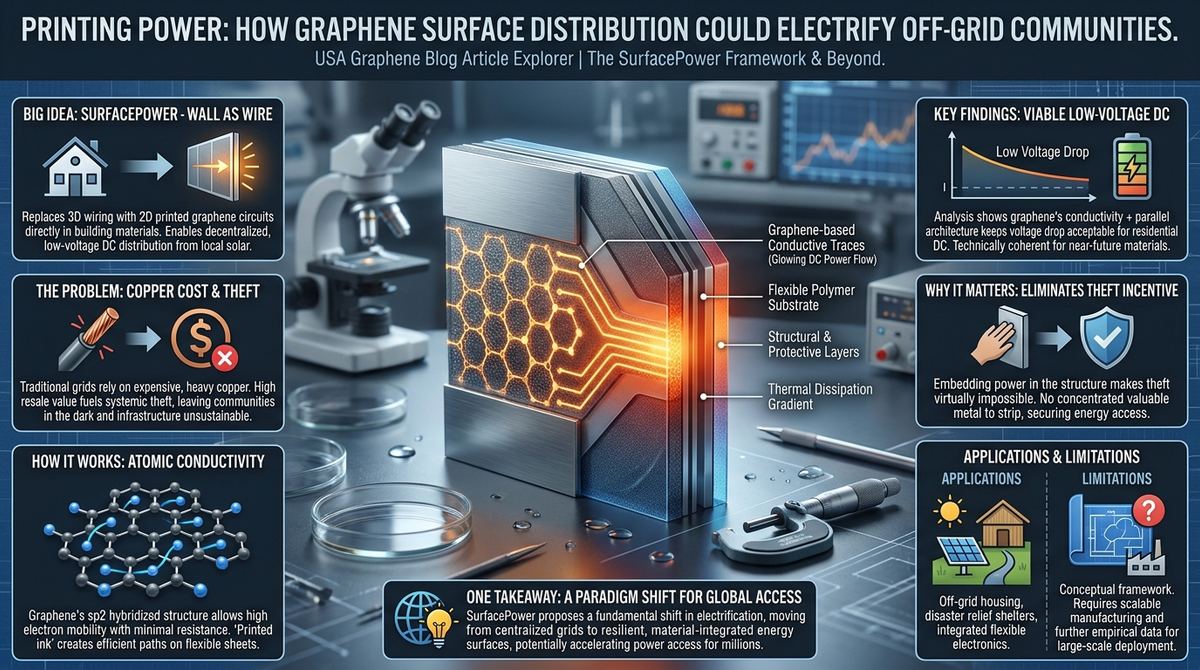
Imagine a world where the electricity powering your home does not travel through heavy copper cables hidden behind plaster, but instead flows through a microscopic layer of carbon integrated directly into the walls themselves. For millions of people in rural Sub-Saharan Africa, the arrival of electricity is often delayed not by a lack of power sources, but by the sheer cost and fragility of the infrastructure required to move that power from a solar panel to a light bulb. This is where the concept of SurfacePower enters the conversation, proposing a shift from three-dimensional wiring to two-dimensional surface distribution.
The Problem This Research Is Solving
The traditional model of electrification relies on a centralized alternating-current grid that pushes electricity over vast distances via copper and aluminum conductors. In the context of dispersed rural settlements, this model is fundamentally broken. The cost of raw copper is prohibitively high, and the infrastructure required to maintain these lines in remote areas is often unsustainable. Furthermore, copper theft has become a systemic crisis in many regions; the high resale value of the metal creates an incentive for thieves to strip power lines, leaving entire communities in the dark.
Leonid Sandler identifies that these challenges are compounded by the inherent inefficiency of adapting legacy grid systems to a decentralized solar economy. Most rural electrification attempts still try to mimic the urban grid on a smaller scale, utilizing expensive conduits and heavy-gauge wiring. There is an urgent need for a distribution paradigm that is not only cheaper to manufacture but is physically integrated into the architecture of the home, making it useless to thieves and vastly simpler to install.
The Key Idea in Plain English
The SurfacePower framework proposes replacing traditional wires with graphene-based conductive traces. Instead of pulling a cable through a hole in a wall, the researchers suggest printing microscopic paths of conductive graphene ink onto flexible polymer sheets. These sheets are then laminated into the very panels used to build the house. Essentially, the wall becomes the wire.
This system operates on direct-current power harvested from local solar arrays and distributes it at an extra-low voltage. By utilizing the unique properties of graphene, the system can move electricity across a surface with minimal loss. To ensure efficiency and safety, the power is not always active; instead, it uses a demand-based activation system similar to how a modern USB-C charger communicates with a laptop to determine how much power is needed. This transforms the home from a collection of passive circuits into an intelligent, integrated energy surface.
How the Graphene-Based System Works
To understand why graphene is the catalyst for this change, one must look at its atomic structure. Graphene consists of a single layer of carbon atoms arranged in a hexagonal lattice, characterized by sp2 hybridization. This structure creates a delocalized pi-electron system where electrons can move with incredibly high mobility and very little scattering. In a traditional copper wire, electrons collide frequently with impurities or the lattice itself, creating resistance that manifests as heat. Graphene's high carrier mobility allows for a more efficient flow of charge, which is critical when distributing power over a wide surface area.
The technical execution relies on flexible printed electronics. Graphene ink is deposited onto a polymer substrate, which serves two purposes: it provides mechanical flexibility and acts as an electrical insulator to prevent short-circuiting. However, a single thin layer of graphene might not handle high currents without significant voltage drops. To solve this, the framework draws on Litz-wire current distribution theory and jellyroll battery construction.
In traditional electronics, a thin trace has high resistance because the cross-sectional area is small. By printing multiple parallel micro-conductor traces and layering them, the system effectively increases the total cross-sectional area available for electron flow. This is analogous to adding more lanes to a highway; while each lane is narrow, the total volume of traffic that can move simultaneously increases. By optimizing these paths in a geometry inspired by the coiled layers of a battery cell, the system minimizes ohmic losses—the energy lost as heat due to resistance—over the distance of a standard room.
The system is energized by solar-generated direct current at extra-low voltage levels. Using low voltage is a critical safety decision; it removes the risk of lethal electric shocks and eliminates the need for heavy, expensive insulation required for high-voltage AC. To manage this power, the framework incorporates USB Power Delivery standards. This means the system uses a handshake protocol where the device (a lamp, a phone charger, or a small appliance) communicates its power requirements to the source. Only then is the specific circuit activated, reducing parasitic power loss and increasing the overall lifespan of the components.
What the Researchers Found
Because SurfacePower is a conceptual framework, the findings are focused on technical coherence and manufacturability rather than laboratory empirical data. The research demonstrates that the integration of flexible printed electronics with low-voltage DC distribution is not only possible but viable using near-future materials science. The analysis shows that by combining graphene's intrinsic conductivity with a multi-trace parallel architecture, the voltage drop across a standard residential wall panel can be kept within acceptable limits for consumer electronics.
The study also found that the socio-economic landscape of Sub-Saharan Africa is the ideal environment for this deployment. Because many of these areas lack existing legacy wiring, there is no need to "rip and replace" old systems. This allows for a technological leapfrog, similar to how many African nations skipped the installation of landline telephones and moved directly to mobile cellular networks. The researchers concluded that a staged 30-month pilot program could move this from a conceptual model to a functional prototype, providing a blueprint for open-source distribution that avoids the bottlenecks of corporate patent restrictions.
Why the Result Matters
The implications of this research extend far beyond the technical specifications of carbon lattices. By embedding the power distribution into the building materials, the incentive for copper theft is virtually eliminated. A thief cannot simply cut a wire from a pole; they would have to dismantle the entire wall of a home to recover a negligible amount of carbon, which has far less resale value than pure copper.
Economically, this reduces the barrier to entry for electrification. Printing graphene traces is potentially far cheaper at scale than mining, refining, and transporting heavy copper cabling to remote villages. This creates a pathway for rapid human development, as reliable electricity enables refrigeration for vaccines, lighting for education, and connectivity for entrepreneurship. Moreover, the use of extra-low voltage DC makes the system inherently safer for users in environments where professional electrical maintenance may be scarce.
Limitations and What Still Needs Testing
It is important to note that SurfacePower is currently a framework, not a commercially available product. Several significant engineering hurdles remain. First, the long-term durability of printed graphene traces must be tested against environmental stressors. Thermal expansion and contraction, caused by the intense heat of Sub-Saharan climates, could potentially lead to micro-fractures in the graphene layers or delamination from the polymer substrate. If a trace cracks, the resistance increases instantly, which could lead to localized overheating or circuit failure.
Additionally, while graphene is highly conductive, the interfaces between the printed traces and the actual device sockets need optimization. Contact resistance at these junctions can often negate the efficiency gains found in the conductor itself. The scale of manufacturing also remains a question; while printing on small scales is common in the electronics industry, printing entire residential wall panels requires a shift in industrial fabrication processes. Finally, the efficiency of these surfaces over very long distances—beyond a single building—still requires rigorous modeling to determine where the surface distribution ends and traditional cabling must begin.
Real-World Applications
The most immediate application is in the construction of low-cost, sustainable rural housing. Prefabricated wall panels could be shipped to off-grid communities with the power distribution already printed and laminated inside. A village could deploy a central solar array, and each home would simply be plugged into this local micro-grid, with the interior power handled by the SurfacePower walls.
Beyond residential use, this technology could be applied to rural health clinics and schools. In a clinic, critical equipment like vaccine refrigerators or diagnostic tools could be powered by integrated surfaces that are resistant to the theft and degradation that plague traditional wiring. It could also be used in agricultural settings, such as powering low-voltage sensors for precision farming or automated irrigation triggers, all integrated into the structures of the farm buildings.
If You Remember One Thing
If you take away one central idea from this research, let it be that we are moving toward a future where electricity is not something delivered through a wire, but something integrated into the very surfaces of our environment. By replacing expensive and stealable copper with printed graphene, we can turn the walls of a home into an efficient, safe, and nearly invisible power grid.
FAQ
Does this mean the walls will be electrified and dangerous to touch?
No, because the system operates at extra-low voltage, which is far below the threshold required to cause an electric shock. Additionally, the graphene traces are laminated between insulating polymer layers, meaning the conductive material is physically separated from the surface of the wall.
Is graphene expensive to produce for this scale?
While high-purity graphene used in semiconductors is expensive, the conductive inks required for printed electronics are becoming increasingly affordable. The goal is to use a form of graphene that provides sufficient conductivity for low-voltage power without requiring the extreme purity of laboratory-grade sheets.
Can this system power heavy appliances like air conditioners?
The current framework is designed for low-voltage DC power, which is ideal for LED lighting, phone charging, and small electronics. High-power appliances would still require more robust cabling or a different power delivery approach, as the current density required for heavy machinery would likely exceed the capacity of printed micro-traces.
How does this actually stop thieves?
Traditional copper wiring is a high-value commodity that can be easily stripped and sold. Graphene, while technologically advanced, is composed of carbon. The amount of carbon in a wall panel has no significant scrap value, and because the traces are printed and laminated into the material, they cannot be "stripped" like a copper wire.
Would this work in cold climates as well as hot ones?
In theory, yes, but the materials science would change. In very cold climates, the polymer substrates would need to be chosen for their ability to resist brittleness. The conceptual framework focuses on Sub-Saharan Africa due to the specific combination of solar abundance and copper theft, but the physics of graphene conductivity remains applicable globally.
Conclusion
The SurfacePower framework represents a bold departure from the linear thinking of the industrial age. By leveraging the extraordinary electronic properties of graphene and the efficiency of printed electronics, Leonid Sandler proposes a system that solves both a technical problem and a socio-economic one. While the transition from a conceptual framework to a widespread utility will require rigorous testing of material durability and manufacturing scalability, the potential reward is a world where energy access is no longer limited by the cost of a copper wire. This is more than just an engineering upgrade; it is a reimagining of how we integrate energy into the human habitat.