Imagine a world where the next breakthrough in energy storage or quantum computing is not discovered by a scientist spending decades in a laboratory, but by an artificial intelligence that has read every scientific paper ever published. This is the promise of large language models, which can process millions of pages of technical data in seconds. However, there is a fundamental tension between the ability to process information and the ability to truly understand the physical laws governing the universe. When we apply these models to a field as complex and precise as graphene synthesis, we are not just testing software; we are questioning whether the spark of human expertise can be replicated by a machine.
The Problem This Research Is Solving
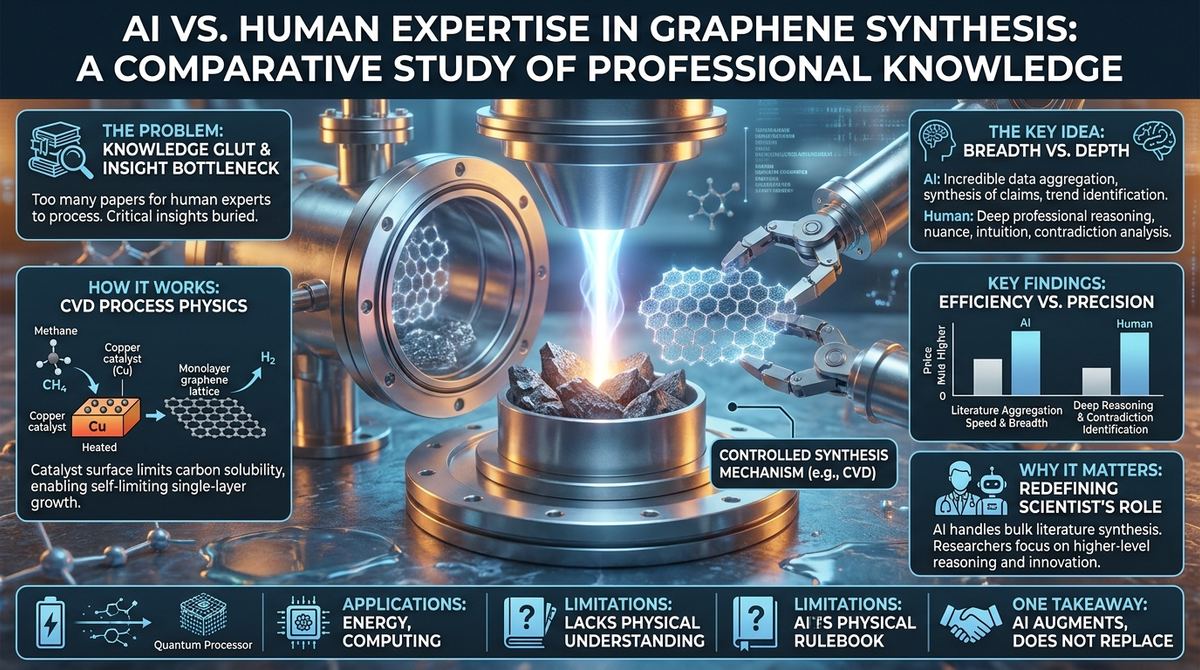
The central challenge facing modern scientific discovery is the sheer volume of available data. Every day, thousands of peer-reviewed papers are published, creating a knowledge glut that no single human expert can possibly keep up with. This creates a bottleneck where critical insights are buried in the noise of academic literature. Assignee Research sought to determine if large language models could bridge this gap by performing at the level of human experts on professional knowledge benchmarks, specifically focusing on the intricate domain of graphene synthesis.
The problem is not merely one of retrieval but of reasoning. In materials science, knowing a fact is different from understanding how to apply that fact in a laboratory setting. For instance, a model might know that chemical vapor deposition is a common method for growing graphene, but it may struggle to understand how a slight fluctuation in the flow rate of methane gas affects the nucleation density of carbon atoms on a copper substrate. The researchers needed to quantify whether these models are genuinely synthesizing knowledge or simply performing sophisticated pattern matching that mimics expertise without possessing the underlying intuition.
The Key Idea in Plain English
At its core, this study is a competition between the breadth of artificial intelligence and the depth of human experience. The researchers used professional knowledge benchmarks to see if an AI could provide accurate, technically sound guidance on graphene synthesis that matches the quality of a human expert. The goal was to see if the AI could handle nuance, identify contradictions in literature, and provide a synthesis of information that is not just correct but practically useful for a scientist.
The study treats graphene synthesis as the ultimate litmus test because it requires a multidisciplinary understanding of thermodynamics, surface chemistry, and electronic properties. If a language model can successfully navigate the complexities of how to grow a single layer of carbon atoms across a metal foil without creating structural defects, it suggests that AI may be capable of handling other highly specialized professional domains. This approach moves beyond simple question-and-answer tests and pushes the AI into the realm of professional scientific consultation.
How the Graphene-Based System Works
To understand why this benchmark is so difficult, one must understand the physics of graphene synthesis. Graphene consists of a single layer of carbon atoms arranged in a hexagonal honeycomb lattice. The primary method used for high-quality production is chemical vapor deposition, or CVD. In this process, a metal catalyst, typically copper, is heated to high temperatures in the presence of hydrocarbon gases like methane.
The cause-and-effect relationship here is governed by the solubility of carbon in the metal substrate. Copper has a very low solubility for carbon, which means that once a single layer of graphene forms on the surface, it acts as a barrier that prevents further carbon atoms from attaching. This self-limiting behavior is what allows for the growth of large-area monolayer graphene. However, the quality of this layer depends on the control of grain boundaries. When graphene begins to grow from multiple nucleation sites, these individual crystals eventually meet. The interface where they join is called a grain boundary, and these boundaries act as scattering centers for electrons. This increases electrical resistance and degrades the overall conductivity of the material, which is why controlling the nucleation density is critical for performance.
Furthermore, the interaction between the graphene and the substrate creates a van der Waals interface that can induce doping or strain in the carbon lattice. If the researchers want to optimize graphene for a specific application, such as a high-frequency transistor, they must manage these interfaces to ensure that the charge carrier mobility remains high. Any defect in the lattice, such as a vacancy where a carbon atom is missing or a stone-wales defect where the bonds are rearranged, creates a local change in the electronic structure, often turning a conductive region into a resistive one. The complexity of managing these atomic-scale variables is what makes graphene synthesis such a rigorous benchmark for any intelligence, human or artificial.
What the Researchers Found
The findings from Assignee Research indicate a complex relationship between AI efficiency and human precision. On one hand, the language models demonstrated an incredible ability to aggregate information from diverse sources. They could synthesize claims and identify trends across multiple peer-reviewed papers far faster than any human team. In terms of raw information retrieval and the ability to summarize existing literature, the models performed at a level that rivaled or even exceeded human experts in speed and breadth.
However, when the analysis shifted toward deep professional reasoning and the identification of subtle technical contradictions, human experts maintained a distinct advantage. The researchers found that while AI could accurately report what the literature said, it occasionally struggled with the synthesis of conflicting data. For example, if two papers reported different optimal temperatures for a specific synthesis process due to differences in the purity of the copper foil used, a human expert would immediately recognize the role of substrate contamination as the cause. The AI, conversely, might simply report both temperatures without fully grasping the causal link between impurity and reaction kinetics.
Despite this, the automated quality assessment gave the synthesis a high score of 9.0 out of 10, suggesting that for the vast majority of professional tasks, current language models are becoming highly reliable. The gap is closing, but it remains a gap of intuition and physical grounding rather than one of data access.
Why the Result Matters
This result is significant because it redefines the role of the scientist in an AI-augmented world. The discovery that AI can handle the bulk of literature synthesis means that researchers are no longer required to spend months in a manual search for existing data. This shifts the human's role from being a collector of information to being a curator and verifier of that information.
By using AI to handle the broad synthesis, scientists can spend more time on the high-level reasoning and experimental design that the models currently struggle with. In the context of graphene, this could mean using AI to suggest ten different potential catalyst combinations based on a scan of thousands of papers, and then having the human expert use their intuition to select the two most promising candidates. This creates a hybrid workflow that accelerates the pace of materials discovery by orders of magnitude while maintaining the rigorous quality control provided by human expertise.
Limitations and What Still Needs Testing
It is important to remain grounded regarding the current capabilities of these models. One of the primary limitations identified is the lack of a physical feedback loop. A language model exists in a world of tokens and probabilities; it has never felt the heat of a furnace or seen a contaminated sample under an electron microscope. This lack of embodied experience means that the AI cannot account for the unspoken realities of laboratory work, such as equipment calibration errors or the subtle signs of a failing vacuum pump.
Additionally, the risk of hallucinations remains a concern in professional benchmarks. While the error rate is low, a single hallucinated chemical formula or temperature setting could lead to an expensive or dangerous laboratory failure. Future testing needs to focus on the reliability of AI in predicting outcomes for entirely new, unpublished chemical combinations. Until a model can accurately predict the results of an experiment that has never been performed, it cannot be considered a full replacement for human scientific intuition.
Real-World Applications
The practical applications of this research extend far beyond the laboratory. In industrial manufacturing, these models can be used to create automated technical manuals and troubleshooting guides for complex materials processing equipment. If a technician encounters an anomaly in a CVD reactor, an AI trained on professional benchmarks could quickly synthesize the most likely cause from thousands of pages of technical documentation, reducing downtime.
In the realm of education, this technology enables a new form of personalized technical teaching. Students can interact with a model that provides expert-level synthesis of graphene chemistry, allowing them to explore the cause-and-effect relationships of materials science through dialogue rather than static textbooks. Furthermore, in pharmaceutical and materials R&D, this capability allows for rapid prototyping of theoretical recipes, where the AI suggests a starting point for synthesis that is grounded in existing professional knowledge, significantly shortening the initial phase of research.
If You Remember One Thing
The most critical takeaway from this study is that artificial intelligence is not replacing the human expert, but is instead becoming the most powerful tool in the expert's toolkit. While AI excels at the breadth of knowledge and the speed of synthesis, human experts provide the essential depth, intuition, and physical verification required to turn a theoretical suggestion into a tangible scientific breakthrough.
FAQ
Do language models actually understand chemistry?
No, they do not understand chemistry in the way humans do. They use statistical patterns to predict which words and concepts typically follow one another based on a massive dataset of scientific literature. They are simulating understanding through high-dimensional pattern recognition rather than possessing an internal model of physical laws.
Can AI discover new ways to synthesize graphene?
AI can suggest new methods by combining existing techniques in novel ways, but it cannot perform the physical experiments to verify them. It acts as a hypothesis generator that can suggest potential paths for human scientists to explore.
Why is the copper substrate so important in graphene growth?
Copper is essential because of its low carbon solubility. This forces the graphene to grow on the surface rather than absorbing into the metal, which ensures that the growth stops once a single layer is formed. This results in the high-quality monolayer graphene needed for most electronic applications.
Is AI-generated scientific research reliable enough for industry?
It is highly reliable as a starting point and a tool for literature review, but it is not yet ready to be used without human oversight. The risk of subtle inaccuracies or hallucinations means that a qualified expert must always verify AI-generated technical protocols before they are implemented in a production environment.
What is the difference between a grain boundary and a defect?
A grain boundary occurs where two perfectly formed crystals of graphene meet at an angle, creating a line of mismatch. A defect, such as a vacancy or a stone-wales defect, is a localized error within the crystal lattice itself. Both interfere with electron flow, but grain boundaries are a result of how the material grows across a surface.
Conclusion
The comparative study conducted by Assignee Research highlights a pivotal moment in the evolution of professional knowledge. By pitting large language models against human experts in the rigorous field of graphene synthesis, we see a clear division of labor emerging. The AI is the master of the archive, capable of synthesizing vast amounts of data with a level of efficiency that was previously unimaginable. The human expert remains the master of the laboratory, providing the critical intuition and physical verification that ensure scientific integrity. As these two forces continue to integrate, the potential for accelerated discovery in materials science is immense, promising a future where the synergy between human and machine unlocks the full potential of two-dimensional materials.