
Graphene-Powered Terahertz Sensors for Early Breast Cancer Detection
Explore how a miniaturized graphene biosensor uses tunable THz waves to detect breast cancer tumors as small as 1mm and determine TNM staging noninvasively.
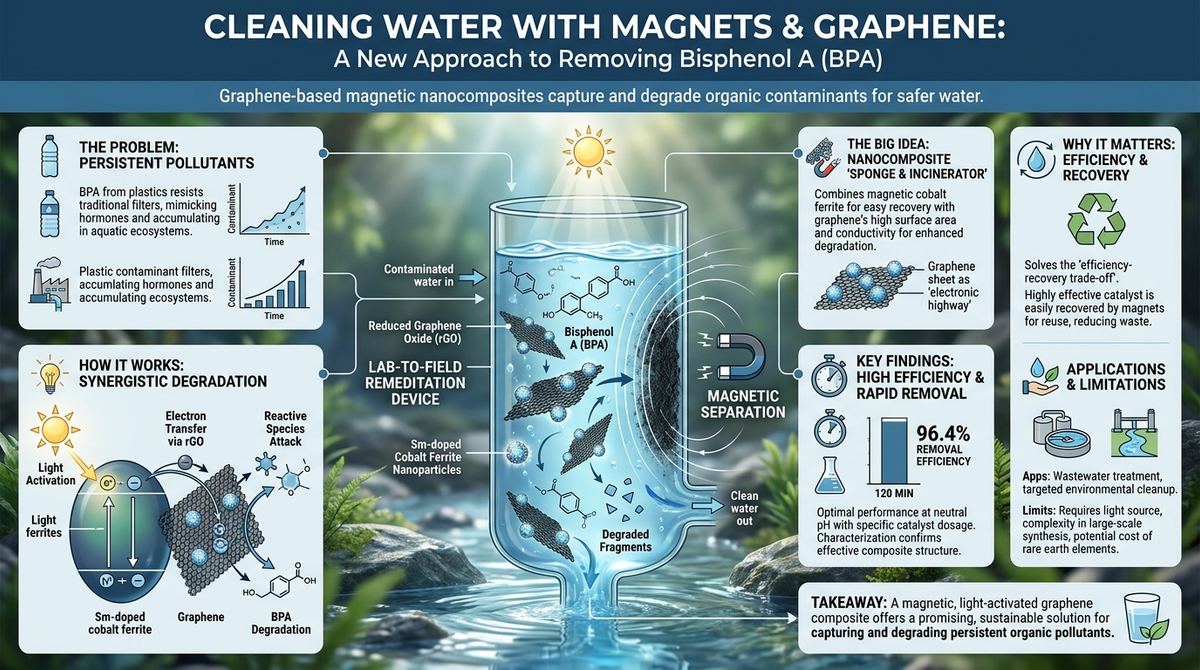
Imagine a world where the invisible chemicals leaking from our plastics and pharmaceuticals no longer threaten our health or the environment. For decades, we have relied on water treatment plants to keep us safe, but many modern contaminants are too small or too chemically stable for traditional filters to catch. One of the most concerning is Bisphenol A, or BPA, a compound found in many plastics and resins that mimics hormones in the human body. Because it is so persistent, BPA often survives standard treatment processes and ends up in our rivers and drinking water. To solve this, scientists are looking toward nanotechnology to create a chemical scavenger that can not only find and destroy these pollutants but also be easily removed from the water once the job is done.
Water contamination by emerging organic pollutants has become a global crisis. Among these, Bisphenol A is particularly problematic because it acts as an endocrine disruptor, meaning it can interfere with the hormonal systems of humans and aquatic wildlife. These chemicals are often hydrophobic or possess complex aromatic structures that make them resistant to biological degradation in traditional wastewater plants. While advanced oxidation processes exist, many of the catalysts used are either inefficient under visible light or difficult to recover from the water after treatment. If a catalyst cannot be recovered, it becomes a pollutant itself, creating a secondary environmental problem.
The challenge is therefore twofold: the catalyst must be powerful enough to break down a stable molecule like BPA, and it must be easy to extract from the treated water. Most high-efficiency photocatalysts are powders that require expensive and energy-intensive membrane filtration or centrifugation to remove. This is where the work of Cabangani Donga, Kholiswa Yokwana, Luyanda L. Noto, Tlou N. Moja, and Pontsho Mbule becomes so critical. They sought to create a material that combines high catalytic activity with magnetic properties, allowing the catalyst to be pulled out of the water using a simple external magnet.
The researchers developed a nanocomposite material that functions like a high-tech chemical sponge and incinerator combined. They used cobalt ferrite as the base because it is magnetic, meaning the material can be easily collected after use. To make this catalyst more powerful, they incorporated samarium, a rare earth element that helps the material absorb visible light and improves its interaction with water pollutants. Finally, they anchored everything onto reduced graphene oxide, a single layer of carbon atoms that acts as both a structural support and an electronic highway.
To push the reaction even further, they added peroxydisulfate to the water. When this chemical meets the catalyst under visible light, it triggers a cascade of highly reactive oxygen species. These are essentially chemical scissors that chop the BPA molecule into smaller, harmless fragments. By combining these three components—the magnetic ferrite, the rare earth dopant, and the graphene sheet—the team created a system that is more efficient than any of its parts acting alone.
To understand why this system works, one must look at the interface between the reduced graphene oxide and the samarium-incorporated cobalt ferrite. Graphene is renowned for its exceptional electrical conductivity and massive surface area. In this nanocomposite, the reduced graphene oxide does not just hold the nanoparticles in place; it actively participates in the chemistry of degradation. One of the biggest hurdles in photocatalysis is electron-hole recombination. When light hits a semiconductor like cobalt ferrite, it excites an electron, leaving behind a positive hole. If the electron and hole simply recombine, the energy is wasted as heat, and no chemical reaction occurs.
Reduced graphene oxide solves this problem by acting as an electron sink. Because of its highly conductive $\pi$-electron network, the graphene sheet quickly whisks away the excited electrons from the cobalt ferrite nanoparticles. This separation keeps the positive holes and negative electrons apart for a longer duration, providing more time for them to react with water and peroxydisulfate. Furthermore, the graphene surface provides a high concentration of active sites where BPA molecules can adsorb through $\pi-\pi$ stacking interactions. This means the pollutant is physically pulled closer to the catalyst, increasing the likelihood of a collision and subsequent degradation.
The addition of samarium further optimizes this process. Rare earth elements like samarium modify the electronic structure of the ferrite, narrowing the bandgap. This allows the catalyst to utilize visible light—the most abundant part of the solar spectrum—rather than requiring expensive and energy-intensive ultraviolet lamps. When this light-activated catalyst interacts with peroxydisulfate, it facilitates the transfer of electrons to the peroxydisulfate molecules. This process splits the peroxydisulfate into sulfate radicals, which are incredibly aggressive oxidants capable of attacking the stable aromatic rings of BPA.
The results of the study were impressive, demonstrating a high level of synergy between the materials. Using a dual co-precipitation and hydrothermal synthesis method, the researchers created a catalyst that achieved a maximum BPA removal efficiency of 96.4 percent within just 120 minutes. The optimal conditions for this reaction involved a BPA concentration of 20 milligrams per liter, a catalyst dosage of 25 milligrams, and a peroxydisulfate concentration of 1.5 millimolar at a neutral pH of 7.0.
Through detailed characterization using X-ray diffraction and scanning electron microscopy, the team confirmed that the samarium was successfully integrated into the cobalt ferrite structure and that these nanoparticles were evenly distributed across the graphene sheets. This prevented the particles from clumping together, which would have reduced the available surface area. The BET adsorption-desorption measurements confirmed that the nanocomposite possessed a significant surface area, which is vital for maximizing the contact between the catalyst and the BPA molecules.
Crucially, the researchers used radical scavenger experiments to prove exactly how the degradation was happening. They discovered that both sulfate radicals and hydroxyl radicals were the primary drivers of the reaction. The presence of peroxydisulfate significantly boosted the degradation rate compared to using light alone, proving that the chemical activation of PDS by the SmCoFe2O4/rGO catalyst is the key to its high efficiency. Finally, the researchers tested the durability of the material over five consecutive cycles, finding that it maintained its catalytic activity and structural integrity, making it a sustainable option for repeated use.
This research is significant because it addresses the efficiency-recovery trade-off that plagues environmental chemistry. In many cases, a catalyst is either highly effective but impossible to recover, or easy to recover but sluggish in performance. The SmCoFe2O4/rGO composite breaks this cycle. By leveraging the magnetic properties of cobalt ferrite, the researchers have created a way to clean water without needing complex filtration systems. A simple magnetic field can pull the catalyst out of the solution, allowing it to be reused multiple times without a significant loss in performance.
Moreover, the move toward visible-light activation is a major step toward green chemistry. If water treatment can be powered by the sun rather than electricity-hungry UV lamps, the carbon footprint of wastewater treatment drops dramatically. The synergy between the rare earth element and graphene demonstrates a blueprint for designing future catalysts: use a semiconductor for light absorption, a rare earth element to tune the energy levels, and graphene to manage the electron flow. This holistic approach maximizes the production of reactive oxygen species while minimizing energy waste.
While the results are promising, it is important to note that this research was conducted in a controlled laboratory setting using aqueous solutions. Real-world wastewater is far more complex than the distilled water used in these experiments. Natural water sources contain dissolved organic matter, various salts, and other competing pollutants that could compete with BPA for active sites on the catalyst or quench the reactive radicals. Therefore, the efficiency of SmCoFe2O4/rGO in a complex matrix like river water or industrial effluent still needs to be rigorously tested.
Additionally, while the catalyst showed stability over five cycles, long-term industrial applications would require it to be stable over hundreds of cycles. The potential for leaching—where small amounts of cobalt, iron, or samarium escape into the water—must also be monitored over longer periods to ensure that the catalyst does not introduce its own toxicity into the environment. Finally, the cost of samarium and the scalability of the hydrothermal synthesis process are factors that will determine whether this technology can be implemented on a municipal scale.
The most immediate application for this technology is in the treatment of industrial wastewater from plastic manufacturing plants, where BPA concentrations are highest. By integrating magnetic recovery systems into the outflow pipes of these factories, companies could strip pollutants from their water before it ever enters the public sewage system. This would prevent BPA from reaching aquatic ecosystems and human drinking sources in the first place.
Beyond industrial runoff, this technology could be adapted for use in urban water reclamation centers. As cities move toward more sustainable water recycling, the ability to remove endocrine disruptors is becoming a priority. Small-scale, solar-powered purification units utilizing SmCoFe2O4/rGO could be deployed in remote areas or used as a tertiary treatment step to polish water before it is released back into the environment. The magnetic nature of the catalyst also makes it suitable for fluidized bed reactors, where the catalyst is kept in suspension and then captured by magnets at the outlet.
The most important takeaway from this research is that combining the conductivity of graphene with the magnetic properties of cobalt ferrite and the light-harvesting abilities of samarium creates a powerful, reusable tool for destroying persistent water pollutants like BPA. This synergistic approach allows for nearly complete removal of the contaminant using visible light, while ensuring the catalyst itself can be easily recovered with a magnet.
What exactly is Bisphenol A and why is it dangerous?
Bisphenol A, commonly known as BPA, is a chemical used to make certain plastics and resins. It is dangerous because it is an endocrine disruptor, meaning it can mimic the hormone estrogen in the body. This interference can lead to reproductive issues, developmental problems in children, and other health complications in both humans and animals.
How does graphene actually help clean the water?
Graphene acts as a high-speed highway for electrons. In this system, it prevents the excited electrons in the catalyst from simply falling back into their holes and wasting energy. By keeping these charges separated, graphene allows more reactive oxygen species to form, which are the chemicals that actually break down the BPA molecules.
Is it possible for the catalyst to stay in the water and pollute it?
One of the main goals of this research was to prevent that. Because the cobalt ferrite part of the nanocomposite is magnetic, researchers can use an external magnet to pull almost all of the catalyst out of the water. This makes it much safer and more sustainable than using non-magnetic catalysts that might wash away into the environment.
Can this system work with just sunlight?
Yes, that is one of its primary advantages. The addition of samarium narrows the bandgap of the catalyst, which means it does not need high-energy ultraviolet light to work. It can be activated by visible light, which is the primary component of natural sunlight, making it a more energy-efficient option.
Does this mean all plastic pollution is solved?
No, this technology specifically addresses the removal of dissolved BPA from water. It does not remove physical plastic bottles or bags from the ocean. However, it provides a vital tool for cleaning the invisible chemical pollution that leaks out of those plastics into our water supply.
The development of the SmCoFe2O4/rGO nanocomposite represents a sophisticated leap in environmental remediation. By integrating the structural and electronic benefits of reduced graphene oxide with the magnetic and photocatalytic properties of samarium-doped cobalt ferrite, researchers have created a system that is both highly efficient and practically recoverable. While the transition from laboratory success to industrial application will require further testing in complex water environments, the fundamental chemistry is sound. This research provides a promising path toward cleaner water and demonstrates how nanotechnology can be leveraged to dismantle some of the most persistent chemical threats in our modern world.
Serious about B2B integration? Test our premium Pulsed Electrical Resistive Carbon Heating turbostratic graphene in your lab. 100g sample packs available now.
Explore More
Explore how a miniaturized graphene biosensor uses tunable THz waves to detect breast cancer tumors as small as 1mm and determine TNM staging noninvasively.

A detailed exploration of molecular dynamics research revealing how amino acids interact with graphene surfaces, highlighting the roles of zwitterionic states and ionic strength in contaminant transport.

Researchers have developed a cyclophane-based shielding strategy to prevent graphene nanoribbons from aggregating, significantly enhancing charge carrier mobility and enabling the creation of single-electron transistors.