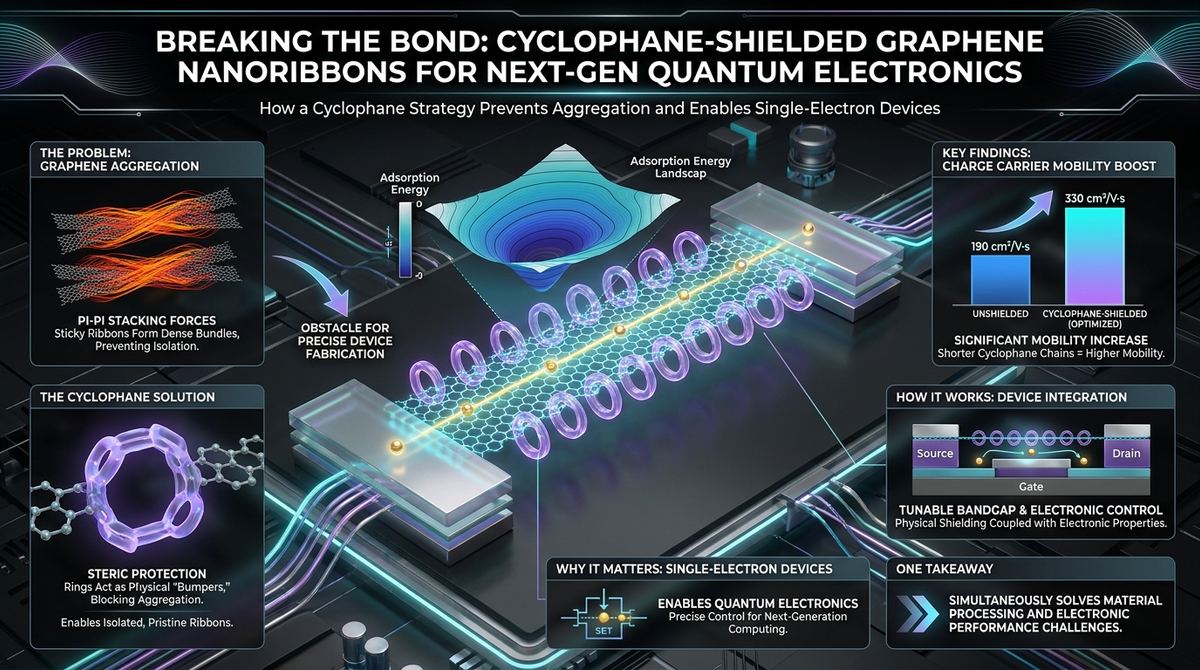
Imagine trying to build a microscopic circuit where the wires are only a few atoms wide. These wires, known as graphene nanoribbons, are the holy grail of nanoelectronics because they can be tuned to conduct electricity in ways that traditional silicon cannot. However, there is a frustrating problem: these ribbons are naturally sticky. Because of their chemical structure, they clump together in large bundles, much like wet sheets of paper sticking to one another. This makes it nearly impossible to place a single, isolated ribbon onto a chip to create the precise quantum devices needed for the next generation of computing.
The Problem This Research Is Solving
The primary obstacle in utilizing graphene nanoribbons for high-performance electronics is the phenomenon of inter-ribbon aggregation. Graphene nanoribbons are essentially long, thin strips of carbon atoms arranged in a hexagonal lattice. Because they possess an extensive system of conjugated pi-electrons, they experience strong attractive forces known as pi-pi stacking. When these ribbons are synthesized and placed in a solution, they naturally gravitate toward one another to minimize their surface energy, forming dense aggregates rather than remaining as individual, isolated strands.
This aggregation is catastrophic for the fabrication of single-ribbon devices. For a device to function as a quantum transistor, it must rely on the intrinsic electronic properties of one single ribbon. When ribbons clump together, the electronic interactions between adjacent strands scramble the signal and destroy the precise bandgap that makes nanoribbons useful in the first place. To date, achieving a stable, singly dispersed state—where each ribbon remains isolated even in concentrated solutions—has been an immense chemical challenge. Without a way to keep these ribbons apart, the potential for creating single-electron transistors and other quantum-scale components remains locked behind a barrier of material instability.
The research conducted by Jin‐Jiang Zhang, Jian Zhang, Guanzhao Wen, Silvio Osella, Zhenlin Qiu, Steffen Böckmann, Xu Wang, Britta Maib, Yubin Fu, Xiuling Yu, Michael Ryan Hansen, Janina Maultzsch, Michel Calame, Mickael L. Perrin, Hai I. Wang, Mischa Bonn, Ji Ma, Klaus Müllen, and Xinliang Feng addresses this exact issue. By rethinking the chemical architecture of the ribbon's edges, they have found a way to create a molecular shield that prevents aggregation while simultaneously improving how electricity flows through the material.
The Key Idea in Plain English
The researchers decided to treat the graphene nanoribbon like a delicate wire that needs an insulating jacket. To do this, they used a structure called a cyclophane. In simple terms, a cyclophane is a ring-shaped molecule that can be fused to the edges of the graphene ribbon. Instead of leaving the ribbon's edges exposed and "sticky," these cyclophane rings act as physical bumpers.
These rings provide steric protection, which is a scientific way of saying they take up space and physically block other ribbons from getting close enough to bond. Think of it like putting small, rigid spheres around a piece of string; the spheres prevent two strings from touching and sticking together. However, these rings do more than just act as spacers. Because they are curved and strained, they actually pull on the graphene backbone, slightly distorting its shape. This subtle internal strain changes the electronic environment of the ribbon, which the researchers discovered actually helps electrons move more efficiently.
How the Graphene-Based System Works
The effectiveness of this system lies in the relationship between the molecular geometry and the electronic band structure. Graphene nanoribbons are semiconductors with a tunable bandgap, meaning the energy required to move an electron from the valence band to the conduction band can be adjusted by changing the ribbon's width or edge structure. When the researchers integrated cyclophane rings into the GNR architecture, they created a system where the physical shielding and the electronic properties were coupled.
The cyclophane rings are attached to the edges of the nanoribbon, creating a three-dimensional shield that extends outward from the flat carbon plane. This prevents the pi-pi stacking mentioned earlier because the rings create a minimum distance that any neighboring ribbon must overcome to interact. Because this repulsion is built directly into the molecule's structure, the ribbons remain singly dispersed in solution, allowing them to be processed and deposited onto substrates with extreme precision.
Beyond the physical spacing, the cyclophanes introduce internal strain into the carbon-carbon bonds of the nanoribbon. In a standard flat graphene sheet, electrons move through a perfectly symmetric lattice. By introducing strain via the cyclophane rings, the researchers modified the overlap of the pi-orbitals. This modification affects the effective mass of the charge carriers—the theoretical "weight" an electron seems to have as it moves through a crystal lattice. By reducing this effective mass, the electrons can accelerate more quickly under an electric field, which directly increases the material's conductivity and efficiency.
What the Researchers Found
Using terahertz spectroscopy, a powerful technique for measuring how electrons move over very short distances, the team discovered a striking correlation between the length of the cyclophane chains and the mobility of the charge carriers. They tested three different versions of these shielded ribbons, denoted as 1a through 1c, which varied in the length of their cyclic chains.
The results showed that as the chain length of the cyclophane shield shortened, the short-range charge carrier mobility increased significantly. Specifically, the mobility rose from 190 to 330 square centimeters per volt-second. This increase is attributed to two primary factors: a reduction in effective mass and an increase in scattering time. In any conductive material, electrons occasionally collide with defects or vibrations in the lattice, a process called scattering. By optimizing the cyclophane structure, the researchers reduced these collisions and lowered the resistance to electron flow.
The most significant practical finding was the successful fabrication of single-electron transistors. Because the ribbons were singly dispersed and could be placed individually on a device, the researchers observed clear Coulomb blockade behavior at low temperatures. The Coulomb blockade is a quantum mechanical effect where the addition of a single electron to a small conductive island requires a significant amount of energy, effectively blocking other electrons from entering. This allows the transistor to act as a switch that can be controlled one electron at a time, which is a fundamental requirement for quantum computing and ultra-low power electronics.
Why the Result Matters
This research is a breakthrough because it solves two problems simultaneously: the material processing problem and the electronic performance problem. Previously, efforts to prevent graphene aggregation often involved adding bulky side-groups that interfered with the ribbon's electronic properties or reduced its conductivity. In this case, the cyclophane shield not only keeps the ribbons apart but actually enhances their ability to transport charge.
The ability to create a solution-processable material that maintains its quantum properties is essential for scaling up nanoelectronics. If we can print or deposit single graphene nanoribbons from a liquid solution onto a circuit, the cost and complexity of manufacturing quantum devices would drop precipitously. Furthermore, the discovery that internal strain can be used to tune carrier mobility provides a new roadmap for engineers. It suggests that we can "dial in" the desired electronic properties of a nanoribbon simply by changing the size and shape of the shielding rings.
Limitations and What Still Needs Testing
While these results are promising, there are several hurdles remaining before this technology enters a commercial phase. First, the observed Coulomb blockade and single-electron transistor behavior occurred at low temperatures. For these devices to be useful in consumer electronics, such as smartphones or laptops, the effects must be stable at room temperature. This would require further shrinking of the ribbon segments or the development of new materials that can maintain quantum coherence in warmer environments.
Additionally, the chemical synthesis of cyclophane-shielded GNRs is a highly complex process. While it works in a controlled laboratory setting, scaling this synthesis to produce kilograms of material with atomic precision is a massive engineering challenge. Future research will need to focus on whether these ribbons maintain their stability over long periods of time and how they interact with different types of dielectric materials used in standard semiconductor fabrication.
Real-World Applications
The most immediate application for this technology is in the realm of quantum computing. Single-electron transistors are the building blocks for qubits and other quantum logic gates. By using cyclophane-shielded GNRs, researchers can create more stable and precise quantum bits that are less prone to the noise caused by material impurities or aggregation.
Beyond computing, this research has implications for ultra-sensitive sensors. Because the electronic properties of these ribbons are so sensitive to their environment and internal strain, they could be used to create sensors capable of detecting a single molecule of a gas or a tiny change in biological markers. The high carrier mobility also makes them candidates for high-frequency transistors that could operate at speeds far exceeding current silicon technology, potentially revolutionizing wireless communications and radar systems.
If You Remember One Thing
The most important takeaway from this research is that the introduction of cyclophane rings serves a dual purpose: it acts as a physical bumper to stop graphene nanoribbons from clumping together and modifies the internal electronic structure to allow electrons to move faster. This combined strategy enables the creation of isolated, single-ribbon devices that can control electricity one electron at a time.
FAQ
What exactly is a graphene nanoribbon?
A graphene nanoribbon is a very thin strip of graphene, which is a single layer of carbon atoms arranged in a honeycomb pattern. Unlike bulk graphene, these ribbons have edges that create a bandgap, allowing them to act as semiconductors which can be turned on and off like a switch in a transistor.
Why do these ribbons clump together?
The flat surfaces of the nanoribbons are rich in pi-electrons, which create a strong attractive force between ribbons. This is similar to how static electricity or surface tension makes things stick; the ribbons naturally want to stack on top of each other to reach a more stable, lower-energy state.
How does the cyclophane shield work?
The cyclophane is a ring-shaped molecule fused to the edges of the ribbon. These rings stick out from the sides, creating a physical barrier that prevents other ribbons from getting close enough to bond. This keeps the ribbons separated in solution, a state called single dispersion.
What is a single-electron transistor?
It is a device so small that its electrical current can be controlled by the movement of individual electrons. This is achieved through the Coulomb blockade effect, where the repulsion between electrons prevents more than one from occupying a small conductive area at a time.
Does this mean we will have graphene computers tomorrow?
Not quite. While the science is a major leap forward, these devices currently require very low temperatures to function as single-electron transistors. Significant work is still needed to make these quantum effects stable at room temperature and to scale the chemical production.
Conclusion
The development of a cyclophane-based shielding strategy represents a sophisticated marriage of organic chemistry and quantum physics. By addressing the fundamental issue of aggregation, the researchers have opened a viable path toward the practical integration of graphene nanoribbons into functional devices. The discovery that structural strain can be leveraged to boost charge carrier mobility further underscores the potential of this approach. As we move toward an era of electronics that operate at the single-electron level, such molecular engineering will be the key to unlocking speeds and efficiencies that were previously thought impossible.