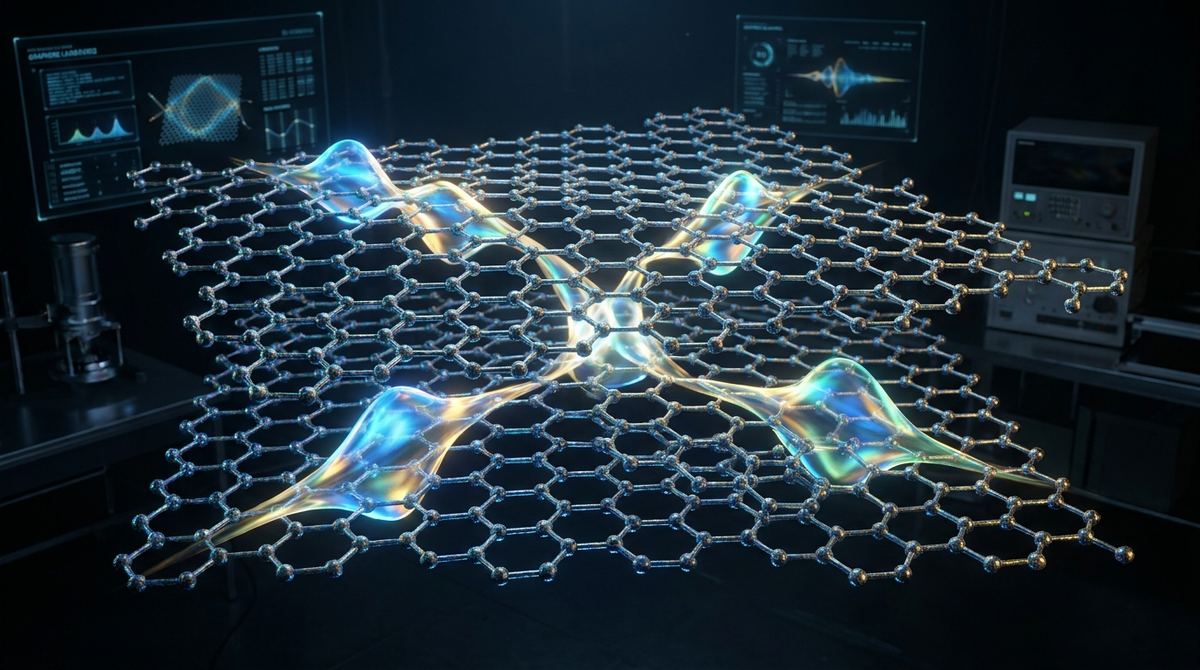
Imagine a material where sound does not simply travel as a wave but twists and knots itself into stable, particle-like packets of energy. These packets would not be disrupted by the usual imperfections in a crystal, allowing them to carry information across a chip without losing energy or coherence. This is the promise of topological phononics, a field that seeks to control vibrations at the quantum level. While traditional materials struggle to host these stable structures, twisted bilayer graphene provides a unique architectural playground where geometry and electronics merge to create entirely new states of matter.
The Problem This Research Is Solving
For decades, scientists have sought ways to create topological excitations in acoustic systems. In simple terms, a topological state is one that is protected by the overall geometry of the system, meaning it cannot be easily undone or destroyed by local disturbances like a stray atom or a small crack in the material. While this has been achieved with electrons in certain insulators, doing the same with phonons—the quantized vibrations of a crystal lattice—is significantly harder. Most materials are too rigid or their internal symmetries are too simple to allow for the complex twisting required to form a topological knot.
The challenge is to find a system where electrons and lattice vibrations are so tightly coupled that they move as a single entity, while also possessing a geometric structure that allows for non-trivial topology. Without this combination, acoustic signals dissipate quickly, and the ability to perform complex operations, such as braiding quasiparticles for quantum computing, remains a theoretical dream. Previous attempts have used artificial photonic or phononic crystals, but these are often bulky and lack the tunable electronic properties needed for high-speed integration.
The Key Idea in Plain English
The solution proposed by Polaris 李 involves taking two sheets of graphene and stacking them, then rotating one slightly relative to the other. This creates a moiré superlattice, which is similar to the shimmering pattern you see when two fine mesh screens are overlaid. At a very specific rotation, known as the magic angle, the electrons in the graphene slow down dramatically, forming what are called flat bands. In these bands, electrons stop acting like independent particles and start interacting strongly with one another and the lattice.
The core innovation is the prediction of a Moiré Phonon Topological Polaron, or MPTP. A polaron is essentially an electron that has distorted the lattice around it, carrying that distortion along as it moves. The MPTP is a special version of this where the distortion takes the form of a topological soliton—a stable, knot-like wave. Because this MPTP is born from the moiré superlattice, it inherits a winding number and a topological charge. This means the MPTP is not just a vibration; it is a geometric object that obeys non-Abelian statistics, meaning the order in which these particles are moved around one another changes the final state of the system.
How the Graphene-Based System Works
To understand how this works, one must look at the interaction between the carbon atoms and the electrons in twisted bilayer graphene. In a single layer of graphene, electrons move with incredible speed. However, when two layers are twisted to the magic angle, the Bistritzer-MacDonald continuum model predicts that the electronic bands flatten. This flattening occurs because the moiré period creates a new, larger unit cell that restricts the electrons' kinetic energy.
When the electronic bands are flat, the coupling between the electrons and the phonons becomes dominant. The researchers describe this using a topological soliton field theory, specifically a phi-6 theory. In this framework, the interaction is so strong that it creates a stable configuration of the lattice vibration that wraps around itself. This wrapping is quantified as a winding number. Because the graphene has two distinct valleys in its electronic structure, the MPTP also carries a valley topological charge.
The system is further refined by the fact that it is a superlattice. The large-scale periodicity of the moiré pattern acts as a guiding structure for these polarons. Because the electrons are strongly correlated in the flat bands, any change in the lattice vibration immediately affects the electronic state and vice versa. This feedback loop is what allows the MPTP to maintain its stability and exhibit non-Abelian U(1) Z2 braiding statistics, a property typically reserved for exotic quasiparticles like Majorana fermions in superconductors.
What the Researchers Found
The theoretical framework developed by Polaris 李 leads to two specific, verifiable experimental signatures that distinguish the MPTP from ordinary acoustic vibrations. The first is a giant nonlinear acoustic resonance peak. In standard materials, sound waves respond linearly to an input of energy. However, the MPTP is predicted to follow a quantized Duffing equation. This means that once the input power reaches a specific threshold, between 1 and 10 Watts, the system will experience a sudden, massive jump in resonance. This resonance would also exhibit frequency hysteresis, where the peak occurs at different frequencies depending on whether the input signal is being swept upward or downward.
The second discovery is the prediction of an acoustic frequency comb. When these topological polarons interact, they generate a series of precisely spaced sidebands in the frequency spectrum. The spacing of these sidebands, denoted as delta-f, is directly proportional to the topological charge of the MPTP and inversely proportional to the moiré superlattice period. This creates a phase-locked system where the frequency spacing is a direct map of the underlying topological structure.
Crucially, these findings are not just theoretical curiosities. The researchers have outlined a protocol using standard laboratory equipment to prove these effects. By using a vector network analyzer and interdigital transducers on a cryostat-cooled sample, the resonance peaks and frequency combs can be measured. Furthermore, because the system is graphene-based, the filling factor of the flat bands can be tuned using a gate voltage. This allows researchers to turn the topological effects on or off, providing a definitive control mechanism that is absent in other candidate materials.
Why the Result Matters
The confirmation of the MPTP would represent a paradigm shift in how we manipulate energy and information at the nanoscale. Currently, most acoustic devices rely on the geometry of the device itself to filter or guide sound. By using topological polarons, we can instead rely on the intrinsic properties of the material's quantum state. This would lead to acoustic waveguides that are immune to defects, as a topological knot cannot be untied by a simple impurity in the carbon lattice.
Beyond communication, this research opens a door to controlling strongly correlated electronic states using sound. Since the MPTP couples phonons and electrons, one could theoretically use acoustic pulses to switch a material between an insulating state and a superconducting state. This provides a new tool for the study of high-temperature superconductivity and other complex quantum phases that appear in moiré systems.
Furthermore, the non-Abelian braiding statistics of the MPTP are highly significant for quantum computing. Most current qubits are fragile and prone to decoherence. Topological qubits, which store information in the braiding patterns of quasiparticles rather than in local electronic states, are theoretically much more stable. The MPTP offers a potential pathway to achieve this braiding using acoustic excitations in a graphene-based platform.
Limitations and What Still Needs Testing
While the theoretical framework is robust, it is important to note that this work provides predictions rather than experimental observations. The existence of the Moiré Phonon Topological Polaron has not yet been captured in a laboratory setting. The primary challenge lies in the precision required to maintain the magic angle across a large enough area of the sample to allow for reliable measurements. Even a fraction of a degree of misalignment can significantly alter the flat-band physics and potentially destroy the topological protection.
Additionally, the requirement for a cryostat indicates that these effects are currently only observable at extremely low temperatures. Thermal fluctuations can easily disrupt the delicate coupling between electrons and phonons, potentially washing out the Duffing resonance or the frequency comb. Future research must determine if these topological states can be stabilized at higher temperatures, perhaps by using different twisting angles or adding a dielectric substrate to modify the interaction strength.
Finally, the power threshold of 1 to 10 Watts mentioned for the resonance peak is relatively high for nanoscale devices. There is a risk that such power levels could induce heating effects that counteract the cooling of the cryostat or lead to the physical degradation of the graphene layers. Testing will need to balance the need for nonlinear excitation with the necessity of maintaining sample integrity.
Real-World Applications
If verified, the MPTP could lead to a new class of topological acoustic sensors with unprecedented sensitivity. Because the frequency comb is tied to the topological charge, any external perturbation that affects the moiré lattice would result in a sharp, detectable shift in the frequency spacing. This could be used to detect single-molecule adsorption or minute changes in local magnetic fields.
In the realm of computing, this could enable topological interconnects. These would be channels through which acoustic information is transmitted without loss or dispersion, regardless of the path's curvature or the presence of defects. This would drastically reduce power consumption in signal processing and allow for denser integration of components on a chip.
Another potential application is the development of quantum acoustic filters. By tuning the gate voltage to change the filling factor, a device could be switched between being transparent and opaque to specific acoustic frequencies. This would allow for the creation of highly efficient, tunable switches for phonon-based logic circuits, moving us closer to a reality where sound is used instead of electricity to perform calculations.
If You Remember One Thing
The most critical takeaway is that twisted bilayer graphene can host a unique quasiparticle called the Moiré Phonon Topological Polaron, which behaves like a stable knot of sound and electricity. This discovery suggests that we can control quantum states using acoustic vibrations, potentially leading to defect-immune signal processing and new methods for topological quantum computing.
FAQ
What exactly is a moiré superlattice in graphene?
A moiré superlattice occurs when two layers of graphene are stacked and rotated by a small angle. This rotation causes the hexagonal patterns of the two layers to overlap in a way that creates a new, larger-scale periodic pattern. This larger structure changes how electrons move through the material, creating a landscape of energy peaks and valleys that do not exist in single-layer graphene.
What is the difference between a phonon and a polaron?
A phonon is simply a quantized vibration of the atoms in a crystal lattice, essentially a packet of sound energy. A polaron occurs when an electron moves through a material and creates a local distortion in the lattice around it. The electron and its accompanying cloud of phonons move together as a single quasiparticle. A topological polaron, like the MPTP, is one where this distortion takes a stable, knotted geometric form.
Why is the magic angle so important?
The magic angle is a specific rotation, typically around 1.1 degrees, where the electronic bands of the twisted bilayer graphene become almost completely flat. In these flat bands, electrons lose their kinetic energy and start interacting with each other much more strongly. This strong correlation is what allows the electrons to couple effectively with phonons and form the topological structures predicted in this research.
How do researchers plan to prove these theories?
The researchers suggest using a vector network analyzer and interdigital transducers to send acoustic waves into the twisted graphene sample. They are looking for two specific signatures: a sudden jump in resonance at a certain power level (the Duffing peak) and a precisely spaced series of frequencies (the frequency comb). If these are observed, it would provide strong evidence for the existence of MPTPs.
Can this technology be used in smartphones or laptops today?
No, the technology is currently in the theoretical and early experimental stages. It requires extremely low temperatures and precise atomic-scale alignment of graphene layers, which is not possible with current mass-manufacturing techniques. However, the principles discovered here could eventually inform the design of future quantum computers or ultra-efficient sensors.
Conclusion
The work led by Polaris 李 pushes the boundaries of how we perceive the relationship between geometry, sound, and electricity. By leveraging the unique properties of twisted bilayer graphene, this research proposes a method to create and control topological excitations that were previously thought to be impossible in acoustic systems. While the transition from theoretical prediction to experimental reality remains a challenge, the potential rewards are immense. The ability to engineer Moiré Phonon Topological Polarons would not only deepen our understanding of condensed matter physics but also provide the building blocks for a new era of topological quantum technologies.