
Designing Sound Barriers: The Power of Graphene-Inspired Twisted Phononic Crystals
Discover how a twisted bilayer structure inspired by graphene can be used to create phononic crystals that block low-frequency vibrations and sound waves.
Imagine a world where the vast quantities of plant starch available from corn, potatoes, and cassava can be converted into pure glucose with almost zero waste and minimal environmental impact. While this process sounds simple, achieving it efficiently on an industrial scale is a significant chemical challenge. Most traditional methods rely on liquid acids that are corrosive, dangerous to handle, and nearly impossible to recover once the reaction is finished. The quest for a sustainable alternative leads us to the intersection of advanced carbon materials and molecular clusters, where a new type of hybrid catalyst is showing immense promise for green chemistry.
The conversion of biomass into valuable chemicals is a cornerstone of the emerging bio-economy. Starch, a complex polymer of glucose, is one of the most abundant renewable resources on Earth. However, breaking these long chains down into individual glucose molecules—a process known as hydrolysis—typically requires a catalyst. In the past, researchers have relied heavily on homogeneous catalysts, which are substances dissolved in the same phase as the reactants. While effective, these liquid catalysts create a nightmare for chemical engineers because they cannot be easily separated from the final product. This leads to significant waste, expensive purification steps, and the risk of contaminating the resulting glucose with corrosive acid residues.
To solve this, scientists seek heterogeneous catalysts, which are solid materials that can be filtered out of the reaction mixture and reused. The challenge is that many solid catalysts lack the necessary balance of acidity and redox activity to break starch bonds efficiently without destroying the glucose in the process. Many catalysts are either too weak, leading to low conversion rates, or too aggressive, which creates unwanted side products like furfural. Langson Chilufya, Bright Chilikwazi, Beraat Umur Kaya, and Mehtap Emirdag‐Eanes have addressed this gap by designing a sophisticated nanohybrid material that combines the catalytic power of polyoxometalates with the structural advantages of graphene oxide.
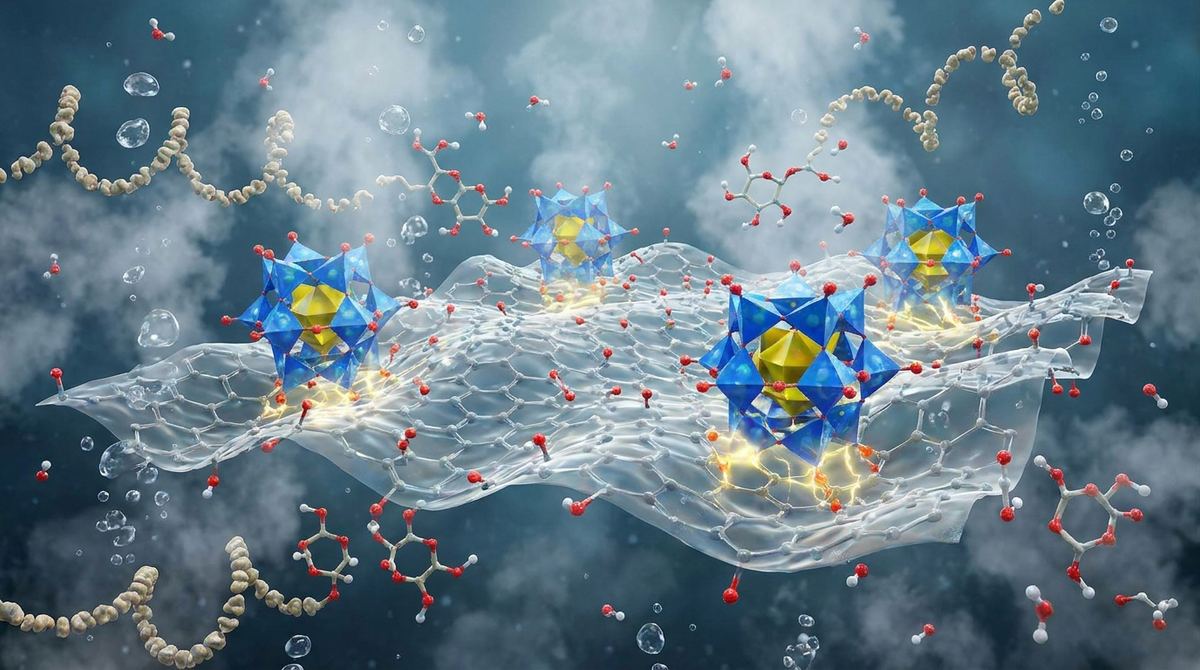
The researchers focused on a class of materials called Polyoxometalates, or POMs. Think of a POM as a tiny, inorganic molecular cage made of metal and oxygen atoms. These cages are incredibly versatile because they can act as both a strong acid and an oxidizing agent simultaneously. Specifically, the team used a copper-substituted Keggin POM, which is a specific structural arrangement of tungsten and phosphorus atoms with a copper atom tucked inside. While these POMs are powerful, they are typically soluble in water, meaning they would behave like the problematic homogeneous catalysts mentioned earlier.
The breakthrough comes from anchoring these POM cages onto a sheet of graphene oxide. Graphene oxide is a single-atom-thick layer of carbon decorated with oxygen groups like hydroxyls and carboxyls. By chemically bonding the POM clusters to the graphene oxide surface, the researchers created a solid-state catalyst. The graphene oxide acts as a high-surface-area platform that keeps the POM clusters spread out and accessible, preventing them from clumping together. This transformation turns a soluble molecular catalyst into a robust, solid-phase material that can be easily recovered from the reaction vessel after the starch has been converted to glucose.
The effectiveness of this system is not just due to the presence of both materials, but rather the specific way they interact at the atomic level. The researchers used a process called ball milling to create the nanohybrid. During ball milling, high-energy mechanical forces push the POM clusters into intimate contact with the graphene oxide sheets. This process ensures that the Bp-PCuW11 catalyst is firmly anchored to the GO support, which prevents the POM from leaching into the solution during the hydrothermal reaction.
The chemistry of graphene oxide is crucial here. Unlike pure graphene, which is chemically inert, graphene oxide is covered in oxygen-containing functional groups. These groups create a polar environment that interacts favorably with the POM clusters, providing stable anchoring points through electrostatic interactions and hydrogen bonding. Furthermore, these oxygen defects on the graphene surface create an interface that facilitates the movement of protons. In starch hydrolysis, the reaction depends on the ability of protons to attack the glycosidic bonds that hold glucose units together. The synergy between the acidic nature of the POM and the oxygen-rich surface of the GO creates a high concentration of active sites where protons can be efficiently transferred to the starch molecules.
Moreover, the copper substitution within the POM adds a redox dimension to the catalysis. The presence of copper helps in stabilizing transition states during the hydrolysis process, which lowers the activation energy required to break the polymer chains. This means the reaction can proceed more quickly and at lower temperatures than would be possible with simple acid catalysts. The graphene oxide also improves the accessibility of the substrate; its two-dimensional structure allows large starch molecules to lay flat against the surface, ensuring that more of the POM active sites are in direct contact with the starch polymer.
When put to the test under optimized hydrothermal conditions, the Bp-PCuW11/GO nanohybrid demonstrated remarkable efficiency. The researchers observed a starch conversion rate of 92 percent, meaning nearly all the raw material was successfully processed. Even more impressive was the selectivity of the reaction. In chemical catalysis, selectivity is everything; it describes the catalyst's ability to produce one specific product without creating a mixture of unwanted by-products. This system achieved a selectivity of 95 percent for glucose, indicating that the catalyst was precisely tuned to break the starch chains without over-reacting and degrading the glucose into other sugars or carbonaceous char.
The final yield of glucose was 82 percent, a high figure for a heterogeneous system. To validate these results, the team employed Density Functional Theory simulations. These computer models allowed them to visualize the electronic interactions between the POM and the graphene oxide. The simulations confirmed that the enhanced performance was a direct result of the synergistic acid-redox behavior. The model showed that the GO support does not just hold the POM in place but actively participates by modulating the electronic environment, making the proton transfer more efficient.
Durability is another key finding. One of the primary advantages of a solid catalyst is the ability to reuse it. The researchers found that the Bp-PCuW11/GO catalyst maintained its performance over five consecutive recycling runs. This stability suggests that the anchoring provided by the ball milling process is strong enough to withstand the pressures and temperatures of hydrothermal synthesis without significant loss of active material.
This research is a significant step forward for sustainable chemistry because it provides a blueprint for designing catalysts that are both highly efficient and environmentally friendly. By replacing liquid mineral acids with a recyclable solid catalyst, the process eliminates the need for neutralizing agents and reduces the production of salty wastewater. The high selectivity toward glucose is particularly important because it simplifies the downstream purification process, reducing the energy required to isolate the final product.
Beyond the specific conversion of starch, this work demonstrates a broader principle in material science: the power of hybridizing inorganic molecular clusters with carbon nanomaterials. The ability to tune the electronic properties of a catalyst by choosing a specific metal substitution in a POM and pairing it with a functionalized carbon support opens the door to a wide range of other biomass valorization reactions. This could include the conversion of cellulose into biofuels or the transformation of lignin into high-value aromatic chemicals, all while maintaining a low environmental footprint.
While the results are impressive, it is important to note that this research was conducted at a laboratory scale. Transitioning from small-batch hydrothermal reactions to industrial-scale continuous flow reactors presents several challenges. One primary concern is the long-term stability of the catalyst over dozens or hundreds of cycles, rather than just five. Over time, the mechanical stresses of industrial processing could potentially dislodge the POM clusters from the graphene oxide surface.
Additionally, the study focused on a specific type of starch. Real-world biomass is rarely pure; it often contains proteins, lipids, and other minerals that could act as catalyst poisons. Testing the Bp-PCuW11/GO system against crude biomass extracts would be a necessary next step to determine if the catalyst remains selective and active in the presence of impurities. There is also a need to explore the cost-effectiveness of ball milling as a production method for large quantities of these nanohybrids to ensure the process is economically viable compared to existing industrial methods.
The most immediate application for this technology is in the production of bio-based glucose, which serves as a primary feedstock for various industries. This includes the fermentation of glucose into bio-ethanol or bio-butanol, which are sustainable alternatives to petroleum-based fuels. Furthermore, glucose is a starting material for the synthesis of biodegradable plastics, such as polylactic acid, which helps reduce global plastic pollution.
In the pharmaceutical and food industries, the ability to produce high-purity glucose with minimal chemical waste is highly desirable. This catalytic system could be integrated into a green manufacturing pipeline for the production of vitamin C or other glucose-derived health supplements. Because the catalyst is solid and easily removable, it ensures that the final food or medical grade products are free from metallic or acidic contaminants.
If you take away one key point from this research, it is that the combination of copper-substituted polyoxometalates and graphene oxide creates a synergistic effect where the carbon support does more than just hold the catalyst—it actively enhances the movement of protons and electrons, allowing for the highly selective and efficient conversion of starch into glucose.
What exactly is a Polyoxometalate?
A polyoxometalate, or POM, is a molecular cluster consisting of early transition metals coordinated to oxygen atoms. They are often described as inorganic cages that can mimic the behavior of enzymes, providing both acidic and redox-active sites in a single molecule.
Why is graphene oxide better than regular graphene for this?
Regular graphene is chemically stable and lacks the functional groups needed to bond with other molecules. Graphene oxide contains oxygen-rich groups like hydroxyls and carboxyls, which act as chemical handles that allow the POM clusters to anchor firmly to the surface.
What does selectivity mean in this context?
Selectivity refers to the catalyst's ability to produce one specific molecule, in this case, glucose, without creating other unwanted sugars or chemical by-products. High selectivity is crucial because it makes the final product purer and easier to refine.
How does ball milling help in making the catalyst?
Ball milling is a high-energy mechanical process that uses grinding balls to smash materials together. In this research, it provided the necessary force to embed the POM clusters onto the graphene oxide sheets, creating a strong physical and chemical bond.
Is this technology ready for use in factories today?
While the results are very promising, the research is currently at the laboratory stage. Further testing on larger scales and with impure biomass sources is required before it can be implemented in industrial factories.
The development of the Bp-PCuW11/GO nanohybrid represents a sophisticated marriage of inorganic chemistry and nanotechnology. By leveraging the unique structural properties of graphene oxide to stabilize and enhance the activity of copper-substituted Keggin POMs, researchers have created a tool capable of transforming renewable biomass into valuable energy and chemical precursors. This study not only solves a practical problem regarding catalyst recovery and selectivity but also provides a framework for future innovations in sustainable catalysis, moving us closer to a circular economy where waste is minimized and resources are utilized with maximum efficiency.
Serious about B2B integration? Test our premium Pulsed Electrical Resistive Carbon Heating turbostratic graphene in your lab. 100g sample packs available now.
Explore More
Discover how a twisted bilayer structure inspired by graphene can be used to create phononic crystals that block low-frequency vibrations and sound waves.

Researchers explore the integration of graphene and high-performance substrates to create tunable, high-gain X-band radar antennas for next-generation satellite communications.

Discover how a new microwave-assisted synthesis of graphene and copper nanoparticles creates a point-to-plane bridging architecture that dramatically improves thermal conductivity in polymer composites.