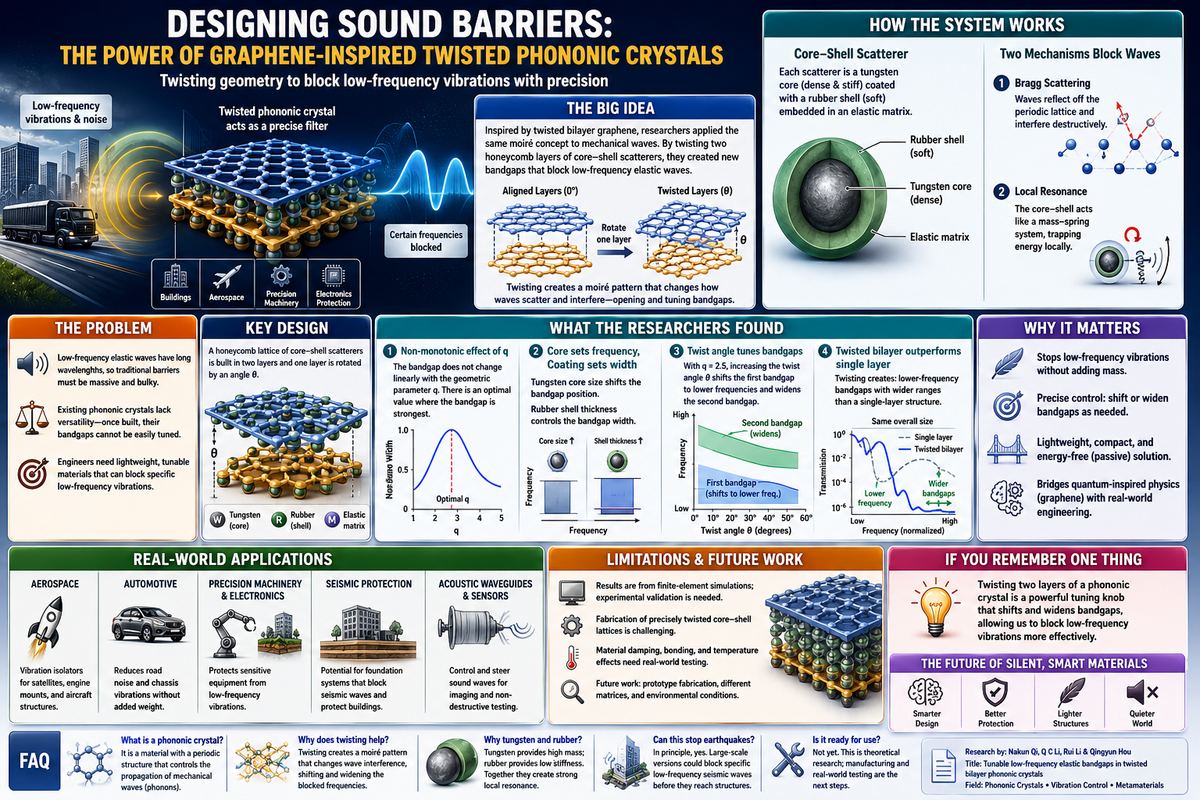
Imagine a material that can act as a precise filter for mechanical vibrations, allowing some frequencies to pass through while completely blocking others. While we are familiar with how noise-canceling headphones block sound using electronics, scientists are now designing physical materials that can do this passively. This is the realm of phononic crystals, which are engineered structures designed to control the propagation of elastic waves. For a smart non-specialist, this research is essentially about building a better wall—one that does not just rely on thickness or mass, but on a sophisticated internal geometry to stop low-frequency noise and vibrations that would otherwise shake a building or disrupt sensitive electronics.
The Problem This Research Is Solving
Low-frequency elastic waves are notoriously difficult to manage because they possess long wavelengths. In the world of acoustics and vibration control, if you want to block a wave using traditional methods, your barrier typically needs to be proportional in size to the wavelength of that wave. For very low frequencies, this means creating structures that are prohibitively large and heavy, making them impractical for use in aerospace components, precision machinery, or urban architectural shielding.
The challenge lies in creating a bandgap, which is a range of frequencies where waves simply cannot propagate through the material. While existing phononic crystals can achieve this, they often lack versatility. Many designs are limited by their fixed geometry, meaning that once a material is manufactured, its frequency-blocking capabilities cannot be easily adjusted. There is a pressing need for design strategies that allow engineers to tune these bandgaps—shifting their position or widening their range—without drastically increasing the overall size of the system. This is where the concept of twisted bilayers comes into play, providing a new geometric lever to manipulate sound.
The Key Idea in Plain English
To solve this problem, Nakun Qi, Q C Li, Rui Li, and Qingyun Hou looked toward the world of nanotechnology for inspiration. Specifically, they drew from the phenomenon seen in twisted bilayer graphene. In the electronic world, when two layers of graphene are stacked and then rotated slightly relative to one another, a moiré pattern emerges. This pattern fundamentally changes how electrons behave, leading to the discovery of entirely new physical properties like superconductivity.
The researchers applied this same logic to mechanical waves instead of electrons. They designed a phononic crystal consisting of two layers of a honeycomb lattice. Each lattice is populated with scatterers made of a dense core and a soft shell. By rotating one layer against the other, they created a mechanical version of the moiré effect. This twisting changes the way elastic waves scatter and interfere as they move through the material, allowing the researchers to open or widen bandgaps at low frequencies. Essentially, they found that by simply twisting the architecture of the material, they could change which vibrations the material blocks.
How the Graphene-Based System Works
The system is built upon a composite architecture known as a core-shell scatterer. In this specific design, the researchers used tungsten for the core and rubber for the shell, all embedded within an elastic matrix. The choice of materials is critical because of the extreme difference in their physical properties. Tungsten is incredibly dense and stiff, while rubber is compliant and soft. This creates a massive impedance mismatch at the interfaces between the core, the shell, and the matrix.
When an elastic wave hits these scatterers, it does not simply pass through. Instead, the heavy tungsten core acts as a mass and the rubber shell acts as a spring. This creates a local resonance where energy is trapped and oscillated within the scatterer rather than being transmitted through the material. When these scatterers are arranged in a periodic honeycomb lattice, two mechanisms work together to block sound: Bragg scattering and local resonance. Bragg scattering occurs when waves reflect off the periodic arrangement of the lattice and interfere destructively, while local resonance happens at the individual scatterer level.
By stacking two of these honeycomb layers and twisting them, the researchers introduced a new variable into the equation. The twist angle alters the distance between scatterers across the two layers and changes the symmetry of the overall structure. This modification forces the elastic waves to follow more complex paths, which increases the interaction between the layers and allows for the creation of bandgaps at much lower frequencies than a single layer could achieve.
What the Researchers Found
The study focused on how different geometric parameters influenced the resulting bandgaps. One of the most important findings involved the parameter q, which relates to the geometric scaling of the system. The researchers discovered that the relationship between q and the bandgap is non-monotonic. This means that increasing q does not simply make the bandgap wider or shift it in one direction; instead, there is an optimal value for q where the bandgap characteristics are most pronounced.
Furthermore, they found a clear division of labor between the core and the coating. Specifically, the size of the tungsten core primarily dictates the frequency position of the bandgap, while the thickness of the rubber coating controls the width of that gap. This is a vital discovery because it gives engineers two separate knobs to turn: if they need to block a different frequency, they adjust the core; if they need to block a wider range of frequencies, they adjust the coating.
The most striking result came from the twist angle. When the researchers set q to 2.5 and began rotating the layers, they observed that twisting significantly modified the bandgap structure. As the angle changed, the first low-frequency bandgap shifted toward even lower frequencies, which is highly desirable for noise control. Simultaneously, the second bandgap widened considerably. This proves that twisting provides an additional degree of freedom for tuning the material, allowing for a level of precision in wave manipulation that is not possible with non-twisted structures.
Why the Result Matters
The ability to tune low-frequency bandgaps through a simple geometric rotation is a game-changer for material science. Most traditional soundproofing relies on adding mass, which leads to bulky and inefficient designs. This research proves that we can achieve superior wave suppression through structural intelligence rather than raw material volume. By utilizing the twisted bilayer approach, designers can create lightweight, compact materials that are specifically tailored to block the exact frequencies of a particular noise source.
Moreover, this work bridges the gap between high-level quantum physics concepts and practical mechanical engineering. By taking a concept from graphene—a material measured in atoms—and applying it to phononic crystals that can be manufactured at a macroscopic scale, the researchers have opened a new pathway for designing meta-materials. This suggests that other patterns found in nature or at the atomic scale could potentially be scaled up to solve engineering problems involving sound, heat, and vibration.
Limitations and What Still Needs Testing
While the results are promising, it is important to note that this research was primarily conducted using finite-element calculations and computer simulations. The study provides a theoretical roadmap, but the physical fabrication of such a complex twisted bilayer structure presents significant challenges. Precisely aligning tungsten-rubber core-shell scatterers in a rotated honeycomb lattice requires high manufacturing precision, and any deviation from the intended geometry could alter the bandgap characteristics.
Additionally, the simulations may not fully account for all real-world variables. For instance, the internal damping of rubber—the way it naturally absorbs energy over time—and the bonding strength between the tungsten and the rubber shell could influence how waves actually behave in a physical prototype. Future research will need to focus on the experimental validation of these models, testing how different types of elastic matrices and varying environmental temperatures affect the stability and efficiency of the bandgaps.
Real-World Applications
The practical applications for this technology are vast. In the aerospace industry, these twisted phononic crystals could be used to create ultra-lightweight vibration isolators for satellite components or engine mounts, protecting sensitive hardware from low-frequency rumble. In the automotive sector, they could be integrated into chassis designs to eliminate road noise and improve passenger comfort without adding significant weight to the vehicle.
Beyond transportation, this technology has immense potential for seismic protection. If scaled up to a larger size, the principles of twisted bilayer lattices could be used to design foundation systems for buildings in earthquake-prone regions. By creating a massive phononic crystal beneath a structure, engineers could potentially block the specific low-frequency seismic waves that cause buildings to collapse. Additionally, this research could lead to the development of advanced acoustic waveguides, which can steer sound waves around corners or focus them onto a specific point for medical imaging or non-destructive testing of materials.
If You Remember One Thing
If you take away one key point from this research, it is that twisting two layers of a material can act as a powerful tuning knob for blocking sound. By applying the logic of twisted bilayer graphene to mechanical structures, researchers have found a way to shift and widen frequency bandgaps, allowing us to stop low-frequency vibrations more effectively than ever before.
FAQ
What exactly is a phononic crystal? A phononic crystal is an engineered material designed to control the movement of phonons, which are essentially quantized mechanical vibrations or sound waves. By arranging materials with different densities and stiffnesses in a repeating pattern, these crystals can block certain frequencies from passing through.
Why is tungsten and rubber used together? Tungsten provides a very high mass density, while rubber provides low stiffness. This combination creates a strong local resonance when a wave hits the structure, which helps trap the vibration and prevents it from traveling further through the material.
How does twisting the layers help block more sound? Twisting changes the spatial arrangement and symmetry of the scatterers. This creates a moiré-like pattern that modifies how waves reflect and interfere with each other, which can shift the blocked frequencies lower or make the blocked range wider.
Is this technology ready to be used in homes today? No, this research is currently at the computational and theoretical stage. While the simulations are highly accurate, creating these complex twisted structures on a commercial scale requires further engineering and testing of physical prototypes.
Can this be used to stop earthquakes? In theory, yes. Since earthquakes produce low-frequency elastic waves, a large-scale version of this twisted lattice could act as a seismic filter, blocking the dangerous frequencies from reaching the foundation of a building.
Conclusion
The exploration of twisted bilayer configurations marks a significant leap forward in the design of low-frequency phononic crystals. By integrating the dense properties of tungsten with the flexibility of rubber in a graphene-inspired geometry, Nakun Qi and their team have demonstrated that structural rotation is a viable method for tuning elastic wave propagation. This shift toward geometric intelligence allows for the creation of materials that are not only more effective at blocking noise and vibration but also more customizable. As we move from simulation to physical implementation, the potential for these twisted structures to revolutionize everything from noise-canceling architecture to seismic shielding becomes increasingly clear.