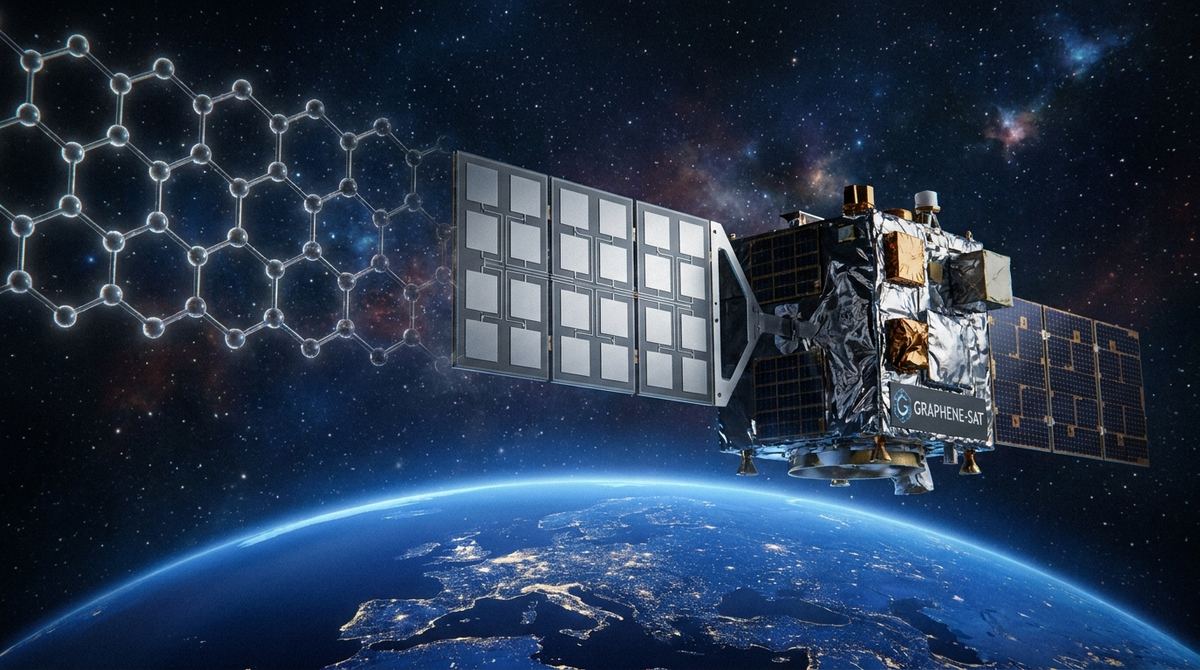
Imagine if a satellite orbiting thousands of miles above Earth could change how it listens and speaks to the ground without moving a single mechanical part. In the world of radar and telecommunications, antennas are typically static pieces of metal designed to operate at one specific frequency. If you want to change that frequency or optimize the signal in real-time, you usually need complex hardware or physical adjustments. However, a new frontier in material science is opening the door to antennas that can be tuned electronically. By leveraging the unique properties of graphene, scientists are developing radar systems that are not only more efficient but also adaptable to the harsh and shifting conditions of space.
The Problem This Research Is Solving
Modern satellite radar systems, particularly those operating in the X-band frequency range around 10 GHz, require extreme precision and high radiation efficiency to be useful for imaging and communication. The primary challenge lies in the materials used to build these antennas. For decades, copper has been the gold standard for conductivity, and FR-4 (a glass-reinforced epoxy laminate) has been the standard substrate. While these materials are cheap and reliable, they have inherent limitations that hinder high-performance satellite applications.
Copper is a fixed conductor; its electrical properties do not change regardless of the environment or external signals. This means that once a copper antenna is manufactured, its resonance frequency and impedance are locked in. Furthermore, standard substrates like FR-4 suffer from high dielectric losses at higher frequencies. This means that a significant portion of the electromagnetic energy intended for transmission is instead absorbed by the substrate and converted into heat, which reduces the overall gain and efficiency of the radar system. To achieve the high-resolution imaging required for modern satellite missions, researchers needed to find a way to reduce these losses while introducing a mechanism for tunability.
This critical search for efficiency and flexibility led MOHAMMED ZAKARYA BABA-AHMED, RAHMA DJAOUDA TALEB, MOHAMMED AMIN RABAH, ASMA BEKHTI, and RANIA MERZOUK to investigate the intersection of advanced dielectric substrates and graphene-based conducting layers.
The Key Idea in Plain English
The core idea of this research is to replace or augment traditional antenna materials with graphene and high-performance plastics to create a more efficient, adjustable radar system. A patch antenna is essentially a thin piece of conductive material sitting on top of an insulating base, known as the substrate. The researchers discovered that by choosing a specific high-end substrate called Rogers RT5880, they could significantly reduce the energy wasted as heat.
Even more exciting is the use of graphene. Unlike copper, graphene's ability to conduct electricity can be changed on the fly by altering its chemical potential. Think of chemical potential as a dial that controls how many electrons are available to move across the material's surface. By turning this dial, the researchers can change the electrical characteristics of the antenna without changing its physical size. This creates a reconfigurable antenna that can be optimized for better performance depending on the specific needs of the satellite radar system.
How the Graphene-Based System Works
To understand how this system functions, we must look at the physics of surface conductivity. In a traditional copper antenna, electrons flow through a bulk metal with a fixed resistance. Graphene, however, is a single layer of carbon atoms arranged in a hexagonal honeycomb lattice. This two-dimensional structure allows electrons to move with incredibly high mobility, but it also makes the material sensitive to external influences.
The researchers focused on the concept of chemical potential, which relates to the Fermi level of the graphene. By adjusting this potential, they can effectively increase or decrease the density of charge carriers within the graphene sheet. When the chemical potential is increased, more electrons become available for conduction, which increases the surface conductivity of the patch. Because the resonance frequency of an antenna depends on its electrical length and conductivity, changing the chemical potential allows the researchers to shift the antenna's operating point. This means the antenna can be tuned to maintain an optimal impedance match with the feed line, ensuring that maximum power is radiated into space rather than reflecting back into the system.
The choice of substrate plays an equally vital role in this process. The substrate acts as the foundation that supports the conductive patch and influences how electromagnetic waves propagate. FR-4 is a common material, but its high dielectric constant and loss tangent make it inefficient for X-band frequencies. The researchers utilized Rogers RT5880, a polytetrafluoroethylene (PTFE) based material. This substrate has a much lower loss tangent, meaning it does not absorb nearly as much electromagnetic energy as FR-4. By combining the low-loss environment of Rogers RT5880 with the tunable conductivity of graphene, the researchers created a system where energy is directed precisely where it needs to go.
What the Researchers Found
The study utilized CST Microwave Studio for complex simulations, which were then validated through experimental measurements. One of the most significant findings was the stark difference in performance between the two substrates tested. The Rogers RT5880 substrate consistently outperformed FR-4 across every critical metric. Specifically, the antennas built on RT5880 exhibited a much better reflection coefficient and a lower Voltage Standing Wave Ratio (VSWR). A low VSWR is crucial because it indicates that most of the power delivered to the antenna is actually being radiated, rather than reflecting back toward the source and potentially damaging the electronics.
When moving from a single antenna element to an array, the results became even more impressive. The researchers developed a four-element antenna array designed to focus the radar beam and increase the overall signal strength. This configuration achieved a remarkable gain of 11.82 dBi at the target frequency of 10 GHz. This increase in gain is a direct result of the constructive interference created by the four synchronized patches, which directs the electromagnetic energy into a narrower, more powerful beam.
Furthermore, the comparison between graphene and copper revealed that while copper is an excellent conductor, graphene provides a level of flexibility that copper simply cannot match. The simulations showed that by modulating the chemical potential, the graphene antenna could be tuned to achieve optimal performance across a range of conditions. This confirms that graphene is not just a substitute for copper, but an upgrade that enables new functionalities in antenna design.
Why the Result Matters
The ability to achieve high gain and low reflection at 10 GHz is essential for the next generation of satellite radar. In practical terms, higher gain means that a satellite can detect smaller objects on the Earth's surface or communicate over longer distances with less power. This is critical for environmental monitoring, disaster response, and military surveillance, where the clarity of a radar image can be the difference between success and failure.
Moreover, the introduction of tunability through graphene solves a long-standing engineering trade-off. Usually, if you want an antenna to be efficient at multiple frequencies or under different atmospheric conditions, you have to make it larger or add heavy mechanical tuning components. Graphene allows for electronic tuning, which reduces the weight and complexity of the satellite payload. Since every gram of weight added to a satellite increases launch costs significantly, moving toward lightweight, reconfigurable materials like graphene is a major economic and technical win.
Limitations and What Still Needs Testing
While the results are promising, it is important to note that this research is currently in the simulation and experimental validation phase. The transition from a controlled laboratory environment to the vacuum of space presents several challenges. One primary limitation is the stability of the graphene's chemical potential over long periods. Maintaining a precise level of doping or gate voltage in the extreme temperature swings of orbit is a significant engineering hurdle that requires further study.
Additionally, while the four-element array showed great success, scaling this up to larger arrays with hundreds of elements will introduce complex challenges in feed-network design and power distribution. The researchers have proven the concept for a small-scale system, but the long-term durability of graphene coatings under intense solar radiation and atomic oxygen exposure in low Earth orbit remains an open question. Future testing must focus on the material's degradation over time to ensure that the tunability does not fade after a few months in space.
Real-World Applications
The implications of this research extend far beyond simple satellite radar. In the realm of deep-space exploration, these tunable antennas could allow probes to adapt their communication frequencies as they move further from Earth or encounter different planetary atmospheres. This would ensure a stable data link even when the environment changes unpredictably.
On Earth, this technology could revolutionize 5G and future 6G telecommunications. Base stations equipped with graphene-based reconfigurable antennas could dynamically shift their beams to follow users in real-time, drastically increasing network capacity and reducing interference. Additionally, this research has potential applications in stealth technology; an antenna that can change its electromagnetic signature by altering its chemical potential could theoretically be used to make aircraft or satellites less detectable to enemy radar.
If You Remember One Thing
If there is one key takeaway from this research, it is that the combination of graphene's tunable electrical properties and high-performance substrates like Rogers RT5880 allows for the creation of radar antennas that are both more efficient and more flexible than traditional copper-based designs. By changing the chemical potential of graphene, we can effectively tune the antenna's performance without needing to move any physical parts.
FAQ
What exactly is a patch antenna?
A patch antenna consists of a flat, conductive piece of material, called the patch, mounted on top of a non-conductive insulating layer known as the substrate. It is widely used in satellite and mobile communications because it is low-profile, lightweight, and relatively easy to manufacture.
Why was Rogers RT5880 better than FR-4?
FR-4 is a common, inexpensive material used in circuit boards, but it absorbs too much electromagnetic energy at high frequencies, which wastes power. Rogers RT5880 is a specialized PTFE-based material with much lower loss, meaning it allows the antenna to radiate more energy and achieve a higher gain.
How does graphene's chemical potential change the antenna?
Chemical potential refers to the energy level of the electrons in graphene. By adjusting this, researchers can increase or decrease the number of available charge carriers, which changes how well the graphene conducts electricity. This change in conductivity alters the antenna's electrical characteristics, allowing it to be tuned to different frequencies.
What is a four-element antenna array?
Instead of using one single patch, an array combines multiple antennas to work together. By coordinating four elements, the researchers were able to focus the radiated energy into a tighter beam, which significantly increased the gain and signal strength compared to a single antenna.
Is this technology ready for commercial satellites today?
While the simulated and experimental results are highly successful, this work is currently a proof-of-concept. Further testing on material longevity in space and the development of stable methods to control chemical potential are necessary before these antennas can be deployed on commercial satellites.
Conclusion
The work conducted by MOHAMMED ZAKARYA BABA-AHMED and his team represents a significant leap forward in the quest for adaptable satellite communications. By moving away from the static nature of copper and the inefficiency of standard substrates, they have demonstrated a viable path toward high-gain, reconfigurable X-band radar systems. As we continue to push the boundaries of space exploration and global connectivity, the integration of two-dimensional materials like graphene will likely become a cornerstone of how we transmit data across the cosmos.