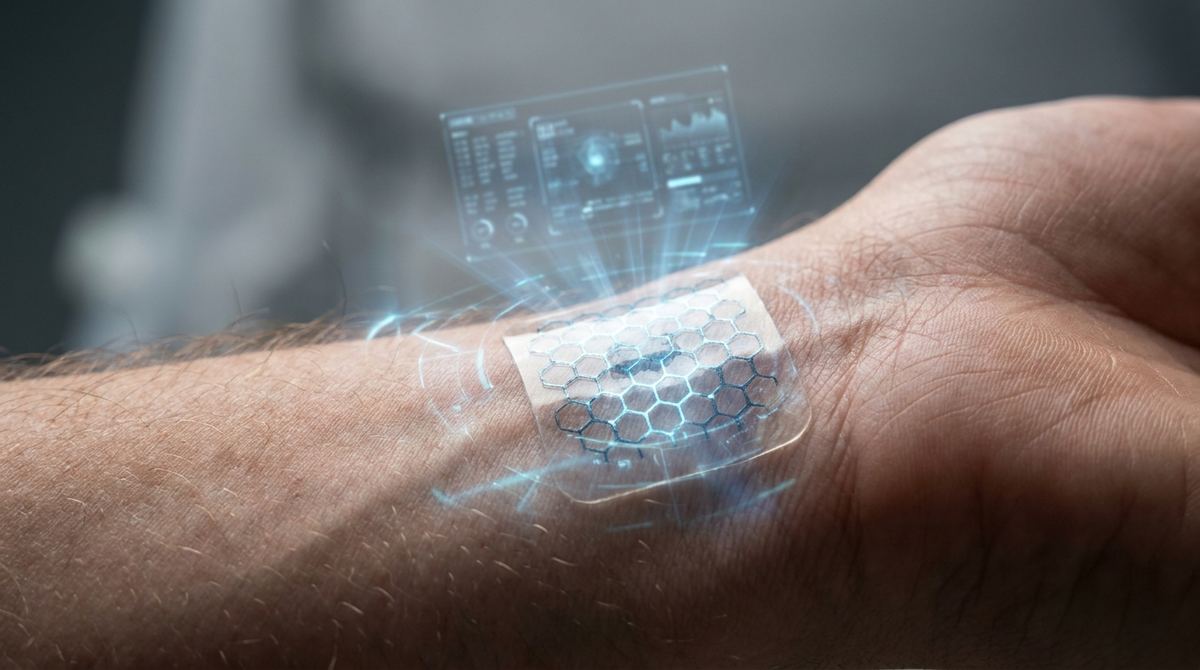
Imagine a world where your clothing or a thin, transparent patch on your skin could feel a pulse as faint as a whisper or detect the subtle shift in pressure when a joint moves by a fraction of a millimeter. For decades, medical monitoring has relied on rigid electrodes and bulky equipment that often struggle to maintain consistent contact with the irregular, shifting surfaces of the human body. This gap between hard electronics and soft biology creates signal noise and discomfort for the patient. The promise of digital skin—a flexible, breathable interface capable of high-fidelity sensing—has long been a goal of bioengineering, but achieving the necessary sensitivity and stability has required a material that is both incredibly conductive and structurally resilient.
The Problem This Research Is Solving
The fundamental challenge in wearable health technology is the mismatch between traditional electronic materials and human tissue. Most high-performance sensors are made from rigid semiconductors or metals that do not bend without breaking or losing their electrical properties. When these rigid sensors are placed on skin, they create gaps; as the wearer moves, the sensor lifts away from the body, leading to intermittent data and inaccurate readings. To solve this, researchers need a material that can conform perfectly to complex surfaces while maintaining an extremely high sensitivity to pressure.
Yezhen Yuan, Zhihao He, and Yanqing Feng have addressed this by focusing on the fabrication of flexible graphene sensors and the integration of these units into a comprehensive array detection system. The problem they are tackling is not just the creation of a single sensor, but the scaling of that technology into an array that can map pressure across a wider area in real time. By moving from individual points of data to a spatial map, it becomes possible to monitor complex physiological signals and mechanical stresses with much higher precision than previously possible with standard flexible polymers.
The Key Idea in Plain English
The core idea behind this research is to use graphene as the active sensing element because of its unique two-dimensional structure. Graphene is a single layer of carbon atoms arranged in a honeycomb lattice, which gives it extraordinary electrical conductivity and mechanical strength. By incorporating graphene into a flexible matrix, the researchers created a material that changes its electrical resistance when it is squeezed or stretched.
Instead of relying on a solid wire that simply bends, these sensors rely on a network of graphene flakes. When pressure is applied, these flakes are pushed closer together, allowing electricity to flow more easily across the material. The researchers then connected these individual sensing points into a grid or array, linked to an Arduino microcontroller and MATLAB software. This allows the system to translate physical pressure into a visual map of data on a computer screen in real time, effectively creating a high-resolution electronic skin.
How the Graphene-Based System Works
To understand why this system is so sensitive, one must look at the physics of the tunneling phenomenon and seepage threshold theory. In a traditional conductor, electrons flow through a continuous path of atoms. However, in a graphene composite sensor, the conductive flakes are not always in direct physical contact. They are separated by thin layers of an insulating polymer. According to quantum mechanics, electrons can tunnel through these thin insulating barriers even if there is no direct physical connection. This tunneling effect is extremely sensitive to the distance between the conductive particles.
As external pressure is applied to the sensor, the distance between the graphene flakes decreases. Because the probability of electron tunneling increases exponentially as the gap narrows, a tiny change in pressure leads to a massive change in electrical conductivity. This creates a high-gain response, meaning the sensor can detect incredibly faint physiological signals, such as a light pulse or a subtle muscle twitch, which would be invisible to sensors that rely on simple mechanical contact.
Complementing this is the seepage threshold theory, also known as percolation theory. In this context, there is a critical concentration of graphene needed for the material to transition from an insulator to a conductor. By carefully controlling the amount of graphene used during fabrication, the researchers ensure the material operates near this threshold. When the system is at the edge of percolation, any slight deformation caused by pressure can create new conductive pathways or break existing ones, causing a significant and measurable shift in resistance. The high surface area of the two-dimensional graphene flakes ensures that there are ample opportunities for these connections to form, maximizing the overall sensitivity of the array.
The hardware side of the system utilizes an Arduino-based detection circuit. The sensors act as variable resistors; as pressure changes, the voltage across the sensor shifts. The Arduino reads this analog voltage and converts it into a digital signal. This data is then streamed to MATLAB, which processes the raw numbers into a visual heat map. This allows the user to see not just that pressure is being applied, but exactly where it is occurring across the array and with what intensity.
What the Researchers Found
The researchers successfully demonstrated a complete pipeline from material fabrication to data visualization. They found that by utilizing graphene’s unique structural properties, they could create sensors that were both flexible enough to wrap around human skin and sensitive enough to capture low-magnitude signals. The integration of the Arduino and MATLAB systems provided a robust method for real-time acquisition, proving that the theoretical sensitivity of graphene translates effectively into a functional electronic system.
The study confirmed that the combined effects of tunneling and percolation allow for a linear and predictable response over specific pressure ranges, which is critical for calibrating medical devices. The array format allowed for spatial resolution, meaning the system could distinguish between different points of contact across the sensor surface. This represents a significant jump from single-point sensors to a systemic monitoring approach, providing a technical foundation for how high-performance medical arrays should be constructed and read.
Why the Result Matters
This research is pivotal because it bridges the gap between material science and clinical application. By proving that graphene can be scaled into an array system with real-time feedback, the work moves graphene from being a laboratory curiosity to a practical tool for intelligent medical engineering. The ability to precisely capture faint physiological signals without interfering with the patient's movement is a requirement for the next generation of wearable health monitors.
Furthermore, the use of open-source hardware like Arduino and widely used software like MATLAB provides a blueprint that other researchers can easily replicate and build upon. This accelerates the development cycle for medical devices. If we can accurately map pressure in real time across a flexible surface, we can develop systems that monitor everything from blood flow in extremities to the gait and balance of patients recovering from neurological injuries.
Limitations and What Still Needs Testing
While the results are promising, this system is currently a technical prototype and is not yet ready for commercial medical use. One primary limitation is the long-term stability of the graphene composite. In many flexible sensors, there is an issue known as hysteresis, where the material does not immediately return to its original electrical state after the pressure is released. This can lead to "ghost" readings or a drift in data over time, which would be unacceptable in a critical care medical setting.
Additionally, the research focuses on the fabrication and detection logic but does not fully address environmental interference. Factors such as ambient temperature shifts and humidity levels can affect the conductivity of graphene and the elasticity of the polymer matrix, potentially introducing noise into the signal. Future testing must focus on encapsulation techniques to protect the sensors from moisture and sweat, as well as rigorous durability tests to see how many thousands of bend-and-stretch cycles the array can withstand before the conductive network begins to degrade.
Real-World Applications
The potential applications for this graphene array system are vast. In a clinical setting, these sensors could be integrated into smart bandages that monitor the healing process of chronic wounds by detecting subtle changes in tissue pressure and inflammation. They could also be used in neonatal care to monitor the vital signs of premature infants without using adhesives or rigid probes that might damage fragile skin.
Beyond direct healthcare, this technology has immense potential for prosthetic development. By creating a graphene-based electronic skin for prosthetic limbs, engineers can provide users with a sense of touch. The array would allow the user to feel the difference between a firm grip and a light touch, translating physical pressure into signals that could eventually be interfaced with the human nervous system. It could also be used in sports medicine to analyze the biomechanics of an athlete's movement in real time, identifying imbalances in pressure distribution during running or jumping to prevent injuries before they occur.
If You Remember One Thing
The most important takeaway is that graphene transforms a simple flexible patch into a high-precision instrument by utilizing quantum tunneling and percolation theory. By allowing electrons to jump across microscopic gaps, the system can detect incredibly faint pressures and map them in real time, creating a bridge between soft human biology and hard digital data.
FAQ
What exactly is graphene and why is it used here? Graphene is a single layer of carbon atoms arranged in a hexagonal pattern. It is used because it is one of the most conductive materials known to science and is incredibly strong yet flexible, making it ideal for sensors that must bend with human skin while maintaining electrical signals.
How does pressure change the electricity in the sensor? The sensor works through the tunneling phenomenon. When you press on the material, the graphene flakes move closer together. This makes it easier for electrons to jump or tunnel across the insulating gaps, which lowers the electrical resistance and tells the computer that pressure is being applied.
What is the role of the Arduino in this system? The Arduino acts as the translator. It takes the analog electrical signals from the graphene sensors—which are just changing voltages—and converts them into digital data that a computer can understand and process.
Is this technology currently available for purchase as a medical device? No, this research describes a fabrication process and a prototype detection system. While it proves the concept is possible, it still requires further testing regarding durability and environmental shielding before it becomes a commercial product.
Can these sensors detect things other than pressure? While this specific study focuses on pressure, graphene's high sensitivity to its environment means that similar arrays could potentially be modified to detect chemical changes, temperature shifts, or electrical activity from muscles and nerves.
Conclusion
The work by Yuan, He, and Feng represents a significant step forward in the integration of two-dimensional materials into wearable electronics. By combining the quantum mechanical advantages of graphene with a scalable array architecture, they have demonstrated a way to capture high-fidelity physiological data without sacrificing flexibility. While challenges regarding long-term stability and environmental shielding remain, the transition from single sensors to a real-time detection system provides a critical framework for future medical engineering. As we move toward a future of personalized, continuous health monitoring, the ability to create an electronic skin that is as sensitive as it is supple will be indispensable.