Imagine a smartphone battery that lasts for days or an electric vehicle that travels hundreds of miles further on a single charge without increasing the size of the battery pack. For years, the materials science community has looked toward silicon as the holy grail for this leap in energy density. Silicon can hold significantly more lithium ions than the graphite used in today's batteries, meaning it can store far more energy in the same amount of space. However, there is a physical catch that has kept silicon trapped in the laboratory: it swells like a sponge when it absorbs lithium. This massive expansion causes the material to crack and crumble, leading to rapid battery failure.
To solve this, researchers including Weiqi Cao, Hongjiang Mou, Zhan Jin, Majid Shaker, Hua Yu, and Kostya S. Novoselov have turned to an unexpected source for inspiration. By borrowing a technique from the biomedical field known as microjet technology, they have developed a way to produce high-quality graphene that can act as a structural reinforcement for silicon anodes. This transdisciplinary approach allows them to create a hybrid material that balances high energy storage with long-term physical stability, potentially clearing a major hurdle on the path toward commercializing silicon-based batteries.
The Problem This Research Is Solving
The primary obstacle in battery design is the mechanical instability of silicon during lithiation. When lithium ions enter the silicon lattice during charging, the material expands by as much as three hundred percent. This volume expansion creates immense internal stress, causing the silicon particles to pulverize or break apart. Once the particles crack, they lose electrical contact with the rest of the battery, which effectively kills the capacity of the cell.
Beyond the physical breakage, there is a chemical problem involving the Solid Electrolyte Interphase, or SEI. The SEI is a protective layer that forms on the anode surface during the first few charge cycles. In a stable graphite battery, this layer is thin and permanent. However, in silicon batteries, every time the particle expands and contracts, the SEI layer cracks open. This exposes fresh silicon to the electrolyte, which then reacts to form more SEI. This continuous consumption of the electrolyte not only depletes the battery's internal chemistry but also creates a thick, insulating crust that blocks lithium ions from moving efficiently, drastically lowering the initial Coulombic efficiency.
While ball milling is a common industrial method used to mix silicon and carbon to mitigate these issues, it often presents a trade-off between yield and quality. High-yield production via ball milling typically results in low-quality materials with too many defects or poor structural integrity, which prevents the battery from reaching its theoretical potential.
The Key Idea in Plain English
The researchers decided to stop trying to fix the silicon problem using only traditional battery chemistry tools. Instead, they looked at biomedical microjet technology. In medicine, microjets are used for precise delivery of fluids or cells. In this research, the team repurposed this high-velocity fluid movement to synthesize multilayer graphene sheets that are both high in quality and cost-effective to produce.
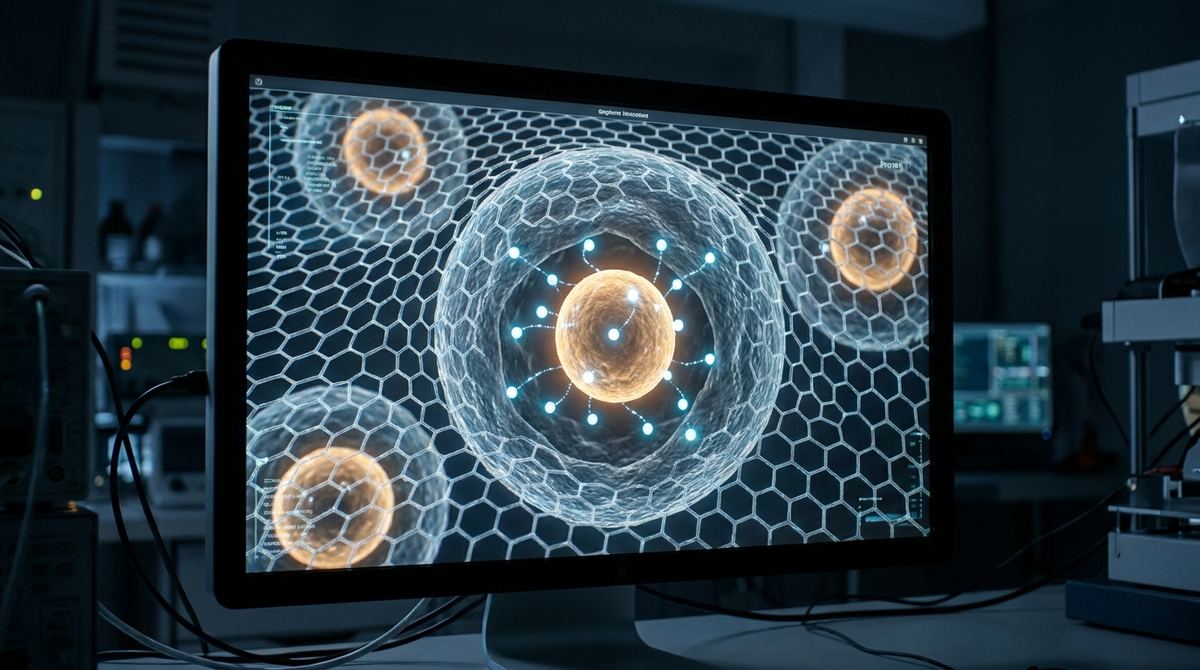
The core idea was to create a dual-layer protection system. Rather than just mixing silicon with carbon, they designed a structure where the silicon is first encapsulated in an amorphous carbon shell and then supported by a framework of these microjet-synthesized graphene sheets. Think of it as putting the silicon inside a flexible rubber ball (the carbon shell) and then placing those balls inside a strong, conductive carbon cage (the graphene). This combination ensures that the silicon can expand internally without breaking the outer structure or exposing the rest of the battery to the volatile expansion process.
How the Graphene-Based System Works
The effectiveness of this system lies in the synergy between the amorphous carbon shell and the graphene framework. To understand why this works, one must look at the electrical and mechanical interfaces of the anode.
Graphene is a single layer of carbon atoms arranged in a hexagonal lattice, renowned for its extraordinary electrical conductivity and mechanical strength. By integrating high-quality multilayer graphene into the ball-milled silicon process, the researchers created an interconnected network that acts as an electrical highway. In traditional silicon-carbon anodes, electrons must jump across gaps between fragmented particles, which increases internal resistance. The graphene framework eliminates these gaps by providing a continuous path for electrons to reach the silicon particles rapidly.
The amorphous carbon shell serves a different but complementary purpose. It acts as the first line of defense, creating a physical barrier between the silicon and the liquid electrolyte. This prevents the electrolyte from decomposing directly on the silicon surface. When the silicon expands, the amorphous carbon layer absorbs some of the mechanical strain.
Because the graphene framework wraps around these coated particles, it controls the growth of the SEI layer. Instead of the SEI forming haphazardly and growing thicker with every cycle, the graphene stabilizes the interface. This ensures that the SEI remains thin and uniform. A thinner SEI reduces the resistance that lithium ions face when migrating from the electrolyte into the anode, which directly improves the speed of charging and the overall efficiency of the battery.
What the Researchers Found
The results of this hybrid approach showed a significant leap in performance compared to standard silicon-carbon anodes produced without graphene support. The researchers measured the initial Coulombic efficiency, which represents how much of the energy put into the battery during the first charge is actually recoverable. Their graphene-supported anode achieved an initial Coulombic efficiency of ninety-two point nine seven percent, a seventeen percent increase over the version without graphene.
In terms of raw capacity, the difference was even more striking. At a discharge rate of one-third C, the graphene-enhanced anode delivered a capacity of sixteen hundred and twenty-two milliampere hours per gram. This represents a forty-eight percent increase in capacity compared to the standard silicon-carbon mix. This jump is attributed to the fact that more silicon remains electrically connected and active throughout the process, rather than breaking off and becoming dead weight.
To prove this worked in a real-world format, the team built a pouch cell using NCM811 as the cathode and their new graphene-silicon composite as the anode. This cell delivered an areal capacity of seven milliampere hours per square centimeter and an energy density of three hundred and ten watt-hours per kilogram. These figures indicate that the material outperforms several commercial batteries currently on the market, proving that the microjet-synthesized graphene provides a tangible advantage in energy storage density.
Why the Result Matters
This research is important because it solves a production paradox. Usually, if you want high-quality graphene to stabilize silicon, you have to use expensive and slow methods like chemical vapor deposition, which are not feasible for mass-producing batteries. If you want high yield, you use ball milling, but you sacrifice the quality of the carbon.
By introducing the microjet synthesis method, the researchers found a way to get both high quality and high yield. This suggests that we can move toward silicon anodes without needing an impossibly expensive manufacturing process. Furthermore, the transdisciplinary nature of the work—applying biomedical fluid dynamics to materials science—opens the door for other industries to borrow tools from one another to solve stubborn engineering problems.
From a consumer perspective, this means the path to batteries that last longer and charge faster is becoming more realistic. The ability to maintain high Coulombic efficiency in a silicon anode reduces the amount of lithium lost during the first few cycles, meaning the battery starts its life with more usable energy and maintains that energy for longer.
Limitations and What Still Needs Testing
While the results are promising, it is important to note that this research was conducted in a controlled laboratory setting. Moving from a pouch cell in a lab to millions of batteries in cars requires scaling the microjet synthesis process to an industrial level. It remains to be seen if the consistency of the graphene quality can be maintained when producing tons of material rather than grams.
Additionally, while the initial capacity and efficiency are high, long-term cycling stability over thousands of charges is a critical metric for commercial viability. The abstract highlights the initial performance, but real-world batteries must survive years of daily use. Further testing is needed to ensure that the graphene framework does not eventually fatigue or degrade under the constant stress of silicon's expansion and contraction over several hundred cycles.
Real-World Applications
The most immediate application for this technology is in the electric vehicle market. Increasing energy density allows manufacturers to either shrink the battery pack to reduce vehicle weight or keep the size the same while extending the range of the car. This directly addresses range anxiety, one of the biggest hurdles to EV adoption.
Beyond cars, high-capacity silicon-graphene anodes could revolutionize portable electronics. Smartphones and tablets could become thinner without sacrificing battery life, or they could maintain their current size but last for several days on a single charge. Wearable technology, such as smartwatches and medical implants, would also benefit from the increased energy density, as these devices have very strict limits on how much physical space can be allocated to the battery.
If You Remember One Thing
The key takeaway is that by using biomedical microjet technology to create high-quality graphene, researchers have created a conductive cage for silicon anodes. This cage prevents silicon from crumbling during charging and stops the buildup of an insulating layer, resulting in a battery with significantly higher capacity and efficiency than traditional silicon-carbon designs.
FAQ
What exactly is the SEI layer mentioned in the research?
The Solid Electrolyte Interphase is a thin film that forms on the anode surface when it first touches the liquid electrolyte. While a stable SEI is necessary to protect the anode, if it grows too thick or keeps breaking and reforming because the silicon is expanding, it consumes the battery's energy and blocks the flow of lithium ions.
Why is silicon better than graphite for batteries?
Silicon can hold significantly more lithium ions per atom than graphite can. This theoretical capacity means that a silicon anode can store much more electricity in the same volume as a graphite anode, leading to batteries with higher energy density.
What is the role of the amorphous carbon shell?
The amorphous carbon shell acts as a primary protective coating around the silicon particles. It prevents the electrolyte from reacting directly with the silicon and provides an initial layer of mechanical cushioning that helps manage the physical expansion of the silicon.
How does microjet technology differ from standard graphene production?
Standard high-quality graphene often requires expensive vacuum chambers or chemical processes. Microjet technology uses high-velocity fluid dynamics, a method borrowed from biomedical research, to produce multilayer graphene sheets more efficiently and cost-effectively while maintaining high structural quality.
Is this battery ready to be put into my phone today?
Not yet. While the pouch cell results are impressive and outperform some commercial batteries, the process still needs to be scaled up for mass production and tested for long-term durability over thousands of charge cycles before it can enter the consumer market.
Conclusion
The integration of microjet-synthesized graphene into silicon anodes represents a sophisticated solution to one of the most stubborn problems in energy storage. By creating a synergistic system where an amorphous carbon shell handles the immediate interface and a graphene framework provides mechanical stability and electrical conductivity, Weiqi Cao and his colleagues have significantly boosted both the capacity and efficiency of silicon anodes. This research proves that the answer to complex materials science problems often lies in looking across disciplines, using tools from medicine to unlock the full potential of next-generation batteries. As this technology moves toward industrial scaling, it brings us one step closer to a future of high-capacity, long-lasting energy storage.