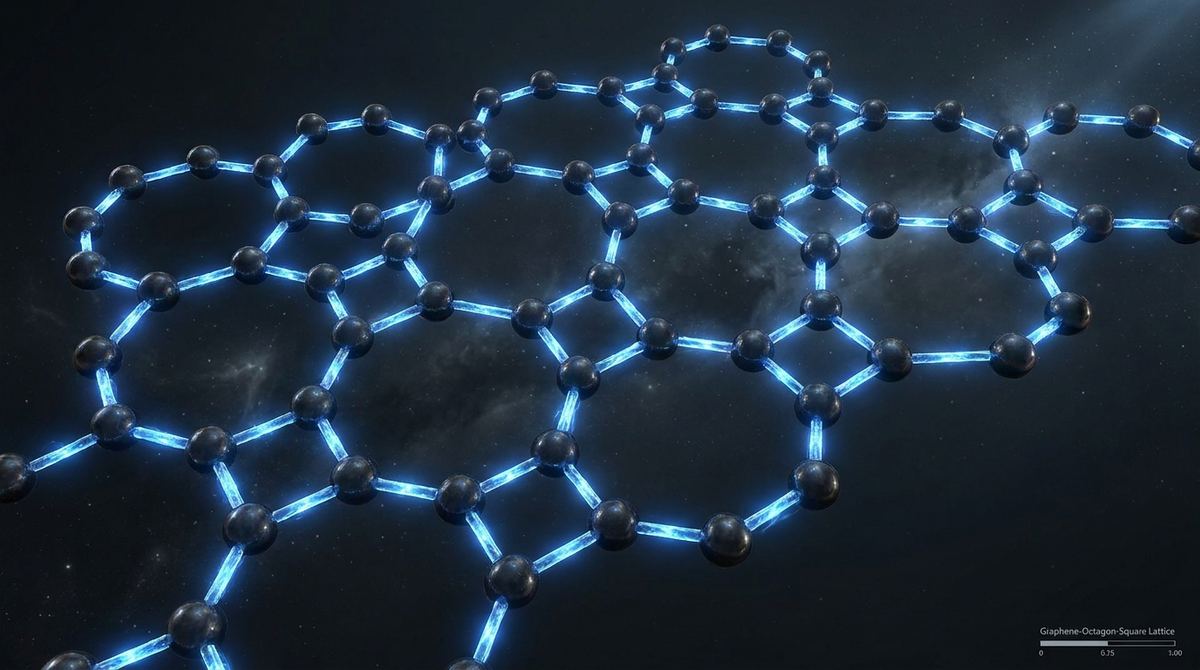
Imagine if we could predict the physical strength, electrical conductivity, and chemical reactivity of a new material simply by treating its atomic structure like a mathematical puzzle. In the world of nanotechnology, building a new material atom by atom is an incredibly slow and expensive process. To accelerate this, scientists use theoretical chemistry to map out the geometry of a molecule before it ever exists in a physical lab. By converting the arrangement of atoms into numerical values, researchers can determine if a structure will be stable or if it will collapse under its own tension. This approach allows us to design materials for specific purposes, such as creating a battery that charges in seconds or a drug delivery vehicle that can slide perfectly into a human cell.
The Problem This Research Is Solving
The primary challenge in material science is the gap between theoretical possibility and physical realization. While standard graphene, with its famous honeycomb hexagonal lattice, has transformed our understanding of conductivity, it is not the only way to arrange carbon atoms. There are countless other geometric configurations, such as those featuring squares or octagons, that could potentially offer better properties for specific tasks. However, calculating the stability and electronic behavior of these complex nanosheets through traditional trial-and-error experimentation is inefficient.
In their work, Vikram R. and Maheswari V. address this problem by applying topological characterization to a specific class of materials known as Octa Graphene. The core issue they are solving is the need for a quantitative method to describe the structural behavior of these nanosheets without needing to synthesize every variation in a laboratory. By focusing on bond additive topological indices, the researchers aim to create a mathematical bridge that links the geometric shape of the carbon lattice to its actual physical properties. Without this characterization, engineers would have no way of knowing how changing a square to an octagon in the lattice would affect the material's ability to conduct electricity or hold a medicinal payload.
The Key Idea in Plain English
The central idea behind this research is that the shape of a molecule dictates its destiny. In chemistry, topology is the study of connectivity. Instead of looking at the exact distance between atoms in nanometers, topological indices look at how atoms are connected to one another. Think of it like a subway map. To understand if the city is well-connected, you do not need to know the exact mileage of every track; you only need to know which stations connect to which other stations and how many lines meet at each hub.
By treating Octa Graphene as a mathematical graph where atoms are points and bonds are lines, the researchers can calculate specific indices based on the degree of each vertex. The degree is simply the number of bonds attached to a single atom. When you sum these degrees across the entire sheet using bond additive methods, you get a numerical value that serves as a structural fingerprint. This fingerprint allows scientists to predict whether the material will be stable and how it will vibrate or conduct electrons based solely on its geometric symmetry and connectivity.
How the Graphene-Based System Works
Octa Graphene differs from standard graphene in its fundamental architecture. While standard graphene consists of repeating hexagons, Octa Graphene is composed of a periodic arrangement of octagons and squares. This shift in geometry fundamentally alters the electronic environment of the carbon atoms. In a hexagonal lattice, electrons move across a very uniform landscape. In a square-octagon lattice, the varying bond angles and ring sizes create a different distribution of electron density.
The system works by leveraging the relationship between structural symmetry and energy. The researchers analyze Octa Grayphyne and Octa Graphdine, which are variations of these nanosheets. These materials utilize different types of bonding, such as sp-hybridized carbon atoms, which can introduce linear chains or triple bonds into the structure. This change in hybridization affects the orbital overlap between atoms. Because electrons reside in these orbitals, any change in the geometric arrangement of the octagons and squares directly changes the bandgap of the material. The bandgap is the energy difference that determines whether a material acts as an insulator, a semiconductor, or a conductor.
The bond additive topological indices specifically quantify how these connections are distributed. By calculating these indices, the researchers can model the vibrational properties of the sheet. Vibration in a crystal lattice is essentially the movement of heat and sound. If the topological index suggests a highly rigid and symmetric structure, the material will likely have specific thermal conductivity profiles, which are essential for preventing overheating in nano-electronic devices.
What the Researchers Found
The study successfully computed the bond additive topological indices for Octa Graphene and its derivatives, providing a quantitative map of their structural behavior. The findings indicate that the periodic arrangement of octagons and squares creates a unique stability profile that differs significantly from purely hexagonal sheets. By using degree-based concepts, the researchers were able to derive mathematical expressions that describe the molecular properties of these nanostructures.
Specifically, the results suggest that the stability of Octa Grayphyne and Octa Graphdine is closely linked to their topological indices. The researchers found that certain bond additive patterns correlate with higher structural integrity. This means that by optimizing the ratio of squares to octagons through mathematical modeling, one can theoretically design a nanosheet that is more resistant to mechanical deformation.
Furthermore, the research highlighted how these topological characteristics influence electronic properties. Because the indices provide a way to quantify the complexity and connectivity of the lattice, they offer insights into how electrons will migrate across the sheet. The findings suggest that Octa Graphene structures can be tuned to have specific electronic signatures, making them potentially more versatile than standard graphene for applications where precise control over conductivity is required.
Why the Result Matters
These results are significant because they move us closer to a library of custom-designed carbon materials. In traditional electronics, we use silicon because its properties are predictable. If we can use topological indices to make Octa Graphene just as predictable, it opens the door to a new generation of semiconductors. The cause-and-effect relationship here is clear: by controlling the geometry (the squares and octagons), we control the electronic bandgap, which in turn allows us to create transistors that are smaller and faster than those made from silicon.
In the realm of medicine, the structural findings are equally critical. Drug delivery depends on surface chemistry and pore size. The Octa Graphene lattice creates specific voids and surface curvatures that differ from the flat plane of standard graphene. This geometric difference affects how molecules adhere to the surface. If a drug molecule fits perfectly into the topological void of an Octa Graphene sheet, it can be transported more efficiently through the bloodstream and released more precisely at a target site.
Additionally, the insights into vibrational properties matter for thermal management. As devices shrink to the nanoscale, heat dissipation becomes a massive failure point. The ability to predict vibrational behavior via topological indices allows engineers to design heat sinks or conductive paths that move energy away from sensitive components more efficiently, preventing the device from melting during high-performance tasks.
Limitations and What Still Needs Testing
While this research provides a powerful mathematical framework, it is important to note that this study is primarily computational. The calculations provide a theoretical blueprint, but they do not constitute physical proof of synthesis. There is a significant difference between a structure being mathematically stable on a computer and being synthesizable in a chemical vapor deposition chamber.
One major limitation is the lack of experimental validation. We do not yet know if Octa Graphene can be produced at scale without introducing defects. In real-world materials, atoms often shift or missing bonds occur, which would change the topological index and, consequently, the material's properties. The current models assume a perfect periodic unit cell, but nature is rarely perfect.
Furthermore, the biological compatibility of these specific octagonal structures has not been tested in vivo. While the geometry suggests potential for drug delivery, the toxicity and metabolic breakdown of Octa Grayphyne or Octa Graphdine inside a human cell remain unknown. Extensive biocompatibility testing and synthesis trials are required before these materials can move from a mathematical paper to a medical clinic.
Real-World Applications
The most immediate application lies in nano-battery technology. The unique void spaces created by the square-octagon arrangement could allow for faster ion transport compared to denser structures. If lithium ions can migrate more freely through the lattice without getting trapped, the result is a battery that charges and discharges much faster while maintaining a high energy density.
In nano-electronics, these materials could be used to create field-effect transistors with tunable bandgaps. By adjusting the topological structure of the sheet, engineers could theoretically create a material that switches between conducting and insulating states more efficiently than current semiconductors, leading to computers that consume less power and generate less heat.
Finally, in cellular drug delivery, the specific surface area and geometric curvature of Octa Graphene could be used as a scaffold for targeted therapy. By chemically attaching medication to the octagonal rings, researchers could create a delivery system that recognizes specific cell membranes based on shape-matching, reducing side effects by ensuring the drug only enters diseased cells.
If You Remember One Thing
If you take away one central point from this research, it is that mathematics can act as a microscope for materials that have not yet been built. By using bond additive topological indices to turn an atomic structure into a number, scientists like Vikram R. and Maheswari V. can predict the stability and electronic behavior of Octa Graphene, effectively shortening the road from theoretical physics to real-world technology.
FAQ
What exactly is Octa Graphene?
Octa Graphene is a two-dimensional carbon nanosheet where the atoms are arranged in a repeating pattern of squares and octagons rather than the hexagons found in regular graphene. This unique geometry changes how the material interacts with electricity and chemicals.
How do topological indices help scientists?
Topological indices simplify complex 3D atomic structures into single numerical values. These numbers allow researchers to compare different materials quickly and predict properties like stability and conductivity without having to build every version in a lab first.
Why are octagons and squares better than hexagons for some uses?
Hexagons are great for general strength and conductivity, but the square-octagon mix creates different electronic gaps and surface voids. This makes Octa Graphene potentially better for things like trapping drug molecules or controlling specific electrical currents.
Is this material already being used in smartphones or medicine?
No, this research is currently at the theoretical and computational stage. While it shows great potential, the materials still need to be synthesized in labs and tested for safety and scalability before they can be used in commercial products.
What is the difference between Octa Graphene, Grayphyne, and Graphdine?
These are variations of carbon nanosheets that use different types of chemical bonds. While they all share a similar topological layout of octagons and squares, some use triple bonds or linear carbon chains to alter their stiffness and electronic properties.
Conclusion
The bridge between abstract mathematics and tangible material science is where the most exciting breakthroughs in nanotechnology occur. By applying bond additive topological characterization to Octa Graphene, this research provides a critical roadmap for future discovery. The ability to quantify structural behavior through degree-based indices allows us to move beyond the limitations of standard graphene and explore a wider variety of carbon geometries. While experimental synthesis and biological testing remain the next great hurdles, the theoretical foundation laid here ensures that when we do build these materials, we will do so with a precise understanding of how they will behave. As we continue to refine these mathematical tools, the transition from silicon-based electronics to custom-tailored carbon nanosheets becomes not just possible, but inevitable.