For decades, the primary method of escaping Earth's gravity has remained fundamentally unchanged since the mid-twentieth century: we burn massive amounts of chemical propellant to create thrust. This approach is inherently limited by the rocket equation, where the weight of the fuel required to lift the fuel itself creates a diminishing return on efficiency. However, a shift toward solid-state electrodynamic propulsion could rewrite the rules of aerospace engineering. By replacing combustion with the manipulation of plasma and magnetic fields, we move from the era of the rocket into the era of the magnetohydrodynamic drive.
The Problem This Research Is Solving
The central challenge in modern aerospace is the inefficiency of chemical propellants. Traditional rockets are largely fuel tanks with small payloads attached; they are often single-use or require immense infrastructure to refurbish. Furthermore, the violent nature of combustion creates extreme thermal and vibrational stress on airframes, limiting the types of materials that can be used and the comfort levels for human passengers. For long-range interplanetary logistics, such as establishing a permanent presence on Mars, relying on chemical boosters is unsustainable due to the mass penalties associated with transporting fuel across the void of space.
In his research, Ilgiz Murtazin addresses these limitations by proposing a vehicle that does not rely on internal combustion. Instead, the goal is to create a system capable of zero-combustion vertical liftoff and interplanetary transit. This requires solving three primary engineering hurdles: generating enough thrust-to-weight ratio to lift hundreds of metric tons without fuel, managing the immense electrical energy required for such a feat, and ensuring the structural integrity of the vehicle against the extreme magnetic stresses generated by superconducting systems.
The Key Idea in Plain English
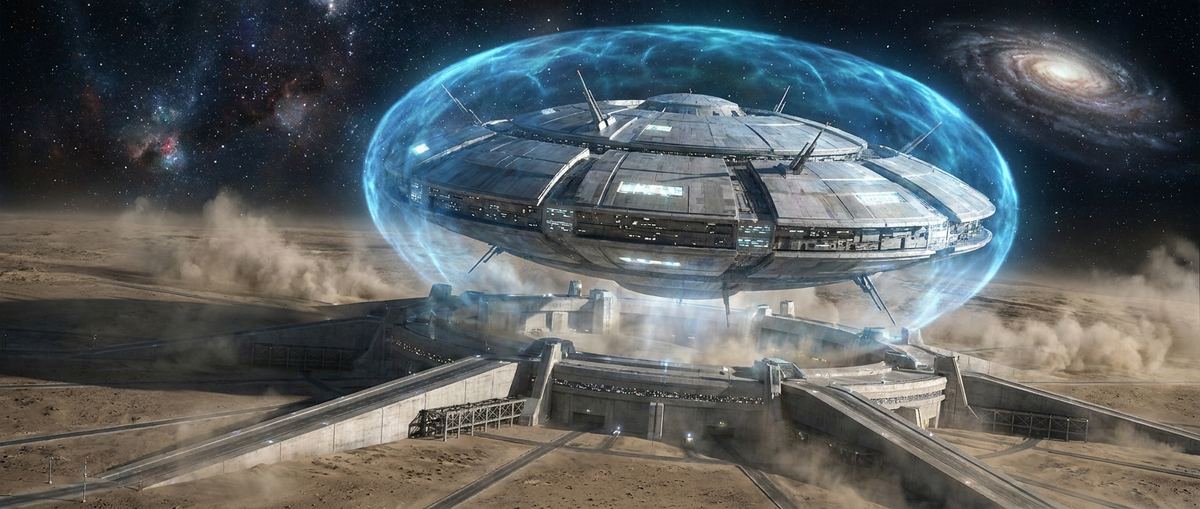
The proposed solution is the MHD Discoid, a circular craft that uses Magnetohydrodynamics (MHD) to move. To understand this, imagine the air around the ship not as a gas, but as a conductive fluid. The vehicle uses high-frequency ultraviolet lasers to strip electrons from the air molecules, turning the surrounding atmosphere into plasma. Once the air is ionized and electrically conductive, the ship applies a powerful magnetic field and an electric current across that plasma.
According to the laws of physics, when an electric current moves through a magnetic field, it creates a physical force called the Lorentz force. In this vehicle, the Lorentz force pushes the plasma downward with immense pressure, propelling the craft upward. To make this more efficient, the ship is shaped like a disc. This geometry allows it to utilize the Coanda effect, where the airflow clings to the curved upper surface of the dome, creating a low-pressure zone that provides significant natural lift, similar to an airplane wing but optimized for vertical ascent.
How the Graphene-Based System Works
The most significant technical bottleneck for any MHD system is energy density and discharge rates. To generate the 125 to 285 kiloamperes of current required for liftoff, traditional batteries are insufficient because they cannot release energy quickly enough. This research integrates a graphene supercapacitor matrix to solve the power delivery problem.
Graphene's role here is rooted in its atomic structure. As a single layer of carbon atoms arranged in a hexagonal lattice, graphene provides an extraordinary surface-area-to-volume ratio. In a supercapacitor, energy is stored not through slow chemical reactions, as in a standard battery, but through the physical accumulation of ions at the interface between the electrode and the electrolyte. Because graphene possesses such high electrical conductivity and a massive available surface area for ion adsorption, it can charge and discharge almost instantaneously.
This allows the energy bank to deliver the massive bursts of power needed by the ultraviolet laser arrays and the REBCO superconducting magnets without the voltage drops associated with traditional materials. Furthermore, the structural integration of graphene into the supercapacitor matrix minimizes internal resistance, ensuring that the electrical energy is converted into plasma ionization and magnetic flux with minimal waste heat. By utilizing the high electron mobility of graphene, the system can modulate the current flow in real-time to stabilize the vehicle during the transition from dense atmosphere to the vacuum of space.
What the Researchers Found
The simulations conducted by Murtazin reveal that this architecture is mathematically viable for both small and large scales. For an expeditionary vehicle weighing 132 metric tons, a circumferential plasma current of 125 kiloamperes yields a thrust-to-weight ratio of 1.28, which is sufficient for vertical takeoff. For the larger Magistral-100 passenger liner, weighing 1120 metric tons, the system requires 285 kiloamperes across a larger interaction zone to achieve stability.
One of the most striking findings involves the aerodynamic efficiency of the discoid shape. The research indicates that the Coanda effect contributes between 65 percent and 78 percent of the total vertical lift in dense air. This means the MHD system does not have to do all the heavy lifting; it primarily initiates the movement, while the geometry of the craft exploits atmospheric pressure to assist the ascent.
Regarding structural integrity, the researchers found that the magnetic fields required for propulsion—reaching up to 9 Tesla—create immense Maxwell stresses on the airframe. To prevent the vehicle from being crushed or warped by its own magnetic field, the design employs a high-modulus carbon fiber reinforced polymer bandage under continuous pre-tension. Additionally, the research describes a Stratospheric Pitch Transition at an altitude of 35 kilometers. At this point, the craft performs a 90 degree S-curve maneuver to fly on its edge, reducing dynamic pressure and allowing for hypersonic acceleration into orbit.
Why the Result Matters
This research represents a fundamental shift from propellant-based propulsion to field-based propulsion. If realized, it eliminates the need for massive fuel depots and the dangerous process of transporting volatile chemicals. The ability to achieve vertical takeoff and landing without auxiliary infrastructure makes the discoid an ideal candidate for Mars operations, where the thin atmosphere is sufficient for MHD interaction but insufficient for traditional aircraft.
Moreover, the integration of active magnetic gimbal suspensions for passengers ensures that high-G maneuvers do not result in physical trauma. By isolating the internal cabin from the hull's angular velocities using a feedforward PID control law, the system can maintain passenger floor misalignment to less than 0.02 degrees. This transforms space travel from a grueling endurance test into a manageable transit experience, potentially opening interplanetary travel to non-astronaut civilians.
Limitations and What Still Needs Testing
Despite the mathematical viability, this system is currently theoretical and faces significant engineering hurdles before it can be built. The most pressing limitation is the energy source. While graphene supercapacitors can discharge power rapidly, they must first be charged. The research mentions a nuclear electric tug for deep space, but a terrestrial power source capable of filling these capacitors for multiple launches remains an open question.
Thermal management is another critical concern. Even with MHD plasma shielding and silicon carbide coatings, the vehicle faces thermal fluxes up to 2200 degrees Celsius during high-velocity flight. While the proposed hybrid thermal protection system using carbon nanotubes and quartz tiles is robust on paper, these materials must be tested in real-world hypersonic environments to ensure they do not degrade under the combined stress of extreme heat and intense magnetic fields. Finally, the REBCO superconducting magnets require cryogenic cooling to maintain their properties; the mass and reliability of these cooling systems during a vertical ascent have yet to be fully prototyped.
Real-World Applications
The most immediate application for this technology would be in planetary logistics. A modular system where small 22-meter discoid landers dock with a larger nuclear propulsion tug would allow for a seamless pipeline between Earth, the Moon, and Mars. The landers could act as reusable shuttles that ferry cargo and personnel from the surface to orbit without needing a landing strip or a chemical launch pad.
Beyond logistics, this technology could revolutionize atmospheric flight on other planets. On Titan or Venus, where atmospheric densities differ wildly from Earth's, the tunable nature of MHD propulsion—adjusting laser ionization and magnetic strength—would allow a single vehicle design to operate across multiple celestial bodies. It could also lead to the development of high-speed, zero-emission transit within Earth's own atmosphere, provided the energy infrastructure can support the charging of the graphene matrices.
If You Remember One Thing
The MHD Discoid moves away from the explosion-based propulsion of rockets and instead uses lasers to turn air into plasma, which is then pushed downward by powerful magnets and graphene-powered electricity to create lift.
FAQ
What exactly is Magnetohydrodynamics?
It is the study of the magnetic properties and behavior of electrically conducting fluids, such as plasma, liquid metals, or salt water. In this context, it refers to using magnetic fields to move a plasma-ionized atmosphere to generate thrust.
Why is graphene necessary for this spacecraft?
Graphene is used in the supercapacitors because its high electrical conductivity and massive surface area allow it to release huge amounts of electricity almost instantly. This is required to power the UV lasers and magnets, which would drain standard batteries too slowly to create lift.
How does a discoid shape help with lifting?
The curved dome of the disc utilizes the Coanda effect, where air follows the curve of the surface. This creates a pressure difference between the top and bottom of the craft, providing up to 78 percent of the lift in thick air.
Is this vehicle ready to be built today?
No, it is currently a theoretical framework based on mathematical modeling and simulations. While the physics are sound, we still need to solve challenges regarding energy storage, cryogenic cooling for magnets, and extreme heat shielding.
What happens when the ship leaves the atmosphere?
At about 35 kilometers up, the air becomes too thin for standard lift. The craft performs a pitch maneuver to fly on its edge, minimizing drag as it transitions from an atmospheric vehicle to a space-faring vessel.
Conclusion
The transition from chemical rockets to electrodynamic systems represents one of the most ambitious leaps in aerospace history. By synthesizing high-temperature superconductivity, laser physics, and the unique material properties of graphene, Ilgiz Murtazin has outlined a path toward truly reusable interplanetary transport. While the engineering challenges are formidable, the shift toward solid-state propulsion offers a future where the stars are reachable not through the brute force of combustion, but through the elegant manipulation of fundamental physical fields.