Imagine a world where ensuring the safety of a city's drinking water does not require transporting samples to a distant laboratory and waiting days for a culture to grow in a petri dish. Instead, a small handheld device could scan a drop of water using light waves that we cannot see, instantly detecting the presence of deadly pathogens like E. coli or Salmonella without needing any chemical dyes or markers. This is the goal of terahertz sensing, a frontier of physics that seeks to identify biological threats by looking at how they interact with electromagnetic energy in the terahertz frequency range.
The Problem This Research Is Solving
The detection of waterborne bacterial pathogens such as Escherichia coli, Salmonella typhimurium, and Vibrio cholerae is a critical public health priority. Currently, most gold-standard methods rely on laboratory cultures or polymerase chain reaction tests. While highly accurate, these processes are time-consuming and often require label-based detection, meaning scientists must add fluorescent dyes or radioactive markers to the sample to make the bacteria visible to sensors. This adds complexity, cost, and time to a process where every hour matters during an outbreak.
Beyond the logistical delays, there is a need for sensing technology that can operate outside of controlled laboratory environments. Traditional optical sensors often struggle with sensitivity when dealing with the very low concentrations of bacteria found in early-stage contamination. To solve this, researchers need a way to amplify the signal produced by these tiny organisms. The challenge lies in creating a sensor that is sensitive enough to detect a slight change in the water's properties without requiring expensive reagents or invasive sample preparation.
The Key Idea in Plain English
The research led by Jacob Wekalao, Abdulkarem H. M. Almawgani, Mohammed M. Alammar, Adam R. H. Alhawari, Monir Abdullah, and Amuthakkannan Rajakannu proposes a solution using metamaterials. A metamaterial is not a natural substance but an engineered structure designed to interact with light or electromagnetic waves in ways that nature cannot. By stacking specific shapes made of different conductive materials—gold, copper, MXene, and graphene—on a silicon base, the team created a device that acts like a high-precision antenna for terahertz waves.
The core principle is based on the refractive index, which is essentially a measure of how much a medium slows down light or electromagnetic waves. Pure water has a specific refractive index, but when bacteria enter the water, they change this value slightly. The metamaterial sensor is designed to resonate at a very specific frequency. When the refractive index of the surrounding liquid changes due to the presence of pathogens, the resonance frequency of the sensor shifts. By measuring this shift, the device can determine exactly what is in the water without ever having to touch or label the bacteria themselves.
How the Graphene-Based System Works
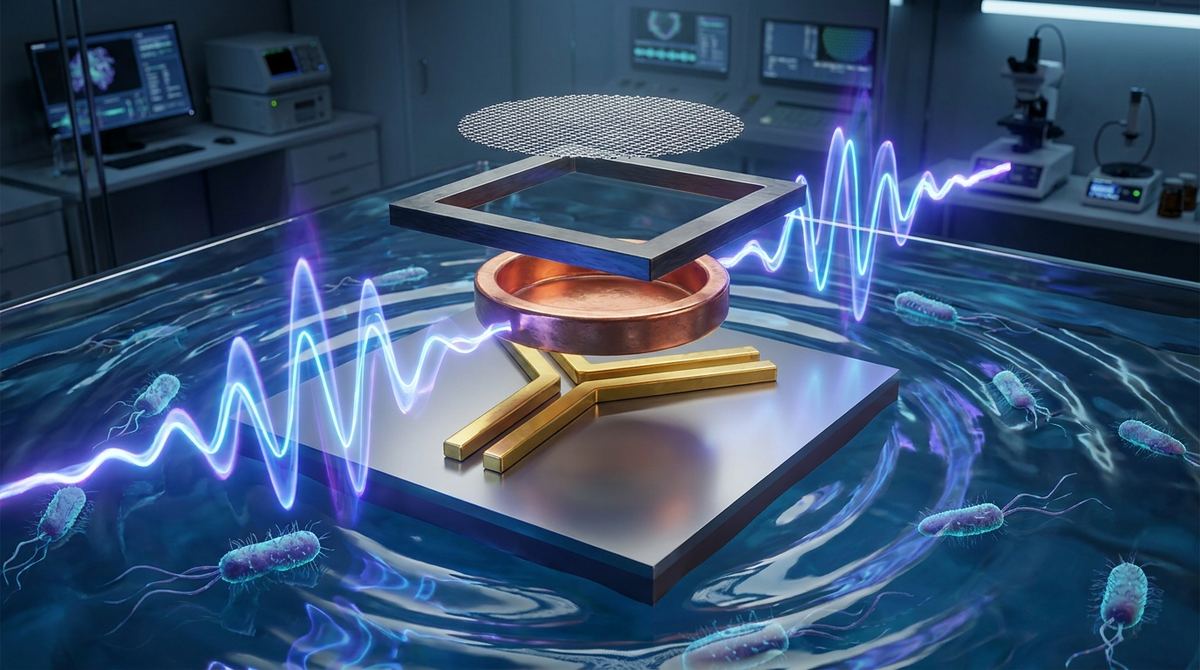
The efficiency of this biosensor depends on a phenomenon called surface plasmon resonance. This occurs when electromagnetic waves trigger the collective oscillation of free electrons at the interface between a conductor and a dielectric material, such as water. To maximize this effect, the researchers designed a multilayer stack consisting of a gold Y-shaped resonator, a copper circular cavity, an MXene square ring, and a graphene circular disc.
The vertical stacking is intentional. By combining different geometries and materials, the sensor creates strong field confinement. This means the electromagnetic energy is squeezed into very small volumes, creating hotspots where the interaction between the terahertz wave and the water sample is intensified. Gold and copper provide excellent conductivity to support these oscillations, while MXene, a relatively new class of two-dimensional transition metal carbides, adds high electrical conductivity and hydrophilicity, which helps the sensor interface better with aqueous biological samples.
Graphene plays perhaps the most critical role in this architecture due to its unique electronic properties. Unlike traditional metals, graphene's conductivity can be dynamically tuned by changing its chemical potential through an external voltage, a process known as electrical gating. When the chemical potential of the graphene disc is adjusted, it alters the way electrons flow across its surface, which in turn shifts the resonant frequency of the entire multilayer stack. This allows the sensor to be fine-tuned to specific pathogens or different environmental conditions, ensuring that the signal remains clear even if there is background noise.
Furthermore, the atomic thinness of graphene provides an immense surface area relative to its volume. Because it is a single layer of carbon atoms, any change in the refractive index occurring directly on its surface has a profound impact on the overall electronic response of the system. The synergy between the graphene disc and the underlying MXene and metallic layers ensures that the electromagnetic field is concentrated exactly where the bacteria are most likely to be detected.
What the Researchers Found
Using finite element simulations in COMSOL Multiphysics, the researchers were able to quantify how different variables affected the sensor's performance. They found that the geometry of the resonators was vital; specifically, a copper circular resonator with a diameter of 5500 nanometers, an MXene square ring with outer dimensions of 2000 nanometers, and gold Y-resonator arms 600 nanometers wide provided the optimal balance for sensitivity.
The results demonstrated that within a refractive index range of 1.33 to 1.3921—which covers the typical values for water contaminated with biological agents—the device achieved a peak sensitivity of 0.751 THz per Refractive Index Unit (RIU). This linear relationship between the shift in frequency and the change in refractive index is crucial because it allows for a simple, predictable calculation to determine the concentration of pathogens.
Another significant finding was the integration of machine learning to streamline the design process. Traditionally, optimizing such a complex multilayer structure would require thousands of slow, computationally expensive simulations. The researchers trained a regression-based surrogate model on their simulation data. This machine learning model could predict the device's response with an accuracy rate where the R-squared value exceeded 0.9992 and the mean absolute percentage error was below 0.2 percent. Essentially, the AI learned the physics of the sensor, allowing the researchers to bypass repeated full-wave simulations and rapidly iterate on the design.
Why the Result Matters
The ability to perform label-free detection is a major leap forward for biosensing. Label-free means that the sample does not need to be chemically modified before testing. This eliminates the risk of altering the biological state of the pathogen and drastically reduces the time from sampling to result. In a public health crisis, such as a cholera outbreak in a region with limited infrastructure, the ability to deploy a sensor that requires only electricity rather than a suite of chemical reagents is transformative.
Moreover, the use of terahertz waves is inherently safer than using X-rays or other ionizing radiation. Terahertz radiation is non-ionizing, meaning it does not have enough energy to strip electrons from atoms or damage DNA, making it safe for continuous monitoring of water supplies. The integration of MXene and graphene also reduces the total amount of gold needed in the sensor's construction. Since noble metals are expensive and difficult to source at scale, replacing portions of the structure with carbon-based materials makes the technology more economically viable for mass production.
Limitations and What Still Needs Testing
While the results are promising, it is important to note that this study was conducted primarily through simulations. A computational model provides a theoretical ceiling for performance, but translating these designs into physical hardware presents significant challenges. The fabrication of four different materials in precisely stacked nanometric shapes—gold, copper, MXene, and graphene—requires extreme precision in lithography and deposition. Any misalignment or impurity during the manufacturing process could degrade the sensitivity or shift the resonance frequency away from the intended target.
Additionally, real-world water is rarely as pure as the simulated dielectric mediums used in COMSOL. Natural water contains dissolved minerals, organic matter, and varying pH levels, all of which can affect the refractive index independently of the bacteria. Future testing must determine if the sensor can distinguish between a change caused by E. coli and a change caused by a sudden increase in salinity or turbidity. The researchers have demonstrated that the system works in theory, but biological validation using live cultures in complex water matrices is the necessary next step before this could move toward a commercial prototype.
Real-World Applications
The most immediate application for this technology is in municipal water quality monitoring. Sensors based on this metamaterial design could be integrated into city piping systems to provide real-time alerts if bacterial levels spike, allowing authorities to shut off contaminated lines before the public is exposed.
Beyond municipal use, this technology has high utility in military and humanitarian logistics. In disaster zones or field hospitals where laboratory infrastructure is nonexistent, a portable terahertz scanner could verify the safety of local water sources instantly. Similarly, it could be used at international borders or ports to scan shipments of liquid food or beverage products for contamination, ensuring that imported goods meet health standards without destroying every sample for testing.
If You Remember One Thing
The most important takeaway is that by combining graphene and MXene with traditional metals in a precision-engineered multilayer stack, researchers have created a theoretical sensor capable of detecting waterborne bacteria through the subtle shift of terahertz waves, all while using machine learning to optimize the design for maximum sensitivity.
FAQ
What exactly is a refractive index?
The refractive index is a number that describes how fast light or other electromagnetic waves travel through a material compared to a vacuum. Different substances, like pure water and bacterial cells, have different indices. When bacteria are present in water, they change the overall refractive index of the liquid, which this sensor can detect.
Why is graphene used instead of just using gold?
Graphene allows for electrical tunability. By applying a voltage to the graphene layer, scientists can change its conductivity and shift the resonance frequency of the sensor on the fly. Gold is an excellent conductor but cannot be tuned in this way, making graphene essential for a flexible, adjustable device.
What are terahertz waves?
Terahertz waves sit in the electromagnetic spectrum between microwaves and infrared light. They are ideal for biological sensing because they can penetrate many materials and are sensitive to the vibrational modes of large biological molecules, all while being non-ionizing and safe for humans.
How does machine learning help in this research?
Simulating how light interacts with nanostructures is computationally heavy and slow. The researchers used machine learning to create a surrogate model that learned the patterns from previous simulations. This allows them to predict how the sensor will behave under different conditions almost instantaneously, without needing to run a full simulation every time.
Is this device available for purchase now?
No, this research is currently at the simulation and optimization stage. While the theoretical results are highly successful, the device must still be fabricated in a physical lab and tested with real water samples and live bacteria to prove it works in practice.
Conclusion
The integration of 2D materials like graphene and MXene into plasmonic metamaterials opens a new window for rapid biological detection. By leveraging the unique electronic tunability of graphene and the high conductivity of MXenes, Jacob Wekalao and his colleagues have designed a system that transforms minute changes in water chemistry into detectable frequency shifts. While the path from simulation to a commercial product requires overcoming significant fabrication and environmental hurdles, the marriage of terahertz physics and machine learning provides a robust framework for the future of label-free pathogen detection. This research not only advances our understanding of metamaterials but offers a potential lifeline for ensuring water safety on a global scale.