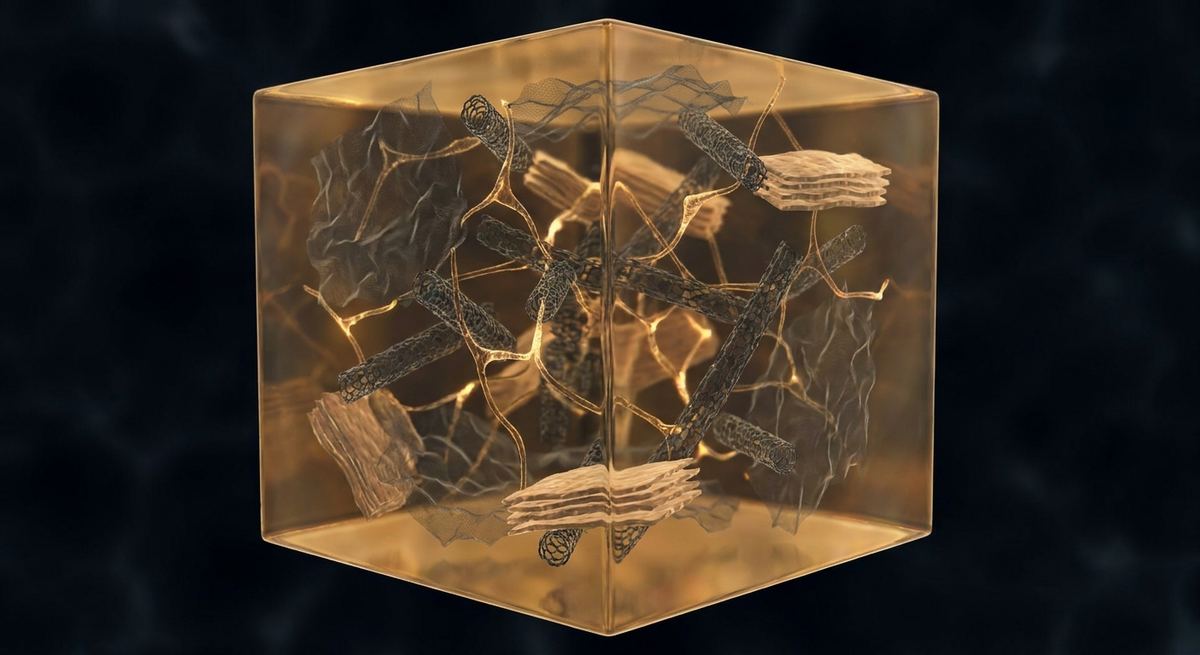
Imagine a material that possesses the versatility of plastic but the strength and heat resistance of advanced alloys. This is the goal behind the development of polymer nanocomposites. Epoxy resins are already widely used in everything from aerospace components to high-performance adhesives because they are strong and adhere well to surfaces. However, epoxy has inherent weaknesses, such as brittleness and a susceptibility to moisture absorption over time. By embedding tiny particles—nanofillers—into the resin, scientists can fundamentally change how the material behaves at a molecular level. Recent research conducted by Arun Kumar, Shalini Patel, Manoj Tripathi, and Rohit K. delves into this precise challenge, comparing different types of carbon-based and mineral reinforcements to determine which provides the best balance of strength, heat resistance, and moisture protection.
The Problem This Research Is Solving
Standard epoxy resins are polymers that form a cross-linked network when mixed with a hardener. While these materials provide excellent structural integrity, they often fail under high impact or extreme thermal stress. One of the primary issues is the propagation of cracks; once a small fracture begins in a neat epoxy resin, it can travel quickly through the material because there is nothing to stop its progress. Furthermore, epoxy polymers are naturally porous at a microscopic level, which allows water molecules to seep into the matrix. This moisture absorption can lead to swelling and a decrease in the glass transition temperature, effectively softening the material and making it more prone to failure in humid environments.
The challenge for materials scientists is not simply adding reinforcements, but doing so in a way that does not introduce new flaws. Often, when fillers are added to a polymer, they tend to clump together due to strong intermolecular forces. These clumps, known as agglomerates, act as stress concentrators rather than reinforcements. Instead of strengthening the material, an agglomerate creates a weak point where a crack can easily start. The researchers aimed to identify the exact concentration and type of nanofiller that maximizes performance without triggering this detrimental clumping effect.
The Key Idea in Plain English
The core concept of this study is to treat the epoxy resin as a matrix and the nanofillers as a structural skeleton. By dispersing graphene oxide, carbon nanotubes, or nanoclay into the liquid resin before it cures, the researchers created a composite where the nanoparticles are locked into place by the hardening polymer. The idea is that these particles will act as barriers and bridges. For instance, a flat sheet of graphene oxide can block a crack from moving forward, while a long carbon nanotube can bridge a gap in the polymer, holding the structure together under tension.
The researchers tested three distinct geometries of fillers: the plate-like structures of nanoclay and graphene oxide, and the tube-like structures of multi-walled carbon nanotubes. By varying the amount of these fillers from one to five percent by weight, they sought to find a sweet spot where the material is sufficiently reinforced but the particles remain evenly spread throughout the resin. This balance is critical because there is a tipping point where adding more reinforcement actually makes the material weaker.
How the Graphene-Based System Works
The performance of these nanocomposites depends entirely on the interface between the filler and the epoxy matrix. In the case of graphene oxide, the presence of oxygen-containing functional groups—such as hydroxyl and carboxyl groups—is a game changer. Unlike pure graphene, which is chemically inert and difficult to mix into polymers, graphene oxide has a chemical affinity for the epoxy resin. These oxygen groups form strong covalent bonds with the polymer chains during the curing process. This creates an efficient load-transfer mechanism; when a physical force is applied to the composite, the stress is transferred from the relatively soft epoxy matrix to the incredibly stiff graphene sheets.
Carbon nanotubes work through a different geometric mechanism. Because they have a very high aspect ratio—meaning they are very long compared to their diameter—they create an interconnected network that acts like rebar in concrete. When these tubes are well-dispersed, they can bridge microscopic voids and deflect cracks, forcing the crack to take a longer, more energy-intensive path around the tube. This process absorbs more energy during an impact, which explains why the impact strength increases.
Nanoclay operates primarily through the creation of a tortuous path. When nanoclay is properly exfoliated—meaning the layers are separated and spread out—it creates a maze for any invading molecules. Water molecules attempting to penetrate the epoxy cannot move in a straight line; they must navigate around these impermeable mineral plates. This significantly slows down the rate of water uptake, enhancing the moisture barrier properties of the material. To ensure all three fillers were properly integrated, the researchers used probe ultrasonication, which uses high-frequency sound waves to physically blast apart agglomerates and push the filler particles into the resin.
What the Researchers Found
The results revealed a clear peak in performance at a loading of three percent by weight across all materials. For those seeking maximum mechanical strength, graphene oxide was the clear winner. At the three percent threshold, GO increased the tensile strength by nearly thirty-five percent and improved impact strength by over forty percent compared to neat epoxy. This is attributed to the high surface area of the GO sheets and the strong chemical bonding mentioned previously, which allows the material to withstand significantly more tension before snapping.
When it came to thermal stability and moisture resistance, nanoclay outperformed the carbon-based fillers. The researchers found that three percent nanoclay reduced water uptake by over thirty percent. In terms of heat, the temperature at which five percent of the material decomposed increased from 312 degrees Celsius in neat epoxy to 368 degrees Celsius in the nanoclay composite. This suggests that the clay layers act as a thermal shield, slowing down the release of volatile decomposition products during heating.
Crucially, the study found that increasing the filler content to four or five percent led to a decline in properties. At these higher concentrations, the nanoparticles began to agglomerate. Instead of a fine, dispersed network, the material contained large clumps of fillers. These clumps created internal voids and disrupted the continuity of the epoxy matrix, resulting in lower tensile strength and reduced thermal stability. This establishes three percent as the optimal loading for this specific system.
Why the Result Matters
This research provides a roadmap for engineers to choose the right reinforcement based on the intended use of the part. If an application requires a component that can survive heavy impacts or high tension—such as a structural bracket in an aircraft—graphene oxide is the superior choice. If the priority is protecting electronics from humidity or ensuring a part does not degrade under extreme heat, nanoclay is the more effective additive.
The discovery of the three percent limit is also economically and structurally significant. In industrial manufacturing, adding unnecessary amounts of expensive nanomaterials increases costs without providing benefits. By proving that more filler is not always better, this research allows for the optimization of material costs while maximizing performance. It emphasizes that the quality of dispersion is far more important than the quantity of the additive.
Limitations and What Still Needs Testing
While these results are promising, they were obtained in a controlled laboratory setting using specific parameters. The use of triethylenetetramine as a hardener means the results may vary if different curing agents are used, as the chemistry of the interface could change. Additionally, while water uptake was measured over 168 hours, this is a relatively short window. Real-world materials must survive for years in varying temperatures and humidity levels, meaning long-term environmental aging tests are still required.
Furthermore, the study focuses on static mechanical properties and thermal stability. It does not address fatigue life—how the material behaves under millions of cycles of stress—or the effect of extreme cold on the composite's brittleness. Because this work was conducted at a lab scale using ultrasonication, it is not yet clear if these same results can be replicated in mass-production environments where industrial mixing equipment might not achieve the same level of dispersion as probe ultrasonication.
Real-World Applications
The ability to tune epoxy properties opens several doors for high-tech industries. In the aerospace sector, these nanocomposites could be used to create lighter, stronger fuselage panels that are less susceptible to moisture degradation, reducing maintenance costs and increasing fuel efficiency by shedding weight.
In the automotive industry, particularly for electric vehicles, these materials could be utilized in battery housings. The thermal stability provided by nanoclay and the strength of graphene oxide would provide a safer enclosure for batteries, protecting them from external impacts and managing heat more effectively during rapid charging cycles. Additionally, the moisture barrier properties make these composites ideal for protective coatings on electronic circuit boards, preventing corrosion and short circuits in humid environments.
If You Remember One Thing
The most important takeaway is that adding nanomaterials to a polymer is a balancing act between reinforcement and dispersion. While graphene oxide provides the best strength and nanoclay offers the best moisture and heat protection, these benefits only exist up to a specific concentration—in this case, three percent. Beyond that point, the particles clump together, creating weaknesses that undermine the entire structure.
FAQ
What exactly is graphene oxide in this context?
Graphene oxide is a chemically modified version of graphene that contains oxygen atoms on its surface. These oxygen groups make it easier to mix into resins like epoxy and allow it to form strong chemical bonds with the polymer, which helps transfer physical loads more efficiently than pure carbon.
Why did the material get weaker when they added five percent filler?
At higher concentrations, nanoparticles tend to stick together through van der Waals forces, forming clumps called agglomerates. These clumps act as defects or holes in the molecular structure of the epoxy, creating points where stress concentrates and cracks can easily start, which lowers the overall strength.
How does nanoclay stop water from entering the epoxy?
Nanoclay consists of very thin, impermeable sheets. When these sheets are spread out throughout the epoxy, they force water molecules to travel a long, winding path to get through the material. This tortuous path significantly slows down the rate of moisture absorption.
What is the purpose of probe ultrasonication?
Ultrasonication uses high-frequency sound waves to create tiny vacuum bubbles that collapse violently. This process provides the mechanical energy necessary to break apart clumps of nanoparticles and ensure they are evenly distributed throughout the liquid epoxy before it hardens.
Is this material ready to be used in commercial products today?
Not quite. While the laboratory results are excellent, the research was done on a small scale. Before commercialization, engineers would need to test the materials for long-term durability, fatigue resistance, and ensure that industrial-scale mixing can achieve the same dispersion as the lab equipment.
Conclusion
The synergy between epoxy resins and nanofillers represents a significant leap forward in materials science. By carefully selecting the geometry and chemistry of the reinforcement—whether it be the high-strength sheets of graphene oxide, the bridging capabilities of carbon nanotubes, or the barrier properties of nanoclay—engineers can create customized materials for specific challenges. The research by Kumar, Patel, Tripathi, and K. underscores a fundamental rule of nanotechnology: precision outweighs quantity. By identifying the three percent optimal loading, this study provides a critical benchmark for creating next-generation composites that are stronger, more heat-resistant, and better protected against the elements.