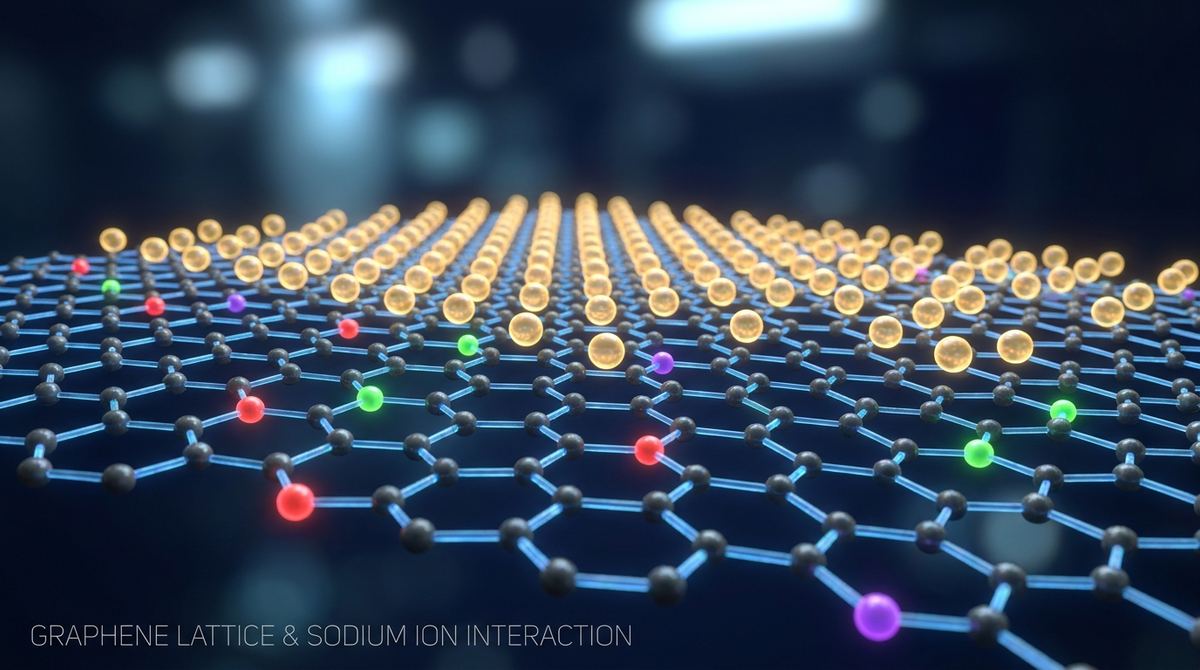
Imagine a world where the batteries powering our homes and cars are not dependent on expensive, scarce minerals like lithium, but instead use sodium—an element found in abundance in common table salt. This shift would drastically lower the cost of energy storage and reduce the geopolitical tension surrounding mineral mining. However, there is a physical hurdle preventing this transition: sodium metal has a tendency to grow into jagged, needle-like structures called dendrites during charging. These microscopic spikes can pierce through the battery separator, causing internal short circuits that lead to sudden failure or even fires. To solve this, we need a way to tell the sodium atoms exactly where and how to land on the anode.
The Problem This Research Is Solving
The primary obstacle in developing high-capacity sodium metal batteries is the uncontrollable nature of sodium nucleation. In a standard battery anode, sodium ions move from the cathode through an electrolyte to deposit as solid metal on the negative electrode. Ideally, this deposition would happen in a smooth, flat layer. In reality, once a tiny bump forms on the surface, it creates a concentrated electric field at its tip. This attracts more sodium ions to that specific point, causing the bump to grow faster than the surrounding areas. This runaway process results in dendrites.
To combat this, scientists have looked toward graphene frameworks because they offer high electrical conductivity and a porous structure that can accommodate the massive volume changes sodium undergoes as it plates and strips. However, pure graphene is not naturally sodiophilic, meaning it does not have a strong chemical affinity for sodium. Without a guiding force, sodium ions still tend to cluster and form dendrites even on a graphene substrate. The research conducted by Yi Xiao, Jing Wan, Yì Wáng, Xin Wang, Kunya Yang, Huan Xiao, 谭兴毅, and Xiao Gu focuses on modifying the chemistry of the graphene surface to create a template that forces sodium to deposit uniformly.
The Key Idea in Plain English
The researchers propose a concept called sodiophilicity, which is essentially a chemical attraction between the anode material and sodium atoms. If the surface of the anode is sodiophilic, it acts like a chemical magnet, pulling sodium ions down and anchoring them firmly in place across the entire surface. By replacing a few carbon atoms in the graphene lattice with other nonmetal elements—a process called doping—the researchers can change the electronic environment of the material.
Instead of allowing the sodium to pile up into spikes, these doped sites act as designated landing zones. When a sodium ion hits a doped site, it forms a strong bond that keeps it locked in place. This encourages the sodium to spread out horizontally across the graphene sheet, filling in the gaps before any single point can grow upward into a dendrite. The goal is to turn the anode from a passive surface into an active guide that manages the architecture of the metal deposition at the atomic level.
How the Graphene-Based System Works
The effectiveness of this system relies on the relationship between the electronic structure of the graphene and the chemical behavior of sodium. Graphene is a single layer of carbon atoms arranged in a honeycomb lattice. While it is an excellent conductor, its surface is chemically relatively inert. To change this, the researchers introduced nonmetal dopants such as Boron, Phosphorus, and Nitrogen. These elements have different electronegativities than carbon, meaning they pull or push electrons differently.
When a dopant atom is integrated into the lattice, it alters the local charge distribution. This creates a local dipole, which is essentially a tiny region of positive and negative charge. Because sodium ions are positively charged, they are naturally attracted to these modified electronic environments. The cause-and-effect chain begins with the dopant altering the electron density, which then lowers the energy barrier for sodium atoms to attach to the surface.
Furthermore, the porous framework of graphene provides a physical advantage. Sodium metal expands significantly when it deposits; if there is no room for this expansion, the material stresses and cracks, which further encourages dendrite growth. The open structure of a graphene host provides an internal volume that cushions this expansion, while the doped chemistry ensures that the sodium fills this volume evenly rather than forming concentrated clusters.
What the Researchers Found
Using first-principles calculations and molecular dynamics simulations, the team evaluated several different doping strategies. They used four primary descriptors to measure sodiophilicity: binding energy, local dipole, charge transfer, and diffusion barriers. Binding energy measures how strongly a sodium atom sticks to a site; higher binding energy generally means better sodiophilicity. Charge transfer describes how electrons move from the graphene to the sodium, which stabilizes the bond.
The results revealed that three specific configurations were exceptionally effective: Boron-doped (pB), Phosphorus-doped (bqP), and Nitrogen-doped (pN) graphene. These materials showed a high affinity for sodium, meaning they could effectively capture sodium ions and hold them firmly. The researchers found that these doped sites significantly reduced the diffusion barrier, which is the energy required for a sodium atom to move across the surface.
When the team simulated the actual deposition process using molecular dynamics, they observed a stark difference between pure graphene and the doped versions. On pure graphene, sodium atoms tended to cluster together quickly, creating the seeds of dendrites. In contrast, on the pB, bqP, and pN frameworks, the sodium atoms bonded strongly to the dopant sites first. This forced the sodium to disperse in a horizontal direction across the framework. By promoting this two-dimensional growth over three-dimensional spiking, the doped graphene effectively inhibited the formation of dendrites.
Why the Result Matters
This discovery is significant because it provides a theoretical blueprint for designing anodes that are inherently safe. Most current attempts to stop dendrites involve adding additives to the liquid electrolyte or using thick coatings, which can increase internal resistance and lower the overall energy density of the battery. By solving the problem at the interface—the exact point where the sodium meets the anode—this research suggests a more permanent and efficient solution.
If we can reliably prevent dendrite growth, the theoretical high capacity of sodium metal anodes becomes practical. Sodium batteries could then compete with lithium-ion batteries not just on cost, but on longevity and safety. This is particularly crucial for large-scale energy storage systems, such as those used to store wind or solar power for a city's electrical grid, where thousands of battery cells must operate safely for decades without the risk of short-circuiting.
Limitations and What Still Needs Testing
While these findings are promising, it is important to note that this research was primarily conducted using computational methods, including first-principles calculations and molecular dynamics simulations. While these tools are incredibly powerful for predicting chemical behavior at the atomic scale, they operate in a simplified environment.
In a real-world battery, the graphene anode would be immersed in a complex liquid electrolyte. The interaction between the doped graphene, the sodium ions, and the solvent molecules can create an interface known as the Solid Electrolyte Interphase (SEI). This layer can change how sodium deposits and might interfere with the sodiophilic sites identified in the simulation. Therefore, these results are not yet evidence of a commercially ready product. Extensive experimental testing is required to see if the predicted sodiophilicity holds true in physical prototypes and whether the doped graphene remains stable over thousands of charge-discharge cycles.
Real-World Applications
The most immediate application for this technology would be in stationary energy storage systems (SESS). Because sodium is abundant and cheap, these batteries are ideal for grid-level storage where the weight of the battery is less important than the cost per kilowatt-hour. A grid-scale battery using doped graphene anodes could store renewable energy more safely and cheaply than current lithium-based solutions.
Beyond the grid, this research paves the way for low-cost electric vehicles and consumer electronics. While sodium batteries are generally heavier than lithium ones, reducing the cost of an EV battery by a significant margin could make electric transportation accessible to a much wider global population. Additionally, any device that requires long-term stability and safety over extreme energy density could benefit from this guided nucleation approach.
If You Remember One Thing
The core takeaway is that purity in graphene isn't always the goal; rather, strategic impurities called dopants (like Boron, Nitrogen, and Phosphorus) are what make it useful for sodium batteries. These dopants turn the graphene surface into a chemical map that guides sodium atoms to lay flat in uniform layers, preventing the growth of dangerous, needle-like dendrites that cause battery failure.
FAQ
What exactly is a sodium dendrite?
A dendrite is a microscopic, metallic spike that grows from the anode during the charging process. It occurs when sodium ions deposit unevenly, piling up on existing bumps rather than spreading out. If these spikes grow long enough, they can pierce through the battery's internal separator and touch the opposite electrode, causing a short circuit.
Why use sodium instead of lithium?
Sodium is vastly more abundant and cheaper than lithium. Lithium is concentrated in a few geographic regions, leading to high costs and supply chain vulnerabilities. Sodium is found everywhere in salt, making it a sustainable alternative for mass-producing batteries on a global scale.
What does doping graphene actually mean?
Doping is the process of intentionally replacing some of the carbon atoms in the graphene lattice with atoms of a different element. In this study, researchers replaced some carbon with Boron, Phosphorus, or Nitrogen to change the electronic properties of the surface and make it more attractive to sodium.
Is this technology already inside my smartphone?
No, this research is currently at the theoretical and simulation stage. While it provides a critical roadmap for how to build better anodes, it has not yet been scaled into commercial battery production. It will require further physical testing in real-world electrolytes before reaching consumers.
How does graphene help with volume expansion?
Sodium metal takes up more space when it deposits as a solid than it does as an ion in the electrolyte. Pure flat surfaces can crack under this pressure. A graphene framework is porous and three-dimensional, providing empty spaces that allow the sodium to expand and contract without destroying the structural integrity of the anode.
Conclusion
The quest for a viable sodium metal battery has long been haunted by the unpredictability of dendrite growth. By shifting the focus toward sodiophilicity chemistry, Yi Xiao and their colleagues have demonstrated that we can manipulate the atomic landscape of graphene to control how sodium behaves. Through the strategic use of nonmetal dopants, they have shown that it is possible to transform a passive carbon sheet into an active guide that ensures uniform deposition. While the journey from computer simulation to commercial battery involves many hurdles, this work provides the mechanistic guidance necessary to move toward safer, cheaper, and more sustainable energy storage for the future.