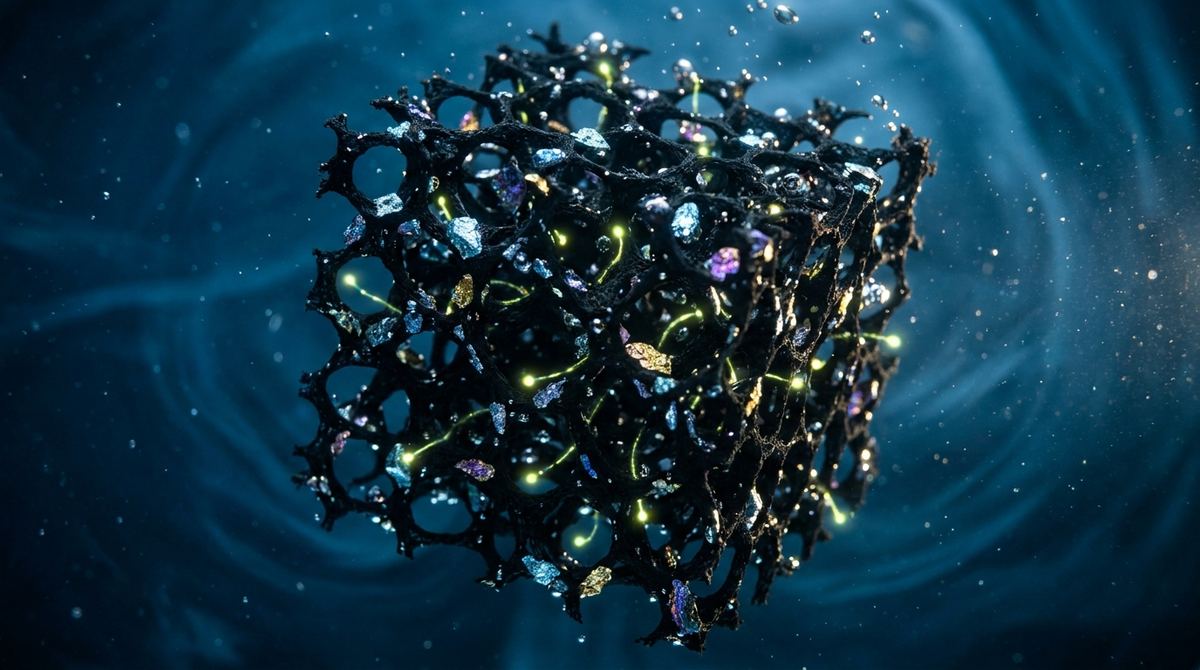
Imagine a world where your electronic devices charge in seconds rather than hours and the energy storage systems powering our cities are more sustainable and efficient. While lithium-ion batteries provide great energy, they charge slowly and degrade over time. Supercapacitors offer the opposite: near-instant charging and incredible longevity, but they typically struggle to store as much energy as a battery. The holy grail of energy science is a hybrid material that captures the best of both worlds. This challenge is exactly what drives recent advancements in materials science, specifically the creative integration of liquid metals with carbon frameworks to create ultra-efficient energy sponges.
The Problem This Research Is Solving
The current landscape of energy storage is dominated by a few well-known materials, but many of these come with significant drawbacks. Carbon-based electrodes, such as activated carbon, provide excellent power delivery because they store energy physically on their surfaces. However, this physical storage limit means they have relatively low energy density. On the other hand, metal oxides can store significantly more energy through chemical reactions, but they often suffer from poor electrical conductivity and structural instability during repeated charging cycles.
Historically, the scientific community has largely overlooked Group 13 elements, specifically gallium and indium, despite their fascinating metallic properties. Most research focuses on transition metals like cobalt or nickel, which are often expensive or environmentally problematic to mine. Saira Ishaaq, Yanzhuo Li, and Georgios Nikiforidis recognized this gap in the literature. Their goal was to determine if these underutilized Group 13 elements could be stabilized within a conductive framework to create a supercapacitor electrode that is both powerful and durable, without relying on the traditional binders and glues that often hinder electrical performance in commercial electrodes.
The Key Idea in Plain English
The researchers decided to build an aerogel, which is essentially a solid version of a cloud. By combining graphene oxide with a liquid metal alloy consisting of gallium and indium, they created a structural hybrid known as EGaInGA. The brilliance of this approach lies in the transition from liquid to solid. Gallium and indium are unique because they can exist in a liquid state at or near room temperature. Through a hydrothermal process—which involves heating the mixture in a sealed vessel under pressure—the researchers forced these liquid metals to react and solidify into a network of oxyhydroxides and oxides.
By weaving these metal particles directly into the sheets of reduced graphene oxide, they created a three-dimensional architecture where the graphene provides the structural highway for electrons and the metal particles provide the chemical sites for storing extra energy. Because the resulting material is self-standing, it does not require an external polymer binder to hold it together. This removes a layer of electrical resistance, allowing ions and electrons to move more freely throughout the electrode.
How the Graphene-Based System Works
To understand why this system performs so well, one must look at the interaction between the reduced graphene oxide and the metal compounds at the atomic level. Graphene is a single layer of carbon atoms arranged in a honeycomb lattice, known for its extraordinary electrical conductivity. However, when graphene sheets are used alone, they tend to stack on top of one another due to van der Waals forces, a process called restacking. Restacking is a major problem because it hides the internal surface area, leaving fewer places for ions to attach and effectively killing the capacitance.
In the EGaInGA system, the gallium oxyhydroxide (GaOOH), indium hydroxide (In(OH)3), and indium oxide (In2O3) particles act as physical spacers. By embedding themselves between the graphene layers, these particles prevent the sheets from collapsing into a dense stack. This keeps the structure open and porous, ensuring that the aqueous alkaline electrolyte can penetrate deep into the interior of the aerogel. This high accessibility maximizes the electric double-layer capacitance, where ions simply cling to the surface of the conductive carbon.
Beyond simple surface storage, the system utilizes pseudocapacitance. While graphene stores energy physically, the Ga and In compounds store energy chemically through fast redox reactions at their surfaces. When a voltage is applied, these metal oxides exchange electrons with the electrolyte. Because these particles are intimately bonded to the highly conductive rGO network, the electrons generated during these chemical reactions can be whisked away instantly. The synergy is clear: the graphene provides the speed and the structural scaffolding, while the Group 13 metals provide the high-capacity energy reservoirs.
What the Researchers Found
The performance metrics of the EGaInGA aerogel demonstrate a significant leap in efficiency for this class of materials. When tested as part of a symmetric supercapacitor in an aqueous alkaline electrolyte, the material achieved a gravimetric capacitance of 99.7 F g−1. This value indicates that the electrode can hold a substantial amount of charge relative to its own weight. Even more impressive is the energy density of 27.7 Wh kg−1 at a power density of 249.3 W kg−1, showing a balanced profile where the device can deliver energy quickly without exhausting its reserves immediately.
Durability is often the Achilles heel of chemical-based capacitors. However, this hybrid material showed remarkable resilience. After 10,000 charging and discharging cycles, it retained 74 percent of its initial specific capacitance. This stability is attributed to the robust integration of the metal particles within the graphene matrix, which prevents the active materials from dissolving into the electrolyte or detaching from the electrode during the expansion and contraction that occurs during ion movement. Furthermore, a coulombic efficiency of 98.4 percent suggests that almost no energy is wasted during the charge-discharge process, pointing to highly reversible electrochemical reactions.
Why the Result Matters
This research provides a proof-of-concept for a new paradigm in energy storage by successfully transforming liquid metals into functional solid-state electrodes. By moving away from transition metals and exploring Group 13 elements, the study opens a door toward more diversified material sourcing for electronics. The removal of chemical reductants during synthesis also makes the process more environmentally friendly than traditional methods that rely on harsh reducing agents to convert graphene oxide to reduced graphene oxide.
The binder-free nature of the aerogel is another critical victory. In most commercial electrodes, active materials are mixed with a polymer binder like PVDF to stick them to a current collector. This binder is electrically insulating and adds dead weight to the system. By creating a self-standing aerogel that is inherently conductive and structurally sound, Ishaaq, Li, and Nikiforidis have eliminated this bottleneck, improving the overall energy-to-weight ratio of the device.
Limitations and What Still Needs Testing
While these results are promising, it is important to note that this research is currently at the laboratory scale. The hydrothermal synthesis method used to create the aerogels is effective for producing small samples, but scaling this process up to industrial volumes without losing the precise structural morphology of the pores remains a challenge. The pressure and temperature controls required for the liquid-to-solid metal transition must be perfectly maintained across large batches to ensure consistency.
Additionally, while 10,000 cycles is an impressive benchmark, commercial applications often require hundreds of thousands of cycles for long-term infrastructure. Further testing is needed to determine how these materials behave under extreme temperature fluctuations or in different types of electrolytes, such as organic solvents or ionic liquids, which could potentially increase the voltage window and further boost energy density. The economic viability also needs a detailed analysis; while gallium and indium are less common than carbon, their market volatility compared to traditional battery materials must be considered before commercialization.
Real-World Applications
The unique properties of the EGaInGA aerogel make it an ideal candidate for several high-tech applications. Because it is lightweight and porous, it could be integrated into wearable electronics or flexible sensors where weight and volume are constrained. A supercapacitor based on this material could power a smartwatch or a medical implant, allowing for rapid bursts of energy to transmit data wirelessly without requiring frequent, slow recharging cycles.
In the automotive sector, these materials could be used in hybrid energy storage systems. For instance, in electric vehicles, a graphene-based supercapacitor could handle the high-current demands of regenerative braking—capturing massive amounts of kinetic energy in seconds—while a standard battery handles the long-range cruising. This would reduce the stress on the main battery, extending its overall lifespan and improving the vehicle's efficiency.
If You Remember One Thing
The most critical takeaway from this study is the successful marriage of liquid metals and graphene to create an energy storage sponge. By using gallium and indium to prevent graphene layers from stacking and providing additional chemical storage sites, the researchers created a binder-free electrode that balances fast power delivery with high energy capacity.
FAQ
What exactly is an aerogel in this context?
An aerogel is an extremely lightweight solid derived from a gel where the liquid component has been replaced by gas. In this research, it is a three-dimensional network of graphene sheets and metal particles that looks like a solid but is mostly empty space, allowing ions to move through it with ease.
Why use gallium and indium instead of other metals?
Gallium and indium are Group 13 elements that offer unique chemical properties and can exist as liquids at low temperatures. This allowed the researchers to blend them into the graphene oxide before solidification, ensuring a more uniform distribution than if they had used solid metal powders.
How does this differ from a standard battery?
A battery stores energy through slow chemical reactions in the bulk of the material, which is why it takes longer to charge. A supercapacitor, like the one described here, stores energy primarily on the surface and through very fast surface redox reactions, allowing for nearly instant charging and discharging.
What is pseudocapacitance?
Pseudocapacitance is a type of energy storage that mimics a capacitor but involves actual chemical redox reactions. In this article, the metal oxides provide pseudocapacitance by exchanging electrons at their surface, which adds significantly more energy storage capacity than graphene could provide on its own.
Is this technology ready for use in smartphones?
Not yet. This is currently a fundamental science discovery conducted in a laboratory setting. While it proves that the material works and is efficient, it still needs to be tested for long-term stability in real-world conditions and developed into a scalable manufacturing process before it can reach consumer electronics.
Conclusion
The development of EGaInGA aerogels marks a significant step forward in the quest for more efficient energy storage. By leveraging the synergistic relationship between the conductive framework of reduced graphene oxide and the pseudocapacitive nature of gallium and indium compounds, the researchers have created a material that overcomes many of the traditional trade-offs between power and energy. While hurdles remain regarding industrial scalability, this work establishes a new pathway for utilizing Group 13 elements to build the next generation of high-performance, sustainable supercapacitors.