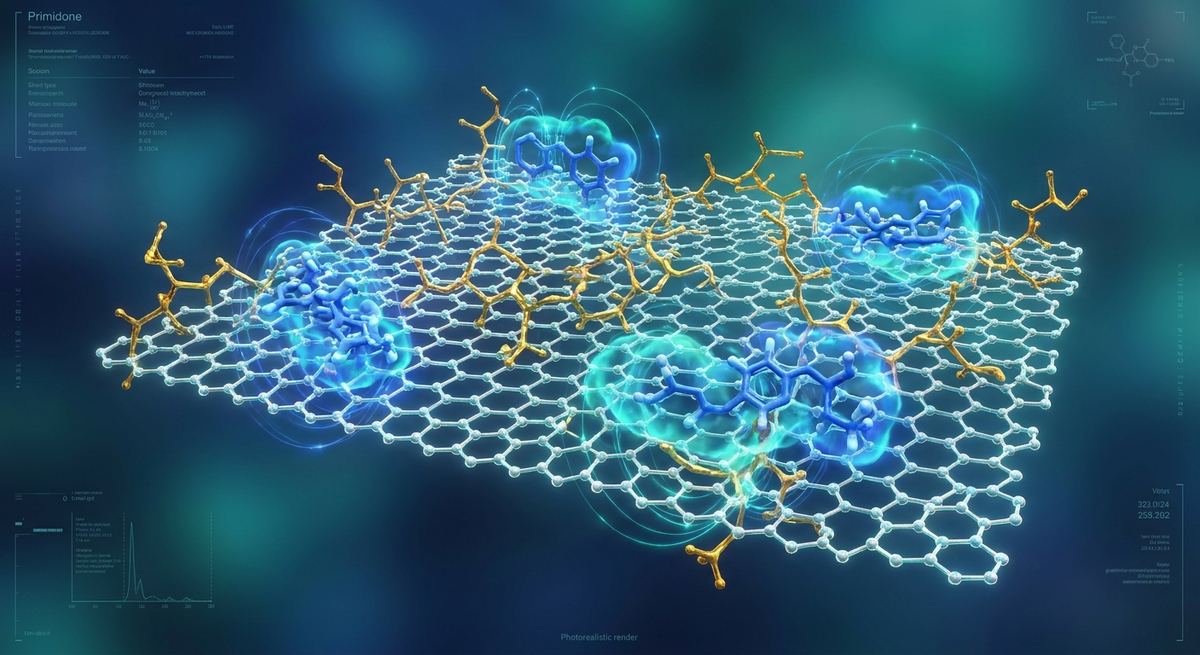
Imagine trying to deliver a fragile package across a crowded city where the roads are blocked and the destination is hidden behind a secure wall. In medicine, this is the challenge of bioavailability. Many potent drugs, such as those used to treat seizures, struggle to reach their target in the body because they are either poorly absorbed or filtered out too quickly by the system. To solve this, scientists create molecular delivery vehicles that protect the drug and ensure it reaches its destination efficiently. By using a combination of carbon nanotechnology and biological polymers, researchers can design a surface that holds onto a drug just tightly enough to transport it, but loosely enough to release it when needed.
The Problem This Research Is Solving
The anticonvulsant medication Primidone is highly effective for treating certain types of seizures, yet its clinical utility is hampered by systemic toxicity and poor bioavailability. Bioavailability refers to the proportion of a drug that enters the circulation and is able to have an active effect. When a drug has low bioavailability, patients may require higher doses to achieve therapeutic results, which in turn increases the risk of side effects and toxicity in non-target organs.
To overcome this, researchers often look toward graphene as a carrier because its massive surface area allows for high loading capacities. However, pristine graphene is hydrophobic, meaning it repels water. Since the human body is primarily aqueous, a pure graphene sheet would clump together or fail to interact properly with biological fluids and hydrophilic drugs. To bridge this gap, a biocompatible polymer called chitosan can be added to the graphene surface. This modification makes the system more hydrophilic and provides chemical anchors for the drug molecules. As Khezri Arina and their colleagues have explored in their recent computational study, the challenge is not just adding chitosan, but determining exactly how much of it is necessary. If the chitosan chains are too short, they may not provide enough stability; if they are too long, they might create steric hindrance, physically blocking the drug from bonding to the surface.
The Key Idea in Plain English
The central goal of this research is to find the Goldilocks zone for chitosan length when decorating graphene sheets for Primidone delivery. The researchers used a method called Density Functional Theory, which is essentially a high-powered computer simulation that allows scientists to model the electronic structure of atoms and molecules without needing to build them in a physical lab first.
By simulating four different scenarios—using plain graphene, graphene with a single chitosan unit (monomer), graphene with two units (dimer), and graphene with three units (trimer)—the team could observe how the drug Primidone behaves on each surface. They were looking for the configuration that produced the strongest and most stable bond between the carrier and the drug, ensuring that the medication stays attached during transport but remains chemically responsive.
How the Graphene-Based System Works
To understand why this system works, we must look at the interface between the carbon atoms of graphene and the organic structure of Primidone. Graphene consists of a single layer of carbon atoms arranged in a hexagonal honeycomb lattice. These atoms are $sp^2$ hybridized, creating a cloud of delocalized pi electrons above and below the sheet. This electron cloud allows for pi-pi stacking interactions, where aromatic rings in drug molecules can essentially sit flat against the graphene surface, held by weak but collective electrostatic forces.
However, because graphene is chemically inert and hydrophobic, the addition of chitosan changes the chemistry of the interface. Chitosan is a linear polysaccharide composed of glucosamine units. These units contain hydroxyl and amine groups that introduce polarity to the system. When these oligomers are attached to the graphene, they create a hybrid environment. The chitosan acts as a chemical mediator; it increases the solubility of the overall complex in water while providing additional sites for hydrogen bonding with the Primidone molecule.
The interaction is governed by thermodynamics and electronic shifts. For a drug to load successfully, the Gibbs free energy change must be negative, indicating that the binding process happens spontaneously. The stability of this bond is further refined by Natural Bond Orbital analysis, which tracks how electrons shift from the donor atoms of the carrier to the acceptor atoms of the drug. This redistribution of electronic charge creates a stabilizing effect that prevents the drug from prematurely detaching.
What the Researchers Found
The results of the simulations revealed a clear winner in terms of efficiency and stability: the graphene-chitosan dimer complex. The interaction energy, which measures the strength of the bond between the carrier and the drug, was highest for the dimer at negative 148.32 kJ per mole. This significantly outperformed pristine graphene, which sat at negative 110.45 kJ per mole, and the monomer configuration, which was surprisingly weak at negative 32.14 kJ per mole.
One of the most critical findings involved the frontier orbital gap, or the energy difference between the Highest Occupied Molecular Orbital and the Lowest Unoccupied Molecular Orbital. A smaller gap generally indicates that a system is more electronically responsive and chemically active. The dimer configuration reduced this gap from 0.0381 atomic units in free graphene to 0.0127 atomic units. This reduction suggests that the dimer optimizes the electronic environment, making it easier for the Primidone molecule to integrate with the surface.
The researchers also observed that while increasing the chain length from a monomer to a dimer improved stability, moving from a dimer to a trimer did not yield the same benefits. This is likely due to steric hindrance. As the chitosan chain grows longer, the polymer begins to fold or occupy more space on the graphene sheet, effectively creating a physical barrier that prevents the Primidone molecule from accessing the most stable binding sites. The dimer provides the perfect balance: it offers enough functional groups to ensure strong binding and water solubility without crowding the surface so much that the drug is pushed away.
Why the Result Matters
This discovery is significant because it moves us closer to a precision-engineered drug delivery system. In pharmacology, the difference between a drug being toxic or therapeutic often comes down to the delivery rate and localization. By identifying the dimer as the optimal length, we can potentially create a carrier that maximizes the amount of Primidone loaded onto each graphene sheet while ensuring the complex remains stable in an aqueous environment.
Because the GN/dimer-PRM complex showed the highest oscillator strength and NBO stabilization energy, it implies a more robust electronic coupling. In practical terms, this means the drug is less likely to leak out during transit through the bloodstream before reaching the target site. If we can increase the efficiency of delivery, we can lower the overall dose administered to the patient, which directly reduces systemic toxicity and minimizes the side effects associated with anticonvulsant therapy.
Limitations and What Still Needs Testing
While these DFT results are promising, it is important to note that this research was conducted entirely through computational modeling. Simulations provide a theoretical blueprint, but they cannot fully replicate the chaotic environment of a living organism. The researchers used an implicit water model to simulate the aqueous environment, which simplifies how water molecules interact with the surface. In a real biological system, explicit water molecules and competing ions in the blood would influence the binding kinetics.
Furthermore, this study focuses on the loading phase—how the drug attaches to the carrier. It does not yet address the release phase—how the drug detaches once it reaches its target. For this to be commercially viable as a medical treatment, future research must move into in vitro and in vivo testing to verify if the dimer configuration maintains its stability inside a cell or across the blood-brain barrier. Toxicity tests for the chitosan-graphene complex itself are also necessary to ensure the carrier is safely metabolized by the body.
Real-World Applications
The implications of this work extend beyond just Primidone. The concept of using specific oligomer lengths to tune the loading of a drug onto graphene can be applied to a wide array of hydrophobic medications. Any drug that suffers from poor bioavailability and possesses aromatic structures could potentially be paired with a similarly optimized chitosan-graphene carrier.
Beyond drug delivery, this research informs the development of biosensors. A surface that is highly responsive to specific molecules, like the GN/dimer complex, could be used to create sensors that detect trace amounts of anticonvulsants or similar organic compounds in patient serum, allowing doctors to monitor medication levels in real-time with extreme precision.
If You Remember One Thing
If you take away one point from this research, it is that the length of the biological bridge matters. Adding chitosan to graphene improves its compatibility with the human body, but only a specific length—the dimer—provides the ideal balance of stability and accessibility for loading Primidone. Too short or too long, and the system loses efficiency.
FAQ
What exactly is DFT in this study?
DFT stands for Density Functional Theory. It is a computational quantum mechanical modeling method used to investigate the electronic structure of many-body systems. In this case, it allowed the researchers to calculate energy levels and bond strengths between graphene, chitosan, and Primidone without needing physical samples.
Why is graphene used instead of other materials?
Graphene is chosen primarily for its extraordinary surface area and its electronic properties. It provides a vast flat plane where many drug molecules can attach simultaneously via pi-pi stacking, which is much more efficient than using spherical nanoparticles or traditional polymers.
What is the role of chitosan in this system?
Chitosan acts as a functionalizing agent. Since pristine graphene hates water, chitosan is added to make the surface hydrophilic. This ensures that the carrier can exist and move within the aqueous environment of the human body while providing chemical hooks for the drug.
What does bioavailability mean in the context of Primidone?
Bioavailability describes how much of a drug actually reaches the systemic circulation to produce an effect. Primidone often has poor bioavailability, meaning much of the dose is wasted or causes toxicity before it can help the patient; a graphene carrier aims to fix this by delivering more of the drug directly to the target.
Why was the dimer better than the trimer?
The dimer provides enough chemical interaction sites to bond strongly with the drug. The trimer, however, introduces steric hindrance, where the larger polymer chain physically blocks the drug from reaching the graphene surface, reducing the overall stability of the complex.
Conclusion
The synergy between carbon nanomaterials and biopolymers offers a promising path forward for modern pharmacology. By applying rigorous computational analysis, Khezri Arina and their team have demonstrated that the fine-tuning of molecular architecture—down to the length of a chitosan chain—can dramatically alter the efficacy of a drug delivery system. The discovery that a dimer configuration optimizes the loading of Primidone provides a theoretical foundation for developing safer, more effective treatments for epilepsy and other neurological conditions. As this research transitions from simulated models to laboratory experiments, it paves the way for a new generation of smart carriers that maximize therapeutic impact while minimizing harm to the patient.