
Probing 2D Metals: Unlocking Electronic Secrets with Raman Spectroscopy
Researchers reveal how breaking inversion symmetry in 2D metals enables electronic Raman scattering, a powerful, non-destructive tool for characterizing...
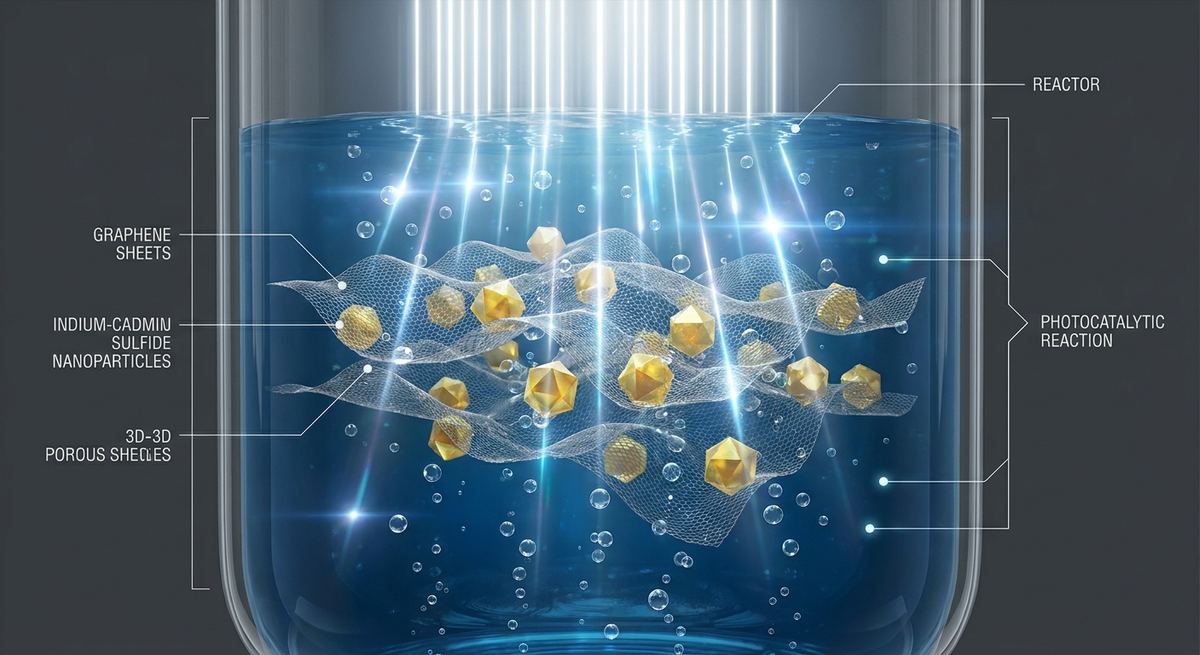
The quest for clean hydrogen fuel has led scientists to explore photocatalysts that can split water using only sunlight. While this sounds like alchemy, it represents one of the most promising pathways toward sustainable energy. The challenge lies in finding materials that efficiently absorb light, separate electrical charges, and drive the chemical reactions needed to liberate hydrogen from water. Recent work by Yuan-Gee Lee, Yi-Hui Li, I-Chen Hsiao, Chung‐Kwei Lin, Yuh‐Jing Chiou, Pei-Jung Chang, and Yu-Ching Weng demonstrates how incorporating graphene into indium-cadmium sulfide semiconductors can more than triple hydrogen production rates, offering fresh insights into designing next-generation photocatalytic systems.
Photocatalytic water splitting faces a fundamental bottleneck that has limited its practical deployment for decades. When light strikes a semiconductor photocatalyst, it generates electron-hole pairs that must be separated and transported to the catalyst surface before they recombine and waste their energy as heat. Traditional photocatalysts like cadmium sulfide absorb visible light effectively due to their narrow band gaps, but they suffer from rapid charge recombination. The electrons and holes generated by light absorption typically reunite within nanoseconds, destroying their potential to drive chemical reactions before they reach the catalyst surface. This recombination problem severely limits the overall efficiency of hydrogen production. Additionally, many photocatalysts form compact grain structures that reduce the available surface area for catalytic reactions, further constraining performance. Researchers need strategies to simultaneously improve charge separation, extend carrier lifetimes, and increase the number of active sites where water molecules can be split into hydrogen and oxygen.
The researchers addressed these challenges by combining two materials with complementary properties. Indium-cadmium sulfide serves as the light-absorbing semiconductor, generating electron-hole pairs when illuminated. Graphene, a single-atom-thick sheet of carbon atoms arranged in a honeycomb lattice, acts as an electron highway and structural modifier. When graphene is incorporated into the photocatalyst, it fundamentally changes how the material behaves. The graphene sheets create pathways for electrons to move rapidly away from where they were generated, reducing the chance they will recombine with holes. This electron extraction happens because graphene possesses exceptional electrical conductivity, approximately one million times greater than copper. Simultaneously, the graphene alters the physical structure of the catalyst from tightly packed grains to a loosely aggregated architecture, exposing more surface area for catalytic reactions. The combination creates a synergistic effect where better charge transport and increased reaction sites work together to dramatically boost hydrogen production.
The mechanism underlying this enhanced performance involves several interconnected physical and chemical processes. When photons strike the indium-cadmium sulfide semiconductor, they excite electrons from the valence band to the conduction band, leaving behind positively charged holes. In pristine indium-cadmium sulfide, these charges quickly recombine unless they immediately encounter a reactive species. The introduction of graphene creates an interfacial junction where electrons preferentially transfer to the graphene sheets due to favorable energy level alignment. Graphene's two-dimensional structure provides an extended network of delocalized pi electrons that can accept and transport photogenerated electrons with minimal resistance.
This charge separation occurs at the interface between graphene and the semiconductor, which X-ray photoelectron spectroscopy analysis revealed to be a surface-level interaction rather than atomic-scale lattice integration. The graphene sheets do not substitute into the crystal structure of indium-cadmium sulfide but instead form intimate contact at grain boundaries and surfaces. This interfacial contact is sufficient to enable electron transfer while preserving the semiconductor's crystal phase and optical properties. The morphological transformation induced by graphene incorporation also plays a critical role. The loosely aggregated structure increases porosity and surface roughness, creating more edge sites and defects that serve as catalytically active locations for hydrogen evolution reactions. Additionally, the graphene network helps distribute reactants more effectively throughout the catalyst structure, improving mass transport of water molecules to active sites and allowing hydrogen bubbles to escape more readily.
The experimental results quantified several key improvements resulting from graphene modification. X-ray diffraction patterns confirmed that graphene addition did not alter the hexagonal crystal structure of indium-cadmium sulfide, indicating that the enhancement mechanism relies on interfacial effects rather than bulk structural changes. Mott-Schottky analysis verified that both pristine and graphene-modified samples exhibited n-type semiconducting behavior, with electrons serving as the majority charge carriers. Interestingly, optical measurements using the Kubelka-Munk method revealed a slight increase in band gap energy from 2.46 electronvolts to 2.51 electronvolts upon graphene incorporation, suggesting subtle electronic interactions at the interface that slightly alter the semiconductor's energy levels.
The most striking results emerged from photocatalytic performance testing. The optimized catalyst containing 3.85 weight percent graphene achieved a hydrogen evolution rate of 4.97 micromoles per hour per square centimeter, representing more than a threefold improvement over pristine indium-cadmium sulfide. Incident photon-to-current efficiency measurements provided additional insight into wavelength-dependent performance, showing values of 9.33 percent at 380 nanometers and 5.01 percent at 480 nanometers. These IPCE values indicate that the catalyst converts nearly one in ten photons to electrical current in the ultraviolet region, with sustained activity extending into visible wavelengths. The enhancement was particularly pronounced in the visible spectrum, where the graphene's contribution to charge separation becomes most beneficial. UV-visible absorption spectroscopy confirmed enhanced light absorption across the measured spectrum, suggesting that graphene not only improves charge transport but may also contribute to light harvesting through optical scattering effects or by reducing reflection losses at the catalyst surface.
This research advances the field of photocatalytic water splitting by demonstrating a practical strategy for overcoming charge recombination limitations without requiring complex synthesis procedures or exotic materials. The threefold improvement in hydrogen evolution rate represents a substantial performance gain achieved through a relatively simple modification. Understanding that graphene functions primarily through interfacial interactions rather than lattice integration provides important design principles for future photocatalyst development. Researchers can focus on optimizing surface contact and morphology rather than attempting to create homogeneous solid solutions, which are often difficult to synthesize and may introduce unwanted defects.
The work also highlights the importance of balancing multiple performance factors. The slight band gap increase observed with graphene addition might initially seem counterproductive, as narrower band gaps generally enable absorption of more solar photons. However, the data demonstrate that improved charge separation and transport can more than compensate for minor changes in light absorption characteristics. This finding suggests that catalyst design should prioritize charge carrier dynamics over simply maximizing light absorption. Furthermore, the morphological transformation from compact to loosely aggregated structures illustrates how physical architecture influences catalytic performance independent of chemical composition, opening avenues for optimizing catalyst design through controlled synthesis conditions.
Despite the impressive performance improvements, several important questions remain unanswered. The study does not report long-term stability data, which is critical for practical applications. Cadmium sulfide-based photocatalysts are known to undergo photocorrosion, where the material gradually degrades under illumination, particularly in aqueous environments. Whether graphene incorporation mitigates or exacerbates this degradation remains unclear. The research also does not address the scalability of the synthesis approach or provide economic analysis comparing the cost of graphene addition against the performance benefits gained.
The optimal graphene loading of 3.85 weight percent appears to represent a carefully balanced composition, but the study does not fully explore the performance decline at higher graphene concentrations. Excessive graphene might block light absorption or create recombination centers, but understanding these trade-offs requires additional investigation. The mechanism by which graphene modifies the morphology from compact to loosely aggregated also deserves deeper examination, as controlling this structural transformation could enable further optimization. Finally, the research was conducted under specific laboratory conditions with particular light sources and reactant concentrations that may not reflect real-world operating environments, such as variable sunlight intensity or water quality issues that could affect performance.
The demonstrated performance improvements bring photocatalytic hydrogen production closer to practical viability, though significant gaps remain before commercial deployment. The technology could potentially be implemented in distributed hydrogen generation systems where sunlight and water are abundant but electrical grid infrastructure is limited. Rural communities, remote industrial facilities, or disaster relief scenarios might benefit from self-contained hydrogen production units based on these catalysts. The approach could also integrate with existing solar energy infrastructure, using photocatalytic panels to produce hydrogen for energy storage, effectively converting intermittent solar energy into a storable chemical fuel.
In the nearer term, this research provides valuable insights for developing improved photocatalytic systems for environmental remediation, where similar charge separation challenges limit the degradation of pollutants. The graphene modification strategy could enhance catalysts used for water purification, air cleaning, or industrial wastewater treatment. The principles demonstrated here also apply to photoelectrochemical cells, where semiconductor electrodes convert light to electrical current, suggesting potential applications in solar cell technology. However, realizing these applications requires addressing the stability and scalability limitations while reducing costs to competitive levels compared to alternative hydrogen production methods like electrolysis powered by photovoltaic panels.
Graphene transforms indium-cadmium sulfide photocatalysts not by changing their fundamental chemistry but by creating electron highways that prevent charge recombination and restructuring the material into a more catalytically active architecture, demonstrating that interfacial engineering and morphology control can be as important as chemical composition in designing efficient solar fuel production systems.
What exactly is a photocatalyst and how does it produce hydrogen? A photocatalyst is a material that uses light energy to drive chemical reactions without being consumed in the process. When light strikes the photocatalyst surface, it generates energetic electrons and holes that can split water molecules into hydrogen and oxygen gas, essentially converting solar energy directly into chemical fuel.
Why is graphene particularly effective in this application? Graphene's single-atom thickness combined with exceptional electrical conductivity creates an ideal platform for rapidly extracting electrons from the semiconductor before they can recombine with holes. Its two-dimensional structure provides maximum interfacial contact area while adding minimal weight, and it remains stable under the harsh oxidizing conditions present during water splitting.
Could this technology replace current hydrogen production methods? Not in the immediate future, as the demonstrated rates remain below what would be needed for industrial-scale hydrogen production, and long-term stability has not been proven. Current hydrogen production relies primarily on natural gas reforming, which is far cheaper but produces carbon dioxide, so photocatalytic approaches represent a potential future alternative as the technology matures and costs decrease.
What makes the 3.85 percent graphene concentration optimal? At this concentration, the benefits of improved charge transport and increased surface area are maximized without the drawbacks of excessive graphene, which could block light from reaching the semiconductor or create additional recombination sites. Finding this optimal balance requires careful experimentation, as too little graphene provides insufficient electron extraction while too much interferes with light absorption.
Is cadmium in the catalyst a safety concern? Cadmium is toxic, which presents challenges for widespread deployment of cadmium-containing photocatalysts. Researchers continue exploring this material in laboratory settings because it provides excellent light absorption properties that help establish performance benchmarks, but commercial systems would likely require alternative materials or robust encapsulation strategies to prevent environmental release.
The successful integration of graphene with indium-cadmium sulfide photocatalysts demonstrates how material interfaces and morphology can dramatically enhance solar hydrogen production. By more than tripling hydrogen evolution rates through improved charge separation and increased catalytic surface area, this work validates interfacial engineering as a powerful strategy for photocatalyst design. While challenges related to stability, scalability, and cost remain before practical deployment, the fundamental insights gained advance our understanding of how to harness sunlight for clean fuel production, contributing another piece to the complex puzzle of sustainable energy systems.
Serious about B2B integration? Test our premium Pulsed Electrical Resistive Carbon Heating turbostratic graphene in your lab. 100g sample packs available now.
Explore More
Researchers reveal how breaking inversion symmetry in 2D metals enables electronic Raman scattering, a powerful, non-destructive tool for characterizing...

Researchers use AI to accelerate the discovery of new materials, identifying a graphene-boron nitride composite for interstellar spacecraft shielding.

In BN-encapsulated graphene, the ultimate limit on electron speed is not graphene itself, but remote phonon scattering from the insulating layers that...