
Probing 2D Metals: Unlocking Electronic Secrets with Raman Spectroscopy
Researchers reveal how breaking inversion symmetry in 2D metals enables electronic Raman scattering, a powerful, non-destructive tool for characterizing...
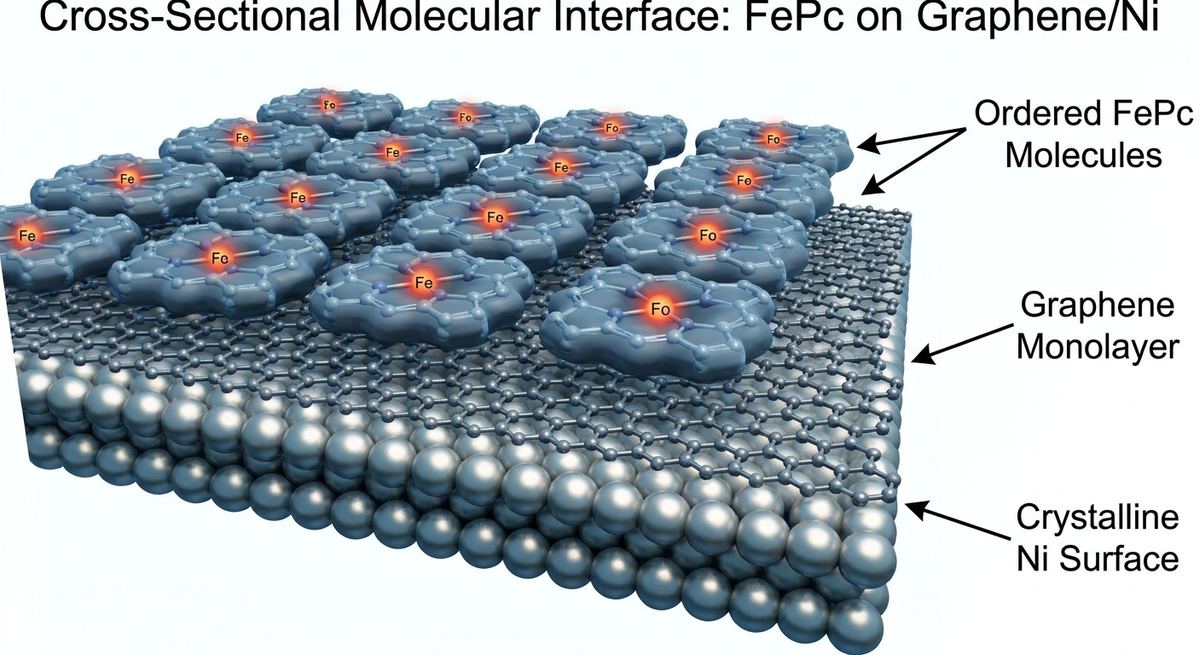
Imagine building an electronic device where individual molecules carry and process information using not just their electrical charge but also their magnetic spin. This is the promise of molecular spintronics, a field that could revolutionize computing by creating devices that are faster, smaller, and more energy-efficient than anything silicon-based technology can achieve. However, getting molecules to sit properly on metal surfaces without losing their special properties has been a persistent challenge. When magnetic molecules land directly on metal substrates, they often bond too strongly, losing their magnetic character and forming disorganized layers that cannot function effectively. Recent work by Andrea Picone, Michele Capra, and A. Brambilla at the University of Milan demonstrates an elegant solution: inserting a single layer of graphene between the molecules and the metal surface acts as a buffer that preserves molecular properties while promoting better organization.
Molecular spintronics requires precise control over how magnetic molecules interact with metal substrates. When iron phthalocyanine molecules, which contain a magnetic iron center surrounded by an organic framework, are deposited directly onto nickel metal surfaces, several problems emerge simultaneously. The strong chemical interaction between the molecule and the metal can quench the magnetic moment of the iron atom, essentially destroying the very property researchers want to exploit. Additionally, these strong interactions cause molecules to adopt various orientations and binding configurations, creating a disordered film rather than the uniform, well-ordered layers needed for predictable device behavior. This disorder makes it nearly impossible to engineer consistent electronic and magnetic properties across a device surface. The challenge is finding a way to decouple the molecules from the substrate enough to preserve their intrinsic properties while still maintaining electronic communication and achieving ordered growth.
The researchers used graphene, a single-atom-thick sheet of carbon atoms arranged in a honeycomb pattern, as an interface layer between the nickel substrate and the iron phthalocyanine molecules. Graphene serves as a chemical buffer that weakens the direct metal-molecule interaction while still allowing electronic coupling. Think of it like placing a smooth, chemically inert tablecloth over a rough, sticky table. The tablecloth provides a uniform surface that items can slide across and organize themselves on, while the underlying table still provides structural support. In this case, the graphene layer reduces the strong chemical bonding that would otherwise disrupt the molecules' magnetic properties and allows the molecules to find energetically favorable arrangements, forming more ordered structures. This approach leverages graphene's unique properties: it is atomically flat, chemically stable, and electronically conductive, making it an ideal buffer material.
The experimental system was built in stages under ultra-high-vacuum conditions to ensure absolute cleanliness. First, the researchers prepared a pristine nickel crystal surface cut along the 111 crystallographic plane, which provides a relatively flat atomic arrangement. They then grew graphene directly on this nickel surface using chemical vapor deposition, a process where carbon-containing gas molecules decompose on the hot metal surface, leaving behind carbon atoms that self-assemble into the graphene lattice. This method produces high-quality graphene that follows the underlying nickel crystal structure. Finally, they deposited iron phthalocyanine molecules onto both graphene-covered and bare nickel surfaces for comparison.
The graphene buffer works through several complementary mechanisms. Its extended pi-electron system provides weak van der Waals interactions with the phthalocyanine molecules rather than strong chemical bonds. This weaker interaction allows molecules greater mobility on the surface during deposition, enabling them to diffuse and find optimal packing arrangements. The graphene also provides a more uniform potential energy landscape compared to the bare metal, where different surface sites have dramatically different binding energies. Furthermore, the buffer reduces charge transfer between the metal substrate and the molecules, helping preserve the electronic structure of the iron center. The result is a system where molecules can organize themselves while maintaining their functional properties.
The experimental characterization revealed striking differences between molecules deposited on bare nickel versus graphene-covered nickel. Using Auger electron spectroscopy, which probes the chemical environment of atoms by measuring the energies of electrons emitted after core-level excitation, the researchers detected subtle but significant changes in the carbon signal line shape. These changes indicated a higher degree of molecular order when graphene was present. Scanning tunneling microscopy provided direct visual confirmation, showing that iron phthalocyanine forms compact, homogeneous layers with locally ordered domains on the graphene buffer. In contrast, molecules deposited directly on bare nickel exhibited strongly disordered morphology with no apparent long-range organization.
The low-energy electron diffraction measurements, which reveal the periodic arrangement of surface atoms and molecules, showed clear diffraction patterns for the graphene layer but did not detect long-range crystalline order in the molecular overlayers in either case. This suggests that while graphene promotes local ordering and more uniform coverage, the molecular layers do not form perfect single-crystal films. Importantly, scanning tunneling spectroscopy measurements demonstrated that the fundamental electronic features of the molecules remain intact in both systems. The density of electronic states near the iron center, which determines the molecule's functional properties, showed similar characteristics whether the molecules were on graphene or directly on nickel. This preservation of electronic structure while improving morphology represents the key achievement of the buffer layer approach.
This research provides experimental validation of a crucial concept for molecular spintronics: that graphene can serve as an effective decoupling layer without completely isolating molecules from the substrate. The improved molecular ordering has immediate implications for device fabrication. Uniform, well-ordered molecular films are essential for creating reproducible devices with predictable properties. When molecules are randomly oriented and disordered, each device fabricated from such a film will have different characteristics, making commercialization impossible. The graphene buffer approach offers a pathway to consistent, scalable fabrication.
Beyond ordering, the preservation of molecular electronic structure while using a buffer layer addresses a fundamental tension in the field. Researchers need molecules to interact with substrates enough to enable charge and spin transport but not so much that the interaction destroys the molecules' unique properties. The graphene buffer achieves this balance, maintaining electronic coupling through its conductive properties while preventing the strong hybridization that would quench magnetic moments. This opens possibilities for studying intrinsic molecular magnetism and spin-dependent transport in systems where the substrate provides a spin-polarized electron source, as nickel does, but the molecules retain their individual magnetic character.
While the results are promising, several important questions remain unanswered. The scanning tunneling microscopy images show improved local ordering but not perfect long-range crystalline order across the entire surface. Understanding what limits the domain size and whether processing conditions could be optimized to create larger ordered regions requires further investigation. The research also does not directly measure the magnetic properties of the iron centers in these systems. Although the electronic structure appears preserved, confirming that the magnetic moment remains intact and determining how it couples to the underlying nickel substrate through the graphene layer will require techniques such as X-ray magnetic circular dichroism or spin-polarized scanning tunneling microscopy.
Additionally, the work focuses on monolayer coverage under ultra-high-vacuum conditions at specific temperatures. Real devices might require thicker films or operation under ambient conditions, scenarios not addressed in this study. The stability of these ordered structures over time and under different environmental conditions needs evaluation. Furthermore, while the study demonstrates the principle using iron phthalocyanine on nickel, extending the approach to other molecule-substrate combinations and verifying its generality remains an open question. Finally, the research characterizes structure and electronic properties but does not demonstrate actual spintronic device operation, which would require fabricating complete structures with electrical contacts and measuring spin-dependent transport.
The graphene buffer layer approach could enable several practical applications in future spintronics technology. Molecular spin valves, devices that change their electrical resistance depending on the relative orientation of magnetic layers, could be fabricated with better performance and reproducibility using ordered molecular layers on graphene-buffered magnetic substrates. These devices might serve as magnetic field sensors with unprecedented sensitivity or as memory elements in non-volatile computer memory that retains information without power.
Quantum computing represents another potential application area. Molecular qubits, where quantum information is stored in the spin state of individual molecules, require precise control over the molecular environment. Graphene buffer layers could provide the necessary isolation from substrate noise while maintaining the electronic coupling needed for qubit readout and manipulation. Similarly, molecular spintronic devices could function as components in neuromorphic computing architectures that mimic brain function, where the ability to tune molecule-substrate interactions through buffer layers offers additional degrees of freedom for programming device behavior. While these applications remain in the research phase, the demonstrated improvement in molecular ordering and property preservation represents an important step toward making them feasible.
A single layer of graphene inserted between magnetic molecules and metal substrates acts as a chemical buffer that dramatically improves molecular ordering and film uniformity while preserving the electronic properties needed for spintronic applications, solving a key challenge in molecular device fabrication.
What is molecular spintronics and why does it matter? Molecular spintronics uses individual molecules to control and manipulate electron spin, the quantum property that makes magnets work, for information processing. This approach promises devices that are smaller, faster, and more energy-efficient than conventional electronics because molecules are naturally nanoscale objects with tunable properties. The field could enable new types of sensors, memory, and computing architectures impossible with silicon technology.
Why does molecular ordering matter for device performance? Disordered molecular films have molecules pointing in random directions with varying environments, causing each molecule to behave slightly differently. This variation makes device properties unpredictable and non-reproducible, preventing commercialization. Ordered films ensure all molecules experience similar conditions, leading to consistent, reliable device behavior that can be engineered and manufactured at scale.
How does graphene improve molecular ordering without blocking electronic communication? Graphene's single-atom thickness allows electrons to tunnel through it easily, maintaining electronic coupling between molecules and substrate. Its extended carbon network provides a uniform, chemically inert surface that reduces strong chemical bonding while allowing weak van der Waals interactions that let molecules organize themselves into ordered structures.
What makes iron phthalocyanine molecules useful for spintronics? Iron phthalocyanine contains a magnetic iron atom at its center surrounded by a stable organic framework. The iron provides a magnetic moment that can store and process spin information, while the organic framework protects it and provides a handle for chemical modification. These molecules are also relatively stable and can be deposited in vacuum, making them practical for fundamental research.
Is this technology ready for commercial devices? No, this research demonstrates fundamental principles in controlled laboratory conditions. Practical devices require solving additional challenges including scaling to larger areas, ensuring stability under ambient conditions, integrating with existing electronics, and demonstrating actual device operation with measurable performance advantages. This work provides essential knowledge for eventually achieving those goals.
The demonstration that graphene buffer layers enable ordered growth of iron phthalocyanine molecules on nickel substrates while preserving their electronic properties represents significant progress in molecular spintronics. By carefully characterizing how the buffer layer modulates molecule-substrate interactions, this research provides both a practical fabrication approach and fundamental insights into interface engineering at the molecular scale. While challenges remain before commercial applications emerge, the ability to achieve uniform, ordered molecular films with intact functional properties brings the field closer to realizing the promise of molecule-based spintronic devices. As researchers continue exploring this approach with different molecular and substrate combinations, the graphene buffer layer strategy may become a standard tool for building the next generation of nanoscale electronic and magnetic devices.
Serious about B2B integration? Test our premium Pulsed Electrical Resistive Carbon Heating turbostratic graphene in your lab. 100g sample packs available now.
Explore More
Researchers reveal how breaking inversion symmetry in 2D metals enables electronic Raman scattering, a powerful, non-destructive tool for characterizing...

Researchers use AI to accelerate the discovery of new materials, identifying a graphene-boron nitride composite for interstellar spacecraft shielding.

In BN-encapsulated graphene, the ultimate limit on electron speed is not graphene itself, but remote phonon scattering from the insulating layers that...