
Probing 2D Metals: Unlocking Electronic Secrets with Raman Spectroscopy
Researchers reveal how breaking inversion symmetry in 2D metals enables electronic Raman scattering, a powerful, non-destructive tool for characterizing...
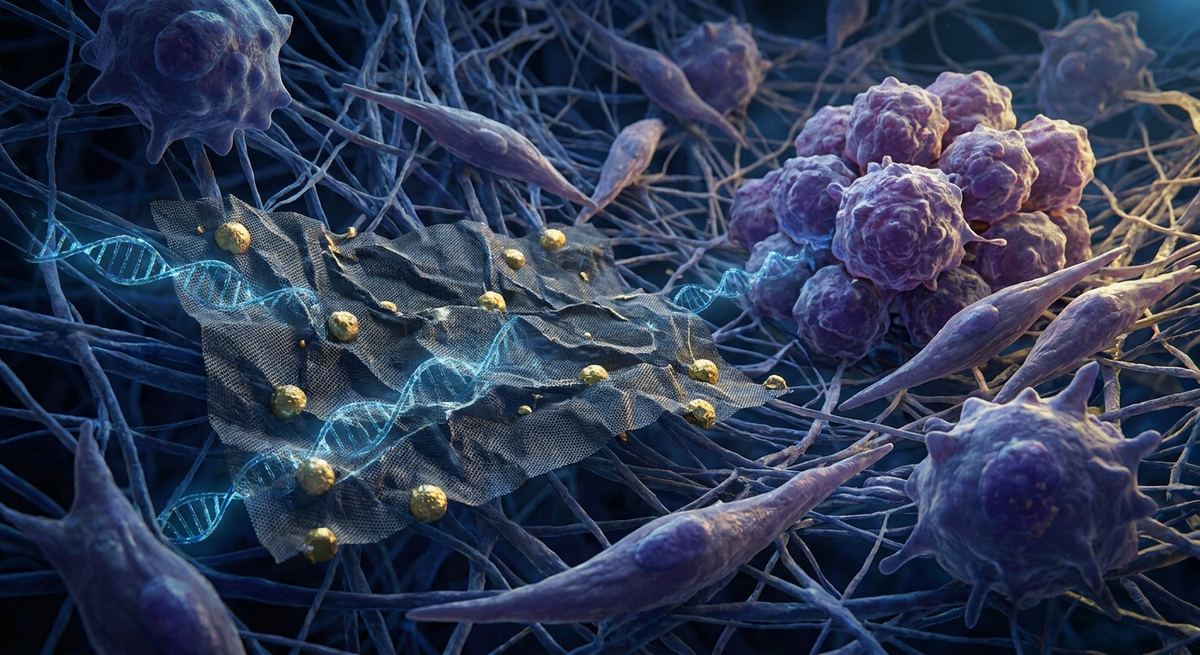
Imagine trying to deliver a precise message to a single person inside a crowded, fortified castle where the guards are actively trying to keep you out and the architecture is designed to confuse intruders. This is essentially what doctors face when treating solid tumors in the lungs. The cancer cells do not exist in isolation; they build a protective fortress called the tumor microenvironment, consisting of supportive stromal cells, immune-system hijackers, and a thick mesh of proteins known as the extracellular matrix. Because this environment is so complex, many drugs that work perfectly in a simple laboratory dish fail miserably when they reach a real patient. To solve this, Francesca Grilli has developed an integrated platform that combines advanced graphene oxide nanocarriers with highly realistic 3D tumor models to ensure that gene-based therapies hit their target without harming healthy tissue.
The central challenge in oncology is selectivity. While chemotherapy and radiation can kill cancer cells, they often cause significant collateral damage to healthy organs. Gene therapy offers a more surgical approach by delivering specific instructions—such as small interfering RNA or plasmid DNA—to turn off survival genes or trigger programmed cell death. However, getting these fragile genetic payloads into the center of a solid tumor is incredibly difficult.
Most preclinical research relies on two-dimensional cultures, where cells grow in a flat layer on plastic. This approach ignores the physical and chemical barriers of a real tumor. In a living body, the extracellular matrix acts as a physical sieve, while stromal fibroblasts and macrophages create a biochemical shield that can neutralize drugs or signal the cancer cells to resist treatment. When researchers use 2D models, they often overestimate how effective a drug will be because there is no fortress to breach. There is an urgent need for a delivery system that can navigate this 3D landscape and a testing framework that accurately mimics the complexity of human biology before moving into clinical trials.
The core idea behind this research is to create a smart delivery vehicle using graphene oxide that can carry multiple genetic instructions at once and deliver them specifically to cancer cells. Instead of just testing this vehicle on flat layers of cells, the researcher built an increasingly complex 3D model of a lung tumor. This model includes not just the cancer cells, but also the supporting cells and the protein mesh they live in. By iteratively refining both the delivery vehicle and the environment it must navigate, the research identifies exactly how to modify the graphene surface to penetrate the tumor and which combinations of genes are most effective at shutting down the cancer's defenses while leaving healthy cells untouched.
Graphene oxide serves as the foundation of this delivery system because of its unique structural chemistry. Unlike pure graphene, which is a flat sheet of carbon atoms, graphene oxide is decorated with oxygen-containing functional groups such as hydroxyl and epoxy groups. These defects in the carbon lattice are critical because they make the material hydrophilic, meaning it can disperse in water and biological fluids rather than clumping together.
To turn this sheet into a delivery vehicle, the researchers utilized surface functionalization. Because nucleic acids like siRNA and pDNA are negatively charged, they would naturally be repelled by a negatively charged graphene oxide surface. To overcome this, the material was modified with polyamidoamine, or PAMAM. This polymer provides a high density of positive charges, creating an electrostatic attraction that allows the genetic cargo to bind securely to the graphene oxide sheet. Furthermore, polyethylene glycol, known as PEG, was added to the surface. The PEG layer acts as a stealth coating, reducing non-specific interactions with proteins and preventing the immune system from identifying and clearing the nanocarrier before it reaches its destination.
To achieve true cancer-specificity, the researchers integrated an epidermal growth factor receptor targeting peptide. Many lung cancer cells overexpress EGFR on their surface. By attaching this specific peptide to the graphene oxide, the nanocarrier acts like a key designed for a specific lock. When the nanocarrier encounters a cell with high levels of EGFR, it binds tightly and is internalized by the cell through endocytosis. Once inside, the chemistry of the PAMAM and the properties of the graphene oxide facilitate the release of the genetic cargo into the cytoplasm, where it can begin modulating protein expression.
The research demonstrated that the physical and chemical properties of the nanocarrier directly dictate its biological success. In simple 2D environments, many formulations seemed effective, but as the complexity increased to 3D spheroids and then to multicellular models containing fibroblasts and macrophages, the performance shifted. The researchers found that the size of the nanocarrier and the degree of PEGylation were decisive factors in how deeply the particles could penetrate the dense protein mesh of the tumor microenvironment.
One of the most significant findings was the superiority of co-delivery strategies. Rather than delivering a single gene to target one pathway, the graphene oxide platform allowed for the simultaneous delivery of multiple genetic payloads. This approach addressed both immune evasion and apoptosis pathways at once. By suppressing the signals that cancer cells use to hide from the immune system while simultaneously triggering the internal machinery for cell death, the researchers achieved a much higher rate of cancer cell elimination than they did with single-target therapies.
Furthermore, the use of the EGFR-targeting peptide significantly reduced off-target effects. In the complex 3D model, the targeted graphene oxide showed a clear preference for cancer cells over the surrounding stromal fibroblasts and macrophages. This precision ensured that the therapeutic effect was concentrated where it was needed most, reducing the potential for toxicity in healthy supporting tissues.
This work is important because it bridges the gap between laboratory curiosity and clinical utility. By proving that a multi-target gene therapy can be delivered specifically to cancer cells within a complex 3D environment, this research provides a roadmap for developing more reliable anticancer drugs. The move from 2D to 3D modeling means that the results are far more predictive of how these materials will behave in a human patient.
Moreover, the versatility of graphene oxide as a platform is highlighted here. Because its surface can be tuned with different polymers and peptides, it can be adapted for different types of cancer or different genetic payloads without needing to redesign the entire system from scratch. The ability to coordinate the modulation of multiple tumor components—the cancer cells, the stromal support, and the immune response—represents a shift toward holistic oncology, where the entire ecosystem of the tumor is treated rather than just the malignant cells.
Despite the promising results, this research remains in the preclinical stage and is not yet ready for commercial or clinical application. While the 3D models are far more advanced than standard cell cultures, they are still an approximation of a living human organ. They lack the systemic complexities of blood flow, lymphatic drainage, and the full range of the systemic immune response that occurs in a whole organism.
Another critical area for future testing is long-term biocompatibility and clearance. While graphene oxide showed promising biocompatibility in these models, it is essential to understand how the body breaks down and excretes these nanomaterials over weeks or months. The potential for accumulation in the liver or spleen must be rigorously evaluated through in vivo animal studies before human trials can be considered. Additionally, the stability of the genetic cargo during transport through a complex bloodstream remains a variable that requires further optimization.
The implications of this research extend beyond lung cancer. Any solid tumor that exhibits high EGFR expression or utilizes similar immune-evasion strategies could potentially be treated with a modified version of this graphene oxide platform. For example, certain types of colorectal or head and neck cancers might be susceptible to this targeted co-delivery approach.
Beyond therapy, the integrated 3D evaluation framework developed in this work can be used as a high-throughput screening tool for other pharmaceutical companies. Instead of relying on flawed 2D data, drug developers could use these multi-cellular 3D scaffolds to test a wide variety of nanocarriers and drugs, significantly reducing the failure rate during expensive clinical trials. This would accelerate the development of personalized medicine, where a patient's own tumor cells could be used to create a customized 3D model to test which specific gene combination works best for their unique cancer profile.
The most critical takeaway is that successful cancer treatment requires more than just a powerful drug; it requires a delivery system and a testing environment that account for the complex, protective fortress of the tumor microenvironment. By using functionalized graphene oxide to deliver multiple genetic instructions specifically to targeted cells within a realistic 3D model, this research demonstrates a way to bypass cancer defenses with high precision.
What is graphene oxide and how does it differ from regular graphene?
Graphene oxide is a derivative of graphene that contains oxygen groups like hydroxyls and epoxies. While regular graphene is a hydrophobic sheet of pure carbon, these oxygen additions make graphene oxide soluble in water and provide chemical handles that allow scientists to attach proteins, polymers, or genes to its surface.
Why are 3D models better than 2D cultures for cancer research?
In a 2D culture, cells grow flat on a surface with easy access to nutrients and drugs. In a 3D model, cells are embedded in a matrix and interact with other cell types, mimicking the physical barriers and chemical signals of a real tumor. This makes it much harder for drugs to penetrate, providing a more honest assessment of whether a therapy will actually work in a patient.
How does the system target only cancer cells?
The researchers attached an EGFR-targeting peptide to the graphene oxide surface. Since many lung cancer cells have an abundance of EGFR receptors on their exterior, the nanocarrier binds specifically to these cells like a key into a lock, avoiding healthy cells that lack these receptors.
What is co-delivery and why is it effective?
Co-delivery is the process of sending multiple different genetic instructions in one single package. This is more effective because cancer cells often have redundant survival mechanisms; if you block one pathway, they simply use another. By attacking multiple pathways simultaneously, the therapy prevents the cancer from adapting and surviving.
Is this treatment currently available at hospitals?
No, this research is preclinical. It has been demonstrated in sophisticated laboratory models to prove the concept and optimize the design. Extensive animal testing and human clinical trials are required to ensure safety and efficacy before it becomes a medical treatment.
The work conducted by Francesca Grilli underscores the necessity of an integrated approach to nanomedicine. By simultaneously optimizing the chemical architecture of graphene oxide, the complexity of biological modeling, and the strategy of genetic targeting, this research provides a sophisticated blueprint for the next generation of cancer therapies. The transition from simple delivery to microenvironment-aware precision medicine marks a significant step forward in our ability to dismantle the protective barriers of solid tumors and eliminate cancer cells with surgical accuracy.
Serious about B2B integration? Test our premium Pulsed Electrical Resistive Carbon Heating turbostratic graphene in your lab. 100g sample packs available now.
Explore More
Researchers reveal how breaking inversion symmetry in 2D metals enables electronic Raman scattering, a powerful, non-destructive tool for characterizing...

Researchers use AI to accelerate the discovery of new materials, identifying a graphene-boron nitride composite for interstellar spacecraft shielding.

In BN-encapsulated graphene, the ultimate limit on electron speed is not graphene itself, but remote phonon scattering from the insulating layers that...