
Probing 2D Metals: Unlocking Electronic Secrets with Raman Spectroscopy
Researchers reveal how breaking inversion symmetry in 2D metals enables electronic Raman scattering, a powerful, non-destructive tool for characterizing...
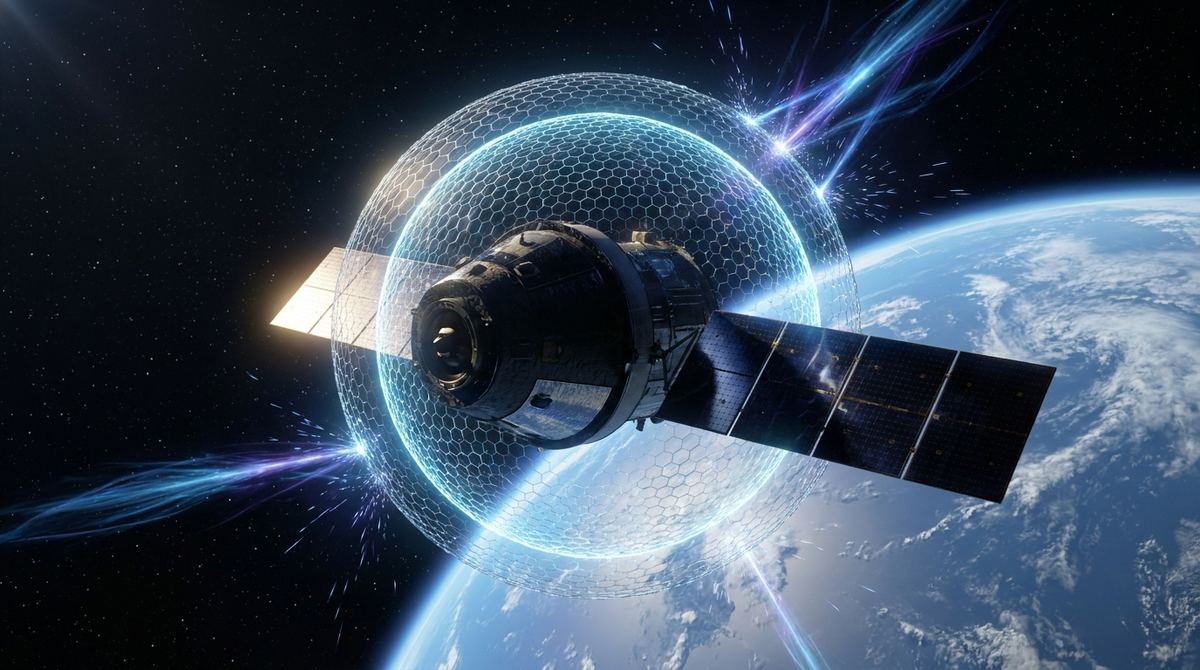
Imagine a spacecraft designed for a multi-year journey to Mars. Every single kilogram of weight added to the vessel requires an exponential increase in fuel and propulsion energy to break Earth's gravity and maneuver through the vacuum of space. This creates a critical engineering paradox regarding safety. To protect astronauts and sensitive flight computers from the onslaught of high-energy gamma and X-ray radiation, engineers have traditionally relied on materials like lead, tungsten, or steel. While these materials are excellent at stopping radiation, they are prohibitively heavy. A ship armored in traditional lead would be too massive to launch efficiently, yet a ship without shielding would succumb to electronic failure and biological degradation. The quest for lightweight, high-efficiency radiation shielding is not just a matter of convenience; it is the primary bottleneck for deep space exploration and advanced avionics.
The fundamental challenge in radiation shielding lies in how high-energy photons, such as those found in X-rays and gamma rays, interact with matter. Unlike alpha or beta particles, which can be stopped by a thin sheet of aluminum or even a layer of skin, gamma photons have no charge and possess immense energy. This allows them to pass through most materials with ease. To stop these photons, you traditionally need high atomic number elements and high density. Lead is the industry standard because its dense nucleus provides a larger target for incoming photons, increasing the likelihood that the photon will be absorbed or scattered before it reaches the sensitive equipment or human tissue behind the shield.
However, as Karolina Filak-Medon, Krzysztof W. Fornalski, Michal Bonczyk, Alicja Jakubowska, Kamila Kempny, Katarzyna Woloszczuk, Krzysztof Filipczak, Klaudia Zeranska, Mariusz Zdrojek, and colleagues have highlighted in their research, the reliance on dense metals creates a massive weight penalty. In the context of avionics and space technology, where every gram is scrutinized, using lead or tungsten is often impractical. The goal is to find a material that maintains high attenuation properties—meaning it can effectively block radiation—while keeping the total mass as low as possible. This requires a shift from bulk heavy metals toward engineered nanocomposites that leverage the unique structural properties of carbon-based materials like graphene.
The central idea behind this research is to create a hybrid material that combines the strength and lightness of graphene with specific additives that can intercept radiation. Graphene is a single layer of carbon atoms arranged in a hexagonal lattice. By itself, graphene is too light to stop a gamma ray, but it serves as an incredible structural matrix. Think of it as a high-tech scaffold. The researchers integrated this scaffold with other elements to create a nanocomposite. This composite material manages to keep its overall density very low—nearly 1 gram per cubic centimeter—which is orders of magnitude lighter than lead.
Instead of relying on sheer bulk and weight, the graphene-based shield relies on an optimized distribution of atoms that can interact with incoming photons. By carefully engineering the composition at the nanoscale, the researchers aimed to create a material that mimics the shielding effectiveness of much heavier substances without the associated weight penalty. The result is a lightweight composite that allows for radiation protection in environments where traditional heavy shielding would be physically or financially impossible to deploy.
To understand how this graphene nanocomposite works, we must look at the physics of photon interaction. When an X-ray or gamma-ray photon hits a material, it does not simply bounce off like a ball hitting a wall. Instead, it interacts through three primary mechanisms depending on its energy level: the photoelectric effect, Compton scattering, and pair production.
At lower energy levels, the photoelectric effect dominates. This occurs when an incoming photon is completely absorbed by an atom, which then ejects an inner-shell electron. For this to happen efficiently, the material needs atoms with a high atomic number. At medium energy levels, Compton scattering takes over. Here, the photon hits an electron and is deflected in a different direction while losing some of its energy. This reduces the intensity of the radiation beam as it passes through the shield. At very high energies, pair production occurs, where a photon interacts with the nucleus to create an electron-positron pair.
The graphene nanocomposite works by maximizing these interactions within a lightweight framework. Graphene provides a massive surface area and structural integrity, allowing for the uniform dispersion of attenuation agents. These agents increase the probability that a photon will collide with an electron or a nucleus. Scientists measure this efficiency using two main metrics: the linear attenuation coefficient and the mass attenuation coefficient. The linear attenuation coefficient describes how much a beam of radiation is weakened as it passes through a specific thickness of material. The mass attenuation coefficient, however, is more critical for space applications because it relates the attenuation to the density of the material. By achieving high mass attenuation values while maintaining low overall density, the graphene composite ensures that each gram of material provides maximum protection.
The research team conducted rigorous testing to determine how effectively their graphene-based nanocomposite blocked radiation across various energy levels. They compared their experimental results against the XCOM model, which is a globally recognized standard for calculating the attenuation of photons in various materials. The validation against XCOM confirmed that the composite behaves predictably and efficiently as a shield.
One of the most significant findings was the material's performance at higher energy levels. The researchers reported mass attenuation coefficients exceeding 0.2 square centimeters per gram. In practical terms, this means that the material is remarkably efficient at scattering and absorbing photons relative to its weight. While lead has a much higher linear attenuation because it is so dense, the graphene composite offers a competitive alternative when the primary constraint is total system mass.
Furthermore, the study found that the energy-dependent nature of the shielding was consistent with theoretical expectations. The material's ability to attenuate radiation changed as the energy of the incoming X-rays and gamma rays shifted, but it remained effective across a broad spectrum. This versatility suggests that the nanocomposite could be tuned for specific types of radiation environments by adjusting the concentration of additives within the graphene matrix.
For space exploration, these results are transformative because they address the weight-to-protection ratio. In a satellite or a crewed spacecraft, electronic components such as microprocessors and memory modules are highly susceptible to radiation-induced upsets. A single high-energy photon can flip a bit in a computer's memory, leading to software crashes or catastrophic navigation errors. Traditionally, these components were encased in heavy metal boxes. Using a graphene nanocomposite allows engineers to achieve similar levels of protection for the electronics while significantly reducing the launch mass.
Beyond avionics, this research opens the door to more flexible shielding geometries. Because these composites can be engineered into different forms more easily than casting thick slabs of lead, they could be integrated directly into the hull of a spacecraft or woven into specialized garments for astronauts. This reduces the fuel required for liftoff and allows for more payload capacity, meaning more scientific instruments or life-support supplies can be carried on a mission.
It is crucial to maintain scientific honesty regarding what this material can and cannot do. While this research is a breakthrough for gamma and X-ray shielding, these are types of electromagnetic radiation (photons). Space is also filled with Galactic Cosmic Rays (GCRs) and Solar Particle Events (SPEs), which consist of high-energy protons and heavy nuclei known as HZE ions.
Shielding against photons is fundamentally different from shielding against charged particles. When a heavy ion hits a high-density metal shield, it can cause spallation, where the nucleus of the shield material splits, creating a shower of secondary radiation that can be more harmful than the original particle. Graphene and other low-Z (low atomic number) materials are actually better at handling these particles because they produce fewer secondary fragments. However, blocking high-energy cosmic rays entirely requires much thicker layers of hydrogen-rich materials or active magnetic shielding.
Therefore, while this graphene nanocomposite is an excellent solution for X-ray and gamma-ray protection in avionics, it is not a complete solution for the biological hazards of deep-space crewed missions. Further testing is needed to see how these composites perform when subjected to the extreme temperature fluctuations of space and long-term exposure to vacuum conditions, which can cause some materials to outgas or degrade.
The applications for this technology extend far beyond the stars. In the medical field, portable X-ray machines are used in emergency rooms and field hospitals. Currently, technicians use heavy lead aprons and shields to protect themselves from scatter radiation. Replacing these with graphene-based composites would drastically reduce the physical strain on medical professionals without compromising their safety.
In the aviation industry, aircraft flying at high altitudes are exposed to higher levels of cosmic radiation than those on the ground. Protecting flight computers and sensitive sensors with lightweight graphene shielding can increase system reliability and longevity while improving fuel efficiency by reducing overall aircraft weight.
Additionally, this material could be used in nuclear power plant maintenance. Robotic drones sent into radioactive environments to perform inspections need shielding for their onboard electronics. A lightweight, durable graphene composite would allow these drones to operate longer and carry more sensors without being bogged down by heavy lead cladding.
If you take away one main point from this research, it is that we no longer have to choose between extreme weight and effective radiation protection. By using graphene as a structural matrix for attenuation agents, researchers have created a nanocomposite with a density of approximately 1 gram per cubic centimeter that can effectively block gamma and X-ray radiation. This shifts the paradigm from using bulk mass to using engineered molecular architecture.
What is the difference between linear and mass attenuation?
Linear attenuation refers to how much radiation is stopped over a specific distance, such as a centimeter of material. Mass attenuation takes density into account, measuring how effectively a certain amount of mass stops radiation regardless of how thick or thin that mass is spread. For space travel, mass attenuation is the more important metric because total weight is the primary constraint.
Can graphene alone stop gamma rays?
No, graphene by itself is composed of carbon atoms, which are too light to effectively stop high-energy photons. The protection comes from the nanocomposite structure, where graphene acts as a stable framework that holds other radiation-blocking elements in place.
Is this material safe for astronauts to wear?
While the study focuses on the physics of attenuation, graphene composites are generally stable. However, before they can be used in clothing, they must undergo rigorous biocompatibility and toxicity testing to ensure that the additives used for shielding do not leak or cause skin irritation.
Will this stop all types of space radiation?
No, it is specifically designed for gamma and X-ray photons. It does not provide a complete solution for Galactic Cosmic Rays or high-energy protons, which require different shielding strategies involving hydrogen-rich materials or magnetic fields.
How does the weight compare to lead?
Lead has a density of about 11.34 grams per cubic centimeter, whereas this composite has a density near 1 gram per cubic centimeter. This means the composite is more than ten times lighter for the same volume of material.
The work performed by Karolina Filak-Medon and her colleagues represents a vital step toward lightweight radiation shielding that can be engineered around mass efficiency rather than brute-force density alone. Their graphene-based nanocomposite does not replace every shielding strategy needed for deep-space human exploration, but it shows that carbon-based materials can be designed to attenuate gamma and X-ray radiation in useful, measurable ways. For spacecraft electronics, avionics, medical imaging, and other weight-sensitive environments, that distinction matters. The larger lesson is that future radiation protection will likely come from layered systems, where graphene composites, polymers, hydrogen-rich materials, and mission-specific structures work together instead of relying on one heavy metal barrier.
Serious about B2B integration? Test our premium Pulsed Electrical Resistive Carbon Heating turbostratic graphene in your lab. 100g sample packs available now.
Explore More
Researchers reveal how breaking inversion symmetry in 2D metals enables electronic Raman scattering, a powerful, non-destructive tool for characterizing...

Researchers use AI to accelerate the discovery of new materials, identifying a graphene-boron nitride composite for interstellar spacecraft shielding.

In BN-encapsulated graphene, the ultimate limit on electron speed is not graphene itself, but remote phonon scattering from the insulating layers that...